


Connected Workplace Market Size
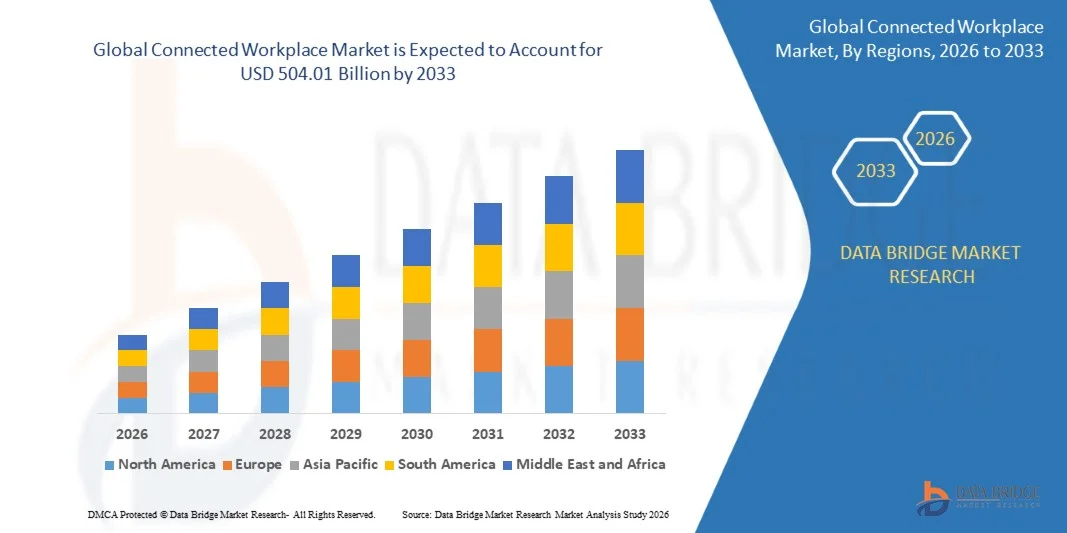
- The global connected workplace market size was valued at USD 89.30 billion in 2025 and is expected to reach USD 504.01 billion by 2033, at a CAGR of 24.15% during the forecast period
- The market growth is largely fuelled by increasing adoption of cloud-based collaboration tools, rising demand for remote and hybrid work solutions, and digital transformation initiatives across enterprises
- Growing focus on employee experience, workplace automation, and IoT-enabled smart offices is further driving market expansion
Connected Workplace Market Analysis
- Enterprises are increasingly leveraging digital tools to improve productivity, collaboration, and operational efficiency
- The shift towards hybrid work models and flexible workspaces is accelerating the adoption of connected workplace solutions
- North America dominated the connected workplace market with the largest revenue share in 2025, driven by increasing adoption of digital workplace solutions, cloud-based collaboration tools, and advanced security and automation systems
- Asia-Pacific region is expected to witness the highest growth rate in the global connected workplace market, driven by rising IT investments, expanding workforce in urban hubs, and accelerated adoption of hybrid and remote work solutions
- The security systems segment held the largest market revenue share in 2025, driven by the growing demand for monitored workspaces, IoT-enabled access control, and real-time threat detection. These solutions ensure safety and operational efficiency, making them vital for enterprises adopting hybrid work models
Report Scope and Connected Workplace Market Segmentation
|
Attributes |
Connected Workplace Key Market Insights |
|
Segments Covered |
|
|
Countries Covered |
North America
Europe
Asia-Pacific
Middle East and Africa
South America
|
|
Key Market Players |
• Accenture (Ireland) |
|
Market Opportunities |
|
|
Value Added Data Infosets |
In addition to the market insights such as market value, growth rate, market segments, geographical coverage, market players, and market scenario, the market report curated by the Data Bridge Market Research team includes in-depth expert analysis, import/export analysis, pricing analysis, production consumption analysis, and pestle analysis. |
Connected Workplace Market Trends
“Rising Demand For Digital Collaboration And Flexible Workspaces”
• The increasing adoption of remote and hybrid work models is significantly shaping the connected workplace market, as organizations prioritize tools that enable seamless communication, collaboration, and productivity across distributed teams. Connected workplace solutions are gaining traction due to their ability to integrate messaging, video conferencing, project management, and workflow automation into unified platforms. This trend strengthens their adoption across IT, finance, healthcare, and professional services sectors, encouraging vendors to innovate with features that cater to evolving workforce expectations
• Growing focus on employee experience, wellness, and operational efficiency has accelerated the demand for connected workplace solutions in enterprise environments. Organizations are seeking solutions that enhance productivity, support flexible work arrangements, and provide data-driven insights for workforce management, prompting providers to emphasize AI-enabled analytics, real-time monitoring, and personalized workspace experiences
• Collaboration and digital transformation trends are influencing technology adoption, with companies emphasizing cloud-based platforms, unified communications, and mobile accessibility. These factors are helping businesses improve efficiency, reduce operational bottlenecks, and enhance employee engagement, while also driving the integration of secure and scalable enterprise solutions. Vendors are increasingly using marketing campaigns to highlight these benefits to attract enterprise clients and reinforce platform value
• For instance, in 2024, Microsoft in the U.S. and Cisco in Germany expanded their connected workplace offerings by introducing AI-powered collaboration tools and unified digital platforms for hybrid teams. These launches were aimed at improving productivity, enhancing team collaboration, and reducing operational inefficiencies, with deployment across enterprise IT, finance, and professional services sectors. The solutions were also marketed as enabling secure, scalable, and flexible work environments, strengthening client retention and satisfaction
• While demand for connected workplace solutions is growing, sustained market expansion depends on continuous innovation, integration capabilities, and scalable deployment options. Vendors are also focusing on improving cybersecurity, interoperability, and user experience to support broader adoption across diverse enterprise environments
Connected Workplace Market Dynamics
Driver
“Rising Adoption Of Remote And Hybrid Work Models”
• Growing demand for digital collaboration tools is a major driver for the connected workplace market. Organizations are increasingly adopting platforms that integrate communication, project management, and workflow automation to meet hybrid workforce requirements, improve operational efficiency, and comply with corporate IT standards. This trend is also encouraging innovation in AI, cloud, and analytics capabilities to enhance productivity and engagement
• Expanding applications across IT, finance, healthcare, professional services, and education sectors are influencing market growth. Connected workplace solutions enable real-time collaboration, improved workflow management, and enhanced employee engagement while supporting remote and flexible work policies, aligning with evolving workforce expectations globally
• Enterprise IT teams are actively promoting connected workplace adoption through digital transformation initiatives, internal training, and technology integration programs. These efforts are supported by increasing demand for efficiency, employee satisfaction, and secure access to corporate resources, encouraging collaboration between solution providers and organizations to optimize platform performance and scalability
• For instance, in 2023, Salesforce in the U.S. and VMware in the U.K. reported increased implementation of connected workplace platforms across enterprise IT and professional services. This expansion followed rising demand for integrated collaboration solutions, AI-enabled analytics, and secure remote work capabilities, driving operational efficiency and business continuity. Both companies emphasized user experience, cloud scalability, and data security in marketing campaigns to strengthen client trust and platform adoption
• Although rising digital collaboration and hybrid work trends support growth, wider adoption depends on cost optimization, seamless integration with existing IT infrastructure, and advanced cybersecurity measures. Investment in platform reliability, cross-functional compatibility, and continuous innovation will be critical for meeting enterprise demand and maintaining competitive advantage
Restraint/Challenge
“Integration Complexity And Security Concerns”
• The complexity of integrating connected workplace solutions with legacy IT systems remains a key challenge, limiting adoption in organizations with outdated infrastructure. High integration costs, interoperability issues, and the need for specialized IT resources can hinder deployment, especially among mid-sized enterprises
• Cybersecurity concerns remain prominent, as connected workplace platforms handle sensitive organizational data across multiple locations and devices. Potential threats and data breaches can restrict adoption and necessitate additional investment in secure access, encryption, and compliance measures
• Adoption is also affected by uneven awareness and readiness among enterprises, particularly in emerging markets where remote work adoption is still developing. Limited understanding of solution benefits and insufficient IT infrastructure restricts uptake across certain sectors, slowing market growth
• For instance, in 2024, mid-sized enterprises in Southeast Asia implementing digital collaboration platforms reported delays due to integration complexities, cybersecurity considerations, and employee training requirements. These challenges also prompted some organizations to limit platform deployment to select departments, affecting overall adoption and scalability
• Overcoming these challenges will require seamless integration, advanced cybersecurity frameworks, and comprehensive training programs for employees. Collaboration with IT service providers, cybersecurity experts, and cloud vendors can help unlock the long-term growth potential of the global connected workplace market. In addition, developing cost-effective, secure, and scalable solutions will be essential for widespread enterprise adoption
Connected Workplace Market Scope
The global connected workplace market is segmented on the basis of components, type, deployment, applications, and vertical.
• By Components
On the basis of components, the market is segmented into security systems and smart lighting. The security systems segment held the largest market revenue share in 2025, driven by the growing demand for monitored workspaces, IoT-enabled access control, and real-time threat detection. These solutions ensure safety and operational efficiency, making them vital for enterprises adopting hybrid work models.
The smart lighting segment is expected to witness the fastest growth rate from 2026 to 2033, driven by energy-efficient, IoT-integrated lighting systems and automated controls. Smart lighting enhances employee comfort, reduces energy consumption, and supports sustainable operations, boosting adoption across corporate offices and flexible workplaces.
• By Type
On the basis of type, the market is segmented into telecommuting, virtual team, and hot desk. The telecommuting segment held the largest share in 2025 due to the widespread adoption of remote work policies and cloud-based collaboration tools. Telecommuting solutions enable productivity, flexible schedules, and seamless connectivity between employees and organizational resources.
The virtual team segment is expected to witness the fastest growth from 2026 to 2033, driven by the rise of global workforce collaboration and increasing dependence on video conferencing, project management tools, and cloud-based platforms. Virtual team solutions facilitate real-time communication, task coordination, and effective project execution across distributed teams.
• By Deployment
On the basis of deployment, the market is segmented into on-premise, on-cloud, and hybrid. The on-cloud segment held the largest market revenue share in 2025, owing to the ease of deployment, scalability, and cost-effectiveness of cloud-based workplace solutions. Cloud deployments support remote work, centralized management, and seamless integration with enterprise systems.
The hybrid segment is expected to witness the fastest growth from 2026 to 2033, driven by organizations adopting mixed deployment strategies that combine cloud flexibility with on-premise security. Hybrid solutions provide adaptability, business continuity, and secure access across multiple locations and devices.
• By Applications
On the basis of applications, the market is segmented into monitoring, building automation, and others. The monitoring segment held the largest revenue share in 2025 due to increasing requirements for real-time surveillance, employee tracking, and workplace analytics. Monitoring solutions help organizations optimize space utilization, enhance safety, and ensure operational efficiency.
The building automation segment is expected to witness the fastest growth from 2026 to 2033, fueled by the adoption of smart HVAC, lighting, and IoT-enabled infrastructure management systems. Building automation improves energy efficiency, reduces operational costs, and enhances employee comfort, making it a critical component of connected workplaces.
• By Vertical
On the basis of vertical, the market is segmented into BFSI, consumer goods and retail, telecommunication and ITES, manufacturing, healthcare and pharmaceuticals, government and public sector, media and entertainment, and others. The BFSI segment held the largest share in 2025, driven by the need for secure, efficient, and technology-enabled workplaces in banking and financial institutions.
The telecommunication and ITES segment is expected to witness the fastest growth from 2026 to 2033, fueled by digital transformation initiatives, cloud adoption, and the increasing use of collaborative tools in IT and telecom companies. This vertical emphasizes productivity, connectivity, and flexible work arrangements to support a dynamic workforce.
Connected Workplace Market Regional Analysis
• North America dominated the connected workplace market with the largest revenue share in 2025, driven by increasing adoption of digital workplace solutions, cloud-based collaboration tools, and advanced security and automation systems
• Businesses in the region highly value seamless integration, enhanced productivity, and secure remote access offered by connected workplace technologies, which facilitate flexible work arrangements and efficient resource management
• This widespread adoption is further supported by high digital maturity, robust IT infrastructure, and growing demand for hybrid and remote work models, establishing connected workplace solutions as a preferred choice for enterprises across industries
U.S. Connected Workplace Market Insight
The U.S. connected workplace market captured the largest revenue share in 2025 within North America, fueled by rapid digital transformation initiatives and the expanding trend of hybrid work models. Organizations are increasingly investing in IoT-enabled office systems, smart lighting, security, and building automation to enhance operational efficiency and employee productivity. Growing adoption of cloud collaboration platforms, AI-driven monitoring tools, and virtual communication technologies is further propelling market growth. Moreover, government support for digital infrastructure and robust enterprise IT frameworks significantly contribute to market expansion.
Europe Connected Workplace Market Insight
The Europe connected workplace market is expected to witness the fastest growth rate from 2026 to 2033, primarily driven by stringent regulations on workplace safety, energy efficiency, and digital compliance. Increasing urbanization, corporate digitalization initiatives, and demand for energy-efficient smart offices are fostering adoption. European organizations are also prioritizing employee experience, connectivity, and automation solutions, which are being integrated into new and retrofitted commercial buildings.
U.K. Connected Workplace Market Insight
The U.K. connected workplace market is projected to witness strong growth from 2026 to 2033, fueled by the rise of hybrid working models and the focus on operational efficiency. Concerns regarding employee safety, real-time monitoring, and digital collaboration are encouraging enterprises to implement advanced smart office systems. The U.K.’s high adoption of cloud services, strong IT infrastructure, and robust e-commerce and professional services sectors continue to drive market expansion.
Germany Connected Workplace Market Insight
The Germany connected workplace market is expected to see significant growth from 2026 to 2033, driven by awareness of digital workplace technologies, energy-efficient solutions, and IoT integration. Germany’s well-established corporate infrastructure, emphasis on sustainability, and focus on innovation promote the adoption of connected office systems in both commercial and industrial buildings. Integration of building automation, smart lighting, and security systems is becoming increasingly prevalent to enhance workplace safety, productivity, and energy management.
Asia-Pacific Connected Workplace Market Insight
The Asia-Pacific connected workplace market is expected to witness the fastest growth rate from 2026 to 2033, fueled by rising urbanization, technological advancements, and government initiatives promoting smart office infrastructure. Countries such as China, Japan, and India are seeing rapid adoption of cloud-based collaboration tools, IoT-enabled office solutions, and smart building automation. As APAC emerges as a technology and manufacturing hub, the affordability and accessibility of connected workplace solutions are increasing, enabling broader adoption across enterprises of all sizes.
Japan Connected Workplace Market Insight
The Japan connected workplace market is projected to witness substantial growth from 2026 to 2033, due to the country’s high technological adoption, urban density, and strong focus on productivity and workplace efficiency. Organizations are increasingly deploying AI-driven monitoring, smart lighting, and IoT-based building automation systems to enhance operational efficiency and employee experience. Aging workforce considerations and the emphasis on remote and flexible work arrangements are also contributing to market expansion.
China Connected Workplace Market Insight
The China connected workplace market accounted for the largest revenue share in Asia-Pacific in 2025, driven by rapid corporate digitalization, technological adoption, and the expansion of smart office infrastructure. The country’s growing enterprise base, push towards smart buildings, and availability of cost-effective connected workplace solutions are key factors propelling market growth. Organizations are investing heavily in IoT, cloud-based collaboration, and intelligent automation tools to improve workplace productivity and operational efficiency across commercial, industrial, and public sector enterprises.
Connected Workplace Market Share
The Connected Workplace industry is primarily led by well-established companies, including:
• Accenture (Ireland)
• NTT DATA CORPORATION (Japan)
• Cisco Systems Inc. (U.S.)
• ATOS SE (France)
• Hewlett Packard Enterprise Development (U.S.)
• Capegemini (France)
• Cognizant (U.S.)
• HCL Technologies Ltd. (India)
• Citrix Systems Inc. (U.S.)
• Computer Sciences Corporation (U.S.)
• Wipro Ltd. (India)
• Unisys (U.S.)
• Tata Consultancy Ltd. (India)
• IBM (U.S.)
• Infosys Ltd. (India)
• Intel Corporation (U.S.)
• Tech Mahindra Ltd. (India)
• BLIZZARD ENTERTAINMENT Inc. (U.S.)
• Adobe Inc. (U.S.)
• Jabil Inc. (U.S.)

- Interactive Data Analysis Dashboard
- Company Analysis Dashboard for high growth potential opportunities
- Research Analyst Access for customization & queries
- Competitor Analysis with Interactive dashboard
- Latest News, Updates & Trend analysis
- Harness the Power of Benchmark Analysis for Comprehensive Competitor Tracking
Data collection and base year analysis are done using data collection modules with large sample sizes. The stage includes obtaining market information or related data through various sources and strategies. It includes examining and planning all the data acquired from the past in advance. It likewise envelops the examination of information inconsistencies seen across different information sources. The market data is analysed and estimated using market statistical and coherent models. Also, market share analysis and key trend analysis are the major success factors in the market report. To know more, please request an analyst call or drop down your inquiry.
The key research methodology used by DBMR research team is data triangulation which involves data mining, analysis of the impact of data variables on the market and primary (industry expert) validation. Data models include Vendor Positioning Grid, Market Time Line Analysis, Market Overview and Guide, Company Positioning Grid, Patent Analysis, Pricing Analysis, Company Market Share Analysis, Standards of Measurement, Global versus Regional and Vendor Share Analysis. To know more about the research methodology, drop in an inquiry to speak to our industry experts.
Data Bridge Market Research is a leader in advanced formative research. We take pride in servicing our existing and new customers with data and analysis that match and suits their goal. The report can be customized to include price trend analysis of target brands understanding the market for additional countries (ask for the list of countries), clinical trial results data, literature review, refurbished market and product base analysis. Market analysis of target competitors can be analyzed from technology-based analysis to market portfolio strategies. We can add as many competitors that you require data about in the format and data style you are looking for. Our team of analysts can also provide you data in crude raw excel files pivot tables (Fact book) or can assist you in creating presentations from the data sets available in the report.













