What is the Consumer Packaged Goods Market Size and Growth Rate?
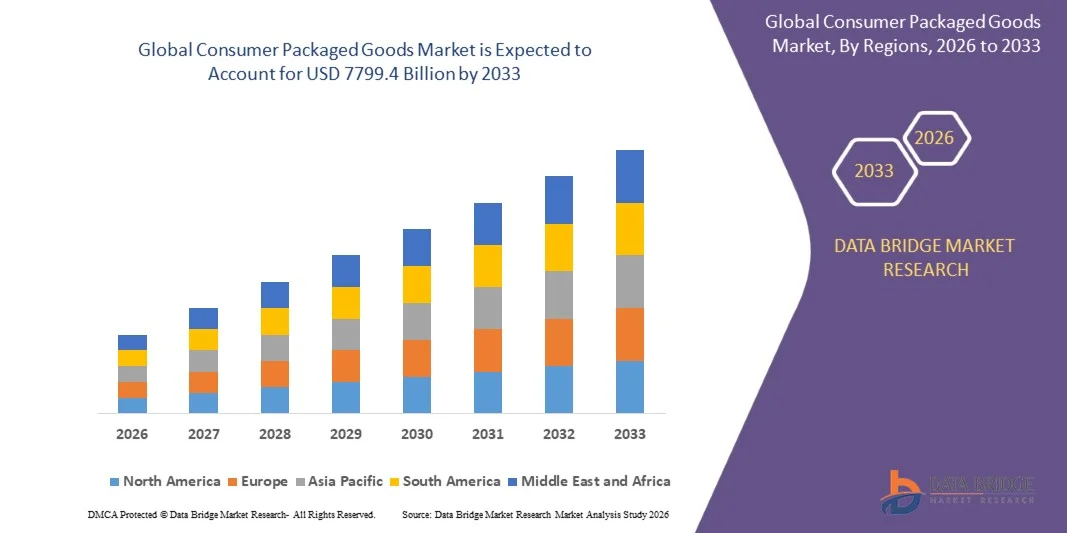
- As per Data Bridge Market Research analysis, the consumer packaged goods market was valued at USD 5664.3 billion in 2025 and is projected to reach USD 7799.4 billion by 2033, growing at a CAGR of 4.10% from 2026 to 2033.
- The market is expanding due to rising consumer spending on everyday essential products, increasing urbanization, population growth, changing consumer lifestyles, growing demand for convenient and packaged products, expansion of organized retail and e-commerce, and increasing product innovation across food, beverages, personal care, household, and other consumer product categories.
- Consumer packaged goods are increasingly being adopted across food and beverages, personal care, household care, and other frequently purchased consumer product categories, supported by increasing demand for convenience, product variety, affordability, improved packaging, brand differentiation, and wider availability through supermarkets, hypermarkets, convenience stores, and online retail channels.
Market Size & Forecast
- Global Market Value (2025): USD 5664.3 billion
- Expected Market Value (2033): USD 7799.4 billion
- Forecast CAGR (2026–2033): 4.10%
- Leading Region in 2025: North America
- Fastest Growing Region: Asia-Pacific
What are the Major Takeaways of the Consumer Packaged Goods Market?
- North America dominated the global consumer packaged goods market with share of 33.19% in 2025, supported by high consumer spending, established retail infrastructure, strong brand penetration, widespread supermarket and convenience-store networks, and increasing demand for packaged food, beverages, personal care, household care, and healthcare products.
- Asia Pacific is expected to be the fastest-growing regional market CAGR of 4.50% from 2026 to 2033, driven by rising disposable incomes, urbanization, expanding organized retail, increasing e-commerce penetration, and changing consumer lifestyles.
- The food and beverages segment dominated the product type category with a market share of 42.55% in 2025, supported by increasing demand for packaged foods and beverages, convenience products, ready-to-consume products, snacks, and changing consumer preferences.
- Personal care products segment is projected to register strong growth at a CAGR of 5.35%, driven by increasing consumer spending on skincare, haircare, cosmetics, hygiene products, and premium personal-care solutions.
- The household care products segment accounted for a market share of 19.25% in 2025, supported by increasing demand for household cleaning products, laundry care, surface-care solutions, and hygiene products.
- The health care products segment is projected to grow at a CAGR of 4.40%, supported by increasing consumer awareness, preventive healthcare, personal wellness, and demand for over-the-counter and everyday healthcare products.
- The supermarkets segment dominated the distribution channel category with a market share of 45.69% in 2025, supported by broad product availability, competitive pricing, promotional activities, established retail infrastructure, and consumer preference for one-stop shopping.
Report Scope and Consumer Packaged Goods Market Segmentation
|
Attributes |
Consumer Packaged Goods Key Market Insights |
|
Segments Covered |
|
|
Countries Covered |
North America
Europe
Asia-Pacific
Middle East and Africa
South America
|
|
Key Market Players |
|
|
Market Opportunities |
|
|
Value Added Data Infosets |
In addition to the insights on market scenarios such as market value, growth rate, segmentation, geographical coverage, and major players, the market reports curated by the Data Bridge Market Research also include in-depth expert analysis, pricing analysis, brand share analysis, consumer survey, demography analysis, supply chain analysis, value chain analysis, raw material/consumables overview, vendor selection criteria, PESTLE Analysis, Porter Analysis, and regulatory framework. |
What is the Key Trend in the Consumer Packaged Goods Market?
- Increasing adoption of artificial intelligence and AI-enabled consumer discovery is becoming a major trend in the global consumer packaged goods market, as brands increasingly use artificial intelligence to understand consumer preferences, improve product discovery, personalize marketing, accelerate innovation, and optimize the path to purchase.
- Integration of consumer packaged goods with personalized digital experiences, omnichannel commerce, and AI-enabled retail platforms is gaining importance as consumers increasingly combine physical stores, e-commerce platforms, social media, and AI-powered shopping tools during the purchasing journey. Brands are increasingly adopting AI-powered personalization, conversational commerce, structured product information, and data-driven consumer insights to improve product visibility and engagement.
- For instance, in March 2026, NielsenIQ and Kearney reported that artificial intelligence was reshaping innovation and product discovery across the consumer packaged goods industry, with challenger brands increasingly gaining visibility through AI-led discovery.
- Overall, the consumer packaged goods market is increasingly shaped by artificial intelligence, agentic commerce, personalized consumer experiences, sustainable packaging, health and wellness innovation, omnichannel retail, and data-driven product development. CPG companies are therefore moving toward technology-enabled and consumer-centric business models that combine AI-powered discovery with sustainable packaging, convenience-oriented products, personalized offerings, and efficient digital distribution
What are the Key Drivers of the Consumer Packaged Goods Market?
- Increasing consumer demand for convenience, accessibility, and value-oriented products is becoming a major driver in the global consumer packaged goods market, as consumers increasingly seek products that simplify daily activities, provide value for money, and are readily available through multiple purchasing channels. Demand for packaged food and beverages, personal care products, household care products, and healthcare products is being supported by changing lifestyles, urbanization, time constraints, and growing consumer expectations for convenient and easily accessible products.
- Rapid expansion of e-commerce, omnichannel retail, and digital purchasing is further driving the consumer packaged goods market, as consumers increasingly use online marketplaces, grocery delivery services, and digital retail platforms for product discovery, comparison, replenishment, and purchasing. The increasing integration of online and offline retail channels is enabling CPG companies to expand market reach, improve product accessibility, and respond more rapidly to changing consumer preferences.
- Growing consumer focus on health, wellness, nutrition, and personal well-being is supporting demand for differentiated CPG products, particularly functional foods and beverages, personal care products, nutritional products, hygiene products, and healthcare products. Consumers are increasingly seeking products that provide specific health and wellness benefits, while younger consumers are placing greater emphasis on personalized wellness and science-backed product claims.
- For instance, McKinsey's 2025 wellness research identified functional nutrition, healthy aging, beauty, weight management, and other wellness categories as areas of expanding consumer demand. Increasing adoption of private-label, premium, and value-oriented products is reshaping purchasing patterns in the consumer packaged goods market, as consumers simultaneously seek affordability and differentiated product experiences.
- Overall, the consumer packaged goods market is increasingly shaped by convenience-driven consumption, digital and omnichannel retailing, health and wellness preferences, value-conscious purchasing, private-label expansion, sustainable product innovation, and changing consumer expectations. CPG companies are therefore focusing on product innovation, flexible packaging, digital engagement, personalized offerings, competitive pricing, and broader distribution networks to address evolving consumer requirements and strengthen market presence
What Factors are Challenging the Growth of the Consumer Packaged Goods Market?
- Increasing input-cost volatility and inflationary pressures are becoming major challenges in the global consumer packaged goods market, as fluctuations in food commodities, packaging materials, energy, transportation, and other raw materials continue to affect production costs and profit margins. CPG companies are facing greater difficulty in maintaining affordability while protecting margins, particularly as consumers have become more price-sensitive and increasingly compare branded products with lower-priced alternatives. McKinsey reported that affordability pressures have constrained volume recovery, while price increases risk further volume declines.
- For instacne, More than 80% of U.S. and European consumers surveyed by McKinsey in 2025 perceived private-label products as having quality equal to or better than branded products, increasing competitive pressure across food, beverages, household care, personal care, and other CPG categories.
- Supply-chain disruption, geopolitical uncertainty, and raw-material availability are creating additional challenges for CPG manufacturers, particularly for companies dependent on globally sourced agricultural commodities, packaging materials, energy, and specialized ingredients. Volatility in raw-material and energy prices, changing trade conditions, tariffs, and increasing regionalization of supply chains are requiring companies to strengthen sourcing strategies, increase supply-chain resilience, and manage inventory more effectively.
- Increasing sustainability requirements and the transition toward sustainable packaging are creating cost, performance, and regulatory challenges for CPG companies. Companies are required to respond to growing demand for recyclable, reusable, and recycled-content packaging while managing affordability, product protection, material availability, and changing regulatory standards.
- Overall, the consumer packaged goods market is increasingly challenged by slower volume growth, fragmented consumer preferences, intense competition, changing retail dynamics, rising operating costs, and sustainability requirements. CPG companies are therefore required to balance affordability with profitability while investing in product innovation, efficient supply chains, digital and e-commerce capabilities, private-label differentiation, sustainable packaging, and data-driven consumer insights. The shift from traditional volume-led growth toward productivity, premiumization, channel diversification, and targeted innovation is expected to remain important for maintaining competitiveness in the global market.
How is the Consumer Packaged Goods Market Segmented?
The global consumer packaged goods market is segmented on the basis of product type, distribution channel, packaging type, and end user.
- By Product Type
On the basis of product type, the global consumer packaged goods market is segmented into food and beverages, personal care products, household care products, and health care products. The food and beverages segment dominated the market with a market share of 42.55% in 2025, driven by increasing demand for convenient packaged products, ready-to-use food and beverages, longer shelf-life products, changing consumption patterns, and growing consumer preference for healthier and diverse product offerings.
The personal care products segment accounted for a market share of 23.10% in 2025, while the Household Care Products segment accounted for 19.25% and is projected to grow at a CAGR of 4.60% from 2026 to 2033. Increasing demand for cleaning, laundry, surface-care, hygiene, and household maintenance products is supporting segment expansion.
- By Distribution Channel
On the basis of distribution channel, the global consumer packaged goods market is segmented into supermarkets, convenience stores, e-commerce, and discount stores. The supermarkets segment dominated the market with a market share of 45.69% in 2025, supported by extensive product availability, competitive pricing, promotional activities, established retail infrastructure, and consumer preference for one-stop shopping.
The convenience stores segment accounted for a market share of 22.40% in 2025 and is projected to grow at a CAGR of 4.50% from 2026 to 2033, supported by increasing demand for quick and convenient purchasing options, extended operating hours, and urbanization.
- By Packaging Type
On the basis of packaging type, the global consumer packaged goods market is segmented into bottles, cans, boxes, and pouches. The bottles segment dominated the market with a market share of 36.81% in 2025, supported by extensive utilization across beverages, personal care, household care, and healthcare products.
The pouches segment is projected to register the fastest growth at a CAGR of 4.56%, driven by increasing demand for lightweight, portable, flexible, space-efficient, and convenient packaging formats. The segment accounted for a market share of 17.49% in 2025,
- By End User
On the basis of end user, the global consumer packaged goods market is segmented into households, businesses, and institutions. The households segment dominated the market with a market share of 71.23% in 2025, supported by high-frequency consumption of packaged food and beverages, personal care products, household care products, and healthcare products. The segment is projected to grow at a CAGR of 4.10% from 2026 to 2033.
The businesses segment is projected to grow at a CAGR of 4.50% from 2026 to 2033. Increasing consumption of packaged food, beverages, healthcare, hygiene, and household products across hospitals, schools, offices, government facilities, hospitality establishments, and other institutional settings is supporting demand.
Which Region Holds the Largest Share of the Consumer Packaged Goods Market?
- North America accounted for the largest share of the global consumer packaged goods market, with a revenue share of 34.68% in 2025, supported by high consumer purchasing power, well-established retail infrastructure, strong brand penetration, extensive supermarket and hypermarket networks, and increasing adoption of e-commerce and direct-to-consumer channels. The region benefits from strong demand for packaged food and beverages, personal care products, household care products, and healthcare products, while growing consumer interest in convenience, health, wellness, premium products, and sustainable packaging is further supporting market expansion.
- The U.S. represents the major contributor within North America, supported by its large consumer base, high disposable income, sophisticated retail and distribution infrastructure, strong presence of multinational CPG companies, and extensive digital commerce ecosystem. Increasing demand for convenient, health-oriented, premium, sustainable, and value-added products is supporting CPG consumption in the country.
U.S. Consumer Packaged Goods Market Insight
The U.S. consumer packaged goods market is expanding due to high consumer spending, strong retail infrastructure, increasing e-commerce penetration, and growing demand for convenient, premium, health-oriented, and sustainable products. The market is supported by widespread adoption of packaged food and beverages, personal care products, household care products, and healthcare products across diverse consumer segments. Rising demand for private-label and value-oriented products, product innovation, omnichannel retailing, and sustainable packaging is further influencing market development. Increasing digitalization, changing lifestyles, and growing consumer focus on health and wellness are also supporting continued growth across the U.S. CPG industry.
Canada Consumer Packaged Goods Market Insight
The Canada consumer packaged goods market is expanding steadily, supported by strong consumer demand for food, beverages, personal care, household care, and health and wellness products, While Health & Wellness is projected to record the fastest growth. Increasing e-commerce adoption, convenience-oriented consumption, and health-conscious purchasing are further supporting market expansion.
Asia-Pacific Consumer Packaged Goods Market Insight
The Asia-Pacific consumer packaged goods market is witnessing strong growth, supported by rising disposable incomes, rapid urbanization, expanding middle-class populations, and changing consumer lifestyles. Increasing demand for convenient packaged food and beverages, personal care products, household care products, and healthcare products is supporting market expansion across the region. The rapid development of organized retail, supermarkets, convenience stores, and e-commerce platforms is further improving product accessibility. Growing consumer awareness of health, wellness, premium products, and sustainable packaging is encouraging product innovation. China, India, Japan, and Southeast Asian economies are expected to remain important contributors to regional market growth.
China Consumer Packaged Goods Market Insight
China’s consumer packaged goods market is experiencing continued transformation, supported by rising consumer demand for convenient, health-oriented, premium, and value-focused products. The market is being strengthened by rapid e-commerce expansion, urbanization, evolving consumer preferences, and increasing penetration of modern retail formats. Theyhighlighting the growing importance of digital channels. Demand for packaged food, personal care, household care, and functional products is further supported by increasing health awareness and product innovation.
Japan Consumer Packaged Goods Market Insight
The Japan consumer packaged goods market is expanding steadily, supported by strong consumer demand for high-quality food and beverages, personal care products, household care products, and healthcare products. An aging population is increasing demand for health-oriented, convenient, functional, and easy-to-use products, while established retail networks and high e-commerce penetration are strengthening product accessibility. Japanese consumers also demonstrate strong preferences for product quality, safety, convenience, and innovative packaging. Growing demand for sustainable and environmentally responsible packaging, premium products, and technologically advanced consumer solutions is further supporting market development.
Germany Consumer Packaged Goods Market Insight
The Germany consumer packaged goods market is supported by strong consumer demand for food and beverages, personal care products, household care products, and healthcare products. Growing consumer preference for premium, convenient, health-oriented, and sustainable products is encouraging manufacturers to expand product portfolios and adopt innovative packaging solutions. Germany’s well-developed retail infrastructure, extensive supermarket networks, discount retailers, and rapidly expanding e-commerce channels are further supporting market accessibility. Increasing private-label penetration, digital shopping adoption, sustainability initiatives, and demand for environmentally responsible packaging are expected to influence market development, while established domestic and international CPG companies continue to strengthen competition.
U.K. Consumer Packaged Goods Market Insight
The U.K. consumer packaged goods market is supported by strong consumer demand for food and beverages, personal care, household care, and healthcare products. Growth is being driven by expanding e-commerce, increasing preference for convenience-oriented products, premiumization, health and wellness awareness, and rising demand for sustainable and recyclable packaging. Established supermarket chains, convenience stores, discount retailers, and online platforms provide extensive distribution opportunities for CPG manufacturers. In addition, private-label products are gaining traction as consumers increasingly seek value for money, while product innovation and digital retail strategies continue to strengthen competition across the U.K. market.
Which are the Top Companies in Consumer Packaged Goods Market?
The consumer packaged goods industry is primarily led by well-established companies, including:
- Procter & Gamble (US)
- Unilever (GB)
- Nestle (CH)
- PepsiCo (US)
- Coca-Cola (US)
- Mondelez International (US)
- Johnson & Johnson (US)
- Colgate-Palmolive (US)
- Kimberly-Clark (US)
- Reckitt Benckiser (GB)
What are Latest Developments in Consumer Packaged Goods Market?
- In October 2026, Nestlé announced its largest international sports sponsorship through a new partnership with the NBA, covering 21 countries across four continents. The initiative is focused on connecting brands such as Milo, Nesquik, and Nescau with younger, health-conscious consumers while promoting physical activity and nutrition. The development highlights the increasing use of sports, digital engagement, and youth-focused marketing strategies by CPG companies to strengthen brand relevance.
- In August 2026, India’s Food Safety and Standards Authority proposed front-of-pack warning labels for packaged foods and beverages containing high levels of sugar, salt, or saturated fat. The proposed red warning labels are intended to help consumers identify products with high levels of specified nutrients. The development is expected to influence product formulation, packaging design, labeling strategies, and compliance requirements for CPG companies operating in India.
- In July 2026, The Procter & Gamble company reported 3% growth in fiscal 2026 net sales to USD 87.0 billion, while organic sales increased 1%. The company reported growth across categories and regions and emphasized productivity, product superiority, consumer-focused innovation, and value creation as key priorities for future growth. The development reflects the industry's increasing focus on productivity and innovation amid challenging economic and geopolitical conditions.
- In July 2026, Nestlé reported 3.7% organic growth in the second quarter of 2026, supported by real internal growth of 1.8%. The company accelerated investment behind leading brands and growth platforms while increasing its focus on portfolio prioritization and operational efficiency. Stronger growth in emerging markets further highlighted the increasing importance of developing economies for global CPG companies.
- In February 2026, Unilever warned that its 2026 underlying sales growth was expected toward the lower end of its 4% to 6% guidance range because of slower market conditions in the U.S. and Europe. At the same time, emerging markets including India, Indonesia, and China continued to support growth. The development highlights the growing importance of emerging markets as CPG companies face weaker consumer demand and cost-of-living pressures in developed markets.

- Interactive Data Analysis Dashboard
- Company Analysis Dashboard for high growth potential opportunities
- Research Analyst Access for customization & queries
- Competitor Analysis with Interactive dashboard
- Latest News, Updates & Trend analysis
- Harness the Power of Benchmark Analysis for Comprehensive Competitor Tracking
Data collection and base year analysis are done using data collection modules with large sample sizes. The stage includes obtaining market information or related data through various sources and strategies. It includes examining and planning all the data acquired from the past in advance. It likewise envelops the examination of information inconsistencies seen across different information sources. The market data is analysed and estimated using market statistical and coherent models. Also, market share analysis and key trend analysis are the major success factors in the market report. To know more, please request an analyst call or drop down your inquiry.
The key research methodology used by DBMR research team is data triangulation which involves data mining, analysis of the impact of data variables on the market and primary (industry expert) validation. Data models include Vendor Positioning Grid, Market Time Line Analysis, Market Overview and Guide, Company Positioning Grid, Patent Analysis, Pricing Analysis, Company Market Share Analysis, Standards of Measurement, Global versus Regional and Vendor Share Analysis. To know more about the research methodology, drop in an inquiry to speak to our industry experts.
Data Bridge Market Research is a leader in advanced formative research. We take pride in servicing our existing and new customers with data and analysis that match and suits their goal. The report can be customized to include price trend analysis of target brands understanding the market for additional countries (ask for the list of countries), clinical trial results data, literature review, refurbished market and product base analysis. Market analysis of target competitors can be analyzed from technology-based analysis to market portfolio strategies. We can add as many competitors that you require data about in the format and data style you are looking for. Our team of analysts can also provide you data in crude raw excel files pivot tables (Fact book) or can assist you in creating presentations from the data sets available in the report.