What is the Controlled-Release Micronutrient Market Size and Growth Rate?
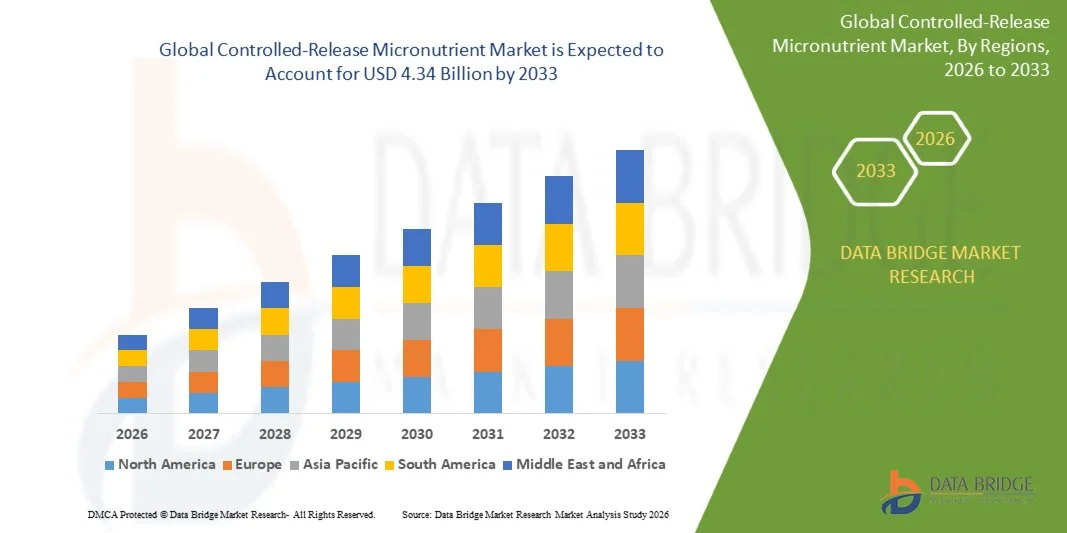
- As per Data Bridge Market Research analysis the controlled-release micronutrient market was valued at USD 2.10 billion in 2025 and is projected to reach USD 4.34 billion by 2033, growing at a CAGR of 9.50% from 2026 to 2033.
- The market is experiencing significant growth driven by increasing demand for efficient fertilizer solutions, rising adoption of precision agriculture practices, growing concerns regarding nutrient losses from conventional fertilizers, and the need to enhance crop productivity through improved nutrient-use efficiency
- The increasing global focus on sustainable farming, soil health management, and reducing environmental impact from excessive fertilizer application is encouraging farmers and agricultural companies to adopt controlled-release micronutrient formulations that provide gradual nutrient availability, minimize wastage, and improve overall crop performance.
Market Size & Forecast
- Market Value (2025): USD 2.10 Billion
- Expected Market Value (2033): USD 4.34 Billion
- Forecast CAGR (2026–2033): 9.50%
- Leading Region in 2025: North America
- Fastest Growing Region: Asia-Pacific
What are the Major Takeaways of the Controlled-Release Micronutrient Market?
- North America dominated the controlled-release micronutrient market with a significant revenue share in 2025, supported by increasing adoption of precision agriculture, advanced fertilizer technologies, and growing emphasis on sustainable crop nutrition practices.
- Asia-Pacific controlled-release micronutrient market is expected to witness the fastest growth rate from 2026 to 2033, supported by increasing agricultural productivity requirements, rising food demand, expanding population, and growing awareness regarding soil nutrient deficiencies.
- The zinc segment held the largest market revenue share in 2025 driven by widespread zinc deficiency in agricultural soils, increasing adoption of zinc-enriched fertilizers, and growing awareness regarding the importance of zinc in improving crop productivity and plant development. Zinc-based controlled-release micronutrients are widely preferred due to their ability to provide sustained nutrient availability, reduce nutrient fixation, and enhance nutrient-use efficiency across field and horticultural crops.
- The iron segment is projected to register the fastest growth at a CAGR from 2026 to 2033 driven by increasing demand for solutions that address iron deficiency in alkaline and calcareous soils. Rising adoption of controlled-release iron formulations in greenhouse cultivation and high-value crops is supporting segment expansion.
- The polymer-coated segment accounted for the largest market share in 2025 driven by its ability to provide controlled nutrient release, improve fertilizer efficiency, and minimize nutrient losses through leaching and runoff. Polymer-coated micronutrients are increasingly adopted in commercial agriculture due to their customizable release patterns based on crop requirements and soil conditions.
- The bio-based coated segment is projected to register the fastest growth at a CAGR from 2026 to 2033 driven by rising demand for sustainable agricultural inputs, biodegradable coating materials, and environmentally friendly nutrient delivery solutions. Increasing focus on reducing the environmental impact of fertilizer applications is encouraging the development of bio-based coating technologies.
Report Scope and Controlled-Release Micronutrient Market Segmentation
Attributes |
Controlled-Release Micronutrient Key Market Insights |
|
Segments Covered |
|
|
Countries Covered |
North America
Europe
Asia-Pacific
Middle East and Africa
South America
|
|
Key Market Players |
|
|
Market Opportunities |
|
|
Value Added Data Infosets |
In addition to the insights on market scenarios such as market value, growth rate, segmentation, geographical coverage, and major players, the market reports curated by the Data Bridge Market Research also include import export analysis, production capacity overview, production consumption analysis, price trend analysis, climate change scenario, supply chain analysis, value chain analysis, raw material/consumables overview, vendor selection criteria, PESTLE Analysis, Porter Analysis, and regulatory framework. |
What is the Key Trend in the Controlled-Release Micronutrient Market?
- Agricultural producers are increasingly adopting controlled-release micronutrient formulations to improve nutrient-use efficiency, reduce fertilizer losses, and ensure sustained availability of essential nutrients such as zinc, iron, manganese, and boron throughout crop growth cycles.
- For instance, in 2024, research published in
Crops Industrial and Productshighlighted that controlled-release fertilizer technologies are gaining importance as sustainable alternatives to conventional fertilizers by improving nutrient utilization efficiency and reducing environmental impacts associated with nutrient losses. - Advanced coating technologies, including polymer-based, sulfur-based, and bio-based coatings, are enabling precise nutrient release patterns that align with crop requirements and soil conditions.
- Fertilizer manufacturers and agricultural technology providers are increasingly focusing on customized micronutrient blends and precision nutrition solutions to support high-value crops, sustainable farming, and improved soil health management.
- For instance, in 2024, the government of India expanded the Nutrient-Based Subsidy (NBS) scheme by including additional fortified fertilizer grades containing micronutrients such as zinc, boron, magnesium, and sulfur, supporting the adoption of balanced nutrient management practices among farmers.
- As global agriculture continues shifting toward precision farming, sustainable intensification, and improved nutrient efficiency, the adoption of controlled-release micronutrients is expected to accelerate, strengthening their role in modern crop nutrition strategies.
What are the Key Drivers of the Controlled-Release Micronutrient Market?
- The rising need to improve fertilizer-use efficiency and address widespread soil micronutrient deficiencies is significantly increasing demand for controlled-release micronutrient solutions that provide consistent nutrient availability and enhance crop productivity.
- For instance, in 2024, the Government of India promoted fortified and customized fertilizers under its balanced fertilization initiatives, including micronutrient-enriched fertilizer grades designed to improve soil health and provide farmers with crop-specific nutrient options.
- Increasing adoption of precision agriculture, soil testing technologies, and data-driven crop management practices is encouraging farmers to shift toward targeted micronutrient application methods that minimize wastage and improve economic returns.
- For instance, a 2024 study on controlled-release silica-coated fertilizers demonstrated improved nutrient and water-use efficiency, with the developed formulation reducing phosphorus release rates by approximately 25–38% compared with commercial fertilizers and improving nutrient utilization performance.
- Growing environmental concerns related to nutrient leaching, runoff, and excessive fertilizer application are further encouraging agricultural producers and fertilizer companies to develop controlled-release solutions that support sustainable farming practices.
- With increasing global emphasis on food security, soil fertility restoration, and efficient resource utilization, controlled-release micronutrients are expected to become an important component of next-generation crop nutrition systems.
Which Factors are Challenging the Growth of the Controlled-Release Micronutrient Market?
- Controlled-release micronutrient formulations often involve advanced coating materials, specialized manufacturing processes, and higher production costs compared with conventional micronutrient fertilizers, limiting adoption among small-scale farmers and price-sensitive markets.
- The higher product cost, limited awareness regarding long-term benefits, and lack of technical knowledge regarding application methods remain key barriers to widespread adoption, particularly in developing agricultural regions.
- For instance, scientific reviews on controlled-release fertilizers have highlighted that although these technologies improve nutrient efficiency and sustainability, challenges related to production costs, commercialization, and large-scale transition from traditional fertilizers continue to restrict broader market penetration.
- In addition, variations in soil conditions, climate factors, and crop nutrient requirements create challenges in developing universally applicable controlled-release micronutrient formulations.
- The requirement for farmer education, improved distribution networks, and cost-effective product innovations remains critical for expanding adoption across emerging agricultural economies.
- These cost and accessibility challenges may slow market growth in price-sensitive regions; however, increasing government support for balanced fertilization and sustainable agriculture is expected to gradually improve market acceptance.
How is the Controlled-Release Micronutrient Market Segmented?
The controlled-release micronutrient market is segmented on the basis of nutrient type, coating technology, form, application, and application method.
- By Nutrient Type
On the basis of nutrient type, the controlled-release micronutrient market is segmented into zinc, iron, manganese, copper, boron, and other micronutrients. The zinc segment held the largest market revenue share in 2025 driven by widespread zinc deficiency in agricultural soils, increasing adoption of zinc-enriched fertilizers, and growing awareness regarding the importance of zinc in improving crop productivity and plant development. Zinc-based controlled-release micronutrients are widely preferred due to their ability to provide sustained nutrient availability, reduce nutrient fixation, and enhance nutrient-use efficiency across field and horticultural crops.
The iron segment is projected to register the fastest growth at a CAGR from 2026 to 2033 driven by increasing demand for solutions that address iron deficiency in alkaline and calcareous soils. Rising adoption of controlled-release iron formulations in greenhouse cultivation and high-value crops is supporting segment expansion.
- By Coating Technology
On the basis of coating technology, the controlled-release micronutrient market is segmented into polymer-coated, sulfur-coated, bio-based coated, and other coating technologies. The polymer-coated segment accounted for the largest market share in 2025 driven by its ability to provide controlled nutrient release, improve fertilizer efficiency, and minimize nutrient losses through leaching and runoff. Polymer-coated micronutrients are increasingly adopted in commercial agriculture due to their customizable release patterns based on crop requirements and soil conditions.
The bio-based coated segment is projected to register the fastest growth at a CAGR from 2026 to 2033 driven by rising demand for sustainable agricultural inputs, biodegradable coating materials, and environmentally friendly nutrient delivery solutions. Increasing focus on reducing the environmental impact of fertilizer applications is encouraging the development of bio-based coating technologies.
- By Form
On the basis of form, the controlled-release micronutrient market is segmented into granular, liquid, powder, and other forms. The granular segment held the largest market revenue share in 2025 driven by its widespread adoption in field crop applications, compatibility with conventional fertilizer spreading equipment, and ease of storage and transportation. Granular controlled-release micronutrients are preferred for large-scale farming operations due to their uniform nutrient distribution and extended nutrient availability.
The liquid segment is projected to register the fastest growth at a CAGR from 2026 to 2033 driven by increasing adoption of fertigation systems, precision agriculture practices, and targeted nutrient application methods. Liquid formulations enable efficient nutrient delivery through irrigation systems and support improved crop nutrition management.
- By Application
On the basis of application, the controlled-release micronutrient market is segmented into field crops, horticultural crops, turf & ornamentals, and greenhouse crops. The field crops segment accounted for the largest market share in 2025 driven by increasing demand for improved crop yields, rising soil micronutrient deficiencies, and growing adoption of efficient fertilizer technologies in cereals, oilseeds, and pulses. Controlled-release micronutrients help farmers improve nutrient availability and reduce fertilizer application losses in large-scale agricultural production.
The greenhouse crops segment is projected to register the fastest growth at a CAGR from 2026 to 2033 driven by increasing adoption of controlled environment agriculture, hydroponic farming, and precision nutrient management systems. Growing cultivation of vegetables, flowers, and specialty crops under protected environments is supporting demand for controlled-release micronutrient solutions.
- By Application Method
On the basis of application method, the controlled-release micronutrient market is segmented into soil application, foliar application, fertigation, and seed treatment. The soil application segment held the largest market revenue share in 2025 driven by its effectiveness in maintaining nutrient availability in the root zone and compatibility with traditional fertilizer application practices. Soil-applied controlled-release micronutrients are widely used to correct nutrient deficiencies and improve long-term crop performance.
The fertigation segment is projected to register the fastest growth at a CAGR from 2026 to 2033 driven by increasing adoption of drip irrigation systems, precision farming technologies, and automated nutrient delivery solutions. Fertigation enables precise micronutrient placement, improves nutrient absorption efficiency, and reduces nutrient wastage in modern agricultural systems.
Which Region Holds the Largest Share of the Controlled-Release Micronutrient Market?
- North America dominated the controlled-release micronutrient market with a significant revenue share in 2025, supported by increasing adoption of precision agriculture, advanced fertilizer technologies, and growing emphasis on sustainable crop nutrition practices.
- Farmers and agricultural producers in the region are increasingly focusing on improving nutrient-use efficiency, reducing fertilizer losses, and enhancing soil health through controlled-release micronutrient solutions. The presence of advanced farming systems, high adoption of soil testing technologies, and strong demand for high-value crops are further supporting market expansion. In addition, government initiatives promoting sustainable agriculture and efficient nutrient management are encouraging the adoption of advanced micronutrient fertilizers across commercial farming operations.
U.S. Controlled-Release Micronutrient Market Insight
U.S. controlled-release micronutrient market captured the largest revenue share in North America in 2025, driven by the rapid adoption of precision farming technologies, increasing focus on crop productivity improvement, and rising awareness regarding balanced plant nutrition. Farmers are increasingly adopting controlled-release zinc, iron, and other micronutrient formulations to address soil deficiencies and improve fertilizer efficiency. The strong presence of major fertilizer manufacturers, advanced agricultural research infrastructure, and increasing use of digital farming solutions are further supporting market growth. Moreover, the growing demand for sustainable farming practices and reduced nutrient runoff is encouraging the adoption of controlled-release micronutrient products across row crops, specialty crops, and horticultural applications.
Europe Controlled-Release Micronutrient Market Insight
Europe controlled-release micronutrient market is expected to witness significant growth from 2026 to 2033, primarily driven by stringent environmental regulations, increasing focus on sustainable agriculture, and rising demand for efficient fertilizer solutions. European farmers are adopting controlled-release micronutrients to improve nutrient-use efficiency, reduce environmental impact, and comply with regulations related to fertilizer application and nutrient losses. The region’s strong emphasis on organic farming, soil health improvement, and climate-smart agriculture is further accelerating adoption across field crops, horticulture, and greenhouse cultivation. In addition, increasing investments in innovative fertilizer technologies and sustainable nutrient delivery systems are supporting market expansion.
U.K. Controlled-Release Micronutrient Market Insight
U.K. controlled-release micronutrient market is expected to witness steady growth from 2026 to 2033, driven by increasing adoption of sustainable farming practices, growing awareness of soil nutrient management, and demand for efficient crop nutrition solutions. Farmers in the U.K. are increasingly utilizing controlled-release micronutrients to improve crop quality, reduce fertilizer wastage, and enhance nutrient availability in challenging soil conditions. The country’s focus on reducing agricultural emissions, improving soil fertility, and promoting precision farming technologies is encouraging the adoption of advanced micronutrient formulations across arable farming and horticultural applications.
Germany Controlled-Release Micronutrient Market Insight
Germany controlled-release micronutrient market is expected to witness strong growth from 2026 to 2033, fueled by increasing emphasis on sustainable agriculture, advanced farming technologies, and environmentally responsible fertilizer usage. Germany’s highly developed agricultural sector is adopting controlled-release micronutrients to improve nutrient efficiency, minimize losses, and support high-quality crop production. The country’s focus on reducing chemical inputs, improving soil health, and implementing precision agriculture practices is driving demand for innovative fertilizer solutions. Furthermore, the presence of leading fertilizer technology companies and strong research capabilities is supporting the development and adoption of advanced controlled-release micronutrient products.
Asia-Pacific Controlled-Release Micronutrient Market Insight
The Asia-Pacific controlled-release micronutrient market is expected to witness the fastest growth rate from 2026 to 2033, supported by increasing agricultural productivity requirements, rising food demand, expanding population, and growing awareness regarding soil nutrient deficiencies. Countries such as China, India, Japan, and Australia are increasingly adopting controlled-release micronutrients to improve crop yields, enhance fertilizer efficiency, and address declining soil fertility. Government initiatives promoting balanced fertilization, sustainable agriculture, and modern farming practices are further supporting market growth. In addition, the increasing adoption of precision agriculture technologies and the presence of major agricultural input manufacturers in the region are improving accessibility and affordability of controlled-release micronutrient solutions.
Japan Controlled-Release Micronutrient Market Insight
Japan controlled-release micronutrient market is expected to witness significant growth from 2026 to 2033 due to increasing adoption of advanced agricultural technologies, aging farming workforce, and demand for efficient crop management solutions. Japanese agriculture places strong emphasis on precision nutrient application, high-quality crop production, and sustainable farming methods, encouraging the use of controlled-release micronutrient formulations. The integration of smart farming technologies, greenhouse cultivation, and automated agricultural systems is further driving demand for efficient nutrient delivery solutions. Moreover, Japan’s focus on improving agricultural productivity with limited arable land availability is supporting the adoption of advanced fertilizer technologies.
China Controlled-Release Micronutrient Market Insight
China controlled-release micronutrient market accounted for the largest market revenue share in Asia-Pacific in 2025, attributed to the country’s large agricultural sector, increasing demand for food security, and growing focus on improving fertilizer efficiency. China is experiencing rising adoption of controlled-release micronutrient products due to widespread soil nutrient imbalances, government initiatives promoting fertilizer efficiency, and increasing modernization of agricultural practices. The expansion of precision agriculture, greenhouse farming, and high-value crop cultivation is further supporting market growth. In addition, the presence of domestic fertilizer manufacturers and increasing investments in sustainable agricultural inputs are strengthening the adoption of controlled-release micronutrient solutions across the country.
Which are the Top Companies in Controlled-Release Micronutrient Market?
The controlled-release micronutrient industry is primarily led by well-established companies, including:
- Nutrien Ltd. (Canada)
- Yara International ASA (Norway)
- ICL Group Ltd. (Israel)
- The Mosaic Company (U.S.)
- Haifa Group (Israel)
- EuroChem Group AG (Switzerland)
- K+S AG (Germany)
- Coromandel International Limited (India)
- COMPO EXPERT GmbH (Germany)
- Verdesian Life Sciences (U.S.)
- Nufarm Limited (Australia)
- Manna Irrigation Ltd. (U.K.)
- Wilbur-Ellis Holdings, Inc. (U.S.)
- Bioceres Crop Solutions Corp. (Argentina)
- Tradecorp International (Spain)

- Interactive Data Analysis Dashboard
- Company Analysis Dashboard for high growth potential opportunities
- Research Analyst Access for customization & queries
- Competitor Analysis with Interactive dashboard
- Latest News, Updates & Trend analysis
- Harness the Power of Benchmark Analysis for Comprehensive Competitor Tracking
Data collection and base year analysis are done using data collection modules with large sample sizes. The stage includes obtaining market information or related data through various sources and strategies. It includes examining and planning all the data acquired from the past in advance. It likewise envelops the examination of information inconsistencies seen across different information sources. The market data is analysed and estimated using market statistical and coherent models. Also, market share analysis and key trend analysis are the major success factors in the market report. To know more, please request an analyst call or drop down your inquiry.
The key research methodology used by DBMR research team is data triangulation which involves data mining, analysis of the impact of data variables on the market and primary (industry expert) validation. Data models include Vendor Positioning Grid, Market Time Line Analysis, Market Overview and Guide, Company Positioning Grid, Patent Analysis, Pricing Analysis, Company Market Share Analysis, Standards of Measurement, Global versus Regional and Vendor Share Analysis. To know more about the research methodology, drop in an inquiry to speak to our industry experts.
Data Bridge Market Research is a leader in advanced formative research. We take pride in servicing our existing and new customers with data and analysis that match and suits their goal. The report can be customized to include price trend analysis of target brands understanding the market for additional countries (ask for the list of countries), clinical trial results data, literature review, refurbished market and product base analysis. Market analysis of target competitors can be analyzed from technology-based analysis to market portfolio strategies. We can add as many competitors that you require data about in the format and data style you are looking for. Our team of analysts can also provide you data in crude raw excel files pivot tables (Fact book) or can assist you in creating presentations from the data sets available in the report.