


What is the Cork Flooring Market Size and Growth Rate ?
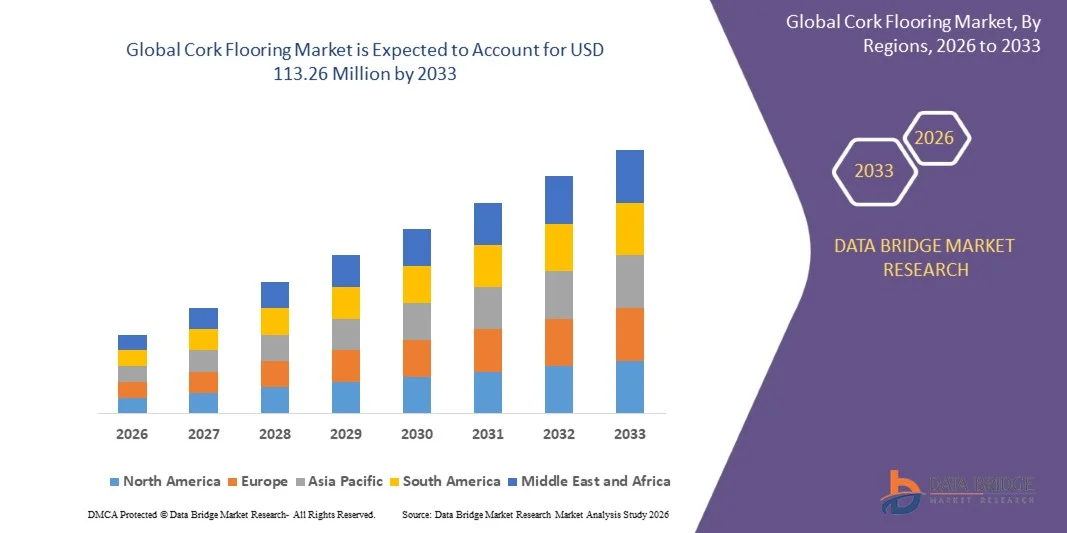
As per Data Bridge Market Research Analysis the Cork Flooring Market was valued at USD 74.64 million in 2025 and is projected to reach USD 113.26 million by 2033, growing at a CAGR of 5.35% from 2026 to 2033. The market is witnessing steady growth driven by increasing demand for sustainable and eco-friendly flooring solutions, rising adoption of renewable building materials in residential and commercial construction, and growing awareness of indoor environmental quality and acoustic comfort.
The expanding preference for cork flooring is supported by its natural properties such as thermal insulation, sound absorption, durability, and resilience, making it suitable for both residential and commercial interiors. Increasing green building initiatives, stricter environmental regulations promoting low-emission construction materials, and rising investments in sustainable infrastructure development are further accelerating market growth globally. In addition, growing renovation activities in developed economies and increasing consumer shift toward aesthetically appealing and environmentally responsible flooring solutions are strengthening market adoption across various end-use sectors.
Market Size & Forecast
- Global Market Value (2025): USD 74.64 Million
- Expected Market Value (2033): USD 113.26 Million
- Forecast CAGR (2026–2033): 5.35%
- Leading Region in 2025: North America
- Fastest Growing Region: Asia-Pacific
What are the Major Takeaways of Cork Flooring Market ?
- North America dominated the cork flooring market with the largest revenue share of 38.6% in 2025, supported by strong demand for green building certifications, increasing renovation activities, and high consumer awareness regarding sustainable and recyclable interior materials.
- Asia-Pacific is expected to be the fastest-growing region, recording a CAGR of 6.4% from 2026 to 2033. Growth is driven by rapid urbanization, expanding construction activities, rising disposable incomes, and increasing adoption of eco-friendly building materials across emerging economies such as China, India, and Southeast Asia.
- The Natural Cork Flooring segment held the largest market revenue share of approximately 61.5% in 2025 driven by its strong demand in sustainable construction projects, residential interiors, and eco-friendly building applications. Natural cork is widely preferred due to its renewable sourcing, excellent thermal and acoustic insulation properties, and compatibility with green building certifications such as LEED and BREEAM.
- The Colourful Cork Flooring segment is projected to register the fastest growth at a CAGR of 6.2% from 2026 to 2033, driven by rising demand for aesthetic interior design solutions, customizable flooring patterns, and modern architectural trends in commercial and residential spaces. Increasing adoption in premium hospitality and office renovation projects is further accelerating segment expansion.
- The Residential Flooring segment accounted for the largest market revenue share of approximately 58.3% in 2025 driven by growing consumer preference for sustainable, comfortable, and noise-reducing flooring materials in housing applications. Rising renovation activities, increasing awareness of indoor air quality, and demand for eco-friendly interiors are further supporting strong residential adoption.
- The Commercial Flooring segment is expected to witness the fastest CAGR of 5.8% from 2026 to 2033 driven by increasing usage in offices, hotels, educational institutions, and healthcare facilities. Growing emphasis on acoustic comfort, thermal efficiency, and sustainable building certifications is encouraging adoption of cork flooring in commercial infrastructure projects.
- The Indirect Distribution Channel segment held the largest market revenue share of approximately 66.9% in 2025 driven by strong penetration of retail flooring stores, online platforms, wholesalers, and construction material distributors. Easy product availability and strong retail networks across developed and emerging markets are supporting this segment’s dominance.
- The Direct Distribution Channel segment is projected to register the fastest growth at a CAGR of 6.5% from 2026 to 2033 driven by increasing manufacturer-to-customer sales models, rising adoption of customized flooring solutions, and growing preference for bulk procurement by large construction and real estate developers. This channel is gaining traction due to better pricing control, improved supply chain efficiency, and direct technical support from manufacturers.
Report Scope and Cork Flooring Market Segmentation
|
Attributes |
Cork Flooring Key Market Insights |
|
Segments Covered |
|
|
Countries Covered |
North America
Europe
Asia-Pacific
Middle East and Africa
South America
|
|
Key Market Players |
• CORKSRIBAS, S.A. (Portugal) |
|
Market Opportunities |
• Rising Adoption Of Eco-Friendly And Sustainable Flooring Solutions In Green Building Projects • Increasing Demand For Premium Acoustic And Thermal Insulation Flooring In Residential And Commercial Spaces |
|
Value Added Data Infosets |
In addition to the insights on market scenarios such as market value, growth rate, segmentation, geographical coverage, and major players, the market reports curated by the Data Bridge Market Research also include in-depth expert analysis, pricing analysis, brand share analysis, consumer survey, demography analysis, supply chain analysis, value chain analysis, raw material/consumables overview, vendor selection criteria, PESTLE Analysis, Porter Analysis, and regulatory framework. |
What is the Key Trend in the Cork Flooring Market?
Trend: Rising Adoption Of Sustainable And Natural Flooring Materials In Green Construction Projects
Increasing demand for eco-friendly, low-emission, and renewable building materials across residential, commercial, and institutional construction sectors is driving the adoption of cork flooring solutions globally. Conventional synthetic flooring materials often contribute to higher environmental impact, lower recyclability, and reduced indoor air quality performance, encouraging builders and consumers to shift toward bio-based alternatives such as cork that offer sustainability, comfort, and durability.
In modern residential and commercial construction projects, manufacturers are increasingly integrating cork flooring, For instance in apartments, office spaces, hospitality buildings, and educational facilities, to improve acoustic insulation, thermal efficiency, and indoor comfort while reducing reliance on synthetic materials. In Europe, cork flooring is widely used in green-certified buildings, with countries such as Portugal and Spain leading cork production and exports, accounting for a significant share of global supply due to abundant cork oak forests and established processing industries.
The rapid expansion of sustainable construction practices, green building certifications such as LEED and BREEAM, and rising renovation activities in urban infrastructure is also increasing demand for renewable flooring materials that offer both performance and environmental benefits. In addition, growing awareness of health-conscious interior design and preference for hypoallergenic and VOC-free materials is accelerating adoption of cork-based flooring systems. Industry implementation studies during 2025 indicated that cork flooring can reduce indoor noise levels by up to 40% and improve thermal insulation efficiency by approximately 20–30% compared to conventional laminate flooring solutions.
Cork Flooring Market Dynamics
Key Market Driver: Rising Demand For Sustainable And Energy-Efficient Building Materials
The construction industry worldwide is increasingly focused on reducing carbon emissions, improving energy efficiency, and adopting sustainable building materials in response to stricter environmental regulations and green building standards. Traditional flooring materials often rely on non-renewable resources and chemical-intensive manufacturing processes, creating strong demand for natural and recyclable alternatives such as cork flooring.
Architects and builders are increasingly deploying cork-based flooring solutions, For instance in residential housing, commercial complexes, and institutional buildings, to enhance thermal insulation, reduce energy consumption, and improve acoustic performance. European countries, particularly Portugal, France, and Germany, are actively promoting cork-based construction materials due to strong environmental policies and sustainable forestry management practices.
Similarly, renovation and retrofitting projects across North America and Europe are increasingly incorporating cork flooring to improve indoor environmental quality while meeting sustainability certification requirements. Real-world construction projects during 2024 in Spain and Italy integrating cork flooring systems demonstrated reductions in heating and cooling energy consumption of approximately 8–12% in selected energy-efficient building models.
Key Restraint/Challenge: Limited Durability Under Heavy Commercial Load And Higher Material Costs
While cork flooring offers strong environmental and comfort benefits, its performance limitations in high-traffic and heavy-load environments can restrict broader commercial adoption. Compared to synthetic and hardwood flooring options, cork may experience surface wear, compression, and reduced durability under continuous heavy usage in industrial and high-traffic commercial spaces.
In addition, higher production costs associated with cork harvesting, processing, and finishing can increase final product pricing compared to conventional flooring materials such as vinyl, laminate, and ceramic tiles. Limited availability of raw cork resources outside Mediterranean regions also creates supply chain dependency concerns and price volatility in global markets.
Commercial benchmarking studies indicate that cork flooring installation costs can be approximately 10–20% higher than standard laminate flooring systems, while durability in high-traffic commercial environments may require more frequent maintenance or surface treatment to maintain long-term performance and appearance standards.
Key Market Opportunity: Expansion In Green Buildings And Premium Interior Design Applications
Modern construction trends increasingly emphasize sustainable architecture, wellness-focused interiors, and environmentally responsible building materials, creating strong opportunities for cork flooring adoption across premium residential and commercial projects. Conventional flooring materials often lack renewable sourcing and acoustic comfort properties, driving demand for natural alternatives that combine aesthetics, sustainability, and performance efficiency.
Developers are increasingly utilizing cork flooring, For instance in luxury apartments, eco-friendly office spaces, hotels, and wellness centers, to enhance interior comfort, reduce noise pollution, and improve thermal efficiency without compromising design flexibility. In Europe, Portugal-based cork manufacturers supply a significant portion of global demand, with cork oak harvesting cycles of approximately 9 years ensuring renewable and sustainable production cycles.
In addition, advancements in engineered cork composites, surface coatings, and hybrid flooring technologies are improving durability, water resistance, and design versatility, opening opportunities across Asia-Pacific and North America construction markets. Green building certification projects conducted during 2025 across Germany and the U.S. reported improved indoor acoustic performance of up to 35–40% and enhanced occupant comfort levels after integrating cork-based flooring systems in selected commercial and residential buildings.
How is the Cork Flooring Market Segmented ?
The market is segmented on the basis of type, application, and sales channel.
• By Type
On the basis of type, the cork flooring market is segmented into Natural Cork Flooring and Colourful Cork Flooring. The Natural Cork Flooring segment held the largest market revenue share of approximately 61.5% in 2025 driven by its strong demand in sustainable construction projects, residential interiors, and eco-friendly building applications. Natural cork is widely preferred due to its renewable sourcing, excellent thermal and acoustic insulation properties, and compatibility with green building certifications such as LEED and BREEAM.
The Colourful Cork Flooring segment is projected to register the fastest growth at a CAGR of 6.2% from 2026 to 2033, driven by rising demand for aesthetic interior design solutions, customizable flooring patterns, and modern architectural trends in commercial and residential spaces. Increasing adoption in premium hospitality and office renovation projects is further accelerating segment expansion.
• By Application
On the basis of application, the cork flooring market is segmented into Commercial Flooring and Residential Flooring. The Residential Flooring segment accounted for the largest market revenue share of approximately 58.3% in 2025 driven by growing consumer preference for sustainable, comfortable, and noise-reducing flooring materials in housing applications. Rising renovation activities, increasing awareness of indoor air quality, and demand for eco-friendly interiors are further supporting strong residential adoption.
The Commercial Flooring segment is expected to witness the fastest CAGR of 5.8% from 2026 to 2033 driven by increasing usage in offices, hotels, educational institutions, and healthcare facilities. Growing emphasis on acoustic comfort, thermal efficiency, and sustainable building certifications is encouraging adoption of cork flooring in commercial infrastructure projects.
• By Sales Channel
On the basis of sales channel, the market is segmented into Direct Distribution Channel and Indirect Distribution Channel. The Indirect Distribution Channel segment held the largest market revenue share of approximately 66.9% in 2025 driven by strong penetration of retail flooring stores, online platforms, wholesalers, and construction material distributors. Easy product availability and strong retail networks across developed and emerging markets are supporting this segment’s dominance.
The Direct Distribution Channel segment is projected to register the fastest growth at a CAGR of 6.5% from 2026 to 2033 driven by increasing manufacturer-to-customer sales models, rising adoption of customized flooring solutions, and growing preference for bulk procurement by large construction and real estate developers. This channel is gaining traction due to better pricing control, improved supply chain efficiency, and direct technical support from manufacturers.
Which Region Holds the Largest Share of the Cork Flooring Market ?
North America Cork Flooring Market Insight
North America dominated the cork flooring market with the largest revenue share of 38.6% in 2025, supported by rising demand for sustainable building materials, growing green construction practices, and increasing consumer preference for eco-friendly interior design solutions. Consumers in the region highly value the durability, thermal insulation, and acoustic comfort offered by cork flooring, especially in residential and commercial renovation projects. This widespread adoption is further supported by high disposable incomes, strong awareness of environmental sustainability, and increasing preference for low-VOC and recyclable flooring materials across modern construction projects.
U.S. Cork Flooring Market Insight
The U.S. cork flooring market captured the largest revenue share in 2025 within North America, fueled by strong adoption of green building certifications such as LEED and increasing renovation activities in residential housing and commercial spaces. Consumers are increasingly prioritizing sustainable flooring options that enhance indoor air quality, reduce noise levels, and provide long-term comfort. The growing trend of eco-friendly home improvement projects, combined with strong demand from hospitality and office renovation sectors, further propels cork flooring adoption. Moreover, rising awareness of climate-conscious construction practices is significantly contributing to market expansion.
Europe Cork Flooring Market Insight
The Europe cork flooring market is expected to witness the fastest growth rate from 2026 to 2033, primarily driven by stringent environmental regulations, strong sustainability initiatives, and widespread adoption of renewable building materials. The region benefits from the presence of major cork-producing countries such as Portugal and Spain, which ensures stable raw material supply and cost efficiency. European consumers are increasingly drawn to natural, recyclable, and hypoallergenic flooring solutions. The region is experiencing significant growth across residential, commercial, and institutional construction projects, with cork flooring being widely used in eco-certified buildings and renovation activities.
U.K. Cork Flooring Market Insight
The U.K. cork flooring market is expected to witness steady growth from 2026 to 2033, driven by increasing demand for sustainable housing materials and rising awareness of indoor environmental quality. Concerns regarding carbon emissions and energy efficiency are encouraging homeowners and builders to adopt eco-friendly flooring solutions. The UK’s strong renovation market, along with its growing focus on green building standards, is expected to continue stimulating cork flooring demand across residential and commercial infrastructure.
Germany Cork Flooring Market Insight
The Germany cork flooring market is expected to witness strong growth from 2026 to 2033, fueled by increasing adoption of sustainable construction practices and strong emphasis on energy-efficient building materials. Germany’s well-developed construction sector and strict environmental policies are promoting the use of renewable flooring solutions in residential and commercial buildings. The integration of cork flooring with modern interior design trends is also becoming increasingly prevalent, with strong preference for durable, recyclable, and low-emission materials aligning with local sustainability expectations.
Asia-Pacific Cork Flooring Market Insight
The Asia-Pacific cork flooring market is expected to witness the fastest growth rate from 2026 to 2033, supported by rapid urbanization, rising construction activities, and increasing awareness of sustainable building materials in countries such as China, India, and Japan. The region’s growing inclination toward modern housing infrastructure and green building initiatives is driving adoption of eco-friendly flooring solutions. Furthermore, expanding middle-class income levels and increasing renovation activities are making cork flooring more accessible to a wider consumer base across residential and commercial sectors.
Japan Cork Flooring Market Insight
The Japan cork flooring market is expected to witness strong growth from 2026 to 2033 due to the country’s high urban density, strong preference for space-efficient housing, and demand for comfortable and low-noise interior environments. Japanese consumers prioritize sustainable and health-conscious building materials, driving adoption of cork flooring in residential apartments and commercial spaces. The integration of cork flooring with modern interior design and compact housing solutions is further fueling growth, especially in urban redevelopment and renovation projects.
China Cork Flooring Market Insight
The China cork flooring market accounted for the largest market revenue share in Asia Pacific in 2025, attributed to rapid urbanization, expanding real estate development, and increasing awareness of eco-friendly construction materials. China’s growing middle class and strong demand for modern residential infrastructure are driving adoption of sustainable flooring solutions. The push toward green buildings and smart city development, along with increasing availability of cost-effective cork flooring products, is further propelling market growth across residential and commercial applications.
Which are the Top Companies in Cork Flooring Market ?
The Cork Flooring industry is primarily led by well-established companies, including:
• CORKSRIBAS, S.A. (Portugal)
• COREtec (U.S.)
• WOODCRETE P/L T/A MJO CORK AUSTRALIA (Australia)
• MJO CORK (Australia)
• Home Depot Product Authority, LLC (U.S.)
• WE Cork Inc (U.S.)
• Zandur (U.S.)
• Expanko Resilient Flooring (U.S.)
• Capri Cork LLC (U.S.)
• Globus Cork (Canada)
• JELINEK CORK GROUP (Canada)
• CCIL-IT Flooring Company (India)
• ACCORD FLOORS (India)
• Green Building Supply, LLC (U.S.)
• Northern Cork Industries (Ireland)
• Rock Melon (U.K.)
• Advance Cork International (Portugal)
• Solace Acoustic (U.S.)
• Amorim Cork Flooring (Portugal)

- Interactive Data Analysis Dashboard
- Company Analysis Dashboard for high growth potential opportunities
- Research Analyst Access for customization & queries
- Competitor Analysis with Interactive dashboard
- Latest News, Updates & Trend analysis
- Harness the Power of Benchmark Analysis for Comprehensive Competitor Tracking
Data collection and base year analysis are done using data collection modules with large sample sizes. The stage includes obtaining market information or related data through various sources and strategies. It includes examining and planning all the data acquired from the past in advance. It likewise envelops the examination of information inconsistencies seen across different information sources. The market data is analysed and estimated using market statistical and coherent models. Also, market share analysis and key trend analysis are the major success factors in the market report. To know more, please request an analyst call or drop down your inquiry.
The key research methodology used by DBMR research team is data triangulation which involves data mining, analysis of the impact of data variables on the market and primary (industry expert) validation. Data models include Vendor Positioning Grid, Market Time Line Analysis, Market Overview and Guide, Company Positioning Grid, Patent Analysis, Pricing Analysis, Company Market Share Analysis, Standards of Measurement, Global versus Regional and Vendor Share Analysis. To know more about the research methodology, drop in an inquiry to speak to our industry experts.
Data Bridge Market Research is a leader in advanced formative research. We take pride in servicing our existing and new customers with data and analysis that match and suits their goal. The report can be customized to include price trend analysis of target brands understanding the market for additional countries (ask for the list of countries), clinical trial results data, literature review, refurbished market and product base analysis. Market analysis of target competitors can be analyzed from technology-based analysis to market portfolio strategies. We can add as many competitors that you require data about in the format and data style you are looking for. Our team of analysts can also provide you data in crude raw excel files pivot tables (Fact book) or can assist you in creating presentations from the data sets available in the report.













