


What is the Corporate Employee Transportation Service Market Size and Growth Rate?
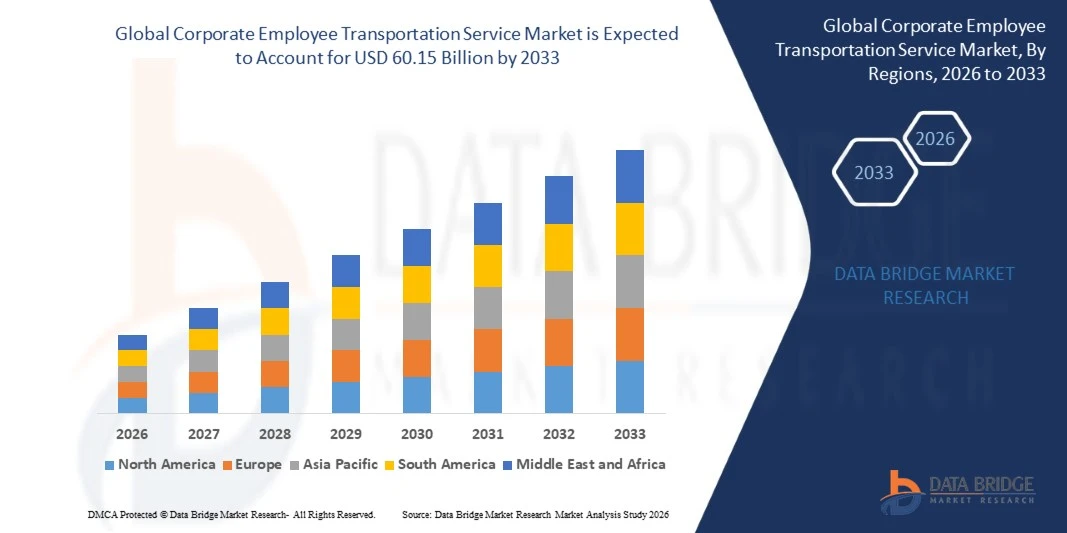
- As per Data Bridge Market Research analysis, the corporate employee transportation service market was valued at USD 40.10 billion in 2025 and is projected to reach USD 60.15 billion by 2033, growing at a CAGR of 5.20% from 2026 to 2033.
- The market is experiencing steady growth driven by rising return-to-office requirements, expanding workforces in IT, business services, and manufacturing hubs, and increasing focus on safe, reliable, and lower-emission commuting for employees.
- The increasing adoption of AI-based routing, electric fleets, and shared shuttle models, combined with growing integration of ride sharing platforms with enterprise HR and facilities systems, is supporting market adoption. Employers are applying shared mobility solutions across shift transport, campus shuttles, and airport and event transfers, while mobility as a service platforms are enabling companies to manage routing, billing, safety, and emissions reporting within a single dashboard.
Market Size & Forecast
- Global Market Value (2025): USD 40.10 Billion
- Expected Market Value (2033): USD 60.15 Billion
- Forecast CAGR (2026–2033): 5.20%
- Leading Region in 2025: Asia Pacific
- Fastest Growing Region: Middle East and Africa
What are the Major Takeaways of the Corporate Employee Transportation Service Market?
- Asia-Pacific dominated the corporate employee transportation service market with the largest revenue share of 38.94% in 2025, supported by large IT and business-services workforces, round-the-clock shift operations, and widely established employer-provided transport programs in India and other countries.
- Middle East and Africa is expected to be the fastest-growing region at a CAGR of 7.28% from 2026 to 2033, fueled by large industrial, construction, and giga-project workforces, rising corporate investment, and growing demand for organized staff transport.
- The cab services segment led the market with a 46.58% share in 2025, driven by shift-based, door-to-door transport for IT, BFSI, and business-services employees with strict safety requirements.
- Bus & shuttle services are the fastest-growing service type, projected to register a CAGR of 7.12%, reflecting demand for high-capacity, lower-cost shared transport across business parks, campuses, and industrial sites.
- The internal combustion engine segment dominated the propulsion category with a 57.64% revenue share in 2025, led by the large installed base of petrol and diesel vehicles in employee transport fleets.
- The fully managed service model accounted for 63.27% of the market share in 2025, preferred by employers seeking to outsource fleet, driver, routing, and compliance management.
- The software-only (SaaS) segment is the fastest-growing operating model category, with a CAGR of 8.54%, driven by employers digitizing rostering, routing, billing, and safety monitoring for existing vendor fleets.
Report Scope and Corporate Employee Transportation Service Market Segmentation
|
Attributes |
Corporate Employee Transportation Service Key Market Insights |
|
Segments Covered |
|
|
Countries Covered |
North America
Europe
Asia-Pacific
Middle East and Africa
South America
|
|
Key Market Players |
|
|
Market Opportunities |
|
|
Value Added Data Infosets |
In addition to the market insights such as market value, growth rate, market segments, geographical coverage, market players, and market scenario, the market report curated by the Data Bridge Market Research team includes in-depth expert analysis, import/export analysis, pricing analysis, production consumption analysis, and pestle analysis. |
What is the Key Trend in the Corporate Employee Transportation Service Market?
- Corporate employee transportation is evolving from manually rostered, vendor-managed cab services into software-driven mobility programs that use AI-based routing, real-time tracking, shift consolidation, and dynamic pooling to lower cost per employee while maintaining safety and punctuality.
- For instance, in May 2025, according to Entrepreneur India, Routematic raised USD 40 million in a Series C round led by Fullerton Carbon Action Fund and Shift4Good to expand its AI-driven corporate commute platform, build city command centers, and convert 30% of its fleet to electric vehicles, with the company serving more than 300 enterprises and handling about 5 million trips a month.
- Electrification of employee fleets is gaining momentum as employers pursue ESG goals and Scope 3 commute-emissions reporting, prompting operators to partner with electric vehicle manufacturers and charging providers and to offer EV-first transport contracts.
- Shared, high-capacity shuttle networks are also emerging in business parks and IT corridors, allowing multiple employers to pool demand, lower costs, and reduce traffic congestion compared with dedicated cab-based commuting.
- For instance, in January 2026, according to Outlook Business, citing Business Standard, Uber said it was expanding into employee transportation in India with dedicated fleets that create routes dynamically based on where employees live and who needs a ride on a given day, targeting IT, financial-services, and global capability center clients in cities including Bengaluru, Hyderabad, Pune, Chennai, and Gurugram.
- As AI-based optimization, electric vehicles, shared shuttle networks, and integrated safety and emissions reporting continue to advance, corporate employee transportation is expected to expand beyond cab rosters into full workforce mobility programs.
What are the Key Drivers of the Corporate Employee Transportation Service Market?
- Rising return-to-office requirements, expansion of 24-hour shift operations in IT, business-services, and manufacturing hubs, and employer responsibility for employee safety, particularly on night shifts, are increasing demand for organized employee transport.
- For instance, in June 2025, according to Uber for Business, the University of California, San Francisco (UCSF) launched a partnership offering employees an Uber Shuttle subscription of USD 160 per month for unlimited rides to its Mission Bay campus, and from June through October 2025 more than doubled shuttle capacity on its most popular routes.
- Employers are also using employee transport to support commute-cost relief, talent attraction, and attendance reliability, while outsourcing fleet management lowers administrative workload and improves compliance with safety and labor norms.
- For instance, in December 2025, according to Kastle Systems, weekly average office occupancy across the ten U.S. metropolitan areas it tracks peaked at 56.3%, indicating that more employees are commuting to workplaces, though still well below pre-pandemic levels, and that employers are paying closer attention to commute programs.
- With electric vehicle availability improving and ESG disclosure requirements expanding to commute emissions, organizations are expected to increasingly adopt managed, trackable, and lower-emission transport programs.
What Factors Are Challenging the Growth of the Corporate Employee Transportation Service Market?
- Employee transportation is a cost-intensive operation, with fuel, driver wages, vehicle maintenance, and idle time directly affecting margins, and contracts often carry fixed rates that make it difficult for operators to pass on cost increases quickly.
- For instance, in May 2026, according to The Quint, commercial vehicle drivers in Delhi-NCR began a three-day strike on 21 May 2026, called by more than 68 unions demanding fare revisions amid rising fuel prices linked to tensions in West Asia, disrupting taxi, auto-rickshaw, and app-based cab services.
- Driver availability, retention, and working conditions are persistent concerns, as operators must maintain night-shift coverage, safety compliance, and vehicle quality while managing driver earnings under tight contract rates.
- Regulatory requirements for women's safety, permits, emissions norms, and vehicle age limits vary across cities and countries, increasing compliance complexity for operators serving multiple locations.
- For instance, in June 2026, according to ANI, Mumbai CNG prices rose by Rs 2 per kg to Rs 86 while Delhi recorded its fourth consecutive CNG price increase of the month, with cab drivers saying fares had not changed, illustrating how fuel-price volatility can squeeze operator margins.
- Hybrid work patterns, variable attendance, and shifts in office occupancy make demand harder to forecast, which can reduce vehicle utilization and restrain adoption of fixed-route services among cost-sensitive employers.
How is the Corporate Employee Transportation Service Market Segmented?
The corporate employee transportation service market is segmented on the basis of service type, propulsion type, operating model, and end user.
- By Service Type
On the basis of service type, the corporate employee transportation service market is segmented into cab services, bus & shuttle services, vanpool & carpooling, and others. The cab services segment dominated the market with 46.58% share in 2025, supported by demand for shift-based, door-to-door transport for IT, BFSI, and business-services employees, particularly during late or early hours. Cab-based programs offer flexible routing, real-time tracking, and safety features such as SOS alerts and escort rules. Employers value predictable service levels and compliance support from established operators. Integration with rostering and HR systems further simplifies day-to-day administration.
The bus & shuttle services segment is projected to register the fastest growth at a CAGR of 7.12% from 2026 to 2033, driven by employer interest in high-capacity, lower-cost shared transport between residential clusters and business parks. Shared shuttles reduce cost per seat, vehicle count, and congestion compared with dedicated cabs. App-based seat booking, fixed routes, and live tracking are improving the rider experience. Multi-employer shuttle networks in IT corridors and campuses are creating new service models. Electrification of buses and vans is also helping employers meet emissions targets.
- By Propulsion Type
On the basis of propulsion type, the corporate employee transportation service market is segmented into internal combustion engine, CNG & hybrid, and electric. The internal combustion engine segment dominated the market with 57.64% share in 2025, supported by the large installed base of petrol and diesel vehicles in existing employee transport fleets and their wide availability across cities. Established vendors, fueling infrastructure, and lower upfront vehicle costs sustain adoption, particularly in contracts with tight rates. Operators are gradually shifting parts of their fleets to cleaner options as clients introduce emissions targets and city-level restrictions.
The electric segment is projected to register the fastest growth at a CAGR of 14.86% from 2026 to 2033, driven by corporate sustainability commitments, Scope 3 emissions reporting, and favorable total cost of ownership for predictable, fixed-route commutes. Operators are signing partnerships with electric vehicle makers and charging providers and offering EV-only contracts to enterprise clients. Predictable daily mileage and depot-based charging suit employee transport. Incentives and city-level clean-air policies are further supporting adoption, although charging availability and vehicle capital costs remain important considerations.
- By Operating Model
On the basis of operating model, the corporate employee transportation service market is segmented into fully managed service, software-only (SaaS), and in-house fleet. The fully managed service segment dominated the category with 63.27% share in 2025, supported by employers' preference to outsource fleet, driver, routing, and compliance management to specialized providers. Managed contracts offer predictable per-seat or per-trip pricing, 24-hour operations, and service-level commitments. Providers combine technology platforms with vehicle supply to optimize routes and utilization. Employers also benefit from consolidated billing and reduced administrative burden across multiple locations.
The software-only (SaaS) segment is projected to register the fastest growth at a CAGR of 8.54% from 2026 to 2033, driven by employers digitizing rostering, routing, billing, and safety monitoring while continuing to use existing transport vendors. SaaS platforms offer transparency over trips, costs, and compliance, and reduce billing discrepancies. Integration with HR, access control, and attendance systems supports hybrid work scheduling. Emissions dashboards and audit trails help companies report commute-related impacts. Lower upfront investment and quicker deployment make software-led models attractive for mid-sized organizations.
- By End User
On the basis of end user, the corporate employee transportation service market is segmented into IT & ITES, BFSI, manufacturing, healthcare, education, and others. The IT & ITES segment dominated the end-user category with 38.86% share in 2025, supported by large workforces, round-the-clock operations for global clients, and employer obligations to provide safe transport for night shifts. Technology and global capability centers typically operate structured transport programs with detailed service levels, tracking, and safety protocols. Growth in office hubs and the return of in-person work are sustaining demand. Preference for scalable vendors with strong technology platforms further supports market concentration.
The manufacturing segment is projected to register the fastest growth at a CAGR of 6.48% from 2026 to 2033, driven by expansion of industrial parks, multi-shift plant operations, and the need to transport workers from distant residential areas. Factories and industrial clusters rely on bus and van services to ensure punctual shift changes and reduce absenteeism. Safety and compliance requirements, together with efforts to improve worker retention, are encouraging employers to formalize transport programs. Government-led industrial development and electric vehicle manufacturing hubs are adding to demand across several regions.
Which Region Holds the Largest Share of the Corporate Employee Transportation Service Market?
- Asia-Pacific dominated the corporate employee transportation service market with the largest revenue share of 38.94% in 2025, supported by large IT and business-services workforces, round-the-clock shift operations, and widely established employer-provided transport programs in India and other countries.
- The region also benefits from rapid growth of global capability centers and industrial parks, expanding electric fleet partnerships, and the presence of strong local technology and fleet providers. Rising focus on women's safety, congestion reduction, and corporate sustainability continues to strengthen Asia-Pacific's position in the global market.
China Corporate Employee Transportation Service Market Insight
The China corporate employee transportation service market is growing rapidly, driven by the country's large IT, business-services, and global capability center workforce, round-the-clock shift operations, and employer obligations around safe commuting. Specialized domestic providers offer AI-based routing, tracking, and managed fleets, while global ride-hailing companies are entering with dedicated employee transport services. Electric fleet partnerships and shared shuttle services in IT corridors are expanding. In addition, rising fuel costs and the need for cost control are encouraging pooling, shift consolidation, and software-led optimization.
Japan Corporate Employee Transportation Service Market Insight
The Japan corporate employee transportation service market is witnessing steady growth, driven by the country's large manufacturing workforce, aging labor population, and strong concentration of employment around industrial facilities and business districts. Automotive, electronics, logistics, and industrial companies use employee shuttle buses and contracted transportation services to connect workers with factories, offices, and railway stations. Labor shortages and increasing emphasis on employee safety and commuting reliability are encouraging companies to optimize transportation operations. In addition, growing adoption of electric and low-emission vehicles, digital route management, and shared employee transportation solutions is supporting market development.
North America Corporate Employee Transportation Service Market Insight
The North America corporate employee transportation service market is expected to witness rapid growth, driven by large industrial, construction, energy, and giga-project workforces, rising corporate and government investment, and growing demand for organized, safe transport to remote and urban sites. Expanding business hubs, the presence of regional ride-hailing and mobility companies, and increasing formalization of staff transport standards are supporting demand. In addition, growing interest in electric buses and vans and in digital fleet management is accelerating adoption.
U.S. Corporate Employee Transportation Service Market Insight
The U.S. corporate employee transportation service market is witnessing consistent growth due to renewed in-person work, employer interest in commute benefits, and growth of shared shuttle models at campuses and healthcare and technology sites. Employers use pre-tax commuter benefits, subscription-based shuttles, and vanpool programs to improve attendance and reduce parking demand. Ride-hailing and transit-technology providers are expanding corporate shuttle offerings. In addition, emphasis on sustainability goals and employee experience is supporting adoption across professional and commercial applications.
U.K. Corporate Employee Transportation Service Market Insight
The U.K. corporate employee transportation service market is expanding steadily, supported by concentrated employment hubs, hybrid-work policies, and increasing employer focus on reliable commuting solutions. Financial services, technology, healthcare, manufacturing, and logistics companies use employee shuttles, contracted buses, and shared mobility services to connect workplaces with major transport hubs and residential areas. Rising congestion, parking constraints, and rail-service disruptions are encouraging organizations to adopt managed employee transportation programs. In addition, corporate sustainability targets and the transition toward electric buses and low-emission fleets are supporting demand for technology-enabled and environmentally focused transportation solutions.
Germany Corporate Employee Transportation Service Market Insight
The Germany corporate employee transportation service market is expanding steadily due to the country's strong industrial base, large manufacturing sites, and employer-supported mobility programs. Automotive, engineering, and chemical companies operate shuttle services between plants, stations, and residential areas. Growing focus on emissions reduction, electric buses, and job-ticket schemes is shaping demand. Moreover, data protection requirements and works-council involvement influence program design, supporting demand for compliant, transparent, and technology-enabled employee transportation solutions.
Which are the Top Companies in Corporate Employee Transportation Service Market?
The corporate employee transportation service industry is primarily led by well-established companies, including:
- MoveInSync Technology Solutions Pvt. Ltd. (India)
- Routematic (Nivaata Systems Pvt. Ltd.) (India)
- Uber Technologies, Inc. (U.S.)
- Transdev Group (France)
- ComfortDelGro Corporation Limited (Singapore)
- Lyft, Inc. (U.S.)
- Via Transportation, Inc. (U.S.)
- Enterprise Holdings, Inc. (U.S.)
- Keolis S.A. (France)
- FirstGroup plc (U.K.)
- Mobico Group PLC (U.K.)
- Arriva Group (Germany)
- Grab Holdings Limited (Singapore)
- DiDi Global Inc. (China)
- Bolt Technology OÜ (Estonia)
- ANI Technologies Pvt. Ltd. (Ola) (India)
- Lithium Urban Technologies Pvt. Ltd. (India)
- Refex Green Mobility Limited (India)
- Everest Fleet Pvt. Ltd. (India)
- Careem Technologies FZ-LLC (U.A.E.)
What are Latest Developments in Corporate Employee Transportation Service Market?
- In June 2026, Routematic signed a memorandum of understanding with Green SM, the VinFast-backed all-electric mobility platform, at Green SM's India launch in New Delhi on 5 June 2026, to deploy electric vehicles across Routematic's corporate transportation operations, which serve more than 400 enterprises in Bengaluru, Pune, Hyderabad, Chennai, and Delhi-NCR.
- In May 2026, Routematic launched COCO Rides, an app-based employee shuttle service in Pune's Hinjawadi IT hub in partnership with the Hinjawadi Industries Association, starting with more than 80 buses across over 70 routes and 500 boarding points and a daily capacity of up to 20,000 riders.
- In September 2025, Via Transportation listed its Class A shares on the New York Stock Exchange under the ticker VIA after an initial public offering of 10.7 million shares marketed at USD 40 to USD 44 per share, with a platform spanning microtransit, student transit, and corporate and campus shuttle solutions.
- In May 2025, MoveInSync acquired EFMFM, a move intended to strengthen the employee commute technology provider's global presence across its enterprise transport platform.
- In March 2025, Refex Green Mobility, operating as Refex eVeelz, agreed with a large ride-hailing platform to induct and operate 1,000 electric four-wheelers across Chennai, Hyderabad, Bengaluru, and Mumbai in FY26, in addition to organic growth of its fleet in the employee transportation segment.

- Interactive Data Analysis Dashboard
- Company Analysis Dashboard for high growth potential opportunities
- Research Analyst Access for customization & queries
- Competitor Analysis with Interactive dashboard
- Latest News, Updates & Trend analysis
- Harness the Power of Benchmark Analysis for Comprehensive Competitor Tracking
Data collection and base year analysis are done using data collection modules with large sample sizes. The stage includes obtaining market information or related data through various sources and strategies. It includes examining and planning all the data acquired from the past in advance. It likewise envelops the examination of information inconsistencies seen across different information sources. The market data is analysed and estimated using market statistical and coherent models. Also, market share analysis and key trend analysis are the major success factors in the market report. To know more, please request an analyst call or drop down your inquiry.
The key research methodology used by DBMR research team is data triangulation which involves data mining, analysis of the impact of data variables on the market and primary (industry expert) validation. Data models include Vendor Positioning Grid, Market Time Line Analysis, Market Overview and Guide, Company Positioning Grid, Patent Analysis, Pricing Analysis, Company Market Share Analysis, Standards of Measurement, Global versus Regional and Vendor Share Analysis. To know more about the research methodology, drop in an inquiry to speak to our industry experts.
Data Bridge Market Research is a leader in advanced formative research. We take pride in servicing our existing and new customers with data and analysis that match and suits their goal. The report can be customized to include price trend analysis of target brands understanding the market for additional countries (ask for the list of countries), clinical trial results data, literature review, refurbished market and product base analysis. Market analysis of target competitors can be analyzed from technology-based analysis to market portfolio strategies. We can add as many competitors that you require data about in the format and data style you are looking for. Our team of analysts can also provide you data in crude raw excel files pivot tables (Fact book) or can assist you in creating presentations from the data sets available in the report.













