


What is the Cosmetic Bottle Market Size and Growth Rate?
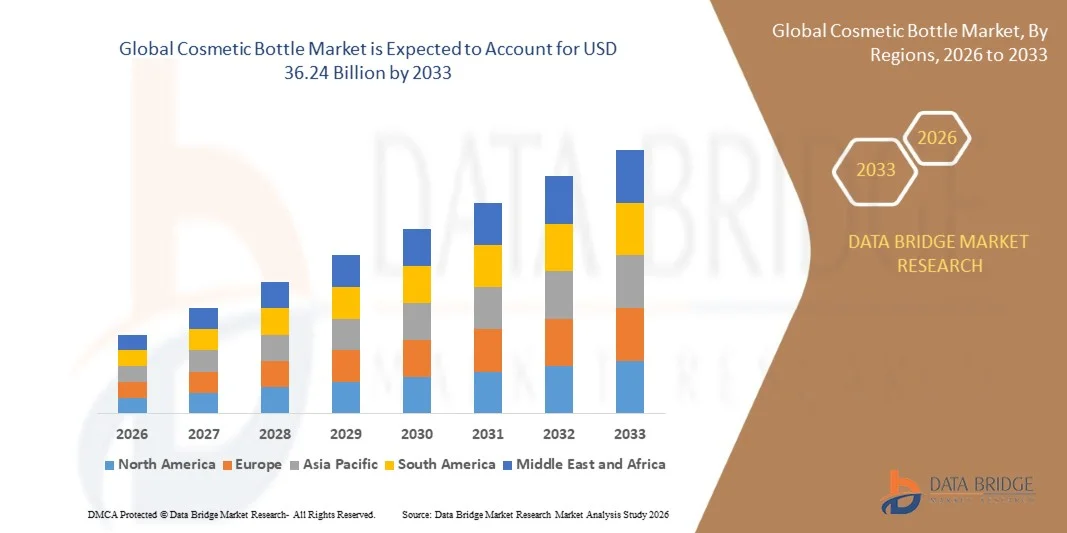
- As per Data Bridge Market Research analysis, the cosmetic bottle market was valued at USD 25.49 billion in 2025 and is projected to reach USD 36.24 billion by 2033, growing at a CAGR of % from 2026 to 2033.
- The market is experiencing consistent growth driven by rising demand for attractive and functional cosmetic packaging, rapid advancements in bottle materials and designs, and expanding applications across skincare, haircare, fragrances, and color cosmetics.
- The increasing consumer preference for premium, sustainable, and convenient cosmetic packaging, combined with growing demand for personal care and beauty products globally, is compelling cosmetic brands and manufacturers to adopt innovative bottle solutions. Plastic, glass, and recyclable bottles are increasingly being developed with lightweight designs, enhanced dispensing features, and sustainable materials to improve product protection, convenience, and brand appeal.
Market Size & Forecast
- Global Market Value (2025): USD 25.49 Billion
- Expected Market Value (2033): USD 36.24 Billion
- Forecast CAGR (2026–2033): 4.50%
- Leading Region in 2025: North America
- Fastest Growing Region: Asia Pacific
What are the Major Takeaways of the Cosmetic Bottle Market?
- North America dominated the cosmetic bottle market with the largest revenue share of 35.42% in 2025, supported by strong demand for premium beauty products, advanced packaging technologies, and established cosmetics brands.
- Asia-Pacific is expected to be the fastest-growing region at a CAGR of 5.4% from 2026 to 2033, fueled by rising disposable incomes, expanding beauty and personal care industries, and increasing demand for innovative cosmetic packaging in China, India, and Japan.
- The dropper bottles segment led the market with a 38.2% share in 2025, driven by their extensive use in serums, facial oils, essences, and concentrated skincare formulations.
- Spray bottles are the fastest-growing product type, projected to register a CAGR of 6.2%, reflecting the surge in demand for facial mists, body sprays, fragrances, hair products, and setting formulations.
- The round segment dominated the product shape category with a 43.8% revenue share in 2025, led by its ergonomic handling, structural stability, and broad compatibility with cosmetic packaging formats.
- Plastic accounted for 60.4% of the market share in 2025, preferred by its lightweight characteristics, durability, cost-effectiveness, and design flexibility.
- The hair care segment is the fastest-growing application category, with a CAGR of 5.9%, driven by rising demand for premium shampoos, conditioners, hair serums, scalp treatments, and styling products.
Report Scope and Cosmetic Bottle Market Segmentation
|
Attributes |
Cosmetic Bottle Key Market Insights |
|
Segments Covered |
|
|
Countries Covered |
North America
Europe
Asia-Pacific
Middle East and Africa
South America
|
|
Key Market Players |
|
|
Market Opportunities |
|
|
Value Added Data Infosets |
In addition to the insights on market scenarios such as market value, growth rate, segmentation, geographical coverage, and major players, the market reports curated by the Data Bridge Market Research also include import export analysis, production capacity overview, production consumption analysis, price trend analysis, climate change scenario, supply chain analysis, value chain analysis, raw material/consumables overview, vendor selection criteria, PESTLE Analysis, Porter Analysis, and regulatory framework. |
What is the Key Trend in the Cosmetic Bottle Market?
- Cosmetic brands are increasingly adopting refillable, recyclable, and lightweight bottle designs to reduce packaging waste while maintaining premium aesthetics, convenience, and product protection across skincare, haircare, and fragrance applications.
- For instance, in January 2025, Aptar Beauty launched its Nomad Refill 10-ml purse spray, a refillable fragrance bottle designed to be refilled directly from the main perfume bottle in less than five seconds, demonstrating the growing integration of convenient refill systems into beauty packaging.
- Refillable bottle systems allow consumers to retain durable outer containers while replacing only the inner product component, reducing material consumption and supporting circular packaging models.
- Premium skincare and fragrance brands are increasingly combining refillability with high-quality glass bottles, customized finishes, and durable designs to strengthen sustainability credentials without compromising luxury positioning.
- For instance, in January 2025, Wheaton introduced a new 200-ml lightweight glass bottle designed for fragrance refills, using approximately 20% less glass than a traditional bottle of the same capacity, highlighting the shift toward material-efficient and refillable cosmetic and fragrance bottles
- As cosmetic manufacturers and beauty brands continue to prioritize circularity, material efficiency, and consumer convenience, the adoption of innovative refillable and recyclable bottles is expected to accelerate, reinforcing sustainable packaging as a core component of cosmetic product development.
What are the Key Drivers of the Cosmetic Bottle Market?
- The rising consumer demand for premium, sustainable, and visually distinctive beauty products is increasing the need for innovative cosmetic bottles that enhance product presentation while supporting environmental and functional requirements.
- For instance, in June 2024, Packaging World reported that The Estée Lauder Companies had developed a closed-loop system in North America to reincorporate collected MAC black plastic into new makeup packaging, demonstrating how beauty companies are investing in circular packaging solutions to support sustainable product development.
- Cosmetic brands, packaging suppliers, and manufacturers are integrating recycled materials, lightweight structures, refill systems, and customized designs to differentiate products and strengthen brand identity across competitive beauty categories.
- For instance, in March 2025, CARBIOS announced that Biotherm would launch the world's first commercially produced fully biorecycled cosmetic bottle, with the new bottle expected to reduce its carbon footprint by 90% compared with virgin PET, highlighting increasing investment in advanced recycled materials for cosmetic packaging
- With sustainability, premiumization, and packaging differentiation increasingly influencing consumer purchasing decisions, demand for advanced cosmetic bottles will continue expanding across skincare, fragrance, haircare, and color cosmetics applications.
What Factors are Challenging the Growth of the Cosmetic Bottle Market?
- Sustainable and premium cosmetic bottles can require substantial investment because recyclable materials, refillable mechanisms, customized designs, and specialized manufacturing processes increase packaging development and production costs.
- For instance, in March 2025, Packaging Europe reported that cost was the most frequently identified concern among packaging professionals regarding meeting sustainable packaging obligations, highlighting the financial pressure associated with transitioning to more sustainable cosmetic bottle solutions.
- These higher costs can limit adoption among smaller beauty brands and manufacturers, particularly when sustainable packaging requires additional testing, tooling, material sourcing, and supply-chain adjustments.
- Complex cosmetic packaging designs can also create recycling and collection challenges, particularly for small bottles incorporating multiple materials, decorative components, pumps, and closures.
- For instance, in July 2024, Premium Beauty News reported that 95% of cosmetic packaging in the UK was thrown away, while only 14% reached recycling plants and just 9% was actually recycled, illustrating the recycling and collection challenges associated with beauty packaging.
- The higher cost of sustainable materials and the technical complexity of recycling diverse cosmetic bottle formats continue to challenge manufacturers, particularly smaller companies, slowing the transition toward fully circular packaging solutions despite increasing sustainability requirements.
How is the Cosmetic Bottle Market Segmented?
The cosmetic bottle market is segmented on the basis of product type, product shape, material, capacity, and application.
- By Product Type
On the basis of product type, the cosmetic bottle market is segmented into solid containers, dropper bottles, spray bottles, liquid bottles, and others. The dropper bottles segment dominated the market with an estimated share of 38.2% in 2025, driven by their extensive use in serums, facial oils, essences, and concentrated skincare formulations. These bottles provide precise and controlled dispensing, helping reduce product wastage while maintaining formulation hygiene. Their compatibility with premium and active-ingredient-based products makes them particularly attractive to skincare and dermocosmetic brands. Manufacturers are also developing recyclable glass and refillable dropper formats to respond to sustainability preferences.
The spray bottles segment is projected to register the fastest growth at an estimated CAGR of 6.2% during forecast period, driven by increasing demand for facial mists, body sprays, fragrances, hair products, and setting formulations. Spray packaging enables convenient, uniform, and touch-free product application, improving the overall consumer experience. Innovations in fine-mist and dispensing technologies are enhancing spray performance and reducing unnecessary product usage. Growing demand for portable and travel-friendly beauty products is also encouraging the use of compact spray bottles. Cosmetic brands are increasingly incorporating recyclable and refillable spray components to combine convenience with sustainability. Continued product innovation and broader use across beauty applications are expected to support strong segment expansion.
- By Product Shape
On the basis of product shape, the cosmetic bottle market is segmented into cylinder, jar, oval, round, square, and oblong. The round segment dominated the market with an estimated share of 43.8% in 2025, owing to its ergonomic handling, structural stability, and broad compatibility with cosmetic packaging formats. Round bottles are widely used across skincare, haircare, fragrance, and personal care products because they are easy to manufacture and handle. Their smooth profile also provides efficient labeling, decoration, and branding opportunities for manufacturers. The shape can be produced in plastic, glass, and other materials, allowing brands to target different price and positioning categories. Its versatility and established use across multiple cosmetic applications continue to reinforce its market leadership.
The oval segment is projected to register the fastest growth at an estimated CAGR of 6.0% during forecast period, supported by increasing demand for distinctive and visually attractive cosmetic packaging. Oval bottles offer a differentiated appearance that can help brands strengthen shelf presence and product recognition. Their ergonomic profile can also provide comfortable handling and an enhanced consumer experience. Premium skincare and haircare brands are increasingly exploring customized shapes to reinforce their individual brand identities. Improvements in printing, coating, and decorative technologies are further supporting the visual appeal of oval packaging. Rising demand for customized and premium cosmetic packaging is expected to drive continued adoption of oval-shaped bottles.
- By Material
On the basis of material, the cosmetic bottle market is segmented into plastic, metal, glass, paper, and others. The plastic segment dominated the market with an estimated share of 60.4% in 2025, supported by its lightweight characteristics, durability, cost-effectiveness, and design flexibility. Plastic bottles are extensively used for shampoos, lotions, cleansers, conditioners, and other mass-market cosmetic products. Their lighter weight facilitates handling, storage, and transportation across the supply chain. Manufacturers can also produce plastic bottles in a wide variety of shapes, sizes, colors, and dispensing configurations. Increasing use of recycled and bio-based plastic materials is further helping brands address sustainability requirements while retaining the functional advantages of plastic packaging.
The glass segment is projected to register the fastest growth at an estimated CAGR of 6.5% during forecast period, driven by increasing demand for premium, recyclable, and luxury cosmetic packaging. Glass provides strong chemical resistance and supports the protection of sensitive cosmetic and fragrance formulations. Premium beauty brands frequently use glass bottles to create a sophisticated appearance and strengthen perceived product quality. Growing consumer interest in recyclable and reusable packaging is also supporting the adoption of glass solutions. Manufacturers are investing in lightweight glass designs to improve material efficiency while preserving premium aesthetics. Expanding use of refillable packaging and increasing premiumization across beauty products are expected to further support segment growth.
- By Capacity
On the basis of capacity, the cosmetic bottle market is segmented into <50 ml, 50–100 ml, 100–150 ml, 150–200 ml, and >200 ml. The 50–100 ml segment dominated the market with an estimated share of 35.1% in 2025, supported by its broad application across serums, lotions, fragrances, foundations, and other beauty formulations. This size offers a practical balance between portability, convenience, and product quantity. It is widely used for premium products, travel-oriented ranges, gift sets, and promotional packaging. The format is also suitable for different dispensing mechanisms, including pumps, droppers, and sprays. Its versatility across multiple cosmetic categories continues to make it a widely preferred capacity segment.
The <50 ml segment is projected to register the fastest growth at an estimated CAGR of 6.3% during forecast period, driven by rising consumer demand for travel-size cosmetics, miniatures, samples, and concentrated beauty formulations. Small bottles offer portability and convenience, making them attractive for consumers with active and travel-oriented lifestyles. Beauty brands increasingly use miniature formats to support product trials and introduce consumers to premium formulations. Compact packaging is also suitable for subscription boxes, gift sets, and promotional campaigns. The continued expansion of e-commerce and direct-to-consumer beauty sales is strengthening demand for lightweight and convenient formats. Increasing consumer preference for portable beauty products is expected to sustain strong growth in this capacity segment.
- By Application
On the basis of application, the cosmetic bottle market is segmented into hair care, nail care, skin care, make-up, and other. The skin care segment dominated the market with an estimated share of 45.6% in 2025, driven by strong demand for serums, moisturizers, cleansers, toners, facial oils, and specialized skincare formulations. Skincare products require packaging that provides effective product protection, controlled dispensing, and convenient handling. Increasing consumer awareness of skin health is supporting the use of specialized beauty products and associated packaging formats. Cosmetic brands are increasingly introducing droppers, airless pumps, and refillable bottles for skincare applications. The continued expansion of premium, clean, and active-ingredient-based skincare products is reinforcing demand for cosmetic bottles in this application.
The hair care segment is projected to register the fastest growth at an estimated CAGR of 5.9% during forecast period, supported by rising demand for premium shampoos, conditioners, hair serums, scalp treatments, and styling products. Growing consumer focus on hair health is encouraging the development of specialized formulations that require differentiated packaging solutions. Professional and salon-oriented haircare products are also creating demand for durable and convenient bottles. Manufacturers are increasingly incorporating recyclable materials and refillable designs into haircare packaging to address sustainability preferences. Product innovation targeting different hair types and specific scalp and styling needs is further expanding packaging requirements. Increasing premiumization within the haircare category is expected to support continued growth of this application segment.
Which Region Holds the Largest Share of the Cosmetic Bottle Market?
- North America dominated the cosmetic bottle market with the largest revenue share of 35.42% in 2025, supported by strong demand for premium beauty products, advanced packaging technologies, and established cosmetics brands.
- The region also benefits from increasing adoption of recyclable and refillable packaging, strong demand for premium skincare and fragrance products, high e-commerce penetration, and continuous innovation in lightweight and functional bottle designs. The presence of major beauty brands and increasing sustainability requirements further support North America's leading position in the global cosmetic bottle market.
U.S. Cosmetic Bottle Market Insight
The U.S. cosmetic bottle market is witnessing strong growth due to rising demand for premium beauty packaging, sustainable bottle solutions, and innovative designs across skincare, fragrance, and haircare applications. The country’s mature beauty and personal care ecosystem, along with increasing adoption of recyclable, refillable, and lightweight packaging systems, is driving demand across premium and mass-market brands. In addition, growing consumer interest in product aesthetics, convenience, and environmentally responsible packaging is accelerating cosmetic bottle adoption among established manufacturers and emerging beauty companies.
Asia-Pacific Cosmetic Bottle Market Insight
The Asia-Pacific cosmetic bottle market is expected to witness rapid growth, driven by expanding beauty and personal care consumption, rising disposable incomes, and increasing investments in modern packaging infrastructure across countries such as China, India, and Japan. Growing awareness regarding sustainable packaging, rising adoption of premium beauty products, and increasing demand for convenient and visually distinctive bottle designs are supporting regional market expansion. In addition, the growing presence of domestic beauty brands and e-commerce channels is accelerating cosmetic bottle demand across developed and emerging markets.
Japan Cosmetic Bottle Market Insight
The Japan cosmetic bottle market is witnessing consistent growth due to rising demand for premium skincare, innovative packaging, and environmentally responsible beauty products. Cosmetic manufacturers and beauty brands are increasingly adopting lightweight, refillable, recyclable, and aesthetically refined bottles for skincare and fragrance applications. Moreover, increasing consumer preference for functional packaging, product convenience, and sustainable materials, along with Japan’s strong focus on quality and design, is further contributing to market growth.
China Cosmetic Bottle Market Insight
The China cosmetic bottle market is growing rapidly, driven by expanding beauty consumption, increasing demand for premium skincare products, and rising adoption of innovative packaging solutions. Growing use of recyclable, refillable, lightweight, and customized bottles across domestic and international beauty brands is significantly boosting market demand. In addition, rapid e-commerce expansion, rising consumer interest in product presentation, and continued development of local cosmetics brands are positioning China as a major growth market for cosmetic bottles.
U.K. Cosmetic Bottle Market Insight
The U.K. cosmetic bottle market is experiencing steady growth, supported by rising adoption of sustainable packaging technologies across skincare, fragrance, haircare, and make-up applications. Increasing investments in refillable, recyclable, and lightweight bottle solutions and growing demand for premium beauty products are contributing to market growth. Furthermore, stronger consumer awareness of packaging sustainability, expanding online beauty retail, and continued innovation in materials and dispensing formats are supporting the U.K. cosmetic bottle market.
Germany Cosmetic Bottle Market Insight
The Germany cosmetic bottle market is expanding steadily due to the country’s strong beauty and personal care industry, advanced manufacturing capabilities, and increasing adoption of sustainable packaging technologies. Cosmetic companies and packaging manufacturers are increasingly utilizing recycled plastics, recyclable glass, refillable formats, and lightweight bottles for skincare, fragrance, and make-up products. Continuous advancements in packaging design, material efficiency, and circularity, along with strong sustainability focus, are further driving market growth in Germany.
Which are the Top Companies in Cosmetic Bottle Market?
The cosmetic bottle industry is primarily led by well-established companies, including:
- Aptar.com (U.S.)
- Gerresheimer AG (Germany)
- Albéa (France)
- Quadpack Industries, S.A. (Spain)
- Virospack S.L. (Spain)
- Baralan International S.p.a. (Italy)
- LUMSON S.p.A (Italy)
- VERESCENCE FRANCE (France)
- Frapak (Netherlands)
- SGD Pharma (France)
- Bormioli Luigi S.p.A. (Italy)
- Estal Packaging (Spain)
- Coverpla (France)
- HEINZ-GLAS GmbH & Co. KGaA (Germany)
- HCP Packaging (China)
- WWP Beauty (China)
- POCHET (France)
- Amcor plc (Switzerland)
- TricorBraun (U.S.)
- LIBO (Taiwan)
What are Latest Developments in Cosmetic Bottle Market?
- In July 2025, Virospack, a specialist in cosmetic packaging, launched its Translucent Harmony range of colored and translucent glass droppers for skincare applications. The packaging combines a color-painted glass bottle with a monomaterial polypropylene dropper cap, with both components designed to be 100% recyclable, while the elimination of heavy opacifiers and metallic elements supports easier recycling.
- In June 2024, Qualiform, in partnership with Plastipak, launched rCarbon cosmetic bottles, the first PET-based cosmetic bottles made with 30% monomers derived from recycled carbon emissions. The development was introduced as part of Qualiform’s decarbonization strategy and provides cosmetic brands with an alternative material approach aimed at reducing the environmental footprint of packaging.
- In April 2023, Baralan introduced its Lilibet series of glass bottles for skincare and make-up products, featuring a distinctive design that combines a circular shape with a square profile. The seven-bottle range was offered in multiple capacities and could be paired with pumps and droppers, providing brands with adaptable packaging options for skincare, nail polish, make-up, and fragrances.
- In August 2022, Mktg Industry launched Vogue, a standard 30-ml glass bottle designed specifically for color-cosmetic emulsions such as liquid foundation. The bottle incorporated a slim profile, high-thick bottom, secure closure system, and one-finger pump actuator, with the company planning additional glass bottle formats with pumps and droppers.
- In February 2021, Baralan launched the Minerva Jar 50 Amber, a 50-ml amber glass container developed for skincare and adaptable to make-up applications. Its amber glass was designed to filter UV rays and help protect light-sensitive formulations from discoloration and other effects associated with light exposure, combining formulation protection with a premium appearance

- Interactive Data Analysis Dashboard
- Company Analysis Dashboard for high growth potential opportunities
- Research Analyst Access for customization & queries
- Competitor Analysis with Interactive dashboard
- Latest News, Updates & Trend analysis
- Harness the Power of Benchmark Analysis for Comprehensive Competitor Tracking
Global Cosmetic Bottle Market, Supply Chain Analysis and Ecosystem Framework
To support market growth and help clients navigate the impact of geopolitical shifts, DBMR has integrated in-depth supply chain analysis into its Global Cosmetic Bottle Market research reports. This addition empowers clients to respond effectively to global changes affecting their industries. The supply chain analysis section includes detailed insights such as Global Cosmetic Bottle Market consumption and production by country, price trend analysis, the impact of tariffs and geopolitical developments, and import and export trends by country and HSN code. It also highlights major suppliers with data on production capacity and company profiles, as well as key importers and exporters. In addition to research, DBMR offers specialized supply chain consulting services backed by over a decade of experience, providing solutions like supplier discovery, supplier risk assessment, price trend analysis, impact evaluation of inflation and trade route changes, and comprehensive market trend analysis.
Data collection and base year analysis are done using data collection modules with large sample sizes. The stage includes obtaining market information or related data through various sources and strategies. It includes examining and planning all the data acquired from the past in advance. It likewise envelops the examination of information inconsistencies seen across different information sources. The market data is analysed and estimated using market statistical and coherent models. Also, market share analysis and key trend analysis are the major success factors in the market report. To know more, please request an analyst call or drop down your inquiry.
The key research methodology used by DBMR research team is data triangulation which involves data mining, analysis of the impact of data variables on the market and primary (industry expert) validation. Data models include Vendor Positioning Grid, Market Time Line Analysis, Market Overview and Guide, Company Positioning Grid, Patent Analysis, Pricing Analysis, Company Market Share Analysis, Standards of Measurement, Global versus Regional and Vendor Share Analysis. To know more about the research methodology, drop in an inquiry to speak to our industry experts.
Data Bridge Market Research is a leader in advanced formative research. We take pride in servicing our existing and new customers with data and analysis that match and suits their goal. The report can be customized to include price trend analysis of target brands understanding the market for additional countries (ask for the list of countries), clinical trial results data, literature review, refurbished market and product base analysis. Market analysis of target competitors can be analyzed from technology-based analysis to market portfolio strategies. We can add as many competitors that you require data about in the format and data style you are looking for. Our team of analysts can also provide you data in crude raw excel files pivot tables (Fact book) or can assist you in creating presentations from the data sets available in the report.













