


What is the Cosmetic Preservative Market Size and Growth Rate?
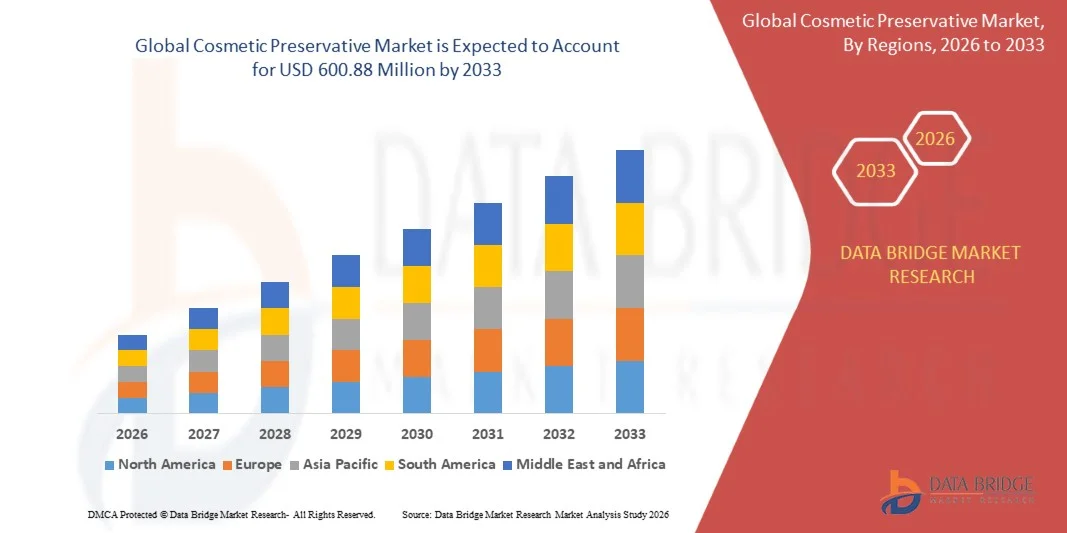
- As per Data Bridge Market Research analysis, the cosmetic preservative market was valued at USD 391.53 million in 2025 and is projected to reach USD 600.88 million by 2033, growing at a CAGR of 5.50% from 2026 to 2033.
- The market is experiencing steady growth driven by the rapid expansion of the global personal care and skincare industry, rising e-commerce penetration that extends product transit and storage time, and increasing formulation innovation aimed at improving product safety and shelf stability.
- Growing consumer inclination toward clean-label, paraben-free, and dermatologically safe cosmetics, combined with stringent regulatory oversight on ingredient safety, is compelling manufacturers to invest in advanced, multifunctional, and naturally derived preservation systems across skin care, hair care, and color cosmetics formulations.
Market Size & Forecast
- Global Market Value (2025): USD 391.53 Million
- Expected Market Value (2033): USD 600.88 Million
- Forecast CAGR (2026–2033): 5.50%
- Leading Region in 2025: North America
- Fastest Growing Region: Asia-Pacific
What are the Major Takeaways of the Cosmetic Preservative Market?
- North America dominated the global cosmetic preservative market with the largest revenue share of 35.20% in 2025, supported by high beauty and personal care spending, rising disposable incomes, and strong demand for dermatologically tested, safety-compliant formulations.
- Asia-Pacific is expected to be the fastest-growing region at a CAGR of 6.90% from 2026 to 2033, fueled by rapid urbanization, rising disposable incomes, and growing western beauty and grooming influences across China, India, and Japan.
- The phenol derivatives segment led the market with a 28.60% share in 2025, driven by the widespread use of phenoxyethanol for its broad-spectrum antimicrobial efficacy and stability across varying pH ranges.
- Organic acids are the fastest-growing product type, projected to register a CAGR of 6.80%, reflecting rising demand for milder, skin-compatible preservation systems.
- The synthetic preservatives segment dominated the type category with a 54.20% revenue share in 2025, owing to superior efficacy, cost-effectiveness, and long-established regulatory acceptance across mass-market formulations.
- Natural preservatives are the fastest-growing type segment, expected to post a CAGR of 7.50%, propelled by the clean beauty movement and reformulation away from parabens and formaldehyde releasers.
- The skin and sun care segment accounted for 34.60% of the market share in 2025, led by rising global demand for lotions, serums, creams, and sunscreens that require robust microbial protection.
- Water-based formulations held the largest share of 46.30% in 2025, given their high susceptibility to microbial contamination and consequent reliance on effective preservation systems.
Report Scope and Cosmetic Preservative Market Segmentation
|
Attributes |
Cosmetic Preservative Key Market Insights |
|
Segments Covered |
|
|
Countries Covered |
North America
Europe
Asia-Pacific
Middle East and Africa
South America
|
|
Key Market Players |
|
|
Market Opportunities |
|
|
Value Added Data Infosets |
In addition to the insights on market scenarios such as market value, growth rate, segmentation, geographical coverage, and major players, the market reports curated by the Data Bridge Market Research also include in-depth expert analysis, geographically represented company-wise production and capacity, network layouts of distributors and partners, detailed and updated price trend analysis and deficit analysis of supply chain and demand. |
What is the Key Trend in the Cosmetic Preservative Market?
- Cosmetic brands and ingredient manufacturers are increasingly reformulating products around natural, plant-derived, and multifunctional preservation systems to align with the clean beauty movement and rising consumer scrutiny of synthetic ingredients.
- For instance, in April 2025, Clariant completed its acquisition of Lucas Meyer Cosmetics, a move designed to strengthen its high-value, sustainability-driven cosmetic ingredients portfolio and expand its natural preservation and active-ingredient offerings.
- Bio-preservation using botanical antimicrobial agents such as rosemary extract, green tea, and grapefruit seed is gaining traction, offering broad-spectrum protection while supporting organic and paraben-free product claims.
- Encapsulation technologies that enable controlled, extended release of preservative actives are improving product shelf life while allowing formulators to reduce overall preservative load.
- For instance, in April 2025, Ashland introduced new platform technologies aimed at improving formulation sustainability and efficiency, reflecting the industry's shift toward responsible, next-generation preservation solutions.
- As clean-label demand and encapsulation-based delivery systems continue to mature, cosmetic preservative innovation is expected to increasingly center on ingredients that combine antimicrobial efficacy with skin-compatible, sustainable profiles.
What are the Key Drivers of the Cosmetic Preservative Market?
- The rapid expansion of global e-commerce has reshaped cosmetic product distribution, with longer transit and storage periods increasing the risk of microbial degradation and driving demand for durable, high-performance preservation systems.
- For instance, growing online-first beauty retail channels are prompting formulators to prioritize preservatives that maintain product stability and safety across extended shelf and delivery timelines, particularly for water-based creams, serums, and lotions.
- The continued growth of the global skincare, haircare, and color cosmetics industries is significantly increasing the volume of preservative-dependent formulations entering the market.
- For instance, in April 2025, Clariant's acquisition of Lucas Meyer Cosmetics was aimed at expanding its footprint in high-growth, eco-conscious personal care ingredient categories, underscoring how expanding personal care demand is reshaping preservative innovation and supply strategies.
- With personal care manufacturers increasingly relying on effective, regulation-compliant preservation to support product safety and extended distribution, cosmetic preservatives will remain a critical enabler of industry growth.
Which Factors are Challenging the Growth of the Cosmetic Preservative Market?
- Rising consumer demand for natural and organic personal care products is pushing brands toward preservative-free or plant-based alternatives, many of which offer shorter shelf life and lower antimicrobial efficacy than conventional synthetic preservatives.
- This shift creates a formulation trade-off between meeting clean-label expectations and maintaining robust protection against microbial contamination, complicating product development for manufacturers.
- Evolving safety concerns around the long-term health and environmental effects of certain synthetic preservatives, such as parabens, are prompting reformulation pressure even where proven natural substitutes remain limited.
- For instance, in March 2022, Sharon Laboratories finalized its acquisition of RES Pharma Industriale in Italy to strengthen its personal care ingredient capabilities, reflecting the scale of investment required to develop safer, next-generation preservation alternatives that satisfy both regulators and consumers.
- The difficulty of identifying effective, broadly accepted natural alternatives that meet regulatory standards while matching synthetic preservative performance continues to restrain the pace of market-wide reformulation.
How is the Cosmetic Preservative Market Segmented?
The cosmetic preservative market is segmented on the basis of product, type, application, and formulation type.
- By Product
On the basis of product, the global cosmetic preservative market is segmented into paraben esters, formaldehyde donors, phenol derivatives, alcohols, quaternary compound, and organic acids. The phenol derivatives segment dominated the market with a 28.60% share in 2025, owing to the widespread use of phenoxyethanol for its broad-spectrum antimicrobial efficacy, low irritation potential, and stability across a wide pH range in water-based formulations.
The organic acids segment is projected to register the fastest growth at a CAGR of 6.80% from 2026 to 2033, driven by rising demand for milder, skin-compatible preservation systems that align with sensitive-skin and clean-label formulation trends.
- By Type
On the basis of type, the global cosmetic preservative market is segmented into natural preservatives, synthetic preservatives, organic preservatives, and antimicrobial preservatives. The synthetic preservatives segment led the market with a 54.20% share in 2025, supported by superior antimicrobial efficacy, cost-effectiveness, and long-standing regulatory acceptance across mass-market skincare, haircare, and color cosmetics formulations.
The natural preservatives segment is expected to witness the fastest growth at a CAGR of 7.50% from 2026 to 2033, propelled by the clean beauty movement, reformulation away from parabens and formaldehyde releasers, and rising consumer preference for plant-derived antimicrobial ingredients.
- By Application
On the basis of application, the global cosmetic preservative market is segmented into skin and sun care, hair care, toiletries, fragrances and perfumes, and makeup and color. The skin and sun care segment dominated the market with a 34.60% share in 2025, driven by rising global demand for lotions, serums, creams, and sunscreens that require robust protection against microbial contamination during extended storage and use.
The hair care segment is anticipated to witness the fastest CAGR of 6.40% from 2026 to 2033, fueled by increasing demand for multifunctional shampoos, conditioners, and styling products that require stable, long-lasting preservation systems.
- By Formulation Type
On the basis of formulation type, the global cosmetic preservative market is segmented into water-based formulations, oil-based formulations, and emulsion formulations. The water-based formulations segment dominated the market with a 46.30% share in 2025, given the high susceptibility of water-containing products such as creams, shampoos, and lotions to microbial growth and the resulting reliance on effective preservation systems.
The emulsion formulations segment is expected to register the fastest CAGR of 6.90% from 2026 to 2033, driven by the growing popularity of cream- and lotion-based skincare and color cosmetics products that require dual-phase, stable preservation solutions.
Which Region Holds the Largest Share of the Cosmetic Preservative Market?
- North America dominated the cosmetic preservative market and accounted for the largest revenue share of 35.20% in 2025, supported by high beauty and personal care spending, rising disposable incomes, and strong demand for dermatologically tested, safety-compliant cosmetic formulations.
- The region also benefits from a well-established regulatory framework, high prevalence of targeted skincare products addressing concerns such as premature aging and acne, and strong presence of leading ingredient manufacturers investing in advanced preservation technologies. Continued focus on clean-label reformulation and premium personal care products is expected to sustain North America's leadership position.
U.S. Cosmetic Preservative Market Insight
The U.S. cosmetic preservative market is experiencing steady growth, supported by strong consumer spending on skincare and color cosmetics, rising demand for dermatologically safe formulations, and increasing adoption of multifunctional and natural preservation systems. Growing regulatory scrutiny of ingredient safety and expanding e-commerce beauty retail are further reinforcing demand for stable, long-lasting preservative solutions across the country.
Canada Cosmetic Preservative Market Insight
The Canada cosmetic preservative market is expanding steadily, driven by rising consumer awareness of clean-label and paraben-free personal care products, growing investment in domestic cosmetics manufacturing, and increasing demand for premium skincare and haircare formulations. Strengthening regulatory oversight of cosmetic ingredient safety continues to support the adoption of advanced, compliant preservation systems.
Asia-Pacific Cosmetic Preservative Market Insight
The Asia-Pacific cosmetic preservative market is expected to witness rapid growth, driven by increasing urbanization, rising disposable incomes, and growing western beauty and grooming influences across countries such as China, India, and Japan. Expanding domestic cosmetics manufacturing, rising e-commerce beauty sales, and growing consumer awareness of product safety are further supporting regional market expansion.
China Cosmetic Preservative Market Insight
The China cosmetic preservative market is growing rapidly, supported by the country's large and expanding cosmetics manufacturing base, rising middle-class disposable incomes, and increasing regulatory focus on ingredient safety and labeling transparency. Growing adoption of natural and multifunctional preservation systems across domestic and international cosmetic brands is further strengthening market growth in the country.
India Cosmetic Preservative Market Insight
The India cosmetic preservative market is witnessing consistent growth, driven by rising personal care spending, expanding domestic cosmetics production, and increasing consumer preference for affordable, safe, and long-lasting beauty products. Growing awareness of clean-label formulations and strengthening cosmetic regulatory standards are further contributing to rising demand for advanced preservation solutions in the country.
Which are the Top Companies in the Cosmetic Preservative Market?
The cosmetic preservative industry is primarily led by well-established companies, including:
- DOW (U.S.)
- Penta Manufactures (U.S.)
- Clariant AG (Switzerland)
- Struchem Co., Ltd. (South Korea)
- AE Chemie, Inc (U.S.)
- The Procter & Gamble Company (U.S.)
- BASF SE (Germany)
- Ashland (U.S.)
- Lonza (Switzerland)
- Akema S.r.l (Italy)
- Symrise AG (Germany)
- THOR INC (U.S.)
- Dadia Chemical Industries (India)
- Gujarat Organic Limited (India)
- Evonik Industries AG (Germany)
- ISCA UK Ltd (U.K.)
- Salicylates and Chemicals Pvt. Ltd. (India)
- Chemipol (Spain)
- Sharon Laboratories Ltd. (Israel)
- Brenntag AG (Germany)
What are the Latest Developments in the Cosmetic Preservative Market?
- In April 2025, Clariant completed its acquisition of Lucas Meyer Cosmetics for approximately USD 810 million, strengthening its high-value cosmetic ingredients portfolio and expanding its footprint in eco-friendly, sustainability-driven personal care ingredients.
- In April 2025, Ashland introduced new platform technologies focused on improving formulation sustainability and efficiency, supporting reduced waste and enhanced energy efficiency while meeting evolving customer needs across the personal care sector.
- In March 2022, Sharon Laboratories finalized its acquisition of RES Pharma Industriale, a specialized chemical manufacturer in Italy, integrating advanced technology, R&D, and production capabilities into its personal care ingredients division.
- In August 2021, Clariant completed the acquisition of the remaining stake in Beraca, a Brazilian personal care ingredients specialist, strengthening its natural ingredients portfolio and expanding its presence in South America's growing cosmetics sector.
- In December 2021, Clariant acquired BASF's U.S. attapulgite business, expanding its sustainable ingredient capabilities in North America and reinforcing its position as a major supplier of natural clay-based materials used across personal care applications.

- Interactive Data Analysis Dashboard
- Company Analysis Dashboard for high growth potential opportunities
- Research Analyst Access for customization & queries
- Competitor Analysis with Interactive dashboard
- Latest News, Updates & Trend analysis
- Harness the Power of Benchmark Analysis for Comprehensive Competitor Tracking
Global Cosmetic Preservatives Market, Supply Chain Analysis and Ecosystem Framework
To support market growth and help clients navigate the impact of geopolitical shifts, DBMR has integrated in-depth supply chain analysis into its Global Cosmetic Preservatives Market research reports. This addition empowers clients to respond effectively to global changes affecting their industries. The supply chain analysis section includes detailed insights such as Global Cosmetic Preservatives Market consumption and production by country, price trend analysis, the impact of tariffs and geopolitical developments, and import and export trends by country and HSN code. It also highlights major suppliers with data on production capacity and company profiles, as well as key importers and exporters. In addition to research, DBMR offers specialized supply chain consulting services backed by over a decade of experience, providing solutions like supplier discovery, supplier risk assessment, price trend analysis, impact evaluation of inflation and trade route changes, and comprehensive market trend analysis.
Data collection and base year analysis are done using data collection modules with large sample sizes. The stage includes obtaining market information or related data through various sources and strategies. It includes examining and planning all the data acquired from the past in advance. It likewise envelops the examination of information inconsistencies seen across different information sources. The market data is analysed and estimated using market statistical and coherent models. Also, market share analysis and key trend analysis are the major success factors in the market report. To know more, please request an analyst call or drop down your inquiry.
The key research methodology used by DBMR research team is data triangulation which involves data mining, analysis of the impact of data variables on the market and primary (industry expert) validation. Data models include Vendor Positioning Grid, Market Time Line Analysis, Market Overview and Guide, Company Positioning Grid, Patent Analysis, Pricing Analysis, Company Market Share Analysis, Standards of Measurement, Global versus Regional and Vendor Share Analysis. To know more about the research methodology, drop in an inquiry to speak to our industry experts.
Data Bridge Market Research is a leader in advanced formative research. We take pride in servicing our existing and new customers with data and analysis that match and suits their goal. The report can be customized to include price trend analysis of target brands understanding the market for additional countries (ask for the list of countries), clinical trial results data, literature review, refurbished market and product base analysis. Market analysis of target competitors can be analyzed from technology-based analysis to market portfolio strategies. We can add as many competitors that you require data about in the format and data style you are looking for. Our team of analysts can also provide you data in crude raw excel files pivot tables (Fact book) or can assist you in creating presentations from the data sets available in the report.













