


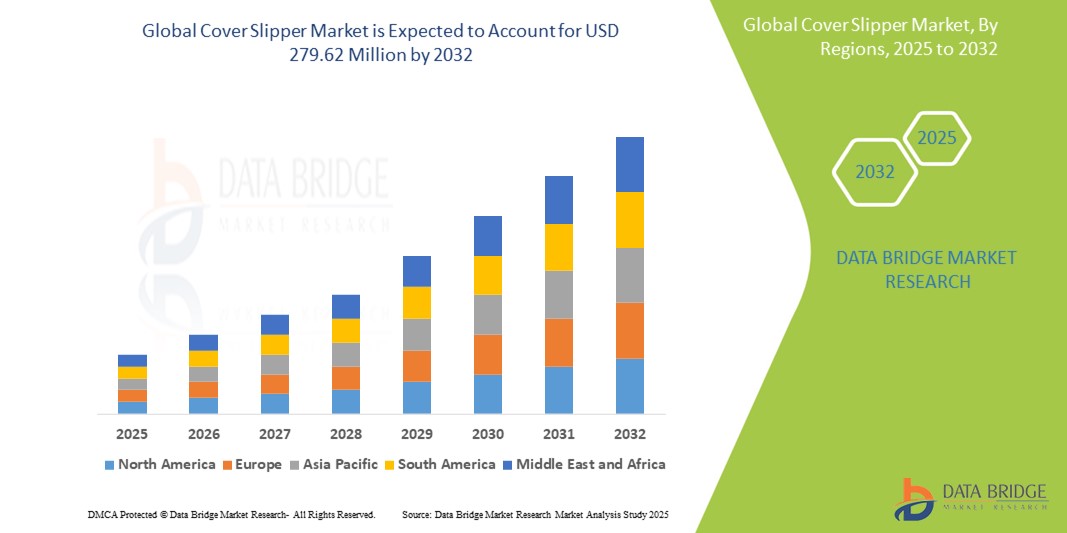
Cover Slipper Market Size
- The global cover slipper market size was valued at USD 218.52 million in 2024 and is expected to reach USD 279.62 million by 2032, at a CAGR of 3.13% during the forecast period
- The market growth is largely fueled by the increasing demand for automated histology lab solutions, driven by the rising global burden of cancer and chronic diseases requiring pathology-based diagnostics, thereby prompting wider adoption of cover slippers in clinical and research laboratories
- Furthermore, rising emphasis on laboratory workflow efficiency, minimized human error, and the need for high-throughput processing is establishing automated cover slippers as a crucial component in modern pathology labs
Cover Slipper Market Analysis
- Cover slippers, automated instruments used to place glass coverslips over microscope slides in histopathology and cytology labs, are increasingly vital in modern pathology workflows due to their ability to improve precision, reduce manual labor, and ensure consistent slide quality in high-throughput environments
- The escalating demand for cover slippers is primarily fueled by the growing global incidence of cancer and chronic diseases, the increasing volume of diagnostic testing, and the widespread adoption of laboratory automation to meet the need for rapid and accurate diagnostic results
- North America dominated the cover slipper market with the largest revenue share of 39.1% in 2024, characterized by a strong presence of leading diagnostic laboratories, advanced healthcare infrastructure, and substantial investment in lab automation technologies, particularly in the U.S., where centralized pathology services and research institutions drive high equipment adoption
- Asia-Pacific is expected to be the fastest growing region in the cover slipper market during the forecast period due to increasing healthcare investments, expanding laboratory infrastructure, and growing awareness of early disease detection in countries such as China and India
- The glass cover slipper segment dominated the cover slipper market with a market share of 46.8% in 2024, driven by its superior optical clarity, compatibility with imaging systems, and widespread usage in both clinical diagnostics and academic research
Report Scope and Cover Slipper Market Segmentation
|
Attributes |
Cover Slipper Key Market Insights |
|
Segments Covered |
|
|
Countries Covered |
North America
Europe
Asia-Pacific
Middle East and Africa
South America
|
|
Key Market Players |
|
|
Market Opportunities |
|
|
Value Added Data Infosets |
In addition to the insights on market scenarios such as market value, growth rate, segmentation, geographical coverage, and major players, the market reports curated by the Data Bridge Market Research also include in-depth expert analysis, pricing analysis, brand share analysis, consumer survey, demography analysis, supply chain analysis, value chain analysis, raw material/consumables overview, vendor selection criteria, PESTLE Analysis, Porter Analysis, and regulatory framework. |
Cover Slipper Market Trends
“Automation and Integration in Digital Pathology Workflows”
- A significant and accelerating trend in the global cover slipper market is the increasing automation and seamless integration of cover slippers into broader digital pathology and histology workflows. Laboratories are transitioning from manual processes to fully automated systems that improve accuracy, reduce errors, and increase throughput, making cover slippers a key component of next-generation diagnostic laboratories
- For instance, Leica Biosystems offers the HistoCore SPECTRA CV, which integrates with automated stainers and imaging systems, streamlining the workflow from staining to slide imaging. Similarly, Sakura Finetek’s Tissue-Tek Film Coverslipper is optimized for integration with their staining platforms, enabling continuous, walk-away operation with minimal technician intervention
- Automation in cover slippers is enhancing productivity in high-volume laboratories by reducing turnaround time and operator fatigue while improving slide consistency. In addition, integration with laboratory information systems (LIS) and tracking technologies allows labs to ensure sample traceability and quality assurance throughout the diagnostic process
- As digital pathology becomes more widespread, the demand for cover slippers capable of producing slides suitable for high-resolution digital imaging is growing. This includes features such as bubble-free coverslipping, consistent glass alignment, and compatibility with image analysis software
- Furthermore, manufacturers are increasingly offering modular systems that can be scaled or customized according to lab size, throughput needs, or specific diagnostic applications, making cover slippers more adaptable to various healthcare and research settings
- The trend toward automation, integration, and digital compatibility in cover slipper systems is fundamentally reshaping laboratory expectations and standards for slide preparation. As a result, companies such as Thermo Fisher Scientific and Epredia are focusing on innovative cover slipper technologies designed to meet evolving clinical demands and to support the global shift toward digital pathology
Cover Slipper Market Dynamics
Driver
“Increased Demand Driven by Rising Chronic Disease Burden and Diagnostic Testing”
- The rising global incidence of cancer, cardiovascular conditions, and other chronic diseases has significantly increased the volume of histological and cytological examinations performed, driving demand for high-efficiency laboratory tools such as automated cover slippers
- For instance, according to the WHO, cancer is one of the leading causes of death worldwide, with more than 20 million new cases expected by 2030. This growing burden fuels the need for timely and accurate pathological diagnostics, where high-throughput automated cover slippers are essential for efficient slide preparation
- Moreover, the demand for improved laboratory workflow efficiency and reduced turnaround times is leading healthcare providers to adopt fully automated systems that reduce human error and standardize results. Cover slippers that support rapid, bubble-free application of coverslips contribute significantly to slide readability and imaging quality
- Technological advancements such as adaptive slide handling, automated error detection, and integration with staining and imaging systems are making cover slippers indispensable tools in modern histopathology labs. Leading vendors such as Leica Biosystems and Sakura Finetek are leveraging these innovations to expand their market share
- In addition, increasing investments in healthcare infrastructure, particularly in emerging economies, and the global trend toward digitization in diagnostics are further contributing to market expansion by encouraging the adoption of sophisticated laboratory equipment
Restraint/Challenge
“High Cost of Automation and Operational Complexity in Resource-Limited Settings”
- Despite their advantages, the high initial cost of automated cover slipper systems, along with the need for skilled technicians to operate and maintain them, presents a significant barrier to adoption, especially in low- and middle-income countries
- For instance, premium cover slippers integrated into full lab automation setups can require considerable capital investment, making them less accessible to smaller clinics or pathology labs with limited budgets
- In addition, operational complexity—including the need for proper calibration, regular maintenance, and compatibility with specific types of glass and mounting media—can deter laboratories from adopting automated solutions, particularly when manual alternatives are perceived as more manageable
- Regulatory compliance and adherence to strict quality control standards in clinical diagnostics further add to operational challenges, as any errors in coverslipping could compromise slide quality, affecting diagnostic outcomes and regulatory audits
- Addressing these challenges through cost-effective, compact, and user-friendly cover slipper designs, as well as training programs and technical support for lab personnel, will be crucial for increasing adoption rates, especially in developing healthcare systems
Cover Slipper Market Scope
The market is segmented on the basis of product, coverage capacity, and end user.
- By Product
On the basis of product, the global cover slipper market is segmented into glass cover slipper and film cover slipper. The glass cover slipper segment dominated the market with the largest market revenue share of 46.8% in 2024, owing to its superior optical clarity, high durability, and widespread compatibility with histological slide imaging systems. These features make glass cover slippers a preferred choice in both clinical diagnostics and academic research settings where precision and image clarity are essential. Their compatibility with traditional staining methods and higher temperature tolerance further contribute to their dominance.
The film cover slipper segment is projected to witness the fastest growth rate from 2025 to 2032, driven by its ease of automation, reduced breakage risks, and faster processing speeds. Film cover slippers are increasingly adopted in high-throughput laboratories aiming to minimize manual handling and improve operational efficiency. Their suitability for automated systems and consistent application make them attractive for modern, high-capacity diagnostic labs and centralized pathology centers.
- By Coverage Capacity
On the basis of coverage capacity, the global cover slipper market is segmented into 400 Slides/H, 600 Slides/H, and Others. The 400 Slides/H segment held the largest share in 2024 due to its suitability for small to mid-sized labs that require moderate throughput. These systems balance cost, performance, and footprint, making them ideal for hospitals and laboratories with average daily slide processing volumes.
The 600 Slides/H segment is expected to exhibit the highest CAGR from 2025 to 2032, as large diagnostic centers and high-volume research institutions increasingly demand faster, uninterrupted slide processing capabilities. These high-capacity models significantly reduce slide preparation time and are instrumental in boosting lab efficiency, especially when integrated with automated staining and imaging solutions.
- By End User
On the basis of end user, the cover slipper market is segmented into small sized hospitals, medium-sized hospitals, large sized hospitals, mega sized hospitals, and research institutes. The large sized hospital segment dominated the market in 2024 due to their robust infrastructure, higher diagnostic workloads, and greater budgetary allocation for advanced pathology equipment. These institutions benefit from automation to streamline workflows and reduce turnaround time for slide preparation and analysis
The research institute segment is expected to witness the fastest growth from 2025 to 2032, propelled by increasing research activity in cancer diagnostics, histopathology, and personalized medicine. Cover slippers with high precision and digital integration capabilities are in demand to support reproducibility and high-resolution imaging in research applications.
Cover Slipper Market Regional Analysis
- North America dominated the cover slipper market with the largest revenue share of 39.1% in 2024, characterized by a strong presence of leading diagnostic laboratories, advanced healthcare infrastructure, and substantial investment in lab automation technologies, particularly in the U.S., where centralized pathology services and research institutions drive high equipment adoption
- Laboratories and hospitals in the region prioritize operational efficiency, diagnostic accuracy, and slide consistency, which are effectively addressed by automated cover slipper systems integrated into broader histopathology workflows
- This widespread adoption is further supported by robust healthcare infrastructure, favorable reimbursement policies, and a strong presence of leading manufacturers, establishing cover slippers as a standard tool in both clinical diagnostics and academic research environments
U.S. Cover Slipper Market Insight
The U.S. cover slipper market captured the largest revenue share of 79% in 2024 within North America, fueled by a robust healthcare infrastructure and the increasing demand for automated laboratory systems. High diagnostic volumes, particularly in cancer screening and pathology labs, are driving adoption. The integration of cover slippers with automated staining and imaging workflows enhances lab efficiency, while government and private investment in healthcare digitization further propels the market.
Europe Cover Slipper Market Insight
The Europe cover slipper market is projected to expand at a substantial CAGR throughout the forecast period, primarily driven by increasing demand for standardized slide preparation and growing investments in laboratory automation. Rising chronic disease prevalence and an aging population are contributing to increased diagnostic needs. The push toward digital pathology across public and private labs, along with stringent regulatory frameworks requiring consistent sample quality, is fostering adoption of automated cover slippers in the region.
U.K. Cover Slipper Market Insight
The U.K. cover slipper market is anticipated to grow at a noteworthy CAGR during the forecast period, supported by strong government focus on modernizing healthcare services and the growing role of precision diagnostics. Pathology labs are adopting automated cover slippers to reduce manual errors and improve efficiency. The shift toward digital pathology and the integration of AI in diagnostics are also encouraging investments in advanced lab automation tools.
Germany Cover Slipper Market Insight
The Germany cover slipper market is expected to expand at a considerable CAGR during the forecast period, propelled by increasing emphasis on diagnostic accuracy, sustainability, and high-tech healthcare solutions. Germany’s well-established pathology infrastructure and commitment to innovation are driving demand for automated systems that improve throughput and consistency. Furthermore, integration with laboratory information systems and imaging solutions supports the growth of high-end cover slippers in research and clinical labs.
Asia-Pacific Cover Slipper Market Insight
The Asia-Pacific cover slipper market is poised to grow at the fastest CAGR during the forecast period of 2025 to 2032, driven by expanding healthcare infrastructure, rising disease burden, and growing awareness of early diagnosis in countries such as China, India, and Japan. Government initiatives for healthcare modernization and the growing number of pathology labs are boosting demand. As regional manufacturers expand their footprint and affordability improves, adoption of automated cover slippers is increasing across both urban and semi-urban diagnostic centers.
Japan Cover Slipper Market Insight
The Japan cover slipper market is gaining momentum due to its advanced healthcare system, rapid adoption of laboratory automation, and a strong culture of precision diagnostics. Growing interest in digital pathology, especially in academic and research institutions, is supporting the adoption of high-quality cover slippers. In addition, Japan’s focus on reducing laboratory turnaround time and improving reproducibility is boosting demand for automated systems.
India Cover Slipper Market Insight
The India cover slipper market accounted for the largest market revenue share in Asia Pacific in 2024, attributed to the country’s increasing healthcare investments, urbanization, and growing network of diagnostic labs. With the government pushing for digital healthcare and smart diagnostics, demand for automated pathology equipment, including cover slippers, is rising. The presence of cost-effective domestic manufacturers and the growing prevalence of cancer and infectious diseases are further driving market growth.
Cover Slipper Market Share
The cover slipper industry is primarily led by well-established companies, including:
- Leica Biosystems Nussloch GmbH (Germany)
- Sakura Finetek USA, Inc. (U.S.)
- Epredia (U.S.)
- Thermo Fisher Scientific Inc. (U.S.)
- Agilent Technologies, Inc. (U.S.)
- Milestone Srl (Italy)
- General Data Company, Inc. (U.S.)
- F. Hoffmann-La Roche Ltd (Switzerland)
- Histoline Laboratories Srl (Italy)
- Medite GmbH (Germany)
- Histo-Line Laboratories (Italy)
- AMOS Scientific Pty Ltd. (Australia)
- Avantor, Inc. (U.S.)
- Diapath S.p.A. (Italy)
- Lupetec Tecnologia Aplicada (Brazil)
- Jinhua Yidi Medical Appliance Co., Ltd. (China)
- SLEE medical GmbH (Germany)
- Auxilab (Spain)
- HistoLab Products AB (Sweden)
What are the Recent Developments in Global Cover Slipper Market?
- In March 2023, Leica Biosystems launched the HistoCore SPECTRA Workstation Update, an enhanced version of its fully automated staining and coverslipping system. This integrated platform allows synchronized slide processing with improved throughput and consistency, designed to meet the increasing demands of high-volume histopathology laboratories. The upgrade reflects Leica's focus on delivering reliable, efficient, and scalable automation solutions that support digital pathology workflows
- In February 2023, Sakura Finetek USA, Inc. introduced advancements in its Tissue-Tek Film Coverslipper, emphasizing bubble-free performance and compatibility with advanced staining systems. The enhancements cater to labs transitioning toward full automation by improving turnaround time and slide quality, reinforcing the company’s position as a leader in tissue preparation technologies
- In January 2023, Epredia, a subsidiary of PHC Group, announced the expansion of its pathology lab automation portfolio with new high-throughput cover slipper models. These models are optimized for integration with imaging systems, enabling seamless workflows in digital pathology. The move aligns with Epredia's broader strategy to support precision diagnostics through automation and innovation
- In December 2022, Thermo Fisher Scientific Inc. reported collaborations with hospital networks across Asia-Pacific to deploy fully automated slide preparation systems, including advanced cover slippers, aimed at improving cancer diagnostic capabilities. This initiative highlights the increasing regional demand for automated histology solutions in response to rising pathology workloads and growing disease prevalence
- In November 2022, General Data Healthcare unveiled its next-generation SlideMate AS cover slipper system, focusing on reducing maintenance and operational costs while delivering improved slide quality. Targeting small to mid-sized labs, the system is part of the company’s effort to democratize access to automation in histopathology, supporting enhanced diagnostic outcomes through consistent and efficient slide preparation

- Interactive Data Analysis Dashboard
- Company Analysis Dashboard for high growth potential opportunities
- Research Analyst Access for customization & queries
- Competitor Analysis with Interactive dashboard
- Latest News, Updates & Trend analysis
- Harness the Power of Benchmark Analysis for Comprehensive Competitor Tracking
Data collection and base year analysis are done using data collection modules with large sample sizes. The stage includes obtaining market information or related data through various sources and strategies. It includes examining and planning all the data acquired from the past in advance. It likewise envelops the examination of information inconsistencies seen across different information sources. The market data is analysed and estimated using market statistical and coherent models. Also, market share analysis and key trend analysis are the major success factors in the market report. To know more, please request an analyst call or drop down your inquiry.
The key research methodology used by DBMR research team is data triangulation which involves data mining, analysis of the impact of data variables on the market and primary (industry expert) validation. Data models include Vendor Positioning Grid, Market Time Line Analysis, Market Overview and Guide, Company Positioning Grid, Patent Analysis, Pricing Analysis, Company Market Share Analysis, Standards of Measurement, Global versus Regional and Vendor Share Analysis. To know more about the research methodology, drop in an inquiry to speak to our industry experts.
Data Bridge Market Research is a leader in advanced formative research. We take pride in servicing our existing and new customers with data and analysis that match and suits their goal. The report can be customized to include price trend analysis of target brands understanding the market for additional countries (ask for the list of countries), clinical trial results data, literature review, refurbished market and product base analysis. Market analysis of target competitors can be analyzed from technology-based analysis to market portfolio strategies. We can add as many competitors that you require data about in the format and data style you are looking for. Our team of analysts can also provide you data in crude raw excel files pivot tables (Fact book) or can assist you in creating presentations from the data sets available in the report.













