


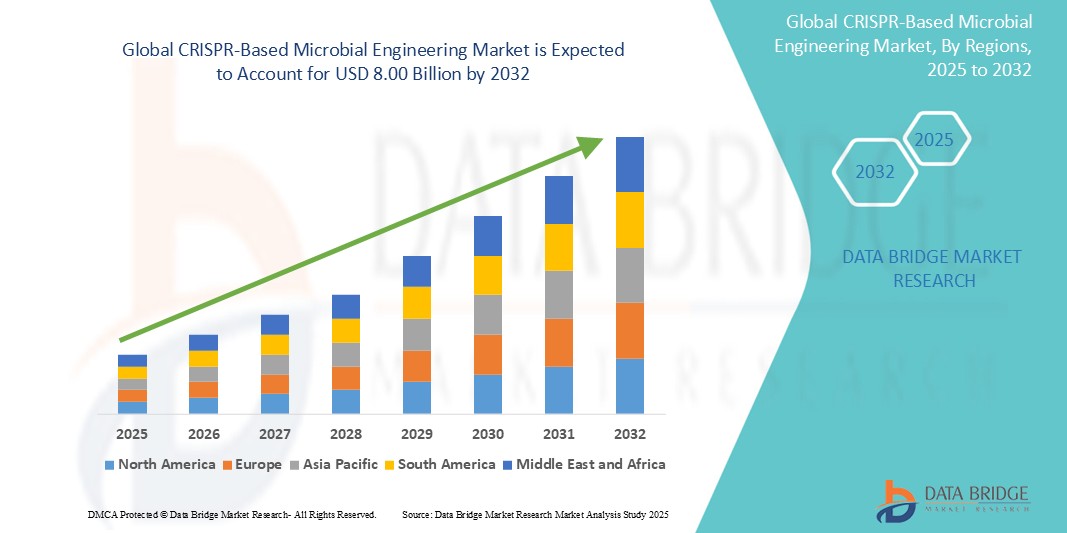
CRISPR-Based Microbial Engineering Market Size
- The global CRISPR-based microbial engineering market size was valued at USD 1.08 billion in 2024 and is expected to reach USD 8.00 billion by 2032, at a CAGR of 28.30% during the forecast period
- The market growth is largely fueled by the increasing prevalence of genetic disorders, significant advancements in gene editing technologies, and the growing application of CRISPR in diverse fields such as drug discovery, industrial biotechnology, and agriculture
- Furthermore, rising public and private investments in genomics research, coupled with the expanding need for precise and efficient genome editing tools, are establishing CRISPR-based microbial engineering as a transformative technology across various sectors, thereby significantly boosting the industry's growth
CRISPR-Based Microbial Engineering Market Analysis
- CRISPR-based microbial engineering, leveraging precise gene editing tools such as CRISPR/Cas systems, is a critical technology revolutionizing fields such as industrial biotechnology, agriculture, and therapeutics due to its unparalleled accuracy, efficiency, and cost-effectiveness in modifying microbial genomes
- The escalating demand for CRISPR-based microbial engineering is primarily fueled by the increasing prevalence of genetic disorders, rising investments in genomics and biotechnology research, and the growing need for enhanced productivity and novel products in biomanufacturing and agriculture
- North America dominates the CRISPR-based microbial engineering market with the largest revenue share of 42.5% in 2024, characterized by robust R&D infrastructure, significant government and private funding for life sciences, and the strong presence of key biotechnology and pharmaceutical companies, with the U.S. being a major hub for CRISPR innovations and clinical trials
- Asia-Pacific is expected to be the fastest growing region in the CRISPR-Based microbial engineering market during the forecast period with a CAGR of 21.3% due to increasing government support for biotechnology, rapid expansion of the biopharmaceutical sector, and rising adoption of advanced gene editing technologies in countries
- Therapeutic applications dominates the CRISPR-Based microbial engineering market with a market share of 64.55% in 2024, driven by its immense potential of CRISPR to develop gene therapies for various diseases, engineer microbial vectors for drug delivery, and combat antibiotic resistance
Report Scope and CRISPR-Based Microbial Engineering Market Segmentation
|
Attributes |
CRISPR-Based Microbial Engineering Key Market Insights |
|
Segments Covered |
|
|
Countries Covered |
North America
Europe
Asia-Pacific
Middle East and Africa
South America
|
|
Key Market Players |
|
|
Market Opportunities |
|
|
Value Added Data Infosets |
In addition to the insights on market scenarios such as market value, growth rate, segmentation, geographical coverage, and major players, the market reports curated by the Data Bridge Market Research also include in-depth expert analysis, pricing analysis, brand share analysis, consumer survey, demography analysis, supply chain analysis, value chain analysis, raw material/consumables overview, vendor selection criteria, PESTLE Analysis, Porter Analysis, and regulatory framework. |
CRISPR-Based Microbial Engineering Market Trends
“Accelerated Precision and Throughput through AI and Automation Integration”
- A significant and accelerating trend in the global CRISPR-based microbial engineering market is the deepening integration with artificial intelligence (AI) and advanced automation platforms. This fusion of technologies is significantly enhancing the precision, efficiency, and scalability of microbial genome editing and strain engineering
- For instance, AI algorithms are increasingly being used to design optimal guide RNAs (gRNAs) that maximize on-target editing and minimize off-target effects, a critical factor for therapeutic and industrial applications. Similarly, automated high-throughput screening platforms and robotic systems are enabling researchers to perform thousands of genetic edits simultaneously, dramatically reducing time and cost
- AI integration in microbial engineering enables features such as predicting metabolic network interactions, optimizing bioprocesses, and accelerating drug discovery by designing and engineering microbes to produce desired proteins and substances. For example, some platforms leverage AI to analyze vast genomic datasets for novel CRISPR-associated proteins, enabling faster discovery of smaller, more efficient Cas variants suitable for diverse applications
- The seamless integration of CRISPR with AI and automation facilitates the rapid development and optimization of microbial strains for various purposes. Through unified platforms, researchers can manage their gene editing experiments alongside automated culturing, phenotyping, and data analysis, creating a unified and accelerated engineering workflow
- The demand for CRISPR-based microbial engineering solutions that offer seamless AI and automation integration is growing rapidly across biotechnology, pharmaceutical, and industrial sectors, as stakeholders increasingly prioritize speed, efficiency, and robust results in developing novel biological systems and products
CRISPR-Based Microbial Engineering Market Dynamics
Driver
“Increasing Demand Driven by Advancements in Gene Editing and Biomanufacturing”
- The increasing demand for highly precise and efficient gene editing tools, coupled with rapid advancements in biomanufacturing and pharmaceutical development, is a significant driver for the heightened demand for CRISPR-based microbial engineering
- For instance, in December 2023, Vertex Pharmaceuticals and CRISPR Therapeutics received FDA approval for Casgevy, the first CRISPR-based gene therapy for sickle cell disease, demonstrating the clinical validation and immense potential of CRISPR technology, which is expected to cascade into microbial engineering applications. Such milestones by key companies are expected to drive the CRISPR-based microbial engineering industry growth in the forecast period
- As researchers and industries seek to engineer microbes for novel applications, CRISPR offers advanced features such as multiplex gene editing, precise knock-ins and knock-outs, and targeted gene regulation, providing a compelling upgrade over traditional genetic engineering methods
- Furthermore, the growing global focus on sustainable production, personalized medicine, and the development of new therapeutics is making CRISPR-based microbial engineering an integral component of these initiatives, offering seamless integration into various research and industrial workflows
- The versatility of CRISPR in optimizing microbial cell factories for producing everything from advanced biofuels and enzymes to complex biopharmaceuticals and diagnostic tools are key factors propelling the adoption of CRISPR-based microbial engineering in both academic and industrial sectors. The trend towards high-throughput screening and the increasing accessibility of user-friendly CRISPR platforms further contribute to market growth
Restraint/Challenge
“Off-Target Effects, High Development Costs, and Ethical/Regulatory Complexities”
- Concerns surrounding the potential for off-target effects in CRISPR-based gene editing, coupled with the high initial costs of research and development, pose significant challenges to broader market adoption and therapeutic translation. While CRISPR offers precision, unintended edits at non-target genomic sites remain a concern, raising anxieties among researchers and regulators about safety and unforeseen consequences in engineered microbes and their downstream applications
- For instance, high-profile reports of off-target mutations or the challenge of consistently achieving desired on-target edits in complex microbial systems can make some industries hesitant to fully invest in large-scale CRISPR-based solutions. This necessitates rigorous validation and optimization, adding to development timelines and expenses
- Addressing these challenges through continuous innovation in CRISPR tool design (e.g., modified Cas variants, enhanced gRNA specificity), improved delivery methods, and sophisticated screening techniques is crucial for building trust and accelerating adoption. Companies are heavily investing in R&D to refine CRISPR systems that minimize off-target activity and enhance specificity. In addition, the relatively high initial cost associated with developing, validating, and scaling up CRISPR-engineered microbial strains can be a barrier for smaller companies or academic labs, particularly for complex industrial applications or early-stage therapeutic development
- Furthermore, the evolving and often complex ethical and regulatory landscape surrounding genetic modification, particularly concerning environmental release of engineered microbes or gene-edited food products, can slow down market entry and require substantial investment in compliance. Intellectual property disputes over foundational CRISPR technologies also add a layer of complexity and potential cost for companies seeking to commercialize
- Overcoming these challenges through continuous scientific refinement, transparent regulatory frameworks, increased funding, and strategic collaborations will be vital for sustained market growth and the widespread realization of CRISPR's potential in microbial engineering
CRISPR-Based Microbial Engineering Market Scope
The market is segmented on the basis of product type, services, technology, application, and end user
- By Product Type
On the basis of product type, the CRISPR-based microbial engineering market is segmented into vector-based Cas and DNA-free Cas. The Vector-based Cas segment currently holds a significant market share, driven by its established efficiency in delivering CRISPR components into microbial cells and its suitability for stable genomic integration in industrial and research applications. Researchers prioritize vector-based systems for their robust and often more permanent gene editing capabilities, essential for developing stable microbial strains. The market also sees strong demand for vector-based types due to their extensive validation in existing research and compatibility with various microbial hosts.
The DNA-free Cas segment is anticipated to witness the fastest growth rate, fueled by increasing demand for reduced off-target effects, lower immunogenicity, and transient gene editing. DNA-free methods, such as direct delivery of Cas ribonucleoproteins (RNPs), offer faster results and greater control over the editing process, making them suitable for sensitive applications and where rapid prototyping of microbial strains is required. The perceived safety and precision of DNA-free approaches also contribute to their growing popularity.
- By Services
On the basis of services, the CRISPR-based microbial engineering market is segmented into DNA synthesis, cell line engineering, gRNA design, and microbial gene editing. The Microbial Gene Editing segment held the largest market revenue share, driven by the direct demand for skilled expertise and advanced tools to perform precise genetic modifications in microbial systems. As the complexity of engineering projects increases, companies and researchers often outsource this core service
The gRNA Design segment is expected to witness the fastest CAGR, driven by the critical need for highly specific and efficient guide RNA sequences to ensure successful and accurate CRISPR editing. As new CRISPR systems emerge and applications become more diverse, the demand for specialized design services to optimize gRNA performance and minimize off-target activity is accelerating
- By Technology
On the basis of technology, the CRISPR-based microbial engineering market is segmented into CRISPR/Cas9, CRISPR/Cas12, and Other CRISPR Technologies. The CRISPR/Cas9 held the largest market revenue share (e.g., around 55% in 2024 for the broader CRISPR market), driven by its widespread adoption, extensive research validation, and established protocols across academic and industrial settings. Its versatility and efficiency make it the go-to choice for a broad range of microbial engineering tasks
The CRISPR/Cas12 segment is expected to witness the fastest CAGR, driven by its unique advantages such as different PAM specificities, which expand targeting options, and its potential for more precise or alternative cleavage patterns. As researchers explore new applications and seek greater flexibility, Cas12 offers valuable complementary capabilities
- By Application
On the basis of application, the CRISPR-based microbial engineering market is segmented into genome engineering, disease models, functional genomics, knockout/activation, therapeutic applications, agriculture and livestock, and others. The Therapeutic Applications segment accounted for the largest market revenue share of 64.55% in 2024 for the broader gene editing market), driven by the immense potential of CRISPR-engineered microbes in developing novel therapies, combating infectious diseases, and creating live biotherapeutic products. Significant investments and clinical advancements in this area are fueling its dominance
The agriculture and livestock segment is expected to witness the fastest CAGR of 14.8%, driven by the growing global demand for sustainable food production, improved crop resilience, and enhanced animal health. CRISPR-based microbial engineering offers solutions for optimizing plant-microbe interactions, developing biocontrol agents, and improving feed efficiency, providing significant economic and environmental benefits
- By End User
On the basis of end-user, the CRISPR-based microbial engineering market is segmented into Biotechnology & Pharmaceutical Companies, Academic & Government Research Institutes, Contract Research Organizations, and Others. The Biotechnology & Pharmaceutical Companies segment accounted for the largest market revenue share driven by their extensive R&D activities, substantial funding, and commercialization efforts in drug discovery, biomanufacturing, and advanced therapeutics utilizing microbial platforms
The Contract Research Organizations (CROs) segment is expected to witness the fastest CAGR, driven by the increasing demand from biotech and pharma companies to outsource specialized CRISPR-based microbial engineering services. CROs offer expertise, high-throughput capabilities, and cost-effectiveness, enabling faster development and reducing the need for in-house infrastructure
CRISPR-Based Microbial Engineering Market Regional Analysis
- North America dominates the CRISPR-based microbial engineering market with the largest revenue share of 42.5% in 2024, driven by robust R&D infrastructure, significant government and private funding for life sciences, and the strong presence of key biotechnology and pharmaceutical companies
- Consumers and industries in the region highly value the precision, efficiency, and broad applicability offered by CRISPR systems in areas such as disease modeling, biomanufacturing, and agriculture
- This widespread adoption is further supported by high R&D investments, a technologically advanced scientific community, and the growing preference for personalized medicine and sustainable industrial processes, establishing CRISPR-based microbial engineering as a favored solution for both research and commercial ventures
U.S. CRISPR-Based Microbial Engineering Market Insight
The U.S. CRISPR-based microbial engineering market is a powerhouse, accounting for a significant share within North America fueled by substantial R&D investments, a robust biopharmaceutical industry, and a thriving academic research ecosystem. The nation's leadership in genetic research and the increasing number of clinical trials involving CRISPR-based therapies are key drivers. The growing preference for advanced gene editing tools in both therapeutic development and industrial biotechnology, combined with strong venture capital funding for biotech startups, further propels the market. Moreover, the increasing integration of CRISPR technology into personalized medicine initiatives and the development of novel delivery systems are significantly contributing to the market's expansion.
Europe CRISPR-Based Microbial Engineering Market Insight
The European CRISPR-based microbial engineering market is projected to expand at a substantial CAGR primarily driven by rising demand for advanced medical and industrial biotechnological products, stringent regulations fostering innovation, and increasing investments in healthcare and life sciences research. The increase in focus on sustainable bioproduction and the demand for novel therapeutics are fostering the adoption of CRISPR-based microbial engineering. European researchers and industries are also drawn to the precision and versatility these technologies offer in developing new biopharmaceuticals and optimizing industrial processes.
U.K. CRISPR-Based Microbial Engineering Market Insight
The U.K. CRISPR-based microbial engineering market is anticipated to grow at a noteworthy CAGR, driven by a strong emphasis on genomic research, a burgeoning biotech sector, and significant government funding for life sciences. In addition, concerns regarding genetic diseases and the desire for innovative therapeutic solutions are encouraging both academic institutions and biopharmaceutical companies to choose CRISPR-based microbial engineering tools. The UK's embrace of advanced biotechnologies, alongside its robust scientific infrastructure and access to global collaborations, is expected to continue to stimulate market growth, particularly in areas such as gene therapy and antimicrobial development
Germany CRISPR-Based Microbial Engineering Market Insight
German CRISPR-based microbial engineering market is expected to expand at a considerable CAGR, fueled by increasing investments in genomic research, a strong pharmaceutical industry, and a focus on precision medicine and advanced therapies. Germany's well-developed research infrastructure, combined with its emphasis on innovation and high-quality scientific output, promotes the adoption of CRISPR-based microbial engineering, particularly in areas such as cancer treatment and regenerative medicine. The integration of CRISPR with cutting-edge analytical tools and a strong preference for rigorous validation and safety standards, aligning with local scientific expectations, is also becoming increasingly prevalent
Asia-Pacific CRISPR-Based Microbial Engineering Market Insight
Asia-Pacific CRISPR-based microbial engineering market is poised to grow at the fastest CAGR of 21.3%, driven by increasing government support for biotechnology, rising healthcare expenditures, and rapid advancements in countries such as China, Japan, and India. The region's growing inclination towards indigenous drug discovery and biomanufacturing, supported by strategic national initiatives promoting life sciences, is driving the adoption of CRISPR-based microbial engineering. Furthermore, as APAC emerges as a global hub for contract research and manufacturing organizations (CROs) providing gene editing services, the accessibility and affordability of CRISPR technologies are expanding to a wider research and industrial base
Japan CRISPR-Based Microbial Engineering Market Insight
The Japan CRISPR-based microbial engineering market is gaining momentum due to the country's high-tech scientific culture, strong focus on medical research, and demand for advanced therapeutic solutions. The Japanese market places a significant emphasis on precision medicine and regenerative therapies, and the adoption of CRISPR-based microbial engineering is driven by increasing investments in academic research and pharmaceutical R&D. The integration of CRISPR with other cutting-edge technologies, such as synthetic biology and automation platforms, is fueling growth. Moreover, Japan's leading role in certain industrial biotechnology sectors is likely to spur demand for optimized microbial strains
India CRISPR-Based Microbial Engineering Market Insight
The India CRISPR-based microbial engineering market is experiencing robust growth, attributed to the country's expanding biotechnology sector, increasing investments in genomics research, and rising awareness of genetic disorders. India is emerging as a significant market for gene editing services, and CRISPR-based microbial engineering is becoming increasingly popular in academic research, pharmaceutical development, and agricultural applications. The push towards indigenous biomanufacturing capabilities and the availability of skilled scientific talent, alongside strong government initiatives promoting biotechnology, are key factors propelling the market in India
CRISPR-Based Microbial Engineering Market Share
The CRISPR-based microbial engineering industry is primarily led by well-established companies, including:
- Thermo Fisher Scientific Inc. (U.S.)
- Merck KGaA (Germany)
- GenScript (China)
- Integrated DNA Technologies, Inc. (U.S.)
- New England Biolabs (U.S.)
- Synthego (U.S.)
- Agilent Technologies, Inc. (U.S.)
- Revvity (U.K.)
- Twist Bioscience (U.S.)
- Inscripta, Inc. (U.S.)
- Atum (U.S.)
- Lonza (Switzerland)
- QIAGEN (Netherlands)
- Precision BioSciences (U.S.)
- Caribou Biosciences, Inc. (U.S.)
- Editas Medicine (U.S.)
- Intellia Therapeutics, Inc. (U.S.)
- Sangamo Therapeutics (U.S.)
- Mammoth Biosciences, Inc. (U.S.)
- SNIPR BIOME (Denmark)
Latest Developments in Global CRISPR-Based Microbial Engineering Market
- In December 2023, Vertex Pharmaceuticals and CRISPR Therapeutics received FDA approval for Casgevy, the first CRISPR-based gene therapy for sickle cell disease. This landmark approval, while for human gene therapy, significantly validates the clinical potential and regulatory pathway for CRISPR technology, which bodes well for therapeutic applications involving engineered microbes
- In May 2023, Scientists created the first CRISPR-based drug candidate specifically targeting the microbiome. Developed by a team primarily at SNIPR Biome, this therapeutic uses CRISPR-armed phages to selectively eliminate problematic E. coli strains in the gut, with initial clinical trials showing promise for blood cancer patients. This marks a significant leap towards precision microbiome engineering for human health
- In April 2023, A TED Audacious Project grant of USD 70 million was awarded to a collaboration between UC San Francisco and UC Berkeley researchers to leverage CRISPR gene editing for modulating the human microbiome to address conditions such as asthma. This initiative aims to develop methods to edit microbes within the body, pushing CRISPR-based microbial engineering from lab-based studies to in vivo human therapeutic applications
- In March 2023, SNIPR Biome announced positive interim clinical results from its phase 1 clinical trial with SNIPR001, the first CRISPR-armed phage therapeutic developed to specifically target and remove E. coli (including antibiotic-resistant strains) from the human gastrointestinal tract. This is a significant step forward in therapeutic microbial engineering.
- In March 2023, Ricoh Company and ERS Genomics announced a non-exclusive licensing agreement in the USA and Japan, giving Ricoh access to foundational CRISPR-Cas9 genome editing technology patents. This agreement will contribute to expanding the creation of novel disease models, including those utilizing engineered microbes

- Interactive Data Analysis Dashboard
- Company Analysis Dashboard for high growth potential opportunities
- Research Analyst Access for customization & queries
- Competitor Analysis with Interactive dashboard
- Latest News, Updates & Trend analysis
- Harness the Power of Benchmark Analysis for Comprehensive Competitor Tracking
Data collection and base year analysis are done using data collection modules with large sample sizes. The stage includes obtaining market information or related data through various sources and strategies. It includes examining and planning all the data acquired from the past in advance. It likewise envelops the examination of information inconsistencies seen across different information sources. The market data is analysed and estimated using market statistical and coherent models. Also, market share analysis and key trend analysis are the major success factors in the market report. To know more, please request an analyst call or drop down your inquiry.
The key research methodology used by DBMR research team is data triangulation which involves data mining, analysis of the impact of data variables on the market and primary (industry expert) validation. Data models include Vendor Positioning Grid, Market Time Line Analysis, Market Overview and Guide, Company Positioning Grid, Patent Analysis, Pricing Analysis, Company Market Share Analysis, Standards of Measurement, Global versus Regional and Vendor Share Analysis. To know more about the research methodology, drop in an inquiry to speak to our industry experts.
Data Bridge Market Research is a leader in advanced formative research. We take pride in servicing our existing and new customers with data and analysis that match and suits their goal. The report can be customized to include price trend analysis of target brands understanding the market for additional countries (ask for the list of countries), clinical trial results data, literature review, refurbished market and product base analysis. Market analysis of target competitors can be analyzed from technology-based analysis to market portfolio strategies. We can add as many competitors that you require data about in the format and data style you are looking for. Our team of analysts can also provide you data in crude raw excel files pivot tables (Fact book) or can assist you in creating presentations from the data sets available in the report.













