What is the Cultured Poultry Meat Market Size and Growth Rate?
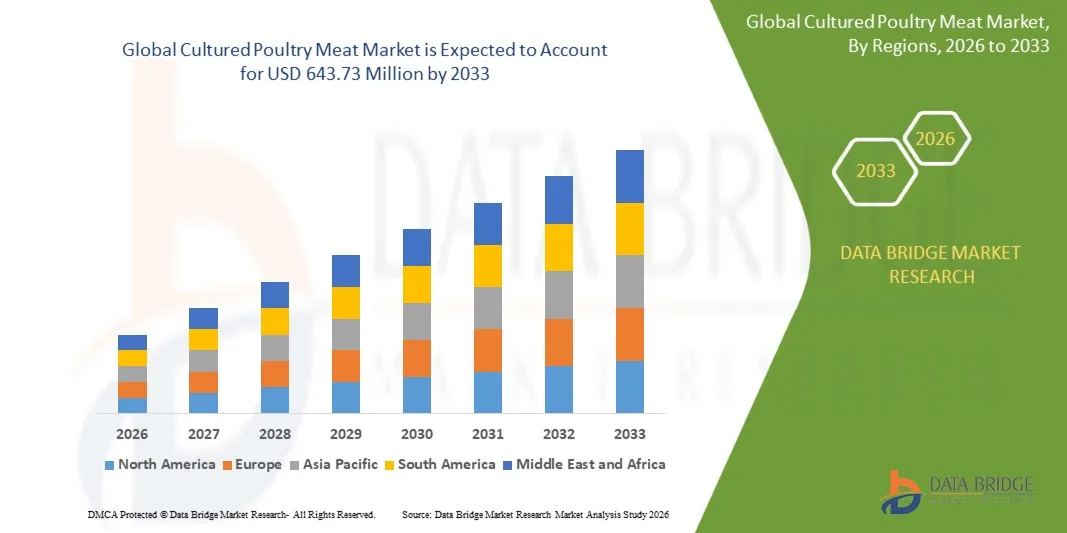
- As per Data Bridge Market Research analysis, the cultured poultry meat market was valued at USD 135.55 million in 2025 and is projected to reach USD 643.73 million by 2033, growing at a CAGR of 21.50% from 2026 to 2033.
- The market is experiencing rapid growth driven by rising global poultry consumption, advances in cell culture, serum-free media, and bioreactor technologies, and expanding regulatory approvals across the U.S., Singapore, Australia, and Europe. Growing demand for animal-welfare-friendly and sustainable protein is further supporting adoption across foodservice, retail, and pet food applications.
- Increasing investments in cultured meat and cultured beef platforms, combined with the shift of cultivated products from pilot scale to restaurant and retail launches, are supporting market adoption. Cultured poultry products are being applied across nuggets, sausages, minced preparations, and structured whole cuts, offering consumers familiar taste and texture through cultured poultry meat produced in controlled bioreactors.
Market Size & Forecast
- Global Market Value (2025): USD 135.55 Million
- Expected Market Value (2033): USD 643.73 Million
- Forecast CAGR (2026–2033): 21.50%
- Leading Region in 2025: North America
- Fastest Growing Region: Asia Pacific
What are the Major Takeaways of the Cultured Poultry Meat Market?
- North America dominated the cultured poultry meat market with the largest revenue share of 41.20% in 2025, supported by USDA and FDA clearances for cultivated chicken, strong venture funding, and early restaurant launches across the U.S.
- Asia-Pacific is expected to be the fastest-growing region at a CAGR of 24.60% from 2026 to 2033, fueled by Singapore’s regulatory leadership, approvals in Australia, and rising protein demand across China, India, and Southeast Asia.
- The chicken segment led the market with a 71.30% share in 2025, driven by the scale of global chicken consumption and the maturity of avian cell lines and production processes.
- Duck is the fastest-growing source, projected to register a CAGR of 25.80%, reflecting the emergence of multi-species production platforms and recent duck clearance in Singapore.
- The suspension culture segment dominated the technology category with a 49.70% share in 2025, led by its suitability for high-density, scalable bioreactor production.
- Foodservice accounted for 63.90% of the market share in 2025, preferred by restaurants and chefs for premium, small-batch launches of cultivated poultry dishes.
- The retail segment is the fastest-growing end-use category, with a CAGR of 26.10%, driven by label approvals, falling production costs, and the gradual entry of cultivated products into supermarkets.
Report Scope and Cultured Poultry Meat Market Segmentation
|
Attributes |
Cultured Poultry Meat Key Market Insights |
|
Segments Covered |
By Source: Chicken, Duck, Turkey, and Others By Technology: Suspension Culture, Scaffold-Based Culture, and Others By End Use: Foodservice, Retail, Pet Food, and Others By Product Form: Processed Products, Minced and Ground, and Whole-Cut and Structured |
|
Countries Covered |
North America
Europe
Asia-Pacific
Middle East and Africa
South America
|
|
Key Market Players |
|
|
Market Opportunities |
|
|
Value Added Data Infosets |
In addition to the insights on market scenarios such as market value, growth rate, segmentation, geographical coverage, and major players, the market reports curated by the Data Bridge Market Research also include in-depth expert analysis, pricing analysis, brand share analysis, consumer survey, demography analysis, supply chain analysis, value chain analysis, raw material/consumables overview, vendor selection criteria, PESTLE Analysis, Porter Analysis, and regulatory framework. |
What is the Key Trend in the Cultured Poultry Meat Market?
- Cultured poultry production is increasingly shifting from pilot-scale, serum-dependent processes toward continuous, serum-free manufacturing and multi-species platforms, enabling producers to lower costs, raise cell densities, and extend one technical and regulatory platform across chicken, duck, and other avian products.
- For instance, in August 2024, according to Nature Food, researchers used tangential flow filtration for continuous manufacturing of cultivated chicken, reaching up to 130 million cells per millilitre in an animal-component-free medium costing USD 0.63 per litre, while a techno-economic analysis of a 50,000-litre facility projected a cost of about USD 6.2 per pound.
- Producers are also moving toward hybrid formulations and higher cultivated-cell inclusion rates, using cultured avian muscle and fat cells to deliver the taste, texture, and nutritional profile of conventional poultry.
- Regulators are building clearer approval pathways for cultivated poultry, encouraging companies to design products and dossiers that can be filed across multiple jurisdictions at the same time.
- For instance, in April 2026, according to vegconomist, Parima secured Singapore Food Agency authorization for its cultivated duck six months after its cultivated chicken approval, becoming the first company with clearance for two species and holding eight active regulatory filings, including in the EU and the U.K.
- As cell-culture efficiency, regulatory clarity, and multi-species production platforms continue to advance, cultured poultry is expected to expand from premium restaurant offerings into pet food, processed products, and selected retail channels.
What are the Key Drivers of the Cultured Poultry Meat Market?
- Rising global demand for poultry, the world’s most consumed and lowest-priced meat, is encouraging food companies and investors to develop cultivated alternatives that can be produced without conventional rearing and slaughter.
- For instance, in July 2025, according to the OECD and FAO, global poultry consumption is projected to reach 173 million tonnes ready-to-cook by 2034, accounting for 62% of the additional meat consumed worldwide over the decade, underscoring the scale of the protein market that cultured poultry aims to serve.
- Growing concern over animal welfare, antibiotic use, avian disease outbreaks, and the environmental footprint of intensive poultry farming is increasing interest in cell-based production systems that operate in controlled, hygienic bioreactor environments.
- For instance, in October 2025, according to Food Business Middle East & Africa, Believer Meats received final USDA approval to produce and sell cultivated chicken, becoming the first non-U.S. company and the fifth overall cleared to sell cultivated meat in the U.S., while eight start-ups worldwide secured some form of market approval during 2025.
- With regulatory clearances expanding, production costs falling, and food-security strategies encouraging alternative proteins, cultured poultry is positioned to attract continued investment from food manufacturers, foodservice operators, and pet food brands.
What Factors Are Challenging the Growth of the Cultured Poultry Meat Market?
- Cultured poultry production requires specialized bioreactors, cell lines, growth media, and food-grade facilities, resulting in capital-intensive operations and unit costs that remain well above those of conventional chicken.
- For instance, in September 2025, according to FoodNavigator-USA, Texas enacted Senate Bill 261 banning the sale of cultivated meat for two years, with penalties of up to USD 25,000 per day, becoming the seventh U.S. state to restrict the product and prompting a lawsuit by UPSIDE Foods and Wildtype.
- State-level bans, labeling restrictions, and differing novel-food approval timelines across regions create regulatory uncertainty and delay commercialization, particularly for companies seeking simultaneous launches in multiple countries.
- Consumer acceptance, perceived naturalness, and price premiums remain barriers, as many consumers are hesitant to purchase cell-based meat and limited production volumes restrict availability beyond selected restaurants.
- For instance, in November 2025, according to Reuters as reported by The Poultry Site, Singapore dropped its 30-by-30 food self-sufficiency goal, with the minister noting that efforts to scale up the local alternative protein industry had been held back by higher production costs and weaker-than-expected consumer acceptance.
- The combination of high production costs, regulatory fragmentation, and uncertain consumer demand can slow investment and limit adoption, particularly where conventional poultry remains abundant, affordable, and widely accepted.
How is the Cultured Poultry Meat Market Segmented?
The cultured poultry meat market is segmented on the basis of source, technology, end use, and product form.
- By Source
On the basis of source, the cultured poultry meat market is segmented into chicken, duck, turkey, and others. The chicken segment dominated the market with 71.30% share in 2025, supported by the scale of global chicken consumption and the maturity of avian cell lines and fibroblast-based production processes. Chicken was the first cultivated poultry product cleared in the U.S. and Singapore, giving it the broadest regulatory and commercial track record. Its neutral flavor and versatility across nuggets, cutlets, and minced applications strengthen foodservice appeal. Continued progress in serum-free media and bioreactor yields is further reinforcing its leadership. Growing pet food launches are creating additional volume opportunities.
The duck segment is projected to register the fastest growth at a CAGR of 25.80% from 2026 to 2033, driven by premium gastronomy demand and the development of multi-species production platforms. Duck cells enable differentiated products such as fat-rich preparations that command higher price points in fine dining. Companies are extending existing cell-culture platforms from chicken to duck, which shortens development timelines and reuses regulatory knowledge. Recent clearance in Singapore has demonstrated a viable approval pathway for new avian species. Growing interest from Asia-Pacific and European foodservice operators is expected to support commercial launches. Smaller volumes and higher unit values make duck attractive for early commercialization.
- By Technology
On the basis of technology, the cultured poultry meat market is segmented into suspension culture, scaffold-based culture, and others. The suspension culture segment dominated the market with 49.70% share in 2025, supported by its suitability for high-density, scalable bioreactor operation. Suspension systems allow cells to grow without anchorage, simplifying harvesting and enabling continuous or perfusion-based manufacturing. These processes can raise cell densities and reduce media consumption per kilogram of product. Compatibility with stirred-tank and airlift bioreactors allows producers to leverage established fermentation expertise. Growing adoption of animal-component-free media is further improving the economics of suspension-based production.
The scaffold-based culture segment is projected to register the fastest growth at a CAGR of 24.30% from 2026 to 2033, driven by demand for structured whole-cut products with realistic fibre alignment and texture. Edible and plant-derived scaffolds guide muscle and fat cell attachment, enabling cutlets and fillets rather than only minced formats. Advances in biomaterials, 3D bioprinting, and tissue engineering are improving cell infiltration and nutrient delivery in thicker tissues. Collaboration between cultivated meat developers and materials suppliers is accelerating scaffold innovation. As producers target premium whole-cut positioning, scaffold-based systems are expected to capture a growing share of new capacity. Manufacturing complexity and validation requirements remain important considerations.
- By End Use
On the basis of end use, the cultured poultry meat market is segmented into foodservice, retail, pet food, and others. The foodservice segment dominated the end-use category with 63.90% share in 2025, supported by restaurant-led launches that allow producers to introduce limited volumes at premium price points. Chefs and restaurateurs act as early adopters, helping to build consumer familiarity and brand credibility. Tasting menus and curated dishes reduce the price sensitivity associated with early cultivated products. Direct relationships with restaurants also simplify logistics and compliance in the initial commercialization phase. Regulatory clearance of foodservice-first products in the U.S. and Singapore has reinforced this channel’s leadership.
The retail segment is projected to register the fastest growth at a CAGR of 26.10% from 2026 to 2033, driven by label approvals, falling production costs, and the gradual entry of cultivated and hybrid poultry products into supermarkets. Retail distribution offers significantly larger volume potential than restaurants, encouraging producers to develop packaged nuggets, sausages, and minced products. Hybrid formulations that blend cultivated cells with plant-based ingredients help meet retail price points. Clear labeling requirements, such as the U.S. “cell-cultivated” designation, are building consumer transparency. Partnerships with grocery chains and food manufacturers are expected to broaden access. Price parity and consumer acceptance remain critical for scaling in this channel.
- By Product Form
On the basis of product form, the cultured poultry meat market is segmented into processed products, minced and ground, and whole-cut and structured. The processed products segment, covering nuggets, sausages, and patties, dominated the category with 54.20% share in 2025, supported by the ability to combine cultivated cells with binders, fats, and plant proteins without complex tissue structure. Processed formats tolerate lower cell inclusion rates and variable texture, reducing production cost per serving. Familiar formats lower the barrier to consumer trial. Established food-processing equipment and co-manufacturing partners can be used for forming, cooking, and packaging. Hybrid formulations are further improving affordability and taste consistency.
The whole-cut and structured segment is projected to register the fastest growth at a CAGR of 27.60% from 2026 to 2033, driven by the pursuit of true chicken-breast and thigh-like eating experiences. Progress in scaffolds, bioprinting, and perfusion bioreactors is enabling thicker and more aligned tissue. Whole-cut products can command higher price points in premium foodservice and gourmet retail. Companies are investing in cell-line stability, vascularization strategies, and texture engineering to improve consistency. Success in structured products would also expand the addressable market beyond processed applications. High technical complexity and capital intensity remain key constraints on near-term volumes.
Which Region Holds the Largest Share of the Cultured Poultry Meat Market?
- North America dominated the cultured poultry meat market with the largest revenue share of 41.20% in 2025, supported by USDA and FDA clearances for cultivated chicken, strong venture funding, and early restaurant launches across the U.S.
- The region also benefits from a deep biotechnology talent pool, established food-technology start-ups, and partnerships with large meat processors. Growing consumer interest in alternative proteins, combined with federal label approvals, continues to strengthen North America’s position, although state-level restrictions remain a factor in market access.
U.S. Cultured Poultry Meat Market Insight
The U.S. cultured poultry meat market is witnessing strong growth due to federal regulatory clearance for cultivated chicken, the presence of leading developers, and sustained investment in cell-culture and bioreactor technologies. The joint FDA and USDA pathway has created a clear framework for production, inspection, and labeling of cell-cultivated poultry. In addition, restaurant-led launches, growing interest from pet food brands, and partnerships with large meat processors are accelerating commercialization. At the same time, state-level restrictions in several states are shaping where and how products can be sold across the country.
Asia-Pacific Cultured Poultry Meat Market Insight
The Asia-Pacific cultured poultry meat market is expected to witness rapid growth, driven by Singapore’s pioneering regulatory framework, approvals in Australia and New Zealand, and rising protein demand across China, India, and Southeast Asia. Governments are supporting alternative protein research to improve food security in import-dependent markets. In addition, the region’s large poultry-consuming population, strong biomanufacturing capabilities, and growing investments in cell-culture infrastructure are accelerating adoption. Rising urban incomes and openness to novel foods in several markets are further supporting regional expansion.
Japan Cultured Poultry Meat Market Insight
The Japan cultured poultry meat market is witnessing steady growth due to strong research capabilities in cell biology, government interest in food-technology innovation, and a highly quality-conscious consumer base. Domestic start-ups, universities, and food manufacturers are collaborating on cell-culture, scaffold, and tissue-engineering technologies. Moreover, Japan’s large poultry consumption, aging population, and emphasis on food security are encouraging exploration of alternative proteins. Regulatory frameworks for cultivated food are still evolving, and clear guidelines are expected to support commercialization in the coming years.
China Cultured Poultry Meat Market Insight
The China cultured poultry meat market is growing rapidly, driven by national interest in new protein sources, large-scale biomanufacturing capacity, and the world’s largest poultry-consuming population. Domestic start-ups and research institutes are advancing cell lines, serum-free media, and bioreactor processes for cultivated chicken and other meats. In addition, supportive policy attention to novel food sources is encouraging public and private investment. Regulatory approval pathways for cultivated products are still being defined, and progress on them will influence the pace of commercial launches across the country.
U.K. Cultured Poultry Meat Market Insight
The U.K. cultured poultry meat market is experiencing steady growth, supported by a regulatory sandbox for cultivated meat, strong research institutions, and early activity in cultivated pet food. The Food Standards Agency is working with companies and regulatory experts to accelerate safety assessments, and cultivated chicken and duck dossiers are currently under review. Furthermore, interest from sustainability-focused consumers, food retailers, and investors is supporting commercialization plans. Regulatory independence after Brexit is also seen as an opportunity for faster novel-food decisions in the U.K.
Germany Cultured Poultry Meat Market Insight
The Germany cultured poultry meat market is expanding steadily due to the country’s strong food-processing sector, advanced biotechnology ecosystem, and growing interest in sustainable proteins. Research institutions, start-ups, and established meat producers are exploring cell-culture and bioreactor technologies for poultry applications. Furthermore, Germany’s role within the European Union means that progress on EU novel-food assessments, including the first cultivated food application filed under the framework, will strongly influence market timing. High consumer standards for quality, labeling, and animal welfare are also shaping product development.
Which are the Top Companies in Cultured Poultry Meat Market?
The cultured poultry meat industry is primarily led by well-established companies, including:
- UPSIDE Foods (U.S.)
- Eat Just, Inc. (U.S.)
- Aleph Farms Ltd. (Israel)
- Mosa Meat B.V. (Netherlands)
- SuperMeat The Essence of Meat Ltd. (Israel)
- Parima (France)
- Vow Group Pty Ltd (Australia)
- Wildtype, Inc. (U.S.)
- Mission Barns (U.S.)
- Steakholder Foods Ltd. (Israel)
- BioTech Foods (JBS S.A.) (Spain)
- Ivy Farm Technologies Ltd. (U.K.)
- Meatly Ltd. (U.K.)
- Integriculture Inc. (Japan)
- CellX Limited (China)
- Joes Future Food (China)
- Umami Bioworks (Singapore)
- Tyson Foods, Inc. (U.S.)
- Cargill, Incorporated (U.S.)
- Charoen Pokphand Foods PCL (Thailand)
What are Latest Developments in Cultured Poultry Meat Market?
- In February 2026, Singapore’s Ministry of Sustainability and the Environment stated in a written parliamentary reply that the Singapore Food Agency has awarded SGD 64 million to 21 multi-year alternative protein research projects since 2024, reaffirming public support for cultivated food capabilities in process development, nutrition, and functionality despite sector-wide cost and consumer-acceptance hurdles.
- In October 2025, Parima, formed through the merger of Gourmey and Vital Meat, received Singapore Food Agency approval for its cultivated chicken, the first approval for a European cultivated meat company. The product is made from cells of fertilized chicken eggs and produced in bioreactors with combined capacities reaching several thousand litres, according to the company.
- In April 2025, Vow received approval from Food Standards Australia New Zealand for its cultivated quail, extending the Australian company’s regulatory footprint beyond Singapore, where its product had been cleared in April 2024 and has since been served across restaurants in dishes such as parfaits and foie gras.
- In April 2024, the Singapore Food Agency approved Vow’s cultured quail, adding a second avian species to the products cleared in the city-state alongside GOOD Meat’s chicken. The quail was subsequently commercialised in a variety of restaurant dishes across Singapore, including parfaits and foie gras.
- In June 2023, the U.S. Department of Agriculture granted approval to UPSIDE Foods and GOOD Meat to produce and sell cultivated chicken, the first U.S. clearance of its kind following FDA safety review. The products debuted in restaurants in San Francisco and Washington, D.C., and carry the mandatory “cell-cultivated” label.

- Interactive Data Analysis Dashboard
- Company Analysis Dashboard for high growth potential opportunities
- Research Analyst Access for customization & queries
- Competitor Analysis with Interactive dashboard
- Latest News, Updates & Trend analysis
- Harness the Power of Benchmark Analysis for Comprehensive Competitor Tracking
Global Cultured Poultry Meat Market, Supply Chain Analysis and Ecosystem Framework
To support market growth and help clients navigate the impact of geopolitical shifts, DBMR has integrated in-depth supply chain analysis into its Global Cultured Poultry Meat Market research reports. This addition empowers clients to respond effectively to global changes affecting their industries. The supply chain analysis section includes detailed insights such as Global Cultured Poultry Meat Market consumption and production by country, price trend analysis, the impact of tariffs and geopolitical developments, and import and export trends by country and HSN code. It also highlights major suppliers with data on production capacity and company profiles, as well as key importers and exporters. In addition to research, DBMR offers specialized supply chain consulting services backed by over a decade of experience, providing solutions like supplier discovery, supplier risk assessment, price trend analysis, impact evaluation of inflation and trade route changes, and comprehensive market trend analysis.
Data collection and base year analysis are done using data collection modules with large sample sizes. The stage includes obtaining market information or related data through various sources and strategies. It includes examining and planning all the data acquired from the past in advance. It likewise envelops the examination of information inconsistencies seen across different information sources. The market data is analysed and estimated using market statistical and coherent models. Also, market share analysis and key trend analysis are the major success factors in the market report. To know more, please request an analyst call or drop down your inquiry.
The key research methodology used by DBMR research team is data triangulation which involves data mining, analysis of the impact of data variables on the market and primary (industry expert) validation. Data models include Vendor Positioning Grid, Market Time Line Analysis, Market Overview and Guide, Company Positioning Grid, Patent Analysis, Pricing Analysis, Company Market Share Analysis, Standards of Measurement, Global versus Regional and Vendor Share Analysis. To know more about the research methodology, drop in an inquiry to speak to our industry experts.
Data Bridge Market Research is a leader in advanced formative research. We take pride in servicing our existing and new customers with data and analysis that match and suits their goal. The report can be customized to include price trend analysis of target brands understanding the market for additional countries (ask for the list of countries), clinical trial results data, literature review, refurbished market and product base analysis. Market analysis of target competitors can be analyzed from technology-based analysis to market portfolio strategies. We can add as many competitors that you require data about in the format and data style you are looking for. Our team of analysts can also provide you data in crude raw excel files pivot tables (Fact book) or can assist you in creating presentations from the data sets available in the report.