


What is the Curved Panel Market Size and Growth Rate?
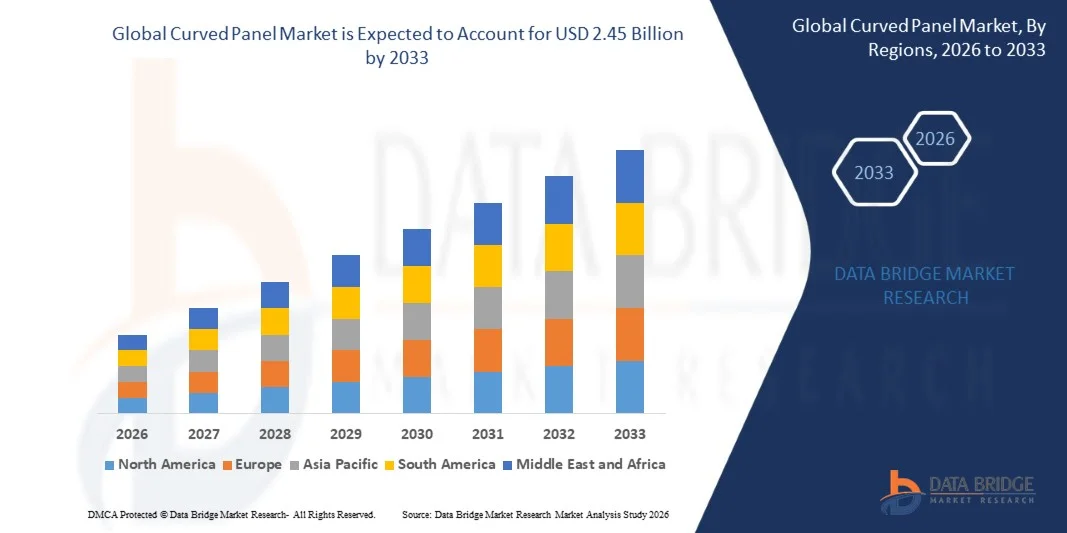
- As per Data Bridge Market Research analysis, the curved panel market was valued at USD 1.58 billion in 2025 and is projected to reach USD 2.45 billion by 2033, growing at a CAGR of 5.65% from 2026 to 2033.
- The market is experiencing consistent growth driven by increasing demand for immersive display experiences, rising adoption of curved panels in automotive and consumer electronics, expanding use in architectural and commercial applications, and growing preference for sleek, high-quality display solutions. Curved panels are increasingly being adopted in televisions, monitors, automotive displays, digital signage, and architectural installations due to their enhanced visual appeal and immersive viewing experience.
- The increasing adoption of advanced display technologies, premium automotive interiors, gaming monitors, digital signage, and smart architectural solutions is encouraging manufacturers to invest in innovative curved panel technologies. OLED, QLED, flexible display, and LED technologies are gaining preference as they enable improved image quality, thinner designs, greater design flexibility, enhanced user experience, and wider application across automotive, consumer electronics, commercial, and architectural environments.
Market Size & Forecast
- Global Market Value (2025): USD 1.58 Billion
- Expected Market Value (2033): USD 2.45 Billion
- Forecast CAGR (2026–2033): 5.65%
- Leading Region in 2025: North America
- Fastest Growing Region: Asia Pacific
What are the Major Takeaways of the Curved Panel Market?
- North America dominated the curved panel market with the largest revenue share of 38.6% in 2025, supported by technological advancements in display systems, strong adoption of curved displays, the presence of major technology companies, and increasing demand from automotive, entertainment, and gaming applications.
- Asia-Pacific is expected to be the fastest-growing region at a CAGR of 7.1% from 2026 to 2033, fueled by expanding electronics manufacturing, rising consumer demand for immersive displays, increasing automotive production, and growing adoption of OLED and other advanced curved-display technologies.
- The 90 Degrees segment led the market with a 48.2% share in 2025, driven by its broad applicability in architectural structures, commercial installations, display systems, and industrial applications where moderate curvature is preferred for design flexibility and ease of installation.
- 180 Degrees is the fastest-growing type, projected to register a CAGR of 7.0%, reflecting increasing demand for highly immersive and wraparound display solutions across automotive interiors, digital signage, entertainment, architectural installations, and advanced visualization applications.
- The architectural segment dominated the application category with a 41.5% revenue share in 2025, supported by increasing adoption of curved panels in commercial buildings, interiors, public spaces, hospitality projects, and aesthetically focused architectural designs.
- The industries segment is expected to be the fastest-growing application category, with a CAGR of 7.2%, driven by increasing adoption of curved panels in industrial facilities, manufacturing environments, specialized display systems, and customized commercial applications.
Report Scope and Curved Panel Market Segmentation
|
Attributes |
Curved Panel Key Market Insights |
|
Segments Covered |
|
|
Countries Covered |
North America
Europe
Asia-Pacific
Middle East and Africa
South America
|
|
Key Market Players |
|
|
Market Opportunities |
|
|
Value Added Data Infosets |
In addition to the market insights such as market value, growth rate, market segments, geographical coverage, market players, and market scenario, the market report curated by the Data Bridge Market Research team includes in-depth expert analysis, import/export analysis, pricing analysis, production consumption analysis, and pestle analysis. |
What is the Key Trend in the Curved Panel Market?
- Curved panel manufacturing is increasingly shifting toward high-performance and lightweight display solutions, as manufacturers seek to deliver immersive viewing experiences, greater design flexibility, and seamless integration across automotive, consumer electronics, architectural, commercial, and industrial applications.
- For instance, in January 2025, Tianma introduced a dual-screen multi-curved OLED display at CES 2025, combining two 13-inch OLED displays with multi-curve cover glass to create a continuous automotive cockpit display.
- Manufacturers are increasingly focusing on advanced OLED, LCD, LED, and QLED technologies to improve image quality, flexibility, brightness, durability, and viewing angles while enabling curved and non-traditional display designs across multiple applications.
- The growing emphasis on immersive displays and flexible form factors is encouraging curved panel manufacturers to integrate multi-curvature designs, bendable materials, advanced glass-forming technologies, and lightweight display structures rather than relying exclusively on conventional flat panels.
- Energy efficiency and sustainable manufacturing are also gaining importance as manufacturers seek curved panels that can reduce material use, processing requirements, and energy consumption while maintaining high optical performance and durability. Corning's ColdForm technology, for example, enables automotive glass to be shaped at room temperature and can reduce the carbon footprint by up to 25% compared with traditional curved-glass forming.
- For instance, in October 2025, OLEDWorks announced the commercial availability of Atala Wave, a bendable OLED lighting panel designed for automotive integration, demonstrating the increasing adoption of flexible and curved technologies for vehicle interiors.
- Demand for advanced curved panels is also expanding across automotive, consumer electronics, retail and advertising, construction, and industrial applications, with manufacturers increasingly requiring lightweight, durable, high-resolution, and precisely shaped panels for complex designs.
What are the Key Drivers of the Curved Panel Market?
- The rapid expansion of automotive displays, consumer electronics, retail advertising, and architectural applications is increasing demand for curved panels capable of delivering immersive viewing experiences, improved aesthetics, and greater design flexibility.
- For instance, in 2025, Porsche introduced the Cayenne Electric with a curved OLED Flow Display that seamlessly integrates into the center console, demonstrating increasing adoption of curved display technologies in premium vehicles.
- Automakers are increasingly adopting curved OLED and advanced glass panels because these technologies enable larger, seamless cockpit displays, improved driver interaction, and flexible integration across dashboards and center consoles.
- The increasing adoption of electric and premium vehicles is supporting demand for advanced curved panels as automakers seek differentiated interiors, larger digital surfaces, lightweight components, and enhanced infotainment experiences.
- For instance, in January 2025, Visteon showcased curved OLED clusters at CES 2025, highlighting the growing use of curved displays for next-generation automotive cockpits.
- Manufacturers are increasingly investing in flexible OLED, Micro-LED, advanced glass-forming, and multi-curvature technologies, which is encouraging the replacement of conventional flat display designs with more adaptable curved panel solutions.
- The expansion of commercial displays, digital advertising, immersive entertainment, and architectural installations is further supporting demand for curved LED and other flexible panel technologies as businesses seek wider viewing angles, stronger visual impact, and differentiated display environments.
Which Factors are Challenging the Growth of the Curved Panel Market?
- High manufacturing and technology costs can restrict market growth because advanced curved OLED, flexible LED, and precision-formed glass panels require specialized materials, equipment, processing technologies, and quality-control systems.
- For instance, in January 2026, Omdia highlighted that high pricing remains a major barrier to broader automotive OLED adoption, particularly because automotive-grade OLED panels remain more expensive than mainstream display technologies.
- Fluctuations in automotive and consumer electronics production remain a significant challenge because weaker demand from major end-use industries can reduce orders for advanced curved panels and delay investment in new production capacity.
- Complex manufacturing processes and supply chains can increase production costs and lead times because curved panels require specialized substrates, flexible materials, precision forming, display components, coatings, and bonding technologies.
- For instance, in January 2025, Tianma's multi-curved automotive OLED solution required specialized SLOD technology and Corning ColdForm multi-curve cover glass, demonstrating the technological complexity involved in producing advanced curved panels.
- Rising competition among display and panel manufacturers can create pricing pressure, particularly as manufacturers across Asia Pacific expand production capabilities and offer increasingly cost-competitive OLED, LCD, LED, and Micro-LED solutions.
- The growing technical requirements for durability, optical consistency, thermal performance, and reliability can further increase development costs, particularly for curved panels used in automotive and other demanding applications where stringent performance and safety requirements must be met.
How is the Curved Panel Market Segmented?
The curved panel market is segmented on the basis of type, application, material, technology, and end use.
- By Type
On the basis of type, the curved panel market is segmented into 90 Degrees, 180 Degrees, 270 Degrees, 360 Degrees, and Others. The 180 Degrees segment dominated the market with 31.7% share in 2025, owing to its widespread use in immersive displays, commercial installations, automotive interiors, simulation systems, and architectural applications. The 180-degree configuration provides an extended field of view while maintaining relatively manageable installation and manufacturing requirements. Increasing adoption of curved commercial displays and immersive environments is further supporting segment growth. Growing demand for large-format and panoramic display solutions across automotive, retail, entertainment, and industrial applications is expected to reinforce its leading position.
The 360 Degrees segment is projected to register the fastest growth at a 8.2% CAGR from 2026 to 2033, driven by increasing demand for fully immersive visual environments, panoramic digital signage, simulation systems, control rooms, and experiential installations. Full-surround curved panels provide wider viewing coverage and enable immersive visualization across multiple applications. Increasing adoption of advanced simulation and entertainment technologies is further contributing to segment expansion. Consequently, the 360 Degrees segment is expected to maintain strong growth during the forecast period.
- By Application
On the basis of application, the curved panel market is segmented into Architectural, Automotive, Traffic, Commercial, and Industrial. The Automotive segment dominated the market with 30.5% share in 2025, supported by increasing adoption of curved cockpit displays, wraparound infotainment systems, digital instrument clusters, and curved automotive glass. Automakers are increasingly integrating larger and curved displays to improve cabin aesthetics and provide enhanced digital experiences. The growing production of premium vehicles and electric vehicles is further supporting demand. Recent industry data also indicates continued expansion in automotive display size, with total automotive center-information-display area increasing by 19% in 2025.
The Automotive segment is projected to register the fastest growth at a 8.1% CAGR from 2026 to 2033, driven by increasing integration of curved displays into next-generation vehicle cockpits. Growing adoption of OLED and advanced LCD technologies, together with demand for seamless pillar-to-pillar displays, is expected to support segment expansion. OLED is particularly gaining traction in premium automotive applications because of its ability to support flexible and curved form factors.
- By Material
On the basis of material, the curved panel market is segmented into Glass, Metal, Plastic, Composite, and Others. The Glass segment dominated the market with 38.5% share in 2025, owing to its superior optical clarity, durability, surface quality, and suitability for precision forming. Curved glass is extensively used across automotive glazing, architectural façades, consumer electronics, and display applications. Increasing demand for panoramic automotive glazing and aesthetically advanced building designs is further supporting segment growth.
The Composite segment is projected to register the fastest growth at a 8.4% CAGR from 2026 to 2033, driven by increasing demand for lightweight, durable, and highly customizable curved structures. Composite materials enable manufacturers to achieve complex geometries while reducing weight and improving structural performance. Growing adoption in automotive, industrial, aerospace-related, and advanced architectural applications is expected to strengthen segment expansion throughout the forecast period.
- By Technology
On the basis of technology, the curved panel market is segmented into OLED, LCD, LED, QLED, and Others. The OLED segment dominated the market with 34.8% share in 2025, supported by its high contrast ratio, thin form factor, low response time, and ability to support flexible and curved designs. OLED technology is increasingly used in premium consumer electronics and automotive displays where enhanced visual quality and distinctive form factors are required. In automotive applications, OLED is gaining share in premium curved cockpit displays despite higher costs and technical requirements.
The OLED segment is projected to register the fastest growth at a 9.2% CAGR from 2026 to 2033, driven by increasing adoption of flexible displays, premium smartphones, curved monitors, automotive cockpit displays, and next-generation consumer electronics. The technology's ability to support curved, seamless, and lightweight display surfaces is encouraging manufacturers to expand OLED applications.
- End Use
On the basis of end use, the curved panel market is segmented into Automotive, Consumer Electronics, Construction, Retail and Advertising, and Others. The Consumer Electronics segment dominated the market with 31.8% share in 2025, supported by widespread adoption of curved monitors, televisions, smartphones, tablets, and other display devices. Rising consumer preference for immersive viewing experiences, high-resolution screens, and aesthetically differentiated products is supporting segment growth. The increasing adoption of OLED, QLED, and advanced LCD technologies is further strengthening demand for curved panels.
The Automotive segment is projected to register the fastest growth at a 8.6% CAGR from 2026 to 2033, driven by increasing integration of curved displays, digital cockpits, panoramic interfaces, and advanced infotainment systems. Growing electric vehicle production and increasing emphasis on digitally enhanced vehicle interiors are creating additional opportunities for curved panel manufacturers. The automotive display market is also shifting toward higher-value OLED and LTPS LCD technologies, supporting demand for advanced curved display solutions
Which Region Holds the Largest Share of the Curved Panel Market?
- North America dominated the curved panel market with the largest revenue share of 34.0% in 2025, supported by strong technology infrastructure, high adoption of advanced display solutions, expanding automotive and electronics production, and increasing demand for premium curved displays.
- The region also benefits from growing investments in smart displays, automotive electronics, digital signage, gaming, and commercial display infrastructure across the U.S., Canada, and Mexico. Increasing demand for high-performance and immersive display solutions, combined with strong consumer electronics adoption and technological innovation, continues to strengthen North America’s leadership position in the global market.
U.S. Curved Panel Market Insight
The U.S. curved panel market is witnessing steady growth due to increasing adoption of advanced displays across automotive, consumer electronics, gaming, commercial signage, and enterprise applications. Growing demand for larger, higher-resolution, energy-efficient, and immersive displays is encouraging manufacturers to adopt OLED, LED, QLED, and advanced LCD technologies. The expansion of digital cockpits, premium vehicles, curved gaming monitors, and commercial display installations is further supporting market development. North America remains an important premium market for advanced curved display solutions.
Asia-Pacific Curved Panel Market Insight
The Asia-Pacific curved panel market is expected to witness rapid growth, driven by the region's strong display manufacturing ecosystem, expanding automotive production, growing consumer electronics industry, and increasing adoption of advanced display technologies. China, Japan, South Korea, and India are supporting regional expansion through investments in automotive displays, OLED production, electric vehicles, gaming monitors, and digital signage.
Japan Curved Panel Market Insight
The Japan curved panel market is witnessing consistent growth due to the country's established automotive and electronics industries, advanced manufacturing capabilities, and strong presence of display and component manufacturers. Increasing adoption of curved automotive displays, OLED technologies, digital cockpits, and premium consumer electronics is supporting market demand. Japan's established precision-manufacturing capabilities and continuous investment in advanced automotive and display technologies are further contributing to regional market growth.
China Curved Panel Market Insight
The China curved panel market is growing rapidly, driven by expanding automotive production, electric vehicle manufacturing, consumer electronics production, and strong domestic display manufacturing capabilities. Increasing adoption of large-format automotive displays, OLED panels, curved monitors, digital signage, and immersive display solutions is supporting market expansion. China also benefits from a concentrated display manufacturing and component supply ecosystem, strengthening its position as a leading curved panel market in Asia-Pacific.
U.K. Curved Panel Market Insight
The U.K. curved panel market is experiencing steady growth, supported by increasing adoption of advanced displays across automotive, retail, advertising, gaming, commercial, and architectural applications. Growing demand for high-resolution curved monitors, immersive commercial displays, digital signage, and advanced automotive interfaces is supporting market development. Increasing investments in premium vehicle technologies and digital cockpit systems are further encouraging the adoption of curved display solutions in the country.
Germany Curved Panel Market Insight
The Germany curved panel market is expanding steadily due to the country's strong automotive manufacturing base, premium vehicle production, engineering capabilities, and increasing adoption of advanced digital cockpit technologies. Growing investments in OLED, high-resolution displays, curved automotive interfaces, and connected vehicle technologies are supporting market demand. Germany also represents one of Europe's important automotive-display markets, supported by its strong luxury vehicle industry and increasing adoption of advanced display technologies.
Which are the Top Companies in Curved Panel Market?
The curved panel industry is primarily led by well-established companies, including:
- AGC Inc. (Japan)
- Saint-Gobain S.A. (France)
- Corning Incorporated (U.S.)
- SCHOTT AG (Germany)
- Guardian Industries (U.S.)
- Vitro Architectural Glass (U.S.)
- Fuyao Glass Industry Group Co., Ltd. (China)
- NSG Group (Japan)
- Xinyi Glass Holdings Limited (China)
- CRICURSA (Spain)
- Parapan (Canada)
- FORMS+SURFACES (U.S.)
- Carey Glass (Ireland)
- InVision Glass Design (U.S.)
- Bent Glass Design, Inc. (U.S.)
- HHH Tempering Resources Inc. (U.S.)
- Goldray Industries Ltd. (Canada)
- Viracon (U.S.)
- GSC Glass Ltd. (U.K.)
- DuPont (U.S.)
- VELUX Group (Denmark)
- VIA optronics AG (Germany)
- Visteon Corporation (U.S.)
- OLEDWorks LLC (U.S.)
- Mocom Co., Ltd. (South Korea)
What are Latest Developments in Curved Panel Market?
- In January 2025, Tianma America showcased advanced multi-curved OLED and Micro-LED automotive display technologies at CES 2025 in Las Vegas, including a dual-screen multi-curved color-matched OLED display developed with Corning. The display featured multiple curvature radii and was designed to provide a continuous, immersive cockpit experience. The development highlights increasing adoption of advanced curved OLED solutions across automotive applications in North America.
- In January 2025, Visteon showcased curved OLED clusters at CES 2025, integrating curved displays with advanced cockpit technologies and software-defined vehicle solutions. The development reflected growing demand for immersive, high-resolution, and space-efficient display systems across next-generation vehicles and demonstrated continued innovation in curved panel solutions in the North American automotive market.
- In March 2025, North American automotive manufacturers increasingly adopted larger and more advanced curved display solutions, supported by growing demand for digital cockpits, connected vehicles, electric vehicles, and premium infotainment systems. The U.S. automotive display market reached USD 3.3 billion in 2025, while investments in OLED and curved display technologies continued to support the development of advanced in-vehicle interfaces.
- In January 2025, Corning and CarUX showcased Dynamic Décor and ColdForm technology at CES, enabling automotive display glass to be shaped at room temperature and supporting the development of curved displays with more immersive in-cabin experiences. The technology highlights increasing focus on sustainable manufacturing, flexible form factors, and advanced curved display integration across the North American automotive industry.
- In June 2026, OLED adoption continued to expand in advanced automotive displays, with OLED accounting for 5% of CID/DIC display revenue and recording 26% year-on-year revenue growth globally. The technology’s flexibility, high contrast, and suitability for curved and pillar-to-pillar surfaces are supporting increasing demand for premium curved panels and advanced cockpit displays, particularly across North America’s premium and electric vehicle segments.

- Interactive Data Analysis Dashboard
- Company Analysis Dashboard for high growth potential opportunities
- Research Analyst Access for customization & queries
- Competitor Analysis with Interactive dashboard
- Latest News, Updates & Trend analysis
- Harness the Power of Benchmark Analysis for Comprehensive Competitor Tracking
Data collection and base year analysis are done using data collection modules with large sample sizes. The stage includes obtaining market information or related data through various sources and strategies. It includes examining and planning all the data acquired from the past in advance. It likewise envelops the examination of information inconsistencies seen across different information sources. The market data is analysed and estimated using market statistical and coherent models. Also, market share analysis and key trend analysis are the major success factors in the market report. To know more, please request an analyst call or drop down your inquiry.
The key research methodology used by DBMR research team is data triangulation which involves data mining, analysis of the impact of data variables on the market and primary (industry expert) validation. Data models include Vendor Positioning Grid, Market Time Line Analysis, Market Overview and Guide, Company Positioning Grid, Patent Analysis, Pricing Analysis, Company Market Share Analysis, Standards of Measurement, Global versus Regional and Vendor Share Analysis. To know more about the research methodology, drop in an inquiry to speak to our industry experts.
Data Bridge Market Research is a leader in advanced formative research. We take pride in servicing our existing and new customers with data and analysis that match and suits their goal. The report can be customized to include price trend analysis of target brands understanding the market for additional countries (ask for the list of countries), clinical trial results data, literature review, refurbished market and product base analysis. Market analysis of target competitors can be analyzed from technology-based analysis to market portfolio strategies. We can add as many competitors that you require data about in the format and data style you are looking for. Our team of analysts can also provide you data in crude raw excel files pivot tables (Fact book) or can assist you in creating presentations from the data sets available in the report.













