What is the Dairy Flavors Market Size and Growth Rate?
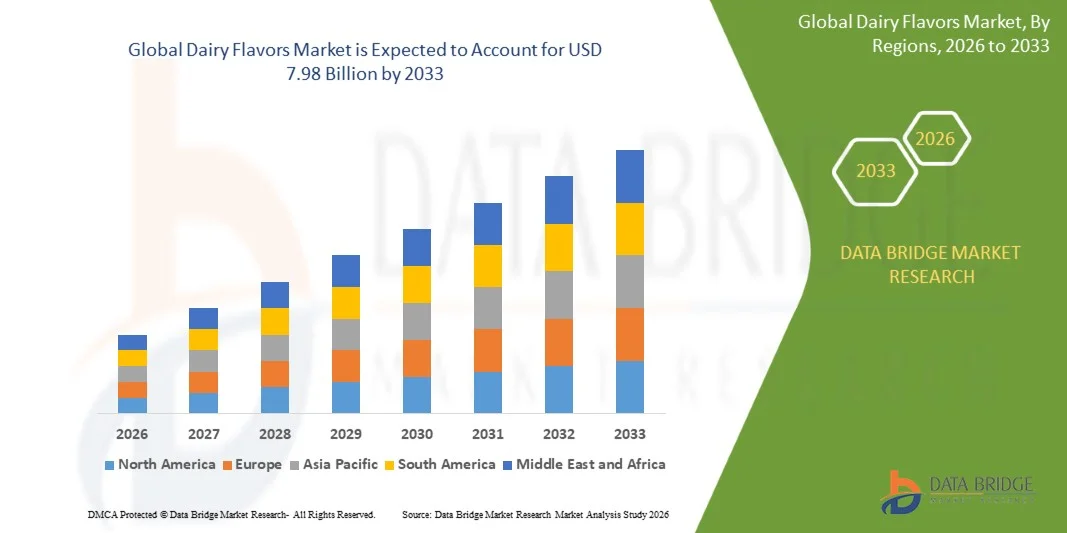
- As per Data Bridge Market Research analysis, the dairy flavors market was valued at USD 5.20 billion in 2025 and is projected to reach USD 7.98 billion by 2033, growing at a CAGR of 5.50% from 2026 to 2033.
- The market is experiencing consistent growth driven by rising demand for flavored and premium dairy products, increasing consumer preference for innovative taste profiles, and expanding applications of dairy flavors across beverages, desserts, bakery, and confectionery products.
- The increasing consumer focus on clean-label, natural, and functional food products, combined with growing demand for yogurt, flavored milk, cheese, and frozen desserts, is encouraging manufacturers to adopt advanced dairy flavor formulations. Natural and customized flavor solutions are increasingly being used to enhance taste, product differentiation, and sensory appeal across a wide range of dairy-based and processed food applications.
Market Size & Forecast
- Global Market Value (2025): USD 5.20 Billion
- Expected Market Value (2033): USD 7.98 Billion
- Forecast CAGR (2026–2033): 5.50%
- Leading Region in 2025: North America
- Fastest Growing Region: Asia Pacific
What are the Major Takeaways of the Dairy Flavors Market?
- North America dominated the dairy flavors market with the largest revenue share of 32.8% in 2025, supported by advanced food-processing infrastructure, high dairy consumption, and strong adoption of innovative flavoring technologies.
- Asia-Pacific is expected to be the fastest-growing region at a CAGR of 9.2% from 2026 to 2033, fueled by rapid urbanization, rising disposable incomes, expanding food-processing industries, and increasing demand for dairy-based beverages and packaged foods.
- The conventional segment led the market with a 63% share in 2025, driven by its widespread industrial adoption, cost efficiency, and broad availability across large-scale food and beverage manufacturing applications
- Organic are the fastest-growing nature type, projected to register a CAGR of 8.5%, reflecting the surge in consumer preference for natural, minimally processed, and clean-label ingredients.
- The cheese segment dominated the flavor type category with a 37.83% revenue share in 2025, led by its extensive use across snacks, sauces, ready meals, bakery products, processed foods, and savory applications.
- Liquid accounted for 56.64% of the market share in 2025, preferred by its ease of mixing, efficient dosing, and broad applicability across food and beverage formulations
- The beverages segment is the fastest-growing application category, with a CAGR of 6.8%, driven by increasing demand for flavored milk, yogurt drinks, nutritional beverages, milkshakes, and other dairy-based drinks.
Report Scope and Dairy Flavors Market Segmentation
|
Attributes |
Dairy Flavors Key Market Insights |
|
Segments Covered |
|
|
Countries Covered |
North America
Europe
Asia-Pacific
Middle East and Africa
South America
|
|
Key Market Players |
|
|
Market Opportunities |
|
|
Value Added Data Infosets |
In addition to the insights on market scenarios such as market value, growth rate, segmentation, geographical coverage, and major players, the market reports curated by the Data Bridge Market Research also include in-depth expert analysis, pricing analysis, brand share analysis, consumer survey, demography analysis, supply chain analysis, value chain analysis, raw material/consumables overview, vendor selection criteria, PESTLE Analysis, Porter Analysis, and regulatory framework |
What is the Key Trend in the Dairy Flavors Market?
- The dairy flavors market is increasingly shifting toward natural, clean-label, and fermentation-derived flavor systems, as manufacturers seek recognizable ingredients while maintaining authentic creamy, buttery, cheesy, and cultured sensory profiles across dairy applications.
- For instance, in May 2025, Kerry highlighted new dairy solutions for lactose-free and reduced-sugar products, reporting that 45% of consumers wanted less sugar in dairy drinks and yogurt, while its flavor technologies were designed to maintain authentic taste and mouthfeel during reformulation.
- Growing demand for reduced-sugar and lactose-free dairy products is encouraging flavor manufacturers to develop solutions that preserve sweetness, creaminess, and indulgent taste while supporting healthier nutritional profiles and simplified formulations.
- Flavor developers are increasingly combining cultures, enzymes, fermentation, and taste-modulation technologies to improve flavor and texture simultaneously, particularly in high-protein, low-sugar, lactose-free, and functional dairy formulations.
- Plant-based dairy alternatives are expanding the addressable market for dairy-type flavors, with manufacturers developing milk, cream, cheese, vanilla, and fruit profiles that reproduce familiar dairy sensory experiences in alternative products.
- For instance, in May 2026, IFF highlighted bioscience-driven dairy flavor innovation using fermentation, microbial science, and biotechnology to develop natural, authentic dairy-like flavor profiles and cleaner-label solutions while improving sensory consistency and scalability
- Regional personalization is becoming increasingly important as consumers seek familiar local taste profiles, encouraging flavor companies to combine global technologies with localized formulations for yogurt, ice cream, dairy beverages, cheese, and desserts.
What are the Key Drivers of the Dairy Flavors Market?
- The rising consumption of flavored milk, yogurt, ice cream, cheese, and dairy beverages is increasing demand for distinctive flavor systems that enhance sensory appeal, product differentiation, and consumer acceptance across increasingly competitive food and beverage categories.
- For instance, in March 2024, dsm-firmenich developed flavor solutions with TasteGEM and TastePRINT for a U.S. dairy company’s new range of fruit-flavored, low-sugar yogurts, combining flavor technology with stevia and enzymes to deliver appealing taste while reducing sugar.
- Growing consumer awareness of digestive health, lactose intolerance, and sugar reduction is accelerating demand for dairy products requiring specialized flavor technologies to maintain familiar taste profiles despite nutritional reformulation and ingredient changes.
- The expansion of high-protein and functional dairy products is increasing demand for taste-masking technologies capable of controlling bitterness, acidity, metallic notes, and protein-related off-notes without compromising creamy sensory experiences.
- For instance, in January 2024, General Mills launched Yoplait Protein, delivering 15 g of protein and 3 g of sugar per serving while retaining familiar Vanilla, Strawberry, and Key Lime Pie flavors, demonstrating how dairy manufacturers are using flavor innovation to address the growing demand for high-protein, lower-sugar products.
- Manufacturers are increasingly using biotechnology and fermentation to create authentic dairy notes while improving formulation flexibility, supporting clean-label positioning, reducing development constraints, and delivering consistent sensory performance across different production environments.
Which Factors are Challenging the Growth of the Dairy Flavors Market?
- Dairy flavor manufacturers face volatile raw-material costs, supply-chain disruptions, and availability constraints for natural ingredients such as vanilla, cocoa, fruits, and botanical extracts, increasing formulation and procurement costs.
- For instance, in May 2025, Kerry highlighted continuing supply-chain volatility affecting key flavor-related ingredients, particularly cocoa and citrus, while rising ingredient prices, logistics challenges, tariffs, and trade tensions were increasing pressure on food and beverage manufacturers to reformulate products.
- The growing shift toward natural and clean-label ingredients can increase development complexity because manufacturers must achieve consistent flavor intensity, stability, and sensory performance while meeting increasingly demanding ingredient and labeling requirements.
- Reformulating dairy products for reduced sugar, lactose-free positioning, high protein, and improved nutrition can create undesirable taste and texture changes, requiring additional flavor modulation, masking, and application-development expertise.
- Stringent regulatory requirements for natural, artificial, and flavoring ingredients across different countries can increase compliance costs, formulation complexity, and time required for product approvals, particularly for multinational flavor manufacturers.
- For instance, in September 2025, Kerry launched Smart Taste to address rising cost pressures, supply-chain disruptions, nutritional demands, and evolving regulatory requirements, highlighting how these factors are increasing formulation complexity for food and beverage manufacturers and creating additional challenges for dairy flavor development.
- Short shelf life and flavor stability challenges in certain natural dairy flavor formulations can affect consistency during processing and storage, requiring specialized encapsulation, stabilization, and formulation technologies that increase production costs.
How is the Dairy Flavors Market Segmented?
The dairy flavors market is segmented on the basis of nature, flavor type, form, application, and end user.
- By Nature
On the basis of nature, the dairy flavors market is segmented into organic, conventional, artificial, and others. The conventional segment dominated the market with an estimated 63% share in 2025, driven by its widespread industrial adoption, cost efficiency, and broad availability across large-scale food and beverage manufacturing applications. Conventional dairy flavors provide consistent sensory profiles and reliable performance across different processing conditions. They are extensively used in bakery, confectionery, beverages, snacks, and processed dairy products. Established production infrastructure also enables manufacturers to supply conventional flavors at competitive prices. Their scalability makes them particularly attractive to mass-market food manufacturers.
The organic segment is projected to register the fastest growth at an estimated CAGR of 8.5% from 2026 to 2033, supported by increasing consumer preference for natural, minimally processed, and clean-label ingredients. Organic dairy flavors provide authentic sensory profiles while aligning with growing demand for transparent ingredient formulations. Food manufacturers are increasingly incorporating organic flavor systems into premium dairy products, beverages, bakery products, and confectionery. Rising health consciousness and interest in sustainable sourcing are further supporting adoption. Expansion of premium and organic food categories is creating additional opportunities for flavor manufacturers.
- By Flavor Type
On the basis of flavor type, the dairy flavors market is segmented into butter, cheese, cream, yogurt, milk, and others. The cheese segment dominated the market with an estimated 37.83% share in 2025, driven by its extensive use across snacks, sauces, ready meals, bakery products, processed foods, and savory applications. Cheese flavors provide strong consumer familiarity and can deliver creamy, sharp, savory, and umami characteristics to finished products. They are particularly important in powdered coatings used for potato chips, popcorn, crackers, and other snack products. Manufacturers can also use cheese flavors to develop differentiated profiles without relying entirely on natural cheese ingredients. Growing interest in specialty and international cheese varieties is creating additional flavor-development opportunities.
The yogurt segment is projected to register the fastest growth at an estimated CAGR of 7% during the forecast period, supported by its Increasing demand for probiotic and functional dairy products is supporting the use of yogurt flavors. Yogurt profiles are increasingly incorporated into beverages, nutritional products, desserts, and wellness-oriented foods. Consumers associate yogurt flavors with freshness, digestive wellness, and healthier consumption. Product manufacturers are also developing innovative yogurt-based beverages and snacks. The expansion of functional nutrition is creating additional opportunities for yogurt flavor applications.
- By Form
On the basis of form, the dairy flavors market is segmented into liquid, powder, paste, and solid. The liquid segment dominated the market with a 56.64% share in 2025, supported by its ease of mixing, efficient dosing, and broad applicability across food and beverage formulations. Liquid dairy flavors can be incorporated rapidly into beverages, dairy products, sauces, desserts, and other liquid or semi-liquid formulations. Their concentrated nature enables manufacturers to achieve consistent flavor intensity using relatively small quantities. Liquid formats are particularly suitable for flavored milk, yogurt beverages, ready-to-drink products, and other beverage applications. They also offer flexibility during continuous industrial production.
The powder segment is projected to register the fastest growth at an estimated CAGR of 6.5% from 2026 to 2033, primarily because of its longer shelf life, ease of storage, transportation efficiency, and suitability for dry formulations. Powdered dairy flavors are extensively used in snacks, bakery products, dry mixes, instant beverages, nutritional products, and seasoning systems. Their low moisture content improves stability and reduces storage-related challenges. Advances in spray drying and microencapsulation are helping manufacturers preserve flavor intensity during processing and storage. Growing demand for clean-label powders and instant food and beverage products is creating further opportunities.
- By Application
On the basis of application, the dairy flavors market is segmented into soups and sauces, snacks, confectionery, dairy products, breakfast cereals, dietary supplements, beverages, and others. The confectionery segment dominated the market with an estimated 34% share in 2025, supported by extensive use of dairy flavors in chocolates, cakes, cookies, fillings, creams, and other indulgent products. Dairy flavors enhance creamy, buttery, milky, and rich sensory characteristics in confectionery formulations. Their ability to improve taste perception supports premium product development and product differentiation. Manufacturers also use dairy flavors to create consistent sensory profiles across large-scale production. Growing consumer demand for indulgent and premium-tasting confectionery products is supporting continued application growth.
The beverages segment is projected to register the fastest growth at an estimated CAGR of 6.8% during the forecast period, driven by increasing demand for flavored milk, yogurt drinks, nutritional beverages, milkshakes, and other dairy-based drinks. Dairy flavors help manufacturers deliver creamy and indulgent sensory experiences while developing reduced-sugar and functional beverage formulations. The expansion of ready-to-drink products is increasing demand for stable and easily dispersible flavor systems. High-protein and fortified beverages are also creating greater requirements for taste-masking and flavor-enhancement technologies. Plant-based beverages are generating additional applications for milk, cream, butter, and yogurt-type flavor profiles
- By End User
On the basis of end user, the dairy flavors market is segmented into food & beverage manufacturers, dairy product manufacturers, bakery & confectionery manufacturers, nutritional & dietary supplement manufacturers, and foodservice. The food & beverage manufacturers segment dominated the market with 75% share in 2025, supported by extensive use of dairy flavors across beverages, snacks, bakery products, confectionery, dairy products, sauces, and processed foods. These manufacturers require consistent and scalable flavor systems for large-volume production. Dairy flavors allow companies to differentiate products through distinctive sensory profiles while maintaining formulation consistency. Increasing product innovation and premiumization are encouraging manufacturers to adopt customized flavor solutions. Demand for clean-label, natural, reduced-sugar, and functional products is further expanding the need for specialized flavor technologies.
The nutritional & dietary supplement manufacturers segment is projected to register the fastest growth at an estimated CAGR of 7% during the forecast period, supported by rising health awareness, sports nutrition consumption, protein supplementation, and demand for functional foods. Dairy flavors improve the palatability of protein powders, meal replacements, nutritional beverages, and other supplements. Flavor enhancement is particularly important for masking bitterness and off-notes associated with high-protein formulations. Manufacturers are increasingly developing vanilla, milk, cream, chocolate, yogurt, and other dairy-type profiles for nutritional products. Growing demand for convenient nutrition is expanding the number of flavor applications within the supplement industry.
Which Region Holds the Largest Share of the Dairy Flavors Market?
- North America dominated the dairy flavors market with the largest revenue share of 32.8% in 2025, supported by advanced food-processing infrastructure, high dairy consumption, and strong adoption of innovative flavoring technologies.
- The region also benefits from advanced food processing infrastructure, high consumer demand for rich and consistent taste profiles, and the strong presence of major food and beverage manufacturers. Increasing adoption of clean-label and natural flavoring solutions, along with continued product innovation across dairy, bakery, confectionery, and beverage applications, continues to strengthen North America’s leadership position in the global market.
U.S. Dairy Flavors Market Insight
The U.S. dairy flavors market is witnessing strong growth due to rising demand for flavored dairy products, functional foods, nutritional products, and convenience beverages. The country’s mature food and beverage industry, along with increasing adoption of clean-label, natural, and reduced-sugar flavor solutions, is driving demand across dairy, bakery, confectionery, and beverage applications. In addition, growing consumer preference for high-protein and nutritionally enhanced products is accelerating the use of dairy flavors across food and beverage formulations.
Asia-Pacific Dairy Flavors Market Insight
The Asia-Pacific dairy flavors market is expected to witness rapid growth, driven by increasing urbanization, expanding food and beverage manufacturing, and rising consumption of dairy-based and flavored food products across countries such as China, India, and Japan. Growing consumer awareness regarding product variety, functional nutrition, and premium food offerings is supporting regional market expansion. In addition, the growing presence of local food manufacturers and increasing demand for innovative dairy beverages, snacks, confectionery, and nutritional products is accelerating dairy flavor adoption across the region.
Japan Dairy Flavors Market Insight
The Japan dairy flavors market is witnessing consistent growth due to rising demand for premium dairy products, functional foods, and innovative flavored beverages. Food and beverage manufacturers are increasingly adopting high-quality dairy flavors for yogurt, confectionery, bakery products, desserts, and nutritional applications. Moreover, increasing consumer interest in health-oriented products, clean-label formulations, and sophisticated taste profiles, along with Japan’s advanced food processing capabilities, is further contributing to market growth.
China Dairy Flavors Market Insight
The China dairy flavors market is growing rapidly, driven by increasing urbanization, expanding food processing industries, and rising consumption of dairy products and flavored beverages. Growing adoption of innovative flavor solutions across commercial food manufacturing, bakery, confectionery, snacks, and nutritional products is significantly boosting market demand. In addition, rising consumer interest in premium and functional foods, increasing investment in product development, and rapid expansion of modern food and beverage retail channels are positioning China as one of the fastest-growing markets for dairy flavors globally.
U.K. Dairy Flavors Market Insight
The U.K. dairy flavors market is experiencing steady growth, supported by rising demand for flavored dairy products, functional beverages, bakery products, confectionery, and nutritional foods. Increasing investments in clean-label and naturally derived flavor solutions and growing consumer demand for healthier and reduced-sugar products are contributing to market growth. Furthermore, innovation in flavor technologies and increasing use of dairy flavors in premium and functional food formulations are improving product differentiation, positioning the U.K. as a key market in the European dairy flavors industry.
Germany Dairy Flavors Market Insight
The Germany dairy flavors market is expanding steadily due to the country’s strong food and beverage manufacturing base, advanced food processing capabilities, and increasing adoption of innovative flavor technologies. Food manufacturers, dairy producers, bakery and confectionery companies, and nutritional product manufacturers are increasingly utilizing dairy flavors to enhance taste and develop differentiated products. Continuous advancements in clean-label formulations, natural flavor solutions, and functional food development, along with strong consumer demand for high-quality food products, are further driving market growth in Germany.
Which are the Top Companies in Dairy Flavors Market?
The dairy flavors industry is primarily led by well-established companies, including:
- International Flavors & Fragrances, Inc. (U.S.)
- dsm-firmenich (Switzerland)
- Kerry Group plc (Ireland)
- Symrise (Germany)
- Givaudan (Switzerland)
- Sensient Technologies Corporation (U.S.)
- ADM (U.S.)
- Olam International Limited (Singapore)
- Takasago International Corporation (Japan)
- V. MANE FILS (France)
- Bell Flavors & Fragrances, Inc. (U.S.)
- The Edlong Corporation (U.S.)
- Flavorchem & Orchidia Fragrances (U.S.)
- Corbion (Netherlands)
- Roquette Frères (France)
- Robertet (France)
- Nactarome S.P.A. (Italy)
- McKnight Standard LLC (U.S.)
- Axxence Aromatic GmbH (Germany)
- T. Hasegawa Co., Ltd. (Japan)
What are Latest Developments in Dairy Flavors Market?
- In September 2025, dsm-firmenich launched its next-generation Dairy Safe™ all-in-one cultures for semi-hard, hard, and continental-style cheese varieties. The new culture solutions are designed to support cheese manufacturers in achieving consistent flavor, texture, and quality across production. The launch strengthens dsm-firmenich’s dairy portfolio by combining fermentation expertise with solutions focused on sensory performance. This innovation highlights the continued development of specialized technologies for improving dairy flavor and sensory characteristics.
- In February 2025, dsm-firmenich reported the commercial launch of new fruit-flavored, low-sugar yogurts by a U.S. dairy company using its TasteGEM and TastePRINT flavor solutions. The yogurt products combined these flavor technologies with stevia sweeteners, cultures, and enzymes to deliver appealing taste while reducing sugar. The development demonstrates how advanced flavor systems are being used to address consumer demand for healthier dairy products without compromising sensory quality.
- In May 2023, IFF launched CREMODAN GREENPRO 101 Modulator Enhanced System in Europe, the Middle East, Africa, Turkey, and India for ice cream manufacturers. The system combines an ice cream stabilizer with flavor-modulating technology to maintain creaminess, mouthfeel, and indulgent taste while enabling recipe reformulation. IFF developed the solution to help manufacturers respond to higher ingredient costs and sustainability requirements. The launch demonstrates the increasing use of flavor modulation technologies to support cost-efficient and more sustainable dairy product development.
- In October 2022, IFF launched four new cultures under its YO-MIX® PRIME series for yogurt manufacturers. The new cultures were developed to provide manufacturers with greater control over yogurt acidity, texture, taste, and consistency throughout shelf life. The portfolio included both freeze-dried and frozen culture formats, giving dairy manufacturers greater flexibility in product development. This launch reflects continued innovation in dairy cultures and flavor-related technologies aimed at improving yogurt sensory performance.
- In June 2021, IFF launched Nurica in North America, a new lactase solution for milk and neutral dairy applications. The technology uses lactose naturally present in milk to generate galacto-oligosaccharide fibers while reducing sugar and lactose levels. It was developed to help dairy producers respond to growing consumer demand for healthier and lactose-reduced products while maintaining balanced sweetness and natural milk notes. The launch demonstrated the growing integration of enzyme and flavor technologies to improve the nutritional and sensory profile of dairy products.

- Interactive Data Analysis Dashboard
- Company Analysis Dashboard for high growth potential opportunities
- Research Analyst Access for customization & queries
- Competitor Analysis with Interactive dashboard
- Latest News, Updates & Trend analysis
- Harness the Power of Benchmark Analysis for Comprehensive Competitor Tracking
Global Dairy Flavors Market, Supply Chain Analysis and Ecosystem Framework
To support market growth and help clients navigate the impact of geopolitical shifts, DBMR has integrated in-depth supply chain analysis into its Global Dairy Flavors Market research reports. This addition empowers clients to respond effectively to global changes affecting their industries. The supply chain analysis section includes detailed insights such as Global Dairy Flavors Market consumption and production by country, price trend analysis, the impact of tariffs and geopolitical developments, and import and export trends by country and HSN code. It also highlights major suppliers with data on production capacity and company profiles, as well as key importers and exporters. In addition to research, DBMR offers specialized supply chain consulting services backed by over a decade of experience, providing solutions like supplier discovery, supplier risk assessment, price trend analysis, impact evaluation of inflation and trade route changes, and comprehensive market trend analysis.
Data collection and base year analysis are done using data collection modules with large sample sizes. The stage includes obtaining market information or related data through various sources and strategies. It includes examining and planning all the data acquired from the past in advance. It likewise envelops the examination of information inconsistencies seen across different information sources. The market data is analysed and estimated using market statistical and coherent models. Also, market share analysis and key trend analysis are the major success factors in the market report. To know more, please request an analyst call or drop down your inquiry.
The key research methodology used by DBMR research team is data triangulation which involves data mining, analysis of the impact of data variables on the market and primary (industry expert) validation. Data models include Vendor Positioning Grid, Market Time Line Analysis, Market Overview and Guide, Company Positioning Grid, Patent Analysis, Pricing Analysis, Company Market Share Analysis, Standards of Measurement, Global versus Regional and Vendor Share Analysis. To know more about the research methodology, drop in an inquiry to speak to our industry experts.
Data Bridge Market Research is a leader in advanced formative research. We take pride in servicing our existing and new customers with data and analysis that match and suits their goal. The report can be customized to include price trend analysis of target brands understanding the market for additional countries (ask for the list of countries), clinical trial results data, literature review, refurbished market and product base analysis. Market analysis of target competitors can be analyzed from technology-based analysis to market portfolio strategies. We can add as many competitors that you require data about in the format and data style you are looking for. Our team of analysts can also provide you data in crude raw excel files pivot tables (Fact book) or can assist you in creating presentations from the data sets available in the report.