


What is the Dark Chocolate Market Size and Growth Rate?
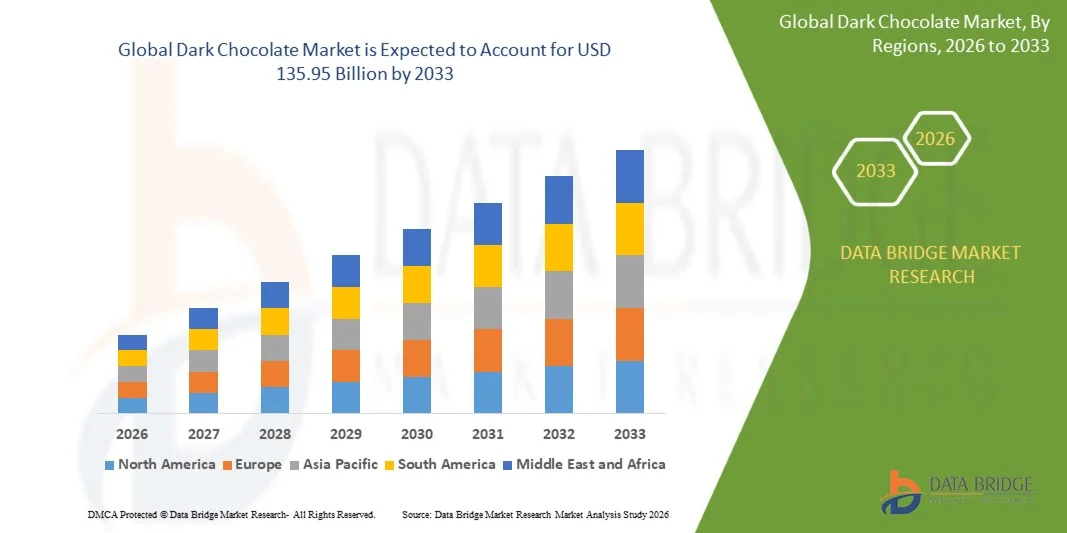
- As per Data Bridge Market Research analysis, the dark chocolate market was valued at USD 73.45 billion in 2025 and is projected to reach USD 135.95 billion by 2033, growing at a CAGR of 8.0% from 2026 to 2033.
- The market is experiencing steady growth driven by the rising consumer awareness of dark chocolate’s antioxidant and health benefits, growing demand for premium and single-origin chocolate products, and expanding availability of dark chocolate variants catering to vegan, sugar-free, and organic dietary preferences.
- The growing consumer shift toward “better-for-you” indulgence products, combined with increasing willingness to pay a premium for high-cocoa-content, ethically sourced chocolate, is compelling manufacturers to expand their dark chocolate portfolios across multiple price tiers. Craft and artisanal chocolate makers are increasingly complementing large multinational brands, offering single-origin and bean-to-bar products that command premium pricing among discerning consumers.
- The growing influence of social media and food content creators showcasing premium chocolate tasting experiences is further raising consumer awareness of flavor nuances associated with different cocoa origins, percentages, and processing techniques, driving increased experimentation and category exploration among younger consumers.
Market Size & Forecast
- Global Market Value (2025): USD 73.45 Billion
- Expected Market Value (2033): USD 135.95 Billion
- Forecast CAGR (2026–2033): 8.0%
- Leading Region in 2025: Europe
- Fastest Growing Region: Asia-Pacific
What are the Major Takeaways of the Dark Chocolate Market?
- Europe dominated the global dark chocolate market with the largest revenue share of 38.24% in 2025, supported by a deeply established chocolate-making heritage, high per-capita chocolate consumption, and strong presence of leading premium chocolate manufacturers across Switzerland, Belgium, and Germany.
- Asia-Pacific is expected to be the fastest-growing region at a CAGR of 10.6% from 2026 to 2033, fueled by rising disposable incomes, growing Western-style snacking habits, and increasing premiumization of confectionery consumption across China, India, and Japan.
- The 70-79% cocoa content segment led the market with a 34.87% share in 2025, driven by its balanced flavor profile that appeals to both new dark chocolate consumers and enthusiasts seeking a moderate-intensity cocoa experience.
- The 80% and above cocoa content segment is the fastest-growing category, projected to register a CAGR of 9.8%, reflecting rising consumer interest in intensely rich, lower-sugar dark chocolate products perceived as offering greater health benefits.
- The chocolate bars product type segment dominated the product category with a 46.53% revenue share in 2025, led by their widespread availability, convenient portion sizing, and broad appeal across everyday snacking and gifting occasions.
- Supermarkets & hypermarkets accounted for 42.68% of the market share among distribution channels in 2025, preferred due to their wide product assortment and ability to offer both mainstream and premium dark chocolate brands under one roof.
- The organic dark chocolate category segment is the fastest-growing category, with a CAGR of 10.2%, driven by increasing consumer demand for ethically sourced, pesticide-free cocoa products supported by growing fair trade and sustainability certification awareness.
- The traditional dark chocolate ingredient type segment held a 62.14% share in 2025, reflecting its widespread consumer familiarity and broad availability across mainstream retail channels worldwide.
- The household/retail consumers end-user segment accounted for 68.92% of the market share in 2025, driven by widespread everyday snacking and gifting consumption patterns across all major markets.
Report Scope and Dark Chocolate Market Segmentation
|
Attributes |
Dark Chocolate Key Market Insights |
|
Segments Covered |
|
|
Countries Covered |
North America
Europe
Asia-Pacific
Middle East and Africa
South America
|
|
Key Market Players |
|
|
Market Opportunities |
|
|
Value Added Data Infosets |
|
What is the Key Trend in the Dark Chocolate Market?
- Chocolate manufacturers are increasingly launching single-origin and terroir-focused dark chocolate products that highlight the specific geographic source of cocoa beans, appealing to consumers seeking authenticity and transparency
- For instance, in March 2025, Mondelez International expanded its premium single-origin dark chocolate bar portfolio under its green and black's lines to feature beans sourced from certified sustainable farming cooperatives in Madagascar and Ecuador.
- Growing consumer interest in functional confectionery is driving the development of dark chocolate products fortified with added wellness ingredients such as probiotics, adaptogens, and plant-based proteins.
- For instance, in January 2026, ChocZero introduced a line of functional dark chocolates infused with immunity-boosting adaptogens and dietary plant fiber to target health-focused wellness buyers.
- Manufacturers are reformulating dark chocolate products with alternative sweeteners and reduced sugar content to target health-conscious consumers looking for lower-glycemic-index options without compromising taste.
- For instance, in February 2025, Lindt & Sprüngli expanded its sugar-reduced dark chocolate line utilizing natural sweetener blends (such as maltitol) to address growing demand for treats with lower overall sugar content.
- Strategic collaborations between chocolate manufacturers and specialty ingredient suppliers are enabling the creation of novel flavor combinations using exotic spices, fruits, and botanicals.
- For instance, in January 2025, Green & Black's launched a limited-edition dark chocolate collection featuring regional spice infusions—including cardamom, chili, and sea salt variants catering to consumers seeking adventurous taste experiences beyond traditional offerings.
What are the Key Drivers of the Dark Chocolate Market?
- The rising global consumer awareness of dark chocolate’s antioxidant content and potential cardiovascular health benefits has significantly increased demand for high-cocoa-content products among health-conscious snackers and confectionery consumers.
- For instance, in April 2025, Barry Callebaut expanded its dark chocolate manufacturing capacity in Europe to meet rising demand from both retail brands and food service customers seeking high-cocoa-content chocolate for premium product formulations.
- The growing global premiumization trend in confectionery, driven by increasing consumer willingness to pay more for higher-quality, ethically sourced, and distinctively flavored chocolate products, is driving sustained investment in premium and artisanal dark chocolate product lines.
- For instance, in December 2024, Ferrero Group expanded distribution of its premium dark chocolate gifting range to additional international markets, capitalizing on rising consumer demand for high-quality chocolate gifting options during festive seasons.
- The expanding influence of plant-based and flexitarian dietary trends is broadening the addressable consumer base for dark chocolate, as many dark chocolate formulations are naturally free from dairy ingredients, positioning the category favorably within the growing plant-based snacking and confectionery movement.
- For instance, in April 2025, major confectionery brand Lindt & Sprüngli expanded its targeted plant-based marketing initiatives to highlight its naturally dairy-free high-cocoa dark chocolate blocks as core offerings for flexitarian snackers, capitalizing on the rising mainstream adoption of plant-based diets.
- With rising health consciousness, growing premiumization trends, and expanding consumer interest in ethically sourced and functionally enhanced confectionery, dark chocolate will remain one of the fastest-growing categories within the global food and beverage industry.
Which Factors are Challenging the Growth of the Dark Chocolate Market?
- The dark chocolate market faces significant exposure to cocoa price volatility, as global cocoa supply remains concentrated in a limited number of West African producing countries vulnerable to adverse weather conditions, crop disease, and political instability.
- These supply chain vulnerabilities create unpredictable input cost fluctuations for manufacturers, often requiring price adjustments that can affect consumer demand, particularly in price-sensitive market segments.
- For instance, in September 2024, global cocoa prices reached multi-year highs following adverse weather conditions and crop disease outbreaks in major West African producing regions, prompting several chocolate manufacturers to implement price increases across their dark chocolate product lines.
- Growing regulatory scrutiny of cocoa supply chains related to child labor and deforestation concerns, particularly under new European Union due diligence regulations, is requiring manufacturers to invest significantly in supply chain traceability and certification systems, adding to production costs.
- The inherently bitter taste profile of higher-cocoa-content dark chocolate continues to limit its appeal among mainstream confectionery consumers accustomed to sweeter milk chocolate products. This taste preference barrier slows broader market penetration beyond core dark chocolate enthusiasts, limiting the pace of category expansion despite growing health-driven interest in high-cocoa-content products.
How is the Dark Chocolate Market Segmented?
The dark chocolate market is segmented on the basis of cocoa content, product type, category, ingredient type, distribution channel, and end user.
- By Cocoa Content
On the basis of cocoa content, the global dark chocolate market is segmented into 50-59% cocoa, 60-69% cocoa, 70-79% cocoa, and 80% and above cocoa. The 70-79% cocoa segment dominated the market with a 34.87% share in 2025, owing to its balanced flavor profile that appeals to both new dark chocolate consumers and enthusiasts seeking a moderate-intensity cocoa experience. These products remain the preferred entry point for mainstream consumers transitioning from milk chocolate to darker chocolate varieties.
The 80% and above cocoa segment is projected to register the fastest growth at a CAGR of 9.8% from 2026 to 2033, driven by rising consumer interest in intensely rich, lower-sugar dark chocolate products perceived as offering greater health benefits. Growing availability of high-cocoa-content products with improved flavor profiles through advanced conching and tempering techniques is accelerating segment expansion.
- By Product Type
On the basis of product type, the global dark chocolate market is segmented into chocolate bars, chocolate chips & chunks, chocolate truffles & pralines, chocolate spreads, and others. The chocolate bars segment led the market with a 46.53% share in 2025, supported by widespread availability, convenient portion sizing, and broad appeal across everyday snacking and gifting occasions.
The chocolate truffles & pralines segment is expected to experience the fastest growth at a CAGR of 9.4% from 2026 to 2033, driven by rising demand for premium gifting products and increasing consumer interest in artisanal, handcrafted confectionery experiences for special occasions and celebrations.
- By Category
On the basis of category, the global dark chocolate market is segmented into organic dark chocolate and conventional dark chocolate. The conventional dark chocolate segment dominated the market with a share of 78.65% in 2025 due to its widespread availability, established supply chains, and lower price points compared to certified organic alternatives. the continued dominance of major multinational chocolate brands in mainstream retail channels is reinforcing this segment’s leading position.
The organic dark chocolate segment is expected to witness the fastest CAGR of 10.2% from 2026 to 2033, driven by this growth is fueled by increasing consumer demand for ethically sourced, pesticide-free cocoa products supported by growing fair trade and sustainability certification awareness among environmentally conscious consumers.
- By Ingredient Type
On the basis of ingredient type, the global dark chocolate market is segmented into vegan/dairy-free dark chocolate, sugar-free/low-sugar dark chocolate, and traditional dark chocolate. The traditional dark chocolate segment dominated the market with a share of 62.14% in 2025 due to its widespread consumer familiarity and broad availability across mainstream retail channels. established manufacturing processes and consumer taste preferences continue to support strong demand for traditional dark chocolate formulations.
The vegan/dairy-free dark chocolate segment is expected to witness the fastest CAGR of 11.3% from 2026 to 2033, driven by rising adoption of plant-based diets and growing consumer awareness that many dark chocolate varieties are naturally dairy-free, positioning the category favorably within the broader plant-based food movement.
- By Distribution Channel
On the basis of distribution channel, the global dark chocolate market is segmented into supermarkets & hypermarkets, convenience stores, specialty stores, and online retail. The supermarkets & hypermarkets segment dominated the market with a share of 42.68% in 2025 due to their wide product assortment and ability to offer both mainstream and premium dark chocolate brands under one roof. the widespread consumer preference for one-stop grocery shopping continues to reinforce this segment’s leading position.
The online retail segment is expected to witness the fastest CAGR of 12.1% from 2026 to 2033, driven by rising consumer preference for convenient home delivery, growing availability of subscription-based premium chocolate services, and increasing direct-to-consumer sales strategies adopted by artisanal and craft chocolate brands.
- By End User
On the basis of end user, the global dark chocolate market is segmented into household/retail consumers, food service, and industrial/B2B. The household/retail consumers segment dominated the market with a share of 68.92% in 2025 due to widespread everyday snacking and gifting consumption patterns across all major markets. the continued expansion of premium and mainstream dark chocolate product availability in retail channels is reinforcing this segment’s leading position.
The industrial/B2B segment is expected to witness the fastest CAGR of 9.1% from 2026 to 2033, driven by rising demand from bakery, confectionery, and dessert manufacturers incorporating high-cocoa-content dark chocolate into their product formulations to capitalize on growing consumer preference for premium, dark-chocolate-flavored baked goods and desserts.
Which Region Holds the Largest Share of the Dark Chocolate Market?
- Europe dominated the dark chocolate market and accounted for the largest revenue share of 38.24% in 2025, supported by a deeply established chocolate-making heritage, high per-capita chocolate consumption, and strong presence of leading premium chocolate manufacturers across the region.
- The region also benefits from a long-standing culture of artisanal chocolate craftsmanship, well-developed cocoa processing infrastructure, and strong consumer awareness of premium and single-origin chocolate products. Continued focus on ethical sourcing and sustainability certification continues to strengthen Europe’s leadership position in the global market.
Germany Dark Chocolate Market Insight
Germany dark chocolate market is growing steadily, supported by strong domestic chocolate consumption traditions, a well-established confectionery manufacturing base, and rising consumer interest in high-cocoa-content and organic chocolate products. Manufacturers continue to expand product portfolios to address growing demand for ethically sourced and functionally enhanced dark chocolate options. Continued consumer focus on premium quality and sustainability certification is further driving market growth in Germany.
Switzerland Dark Chocolate Market Insight
Switzerland dark chocolate market benefits from the country’s globally recognized chocolate-making heritage, presence of leading premium chocolate manufacturers, and strong domestic and export demand for high-quality dark chocolate products. Swiss chocolatiers continue to emphasize traditional conching techniques and premium cocoa sourcing to maintain their reputation for superior quality. Continued innovation in sustainable cocoa sourcing and premium product development is further reinforcing Switzerland’s position as a key market for dark chocolate.
Asia-Pacific Dark Chocolate Market Insight
The Asia-Pacific dark chocolate market is expected to witness rapid growth, driven by rising disposable incomes, growing Western-style snacking habits, and increasing premiumization of confectionery consumption across countries such as China, India, and Japan. Growing consumer awareness of dark chocolate’s health benefits and rising demand for premium gifting products during festive occasions are supporting regional market expansion. Additionally, the growing presence of international chocolate brands establishing regional manufacturing and distribution networks is accelerating market adoption across the region.
China Dark Chocolate Market Insight
The China dark chocolate market is growing rapidly, driven by rising middle-class disposable incomes, increasing Western-style snacking adoption, and growing consumer interest in premium and imported confectionery products. Growing availability of dark chocolate products across both physical retail and e-commerce platforms is significantly boosting market demand. In addition, rising domestic premium confectionery manufacturing capabilities and increasing health awareness among urban consumers are positioning China as one of the fastest-growing markets for dark chocolate globally.
India Dark Chocolate Market Insight
The India dark chocolate market is witnessing robust growth, driven by rising disposable incomes, growing urban health consciousness, and increasing consumer interest in premium confectionery gifting during festive occasions. Growing availability of both international and domestic dark chocolate brands across modern retail and e-commerce channels is supporting market expansion. Additionally, rising domestic cocoa processing capabilities and growing consumer awareness of dark chocolate’s health benefits are further accelerating adoption across the country.
Which are the Top Companies in Dark Chocolate Market?
The dark chocolate industry is primarily led by well-established companies, including:
- Mondelez International, Inc. (U.S.)
- Nestlé S.A. (Switzerland)
- The Hershey Company (U.S.)
- Mars, Incorporated (U.S.)
- Ferrero Group (Italy)
- Lindt & Sprüngli AG (Switzerland)
- Barry Callebaut AG (Switzerland)
- Yıldız Holding (Turkey)
- Ghirardelli Chocolate Company (U.S.)
- Guittard Chocolate Company (U.S.)
- Valrhona S.A.S. (France)
- Alter Eco Americas, Inc. (U.S.)
- Endangered Species Chocolate, LLC (U.S.)
- Fuji Oil Company Ltd. (Japan)
- Divine Chocolate Ltd. (U.K.)
- Theo Chocolate, Inc. (U.S.)
- Alfred Ritter GmbH & Co. KG (Ritter Sport) (Germany)
- August Storck KG (Germany)
- Puratos Group (Belgium)
- Cémoi Group (France)
What are Latest Developments in Dark Chocolate Market?
- In September 2025, Lindt & Sprüngli launched a new single-origin dark chocolate collection sourced from certified sustainable cocoa farms in Peru and Madagascar, emphasizing full supply chain traceability and distinctive regional flavor profiles targeting premium chocolate enthusiasts.
- In January 2025, Barry Callebaut expanded its dark chocolate production facility in Asia-Pacific to increase manufacturing capacity and meet rising demand from regional confectionery and bakery manufacturers seeking high-cocoa-content chocolate ingredients.
- In November 2025, Hershey introduced an expanded organic dark chocolate bar range featuring reduced sugar content and fair trade certified cocoa sourcing, targeting health-conscious consumers seeking premium, ethically sourced confectionery options.
- In November 2024, Ghirardelli launched a new vegan dark chocolate baking chip product line, expanding its ingredient offerings for home bakers and food service customers seeking dairy-free dessert formulation options.
- In June 2023, Alter Eco partnered with several cocoa farming cooperatives in Ecuador and the Dominican Republic to expand its regenerative agriculture sourcing program, demonstrating improved soil health outcomes while maintaining consistent premium cocoa quality for its organic dark chocolate product line.
- In August 2024, Mondelez International expanded its Green & Black’s organic dark chocolate range with new high-cocoa-content variants, targeting growing consumer demand for premium organic confectionery options across European and North American markets.

- Interactive Data Analysis Dashboard
- Company Analysis Dashboard for high growth potential opportunities
- Research Analyst Access for customization & queries
- Competitor Analysis with Interactive dashboard
- Latest News, Updates & Trend analysis
- Harness the Power of Benchmark Analysis for Comprehensive Competitor Tracking
Global Dark Chocolate Market, Supply Chain Analysis and Ecosystem Framework
To support market growth and help clients navigate the impact of geopolitical shifts, DBMR has integrated in-depth supply chain analysis into its Global Dark Chocolate Market research reports. This addition empowers clients to respond effectively to global changes affecting their industries. The supply chain analysis section includes detailed insights such as Global Dark Chocolate Market consumption and production by country, price trend analysis, the impact of tariffs and geopolitical developments, and import and export trends by country and HSN code. It also highlights major suppliers with data on production capacity and company profiles, as well as key importers and exporters. In addition to research, DBMR offers specialized supply chain consulting services backed by over a decade of experience, providing solutions like supplier discovery, supplier risk assessment, price trend analysis, impact evaluation of inflation and trade route changes, and comprehensive market trend analysis.
Data collection and base year analysis are done using data collection modules with large sample sizes. The stage includes obtaining market information or related data through various sources and strategies. It includes examining and planning all the data acquired from the past in advance. It likewise envelops the examination of information inconsistencies seen across different information sources. The market data is analysed and estimated using market statistical and coherent models. Also, market share analysis and key trend analysis are the major success factors in the market report. To know more, please request an analyst call or drop down your inquiry.
The key research methodology used by DBMR research team is data triangulation which involves data mining, analysis of the impact of data variables on the market and primary (industry expert) validation. Data models include Vendor Positioning Grid, Market Time Line Analysis, Market Overview and Guide, Company Positioning Grid, Patent Analysis, Pricing Analysis, Company Market Share Analysis, Standards of Measurement, Global versus Regional and Vendor Share Analysis. To know more about the research methodology, drop in an inquiry to speak to our industry experts.
Data Bridge Market Research is a leader in advanced formative research. We take pride in servicing our existing and new customers with data and analysis that match and suits their goal. The report can be customized to include price trend analysis of target brands understanding the market for additional countries (ask for the list of countries), clinical trial results data, literature review, refurbished market and product base analysis. Market analysis of target competitors can be analyzed from technology-based analysis to market portfolio strategies. We can add as many competitors that you require data about in the format and data style you are looking for. Our team of analysts can also provide you data in crude raw excel files pivot tables (Fact book) or can assist you in creating presentations from the data sets available in the report.













