


What is the Data Center CPU Market Size and Growth Rate?
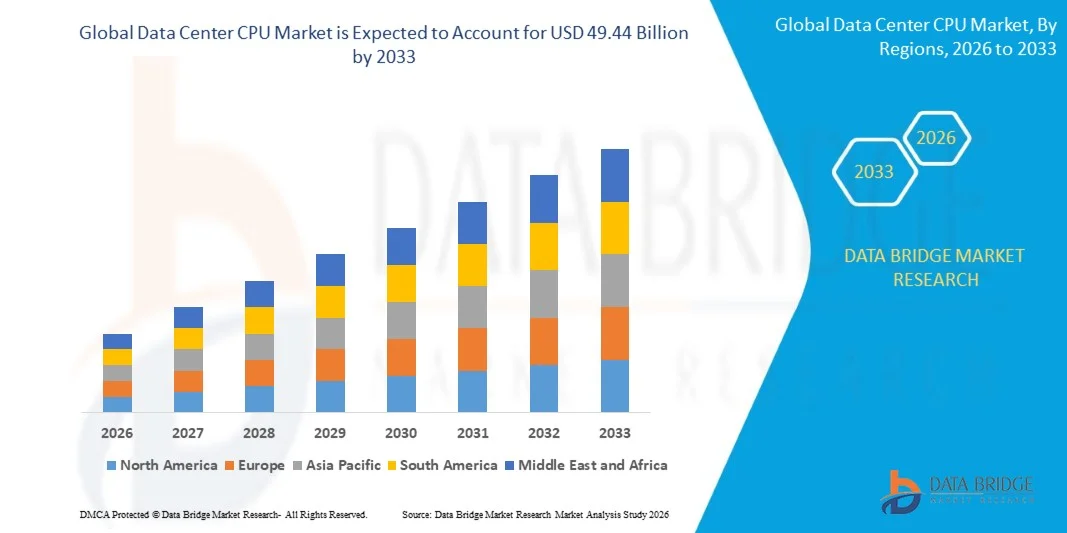
- As per Data Bridge Market Research analysis, the data center CPU market was valued at USD 21.30 billion in 2025 and is projected to reach USD 49.44 billion by 2033, growing at a CAGR of 11.10% from 2026 to 2033.
- The market is experiencing consistent growth driven by rising demand for high-performance computing, rapid advancements in server processor technologies, and expanding data center infrastructure to support cloud computing, artificial intelligence, machine learning, and other data-intensive workloads.
- The increasing adoption of cloud services and AI-driven applications globally, combined with growing investments in hyperscale and enterprise data centers, is compelling organizations to deploy advanced CPUs with higher processing capabilities and energy efficiency. Multi-core, high-performance, and AI-optimized processors are increasingly being adopted to support scalable computing, virtualization, real-time analytics, and intensive workloads across modern data center environments.
Market Size & Forecast
- Global Market Value (2025): USD 21.30 Billion
- Expected Market Value (2033): USD 49.44 Billion
- Forecast CAGR (2026–2033): 11.10%
- Leading Region in 2025: North America
- Fastest Growing Region: Asia Pacific
What are the Major Takeaways of the Data Center CPU Market?
- North America dominated the data center CPU market with the largest revenue share of 41.0% in 2025, supported by the strong presence of hyperscale cloud providers, rapid AI infrastructure deployment, and significant investments in high-performance computing infrastructure
- Asia-Pacific is expected to be the fastest-growing region at a CAGR of 13.5% from 2026 to 2033, fueled by expanding hyperscale data center investments, accelerating cloud adoption, digital transformation initiatives, and increasing AI workload deployments across China, India, Japan, and Southeast Asia.
- The x86 processors segment led the market with a 72.4% share in 2025, driven by its extensive deployment across enterprise servers, hyperscale cloud infrastructure, and mission-critical workloads.
- ARM processors are the fastest-growing type, projected to register a CAGR of 16.8%, reflecting the surge in demand for energy-efficient computing and customized processor architectures.
- The hyperscale segment dominated the data centre category with a 49.8% revenue share in 2025, led by rapid expansion of cloud service providers and increasing AI infrastructure investments
- 64-core accounted for 31.6% of the market share in 2025, preferred by the widespread deployment across hyperscale cloud platforms and enterprise virtualization environments.
- The machine learning segment is the fastest-growing application category, with a CAGR of 15.9%, driven by expanding adoption of predictive analytics, intelligent automation, and enterprise AI solutions.
Report Scope and Data Center CPU Market Segmentation
|
Attributes |
Data Center CPU Key Market Insights |
|
Segments Covered |
|
|
Countries Covered |
North America
Europe
Asia-Pacific
Middle East and Africa
South America
|
|
Key Market Players |
|
|
Market Opportunities |
|
|
Value Added Data Infosets |
In addition to the insights on market scenarios such as market value, growth rate, segmentation, geographical coverage, and major players, the market reports curated by the Data Bridge Market Research also include in-depth expert analysis, geographically represented company-wise production and capacity, network layouts of distributors and partners, detailed and updated price trend analysis and deficit analysis of supply chain and demand. |
What is the Key Trend in the Data Center CPU Market?
- Data center CPU development is increasingly shifting toward high-core-count, AI-optimized, and energy-efficient processors capable of supporting cloud computing, artificial intelligence, high-performance computing, and other compute-intensive workloads.
- For instance, in February 2025, Intel launched new Xeon 6 processors with Performance-cores, delivering up to 2x higher AI processing performance while improving performance-per-watt for modern data center workloads.
- Hyperscale cloud providers are increasingly adopting customized and alternative CPU architectures to improve computing efficiency, workload scalability, and total cost of ownership across large-scale infrastructure deployments.
- Growing AI workloads are also driving CPU innovation toward tighter integration with GPUs, accelerators, high-bandwidth memory, and advanced networking technologies to prevent processor bottlenecks.
- For instance, in May 2025, Intel introduced three Xeon 6 processors specifically designed to manage GPU-powered AI systems, featuring technologies that dynamically boost CPU frequencies for demanding AI workloads.
- As cloud providers and enterprises continue prioritizing AI performance, computing density, and energy efficiency, demand for advanced data center CPUs is expected to accelerate, reinforcing processor innovation as a core infrastructure priority.
What are the Key Drivers of the Data Center CPU Market?
- The rapid expansion of artificial intelligence, machine learning, and generative AI workloads is significantly increasing demand for high-performance CPUs capable of supporting data preprocessing, inference, virtualization, orchestration, and accelerator-based computing environments.
- For instance, in April 2025, Google Cloud introduced new C4D and H4D virtual machines powered by 5th Gen AMD EPYC processors, with C4D delivering up to 80% higher throughput per vCPU than previous generations.
- Hyperscale cloud providers, enterprises, and colocation operators are expanding server infrastructure to accommodate growing cloud services, digital applications, data analytics, and AI workloads requiring scalable and reliable computing capacity.
- For instance, in March 2025, Oracle expanded its cloud infrastructure with Compute E6 shapes powered by 5th Gen AMD EPYC processors, delivering up to 2x higher cost performance compared with its previous E5 generation.
- With AI adoption, cloud migration, and data-intensive applications continuing to expand globally, the need for higher processing performance, greater core density, and improved energy efficiency will remain a major driver of data center CPU demand.
What Factors are Challenging the Growth of the Data Center CPU Market?
- Advanced data center CPUs require substantial investment in semiconductor design, leading-edge manufacturing processes, server platforms, cooling systems, and supporting infrastructure, increasing procurement and deployment costs for data center operators.
- For instance, in September 2026, FERC directed PJM to revise its electricity procurement plan amid a 6,800-MW power shortfall associated with rapidly increasing demand from data centers, highlighting infrastructure pressures linked to expansion.
- Rising electricity consumption from increasingly dense computing infrastructure also creates pressure to improve CPU efficiency, particularly as AI workloads require significantly greater processing capacity and continuous operation.
- For instance, in July 2026, Reuters reported that server CPU prices in China had increased by more than 40% since the beginning of the year, while Intel and AMD faced server CPU order wait times of up to six months amid surging demand.
- Supply constraints and rising processor prices can further delay server deployments, particularly when strong AI infrastructure demand increases competition for advanced server CPUs and semiconductor manufacturing capacity.
How is the Data Center CPU Market Segmented?
The data center CPU market is segmented on the basis of type, data centre, number of CPU core, server form factor, and application.
- By Type
On the basis of type, the data center CPU market is segmented into x86 processors, ARM processors, and power processors. The x86 processors segment dominated the market with a 72.4% share in 2025, owing to its extensive deployment across enterprise servers, hyperscale cloud infrastructure, and mission-critical workloads. x86 processors provide broad compatibility with established enterprise software and virtualization platforms. Major data center operators continue to rely on x86-based server processors for cloud computing and high-performance workloads. Continuous improvements in core density and processing efficiency are strengthening their performance capabilities. The mature x86 ecosystem also provides extensive hardware, software, and OEM support.
The ARM processors segment is projected to register the fastest growth at a CAGR of 16.8% from 2026 to 2033, driven by increasing demand for energy-efficient computing and customized processor architectures. ARM-based CPUs offer strong performance-per-watt characteristics for cloud-native workloads. Hyperscale providers are increasingly deploying customized ARM processors across their data center environments. Growing electricity consumption is encouraging operators to prioritize energy-efficient processor architectures. Improvements in software compatibility are also supporting broader adoption beyond specialized cloud workloads. Increasing AI infrastructure deployment is further creating demand for efficient server processors.
- By Data Centre
On the basis of data centre, the market is segmented into hyperscale, enterprise, colocation, and edge. The hyperscale segment dominated the market with a 49.8% share in 2025, driven by rapid expansion of cloud service providers and increasing AI infrastructure investments. Hyperscale facilities require large volumes of high-performance CPUs to support extensive computing workloads. Increasing cloud adoption is encouraging continued expansion of hyperscale infrastructure. Growing AI and data analytics workloads are also increasing demand for advanced server processors. High server density creates additional requirements for powerful and efficient CPUs. Continuous infrastructure expansion and server upgrades further support processor demand.
The edge segment is anticipated to register the fastest growth at a CAGR of 15.2% from 2026 to 2033, fueled by increasing deployment of 5G, IoT, and latency-sensitive applications. Edge data centers require compact and energy-efficient processors for localized computing. Growing demand for real-time analytics is encouraging processing closer to end users. Autonomous systems and industrial automation are also increasing requirements for distributed computing capabilities. Advancements in low-power CPU architectures are improving the suitability of processors for edge environments. Enterprises are increasingly adopting distributed infrastructure to reduce latency and network congestion. These developments are expected to accelerate CPU deployment across edge data center environments.
- By Number of CPU Core
On the basis of number of CPU core, the market is segmented into 1-core, 2-core, 3-core, 4-core, 8-core, 16-core, 32-core, 64-core, 128-core, and others. The 64-core segment dominated the market with a 31.6% share in 2025, supported by widespread deployment across hyperscale cloud platforms and enterprise virtualization environments. High-core-count processors allow data centers to consolidate multiple workloads on fewer physical servers. They provide substantial processing capacity for virtualization, analytics, and cloud applications. Increasing demand for workload consolidation is supporting adoption of high-core-count CPUs. Improvements in processor architecture and memory capabilities are further enhancing their performance. Data center operators are also prioritizing greater computing density within existing infrastructure.
The 128-core segment is projected to register the fastest growth at a CAGR of 17.1% from 2026 to 2033, driven by increasing demand for AI workloads and high-performance computing. Ultra-high-core-count processors enable greater parallel processing capacity for demanding workloads. The growing complexity of generative AI and large-scale analytics is increasing requirements for advanced server processors. Hyperscale operators are adopting higher-core configurations to improve computing density. Improvements in memory bandwidth and processor architecture are further enhancing high-core-count CPU performance. Growing investment in AI infrastructure is creating additional demand for powerful server CPUs. The increasing use of computationally intensive applications is expected to accelerate adoption of 128-Core processors.
- By Server Form Factor
On the basis of server form factor, the market is segmented into rack servers (1U/2U/4U), blade servers, tower servers, and microservers. The rack servers (1U/2U/4U) segment dominated the market with a 61.3% share in 2025, driven by widespread deployment across hyperscale and enterprise data centers. Rack servers provide efficient utilization of data center floor space while supporting high computing density. Their standardized architecture allows organizations to integrate high-performance CPUs and networking technologies efficiently. They are widely deployed for cloud computing, virtualization, enterprise applications, and AI workloads. Compatibility with high-core-count processors further supports their adoption. Their scalability allows data center operators to expand computing capacity according to workload requirements.
The microservers segment is projected to witness the fastest growth at a CAGR of 14.8% from 2026 to 2033, driven by growing adoption of lightweight workloads, edge computing, and energy-efficient infrastructure. Microservers provide compact computing solutions for applications that do not require conventional high-capacity servers. Their lower power requirements make them suitable for distributed computing environments. Increasing deployment of edge applications is creating additional demand for compact server platforms. ARM-based processor development is also improving microserver performance and efficiency. Growing emphasis on reducing data center power consumption is supporting interest in smaller server architectures. Increasing use in lightweight cloud and distributed workloads is expected to sustain segment growth.
- By Application
On the basis of application, the market is segmented into web hosting, cloud computing, high performance computing, artificial intelligence, machine learning, and big data analytics. The Artificial Intelligence segment dominated the market with 37% share in 2025, supported by rapid adoption of generative AI, large language models, and enterprise AI applications. AI workloads require CPUs for data preparation, workload orchestration, inference, and communication with specialized accelerators. Hyperscale cloud providers are expanding AI-ready infrastructure to accommodate increasing computational requirements. Enterprises are also deploying AI applications across multiple business functions. Increasing integration of CPUs with GPUs and other accelerators is improving heterogeneous computing capabilities.
The machine learning segment is expected to register the fastest growth at a CAGR of 15.9% from 2026 to 2033, driven by expanding adoption of predictive analytics, intelligent automation, and enterprise AI solutions. Machine learning workloads require scalable computing infrastructure for data processing, model development, and inference. Organizations across multiple industries are increasingly incorporating machine learning into operational and analytical processes. Cloud-based machine learning platforms are further expanding access to these technologies. Increasing model complexity is generating greater demand for efficient server processors. Advances in heterogeneous computing are also improving CPU utilization within machine learning environments. Rising investment in AI infrastructure is expected to support continued growth in CPU demand from machine learning applications.
Which Region Holds the Largest Share of the Data Center CPU Market?
- North America dominated the data center CPU market with the largest revenue share of 41.0% in 2025, supported by the strong presence of hyperscale cloud providers, rapid AI infrastructure deployment, and significant investments in high-performance computing infrastructure.
- The region also benefits from rapid adoption of generative AI workloads, continuous expansion of hyperscale and colocation data centers, and strong investments by major technology companies in next-generation cloud infrastructure. Increasing demand for AI-optimized processors, enterprise digital transformation, and advanced server architectures continues to strengthen North America’s leadership position in the global market.
U.S. Data Center CPU Market Insight
The U.S. data center CPU market is witnessing strong growth due to rising investments in hyperscale cloud infrastructure, artificial intelligence (AI) computing, and high-performance data center expansion. The country’s mature cloud ecosystem, along with increasing deployment of AI-optimized server processors, is driving demand across enterprise, government, and research applications. In addition, growing adoption of advanced computing infrastructure and continued expansion of hyperscale facilities are accelerating demand for high-performance and energy-efficient CPUs.
Asia-Pacific Data Center CPU Market Insight
The Asia-Pacific data center CPU market is expected to witness rapid growth, driven by increasing AI adoption, expanding cloud infrastructure, and accelerating digitalization across countries such as China, Japan, India, and South Korea. Growing investments in hyperscale data centers, AI computing infrastructure, and high-performance computing are supporting regional market expansion. In addition, the increasing presence of neocloud providers and rising demand for specialized computing capacity are accelerating the deployment of advanced CPUs across the region.
Japan Data Center CPU Market Insight
The Japan data center CPU market is witnessing consistent growth due to rising investments in AI infrastructure, cloud computing, and advanced data center technologies. Data center operators, technology companies, and enterprises are increasingly deploying high-performance processors to support AI workloads, cloud services, and data-intensive applications. Moreover, increasing investments in AI-focused data centers and the country’s emphasis on strengthening domestic digital infrastructure are further contributing to market growth in Japan.
China Data Center CPU Market Insight
The China data center CPU market is growing rapidly, driven by increasing AI adoption, expanding cloud infrastructure, and rising demand for high-performance computing capabilities. Technology companies are investing heavily in AI infrastructure and data center capacity to support growing workloads, while demand for advanced processors continues to increase across cloud and enterprise applications. In addition, China’s expanding AI ecosystem and continued investments in computing infrastructure are positioning the country as a major growth market for data center CPUs.
U.K. Data Center CPU Market Insight
The U.K. data center CPU market is experiencing steady growth, supported by rising adoption of AI, cloud computing, and high-density data center infrastructure. Increasing investments by hyperscalers and neocloud providers are creating demand for advanced computing capacity capable of supporting AI training, inference, and cloud workloads. Furthermore, the expansion of data center capacity and growing focus on AI-ready infrastructure are supporting the adoption of high-performance and energy-efficient CPUs across the U.K.
Germany Data Center CPU Market Insight
The Germany data center CPU market is expanding steadily due to the country’s strong digital infrastructure, growing demand for cloud services, and increasing adoption of AI and big data technologies. Data center operators and enterprises are increasingly investing in advanced computing infrastructure to support data-intensive workloads, digital transformation, and high-performance applications. Moreover, Germany’s focus on energy efficiency, sustainability, and secure data center infrastructure is further driving demand for efficient next-generation CPU technologies.
Which are the Top Companies in Data Center CPU Market?
The data center CPU industry is primarily led by well-established companies, including:
- Intel Corporation (U.S.)
- Advanced Micro Devices, Inc. (U.S.)
- NVIDIA Corporation (U.S.)
- Ampere Computing LLC (U.S.)
- Arm Limited (U.K.)
- Qualcomm Technologies, Inc. (U.S.)
- IBM (U.S.)
- Oracle (U.S.)
- Marvell (U.S.)
- Fujitsu (Japan)
- Huawei Technologies Co., Ltd. (China)
- Siemens (Germany)
- SiPearl (France)
- Loongson Technology Corporation Limited (China)
- Phytium Technology Co., Ltd. (China)
- Hygon Information Technology Co., Ltd. (China)
- Amazon Web Services, Inc. (U.S.)
- Microsoft Corporation (U.S.)
- Google LLC (U.S.)
- Alibaba Cloud (China)
What are Latest Developments in Data Center CPU Market?
- In February 2025, Intel launched its Xeon 6 processors with Performance-cores (P-cores), designed to address modern data center and AI workloads. The new processors provide enhanced performance and energy efficiency and are designed to serve as host CPUs for AI systems, strengthening Intel’s data center processor portfolio for cloud, enterprise, and AI applications.
- In October 2024, AMD launched its 5th Gen AMD EPYC processors for modern data center workloads. Based on the Zen 5 architecture, the EPYC 9005 Series was introduced for enterprise, AI, and cloud applications, with a broad range of processor configurations and improvements in performance and energy efficiency.
- In April 2024, Google introduced its Axion processors, its first custom Arm-based CPUs designed specifically for data centers. The processors were developed to provide high performance and energy efficiency for workloads including information retrieval, cloud services, and generative AI, highlighting the growing adoption of custom Arm-based CPU architectures in data centers.
- In May 2022, AWS announced the general availability of Amazon EC2 C7g instances powered by AWS-designed Graviton3 processors. The new Arm-based processors were developed to deliver improved performance and energy efficiency for compute-intensive workloads, including high-performance computing, machine learning inference, scientific modeling, and distributed analytics.
- In March 2022, AMD announced the general availability of its 3rd Gen EPYC processors with 3D V-Cache technology. The Milan-X processors represented a significant advancement in data center CPU design by incorporating 3D die stacking and expanded cache capacity, targeting technical computing workloads and strengthening AMD’s high-performance server processor portfolio

- Interactive Data Analysis Dashboard
- Company Analysis Dashboard for high growth potential opportunities
- Research Analyst Access for customization & queries
- Competitor Analysis with Interactive dashboard
- Latest News, Updates & Trend analysis
- Harness the Power of Benchmark Analysis for Comprehensive Competitor Tracking
Global Data Center Cpu Market, Supply Chain Analysis and Ecosystem Framework
To support market growth and help clients navigate the impact of geopolitical shifts, DBMR has integrated in-depth supply chain analysis into its Global Data Center Cpu Market research reports. This addition empowers clients to respond effectively to global changes affecting their industries. The supply chain analysis section includes detailed insights such as Global Data Center Cpu Market consumption and production by country, price trend analysis, the impact of tariffs and geopolitical developments, and import and export trends by country and HSN code. It also highlights major suppliers with data on production capacity and company profiles, as well as key importers and exporters. In addition to research, DBMR offers specialized supply chain consulting services backed by over a decade of experience, providing solutions like supplier discovery, supplier risk assessment, price trend analysis, impact evaluation of inflation and trade route changes, and comprehensive market trend analysis.
Data collection and base year analysis are done using data collection modules with large sample sizes. The stage includes obtaining market information or related data through various sources and strategies. It includes examining and planning all the data acquired from the past in advance. It likewise envelops the examination of information inconsistencies seen across different information sources. The market data is analysed and estimated using market statistical and coherent models. Also, market share analysis and key trend analysis are the major success factors in the market report. To know more, please request an analyst call or drop down your inquiry.
The key research methodology used by DBMR research team is data triangulation which involves data mining, analysis of the impact of data variables on the market and primary (industry expert) validation. Data models include Vendor Positioning Grid, Market Time Line Analysis, Market Overview and Guide, Company Positioning Grid, Patent Analysis, Pricing Analysis, Company Market Share Analysis, Standards of Measurement, Global versus Regional and Vendor Share Analysis. To know more about the research methodology, drop in an inquiry to speak to our industry experts.
Data Bridge Market Research is a leader in advanced formative research. We take pride in servicing our existing and new customers with data and analysis that match and suits their goal. The report can be customized to include price trend analysis of target brands understanding the market for additional countries (ask for the list of countries), clinical trial results data, literature review, refurbished market and product base analysis. Market analysis of target competitors can be analyzed from technology-based analysis to market portfolio strategies. We can add as many competitors that you require data about in the format and data style you are looking for. Our team of analysts can also provide you data in crude raw excel files pivot tables (Fact book) or can assist you in creating presentations from the data sets available in the report.













