


What is the Data Center Insulation Market Size and Growth Rate?
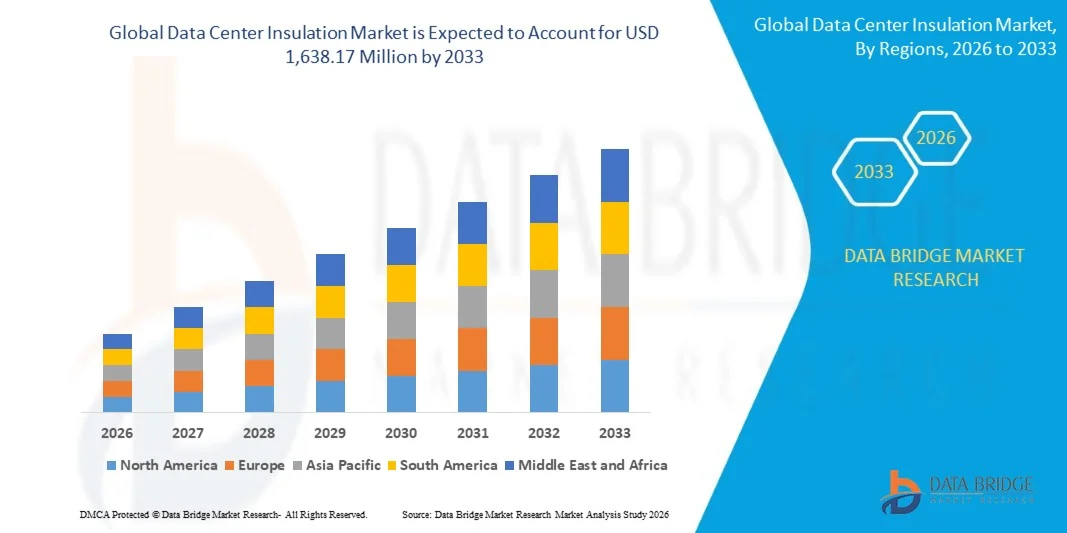
- As per Data Bridge Market Research analysis, the data center insulation market was valued at USD 582.40 million in 2025 and is projected to reach USD 1,638.17 million by 2033, growing at a CAGR of 13.80% from 2026 to 2033.
- The market is experiencing robust growth driven by the rapid build-out of global data center infrastructure, rising demand for energy-efficient cooling, and growing use of high-performance thermal and acoustic insulation to improve operating efficiency and cut energy use.
- The emphasis on sustainable and green data centers, stricter environmental regulation, and investment in hyperscale and edge facilities are encouraging operators to deploy advanced insulation. Materials such as mineral wool, elastomeric foam, and polyethylene foam are increasingly used to limit heat transfer, improve Power Usage Effectiveness (PUE), reduce HVAC energy demand, and support carbon-neutral data center goals.
Market Size & Forecast
- Global Market Value (2025): USD 582.40 million
- Expected Market Value (2033): USD 1,638.17 million
- Forecast CAGR (2026–2033): 13.80%
What are the Major Takeaways of the Data Center Insulation Market?
- North America dominated the data center insulation market with the largest revenue share of 37.4% in 2025, supported by a mature hyperscale data center ecosystem, strong cloud infrastructure investment, and wide adoption of energy-efficient cooling technologies.
- Asia-Pacific is expected to be the fastest-growing region at a CAGR of 16.8% from 2026 to 2033, fueled by rapid expansion of hyperscale and colocation data centers, accelerating cloud adoption, and rising digital infrastructure investment across China, India, and Southeast Asia.
- The thermal insulation segment led the market with a 64% share in 2025, driven by the need to control heat transfer, improve cooling efficiency, and reduce energy use in high-density data center environments.
- Acoustic insulation is the fastest-growing insulation type, projected to register a CAGR of 15.0%, reflecting concern over noise from cooling equipment, servers, and mechanical systems in modern data centers.
- The mineral wool segment dominated the material category with a 30.35% revenue share in 2025, led by its fire resistance, thermal performance, durability, and acoustic properties in critical infrastructure applications.
- Walls/ceilings accounted for 45% of the market share in 2025, preferred for maintaining controlled temperatures and limiting energy losses within data center buildings.
- The edge data centers segment is the fastest-growing data center type, with a CAGR of 17%, driven by demand for low-latency computing, IoT applications, and localized data processing.
Report Scope and Data Center Insulation Market Segmentation
|
Attributes |
Data Center Insulation Key Market Insights |
|
Segments Covered |
|
|
Countries Covered |
North America
Europe
Asia-Pacific
Middle East and Africa
South America
|
|
Key Market Players |
|
|
Market Opportunities |
|
|
Value Added Data Infosets |
In addition to the insights on market scenarios such as market value, growth rate, segmentation, geographical coverage, and major players, the market reports curated by the Data Bridge Market Research also include in-depth expert analysis, geographically represented company-wise production and capacity, network layouts of distributors and partners, detailed and updated price trend analysis and deficit analysis of supply chain and demand. |
What is the Key Trend in the Data Center Insulation Market?
- High-performance thermal insulation is increasingly adopted in hyperscale and AI-ready data centers to improve cooling efficiency, reduce HVAC energy consumption, and support sustainable digital infrastructure.
- For instance, in December 2024, ROCKWOOL approved an investment of more than USD 100 million in a new stone wool production line in Mississippi, expanding capacity for high-performance insulation used in mission-critical facilities, including data centers.
- Advanced insulation materials help operators keep operating temperatures stable, limit heat transfer, and improve energy performance in high-density computing environments.
- Manufacturers are developing products with better fire resistance, moisture protection, and acoustic performance to meet changing data center design requirements.
- For instance, in March 2024, Schneider Electric announced new sustainability reporting capabilities for its EcoStruxure IT platform, helping data center operators monitor energy consumption, automate regulatory reporting, and improve efficiency through data center infrastructure management (DCIM).
- As hyperscale, colocation, and AI data center deployments expand globally, demand for advanced insulation is expected to accelerate, making energy-efficient thermal management a critical element of next-generation digital infrastructure.
What are the Key Drivers of the Data Center Insulation Market?
- The rapid expansion of hyperscale, cloud, and AI data centers has significantly increased demand for insulation systems that improve thermal efficiency, reduce cooling loads, and lower overall energy consumption.
- For instance, in January 2025, Microsoft announced plans to invest approximately USD 80 billion in AI-enabled data centers during fiscal year 2025, supporting demand for high-performance building and thermal management solutions.
- Operators are investing in thermal and acoustic insulation to improve Power Usage Effectiveness (PUE), strengthen equipment reliability, and meet long-term sustainability objectives.
- For instance, in 2024, Google announced a USD 3 billion investment to expand data center campuses in Indiana and Virginia, reinforcing the need for energy-efficient infrastructure and advanced building insulation.
- As governments and enterprises prioritize energy-efficient digital infrastructure and carbon reduction, high-performance insulation will remain essential in data center construction and operation.
What Factors Are Challenging the Growth of the Data Center Insulation Market?
- Advanced insulation materials for mission-critical data centers often carry higher procurement and installation costs than conventional building insulation.
- These costs can discourage adoption among smaller colocation providers and enterprise data center operators with limited capital budgets.
- For instance, in April 2025, according to the International Energy Agency (IEA), global investment in data centers has nearly doubled since 2022, reaching approximately USD 500 billion in 2024, reflecting the capital intensity of building energy-efficient, high-performance facilities.
- Compliance with strict fire safety, moisture resistance, and energy-efficiency standards also adds design complexity and project cost for new facilities.
- For instance, in May 2024, according to Savills, European data center construction costs rose 6.5% annually to approximately USD 9.1 million per MW, owing to supply chain limits, inflation, labor shortages, and land constraints, raising financial barriers for new facilities.
- High capital investment, specialized installation needs, and evolving regulatory standards continue to limit market penetration, particularly in cost-sensitive and developing regions, despite rising demand for energy-efficient digital infrastructure.
How is the Data Center Insulation Market Segmented?
The data center insulation market is segmented on the basis of insulation type, material, material form, application, and data center type.
- By Insulation Type
On the basis of insulation type, the data center insulation market is segmented into thermal insulation and acoustic insulation. The thermal insulation segment dominated the market with a 64% revenue share in 2025, owing to the need to control heat transfer, improve cooling efficiency, and cut energy use in high-density environments. These materials stabilize operating temperatures by limiting heat gain and loss across data center structures. Growth of hyperscale and AI-driven facilities is increasing demand for efficient thermal management, which reduces HVAC workload and improves equipment reliability. The focus on green data centers and lower PUE further strengthens the segment.
The acoustic insulation segment is expected to witness the fastest growth at a CAGR of 15.0% during the forecast period, supported by concern over noise from cooling equipment, servers, and mechanical systems. Acoustic solutions reduce sound transmission and improve working conditions in facilities near commercial or populated areas. Construction of urban edge data centers is raising the need for noise control, and advanced materials are being built into walls, ceilings, and equipment enclosures to meet noise regulations. Modular and compact facilities create further opportunities.
- By Material
On the basis of material, the data center insulation market is segmented into flexible elastomeric foam, mineral wool, polyurethane foam, polyethylene foam, polystyrene foam, and others. The mineral wool segment dominated the market with an estimated 30.35% revenue share in 2025, owing to fire resistance, thermal performance, durability, and acoustic properties in critical infrastructure. It withstands high temperatures and absorbs sound effectively, which suits stringent fire safety requirements. Hyperscale construction is driving demand for long-life, reliable materials, and moisture resistance and dimensional stability add to its suitability.
The flexible elastomeric foam segment is expected to be the fastest-growing material category with an estimated CAGR of 16% during 2026–2033, driven by demand for lightweight, flexible, moisture-resistant insulation. It provides effective thermal insulation and prevents condensation around cooling systems, pipes, and HVAC components. Easy installation suits complex layouts, and energy-efficient cooling systems are increasing the need for insulation around mechanical infrastructure. Edge and modular data centers create additional opportunities.
- By Material Form
On the basis of material form, the data center insulation market is segmented into rigid insulation and flexible insulation. The rigid insulation segment dominated the market with an estimated 60.4% share in 2025, supported by extensive use in walls, ceilings, floors, and structural applications in large facilities. Rigid products offer high thermal resistance, structural stability, and long-term performance in permanent construction, and are widely used in hyperscale sites where environmental control is essential. Investment in large data center campuses supports continued demand.
The flexible insulation segment is projected to register the fastest growth with an estimated CAGR of 15.6% from 2026 to 2033, driven by adoption in modular data centers, cooling systems, and complex equipment layouts. Flexible materials are easy to install and conform to irregular surfaces and piping. Edge computing growth is raising demand for compact, easily installed insulation, while preference for scalable designs further supports adoption.
- By Application
On the basis of application, the data center insulation market is segmented into walls/ceilings, raised floors, pipes & ducts, and others. The walls/ceilings segment dominated the market with an estimated 45% share in 2025, due to adoption of insulation systems that maintain controlled temperatures and reduce energy loss within data center buildings. Insulating walls and ceilings blocks external heat and supports efficient cooling, which is especially important in hyperscale and colocation facilities. Fire resistance and acoustic control requirements add to demand.
The pipes & ducts segment is expected to be the fastest-growing application with an estimated CAGR of 16% during the forecast period, driven by demand for insulation around cooling infrastructure and HVAC systems. Insulating pipes and ducts reduces thermal losses, prevents condensation, and improves cooling efficiency. Liquid cooling and advanced HVAC in high-density computing, together with rising AI workloads and server power densities, are supporting demand.
- By Data Center Type
On the basis of data center type, the market is segmented into large/hyperscale data centers, modular/containerized data centers, and edge data centers. The large/hyperscale data centers segment dominated the market with a 58% share in 2025, driven by investment from cloud service providers, technology companies, and enterprises. These facilities generate high heat and consume large amounts of energy, so they need advanced insulation to improve cooling efficiency and support continuous operation. Expansion of AI, cloud computing, and big data is accelerating construction, making this the largest demand base.
The edge data centers segment is projected to be the fastest-growing data center type with an estimated CAGR of 17% from 2026 to 2033, supported by demand for low-latency computing, IoT applications, and localized data processing. Edge sites need compact, efficient insulation because of their small footprint and distributed deployment, and lightweight flexible materials are favored for ease of installation. Growth of 5G and real-time digital services is expanding edge infrastructure.
Which Region Holds the Largest Share of the Data Center Insulation Market?
- North America dominated the data center insulation market with the largest revenue share of 37.4% in 2025, supported by a mature hyperscale data center ecosystem, strong cloud infrastructure investment, and wide adoption of energy-efficient cooling technologies.
- The region also benefits from rising demand for advanced thermal management, stringent energy-efficiency standards, and growing deployment of AI-driven, high-density computing infrastructure. The focus on sustainable data centers, lower energy consumption, and better cooling performance continues to strengthen North America’s leadership.
U.S. Data Center Insulation Market Insight
The U.S. data center insulation market is witnessing strong growth due to rapid expansion of hyperscale data centers, increasing AI workloads, and investment in energy-efficient infrastructure. The strong presence of cloud providers such as Microsoft, Google, and Amazon, along with demand for thermal management, is driving adoption of high-performance insulation. In addition, the emphasis on reducing data center energy use and improving cooling efficiency is accelerating demand for thermal and acoustic systems. In January 2025, Microsoft announced plans to invest approximately USD 80 billion in AI-enabled data centers during fiscal year 2025.
Asia-Pacific Data Center Insulation Market Insight
The Asia-Pacific data center insulation market is expected to witness rapid growth, driven by expanding cloud computing, digitalization, and construction of hyperscale and edge data centers in China, India, Japan, and Singapore. Investment in data center capacity, adoption of AI applications, and a focus on energy-efficient infrastructure support regional expansion. In addition, government initiatives promoting digital transformation and sustainable data centers are accelerating demand for advanced thermal insulation.
Japan Data Center Insulation Market Insight
The Japan data center insulation market is witnessing consistent growth due to demand for energy-efficient data centers, rising adoption of cloud services, and government initiatives supporting digital infrastructure. Operators and technology companies are adopting advanced insulation to improve thermal performance, reduce cooling requirements, and support sustainable operations. Moreover, Japan’s focus on energy conservation, carbon reduction, and high-performance computing contributes to growth. The IEA has noted that data center electricity demand is rising globally because of AI and digital services, underscoring the importance of energy-efficient infrastructure.
China Data Center Insulation Market Insight
The China data center insulation market is growing rapidly, driven by expanding digital infrastructure, cloud computing adoption, and large-scale investment in AI and data processing facilities. Deployment of hyperscale data centers and government-supported digital economy initiatives boost demand for thermal management and insulation. In addition, the emphasis on energy efficiency, carbon reduction, and sustainable data centers positions China as one of the fastest-growing markets. The Ministry of Industry and Information Technology (MIIT) has announced continued efforts to improve green data center development through efficiency gains and low-carbon infrastructure.
U.K. Data Center Insulation Market Insight
The U.K. data center insulation market is experiencing steady growth, supported by demand for sustainable data centers, cloud infrastructure expansion, and stricter energy-efficiency requirements. Investment in advanced cooling, energy management, and low-carbon facility design contributes to growth. Furthermore, efficient building materials and insulation systems are improving operational performance and helping operators meet sustainability targets. In September 2024, the U.K. government classified data centres as Critical National Infrastructure (CNI), alongside sectors such as energy and water.
Germany Data Center Insulation Market Insight
The Germany data center insulation market is expanding steadily due to a strong data center ecosystem, strict energy-efficiency regulation, and growing adoption of sustainable infrastructure. Operators are using advanced insulation to improve thermal management, reduce energy consumption, and comply with environmental standards. Continued investment in cloud infrastructure, renewable energy integration, and green data centers further drives growth. Germany’s Energy Efficiency Act (EnEfG) sets stricter efficiency and sustainability requirements for data centers, supporting demand for improved thermal management.
Which are the Top Companies in Data Center Insulation Market?
The data center insulation industry is primarily led by well-established companies, including:
- ROCKWOOL A/S (Denmark)
- Owens Corning (U.S.)
- Kingspan Group (Ireland)
- Saint-Gobain (France)
- Knauf Insulation (Germany)
- Johns Manville (U.S.)
- BASF SE (Germany)
- Dow Inc. (U.S.)
- DuPont (U.S.)
- Huntsman Corporation (U.S.)
- Covestro AG (Germany)
- Armacell International S.A. (Luxembourg)
- Avery Dennison Corporation (U.S.)
- Borealis GmbH (Austria)
- Recticel Group (Belgium)
- Soprema Group (France)
- Beijing New Building Material (Group) Co., Ltd. (China)
- Nitto Denko Corporation (Japan)
- Trelleborg AB (Sweden)
- L’ISOLANTE K-FLEX S.p.A. (Italy)
What are Latest Developments in Data Center Insulation Market?
- In April 2025, ROCKWOOL launched Smartrock, a stone wool insulation solution for interior insulated concrete and masonry walls that combines an insulation board with an integrated smart vapor retarder, providing thermal, vapor, and air control in one product. The launch supports adoption of advanced insulation in energy-efficient commercial infrastructure, including data centers.
- In December 2024, ROCKWOOL introduced Fire Barrier EN, a non-combustible stone wool fire protection product that restricts the spread of fire and smoke through concealed spaces while providing thermal insulation. It supports use of fire-resistant insulation in mission-critical projects such as data centers.
- In March 2024, Kingspan Insulated Panels North America opened a new manufacturing facility in Mattoon, Illinois, to increase production capacity for its K-Roc insulated metal panel range, which uses a mineral fiber core for fire performance, thermal efficiency, and durability in commercial and industrial buildings, including data centers.
- In January 2024, Kingspan Insulated Panels North America added the KS Vektra profile to its QuadCore KS Series insulated metal panel portfolio, offering high thermal performance and building envelope design flexibility for facilities where temperature control and efficiency are critical, including modern data center buildings.
- In January 2023, Owens Corning presented an expanded insulation portfolio featuring Ultra-Pure low-VOC spray foam and enhanced PINK Next Gen Fiberglas insulation, designed to improve installation efficiency, thermal performance, and sustainability in commercial and residential construction, supporting energy-efficient facilities such as data center buildings.

- Interactive Data Analysis Dashboard
- Company Analysis Dashboard for high growth potential opportunities
- Research Analyst Access for customization & queries
- Competitor Analysis with Interactive dashboard
- Latest News, Updates & Trend analysis
- Harness the Power of Benchmark Analysis for Comprehensive Competitor Tracking
Global Data Center Insulation Market, Supply Chain Analysis and Ecosystem Framework
To support market growth and help clients navigate the impact of geopolitical shifts, DBMR has integrated in-depth supply chain analysis into its Global Data Center Insulation Market research reports. This addition empowers clients to respond effectively to global changes affecting their industries. The supply chain analysis section includes detailed insights such as Global Data Center Insulation Market consumption and production by country, price trend analysis, the impact of tariffs and geopolitical developments, and import and export trends by country and HSN code. It also highlights major suppliers with data on production capacity and company profiles, as well as key importers and exporters. In addition to research, DBMR offers specialized supply chain consulting services backed by over a decade of experience, providing solutions like supplier discovery, supplier risk assessment, price trend analysis, impact evaluation of inflation and trade route changes, and comprehensive market trend analysis.
Data collection and base year analysis are done using data collection modules with large sample sizes. The stage includes obtaining market information or related data through various sources and strategies. It includes examining and planning all the data acquired from the past in advance. It likewise envelops the examination of information inconsistencies seen across different information sources. The market data is analysed and estimated using market statistical and coherent models. Also, market share analysis and key trend analysis are the major success factors in the market report. To know more, please request an analyst call or drop down your inquiry.
The key research methodology used by DBMR research team is data triangulation which involves data mining, analysis of the impact of data variables on the market and primary (industry expert) validation. Data models include Vendor Positioning Grid, Market Time Line Analysis, Market Overview and Guide, Company Positioning Grid, Patent Analysis, Pricing Analysis, Company Market Share Analysis, Standards of Measurement, Global versus Regional and Vendor Share Analysis. To know more about the research methodology, drop in an inquiry to speak to our industry experts.
Data Bridge Market Research is a leader in advanced formative research. We take pride in servicing our existing and new customers with data and analysis that match and suits their goal. The report can be customized to include price trend analysis of target brands understanding the market for additional countries (ask for the list of countries), clinical trial results data, literature review, refurbished market and product base analysis. Market analysis of target competitors can be analyzed from technology-based analysis to market portfolio strategies. We can add as many competitors that you require data about in the format and data style you are looking for. Our team of analysts can also provide you data in crude raw excel files pivot tables (Fact book) or can assist you in creating presentations from the data sets available in the report.













