


What is the Data Monetization in Telecom Market Size and Growth Rate?
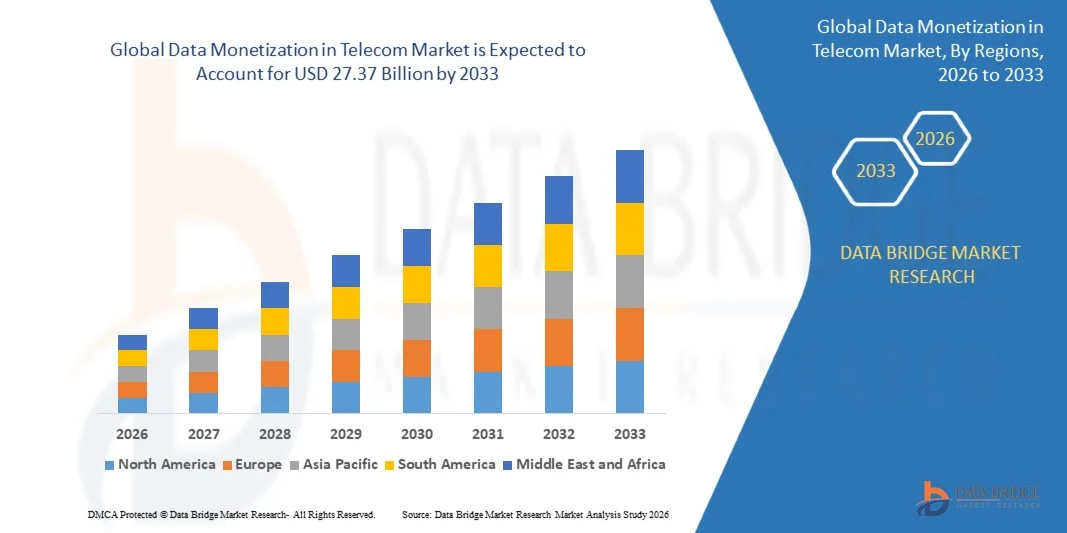
- As per Data Bridge Market Research analysis, the data monetization in telecom market was valued at USD 6.28 billion in 2025 and is projected to reach USD 27.37 billion by 2033, growing at a CAGR of 20.20% from 2026 to 2033.
- The market is experiencing rapid growth driven by declining traditional voice and data-plan revenue per user, rising 5G network rollout generating richer network and location data, and growing demand from enterprises and advertisers for anonymized, privacy-compliant subscriber insights.
- The growing pressure on telecom operators to diversify revenue streams beyond connectivity services, combined with increasing availability of AI-driven analytics platforms, is compelling operators to package network, location, and behavioral data into monetizable insights-as-a-service offerings for retail, advertising, and urban-planning customers. Rising adoption of open API marketplaces is further enabling telecom operators to expose network capabilities and data assets to third-party developers and enterprise partners.
- Increasing enterprise demand for real-time customer insights and location-based analytics across retail, logistics, and smart-city applications is expanding the addressable market for telecom data products, positioning operators as key data infrastructure providers within broader digital economy ecosystems.
Market Size & Forecast
- Global Market Value (2025): USD 6.28 Billion
- Expected Market Value (2033): USD 27.37 Billion
- Forecast CAGR (2026–2033): 20.20%
- Leading Region in 2025: North America
- Fastest Growing Region: Asia-Pacific
What are the Major Takeaways of the Data Monetization in Telecom Market?
- North America dominated the global data monetization in telecom market with the largest revenue share of 36.84% in 2025, supported by advanced 5G network infrastructure and early adoption of data monetization platforms among major operators.
- Asia-Pacific is expected to be the fastest-growing region at a CAGR of 22.6% from 2026 to 2033, fueled by rapid 5G rollout, large subscriber bases, and increasing enterprise demand for telecom data insights across China, India, and Southeast Asia.
- The solutions component segment led the market with a 61.72% share in 2025, driven by rising adoption of big data analytics and AI-based monetization platforms among telecom operators.
- The indirect monetization type segment is the fastest-growing monetization category, projected to register a CAGR of 22.8%, reflecting rising use of data insights to improve internal customer experience, network optimization, and churn reduction.
- The customer analytics & personalization application segment dominated the application category with a 32.47% revenue share in 2025, led by operator demand for improved subscriber retention and targeted service offerings.
- The cloud deployment mode accounted for 68.93% of the market share in 2025, preferred for its scalability, faster deployment timelines, and reduced infrastructure investment compared to on-premises platforms.
- The 5G network type segment is the fastest-growing network category, with a CAGR of 24.3%, driven by the significantly richer data-generation capabilities of 5G networks compared to legacy 4G/LTE infrastructure.
Report Scope and Data Monetization in Telecom Market Segmentation
|
Attributes |
Data Monetization in Telecom Key Market Insights |
|
Segments Covered |
|
|
Countries Covered |
North America
Europe
Asia-Pacific
Middle East and Africa
South America
|
|
Key Market Players |
|
|
Market Opportunities |
|
|
Value Added Data Infosets |
In addition to the market insights such as market value, growth rate, market segments, geographical coverage, market players, and market scenario, the market report curated by the Data Bridge Market Research team includes in-depth expert analysis, import/export analysis, pricing analysis, production consumption analysis, and pestle analysis. |
What is the Key Trend in the Data Monetization in Telecom Market?
- Telecom operators are increasingly launching open API marketplaces that allow third-party developers and enterprises to access anonymized network, location, and subscriber-insight data for building new applications and services.
- For instance, in April 2025, Deutsche Telekom expanded its open API developer platform across additional European markets, enabling enterprise customers to access network-quality and location-insight APIs for logistics and retail applications.
- Rising adoption of AI-driven customer analytics platforms is enabling operators to generate more granular, actionable subscriber insights while maintaining compliance with evolving data-privacy regulations.
- Operators are increasingly forming data-sharing partnerships with advertising technology companies and retail analytics providers to monetize anonymized location and behavioral data without directly selling raw subscriber information.
- For instance, in January 2025, Vodafone expanded its data analytics partnership with a global advertising technology provider to offer privacy-compliant audience insights for targeted marketing campaigns across European markets.
- As telecom operators continue to prioritize revenue diversification beyond core connectivity services, the adoption of advanced data monetization platforms is expected to accelerate, reinforcing their role as a strategic growth lever across the global telecommunications industry.
What are the Key Drivers of the Data Monetization in Telecom Market?
- Declining average revenue per user from traditional voice and data-plan services, combined with intensifying price competition, has significantly increased telecom operator demand for alternative, data-driven revenue streams.
- For instance, in March 2025, AT&T expanded its data analytics and insights business unit to meet rising demand from retail and logistics enterprises seeking location-based consumer behavior data.
- Telecom operators are increasingly incorporating big data analytics and AI platforms into their core operations to reduce churn, optimize network investment, and identify new monetizable data products.
- For instance, in October 2024, Ericsson announced an investment in additional network-data analytics platform capabilities to support rising operator demand for monetizable 5G network insights.
- With telecom operators increasingly relying on data assets to diversify revenue beyond connectivity services, data monetization platforms will remain indispensable across network optimization, customer analytics, and third-party data-product applications worldwide.
- For instance, in June 2024, Amdocs expanded its data monetization software platform to include additional AI-based customer-insight modules, supporting growing operator demand for personalization and targeted-offer capabilities.
- Therefore, the data monetization market in telecom is being driven by declining traditional connectivity revenues, intensifying price competition, and the growing adoption of big data analytics and AI. As operators increasingly leverage network and customer data to optimize operations, reduce churn, personalize offerings, and develop new third-party data products, data monetization platforms are becoming a critical component of telecom operators’ strategies for diversifying and expanding revenue streams.
Which Factors are Challenging the Growth of the Data Monetization in Telecom Market?
- Telecom data monetization initiatives face significant regulatory complexity related to subscriber data privacy, consent management, and cross-border data-transfer restrictions, creating compliance burdens that vary substantially across jurisdictions.
- These regulatory complexities and consumer privacy concerns limit the scope of monetizable data products and constrain the pace of new data-product launches among risk-averse operators.
- For instance, in September 2024, Proximus, a leading regional telecom operator in Europe, experienced delays and had to re-evaluate its planned commercial data and location-analytics product rollouts due to strict compliance reviews and evolving interpretations of data protection under European privacy frameworks.
- The regulatory complexity and consumer-trust sensitivities associated with subscriber data monetization continue to restrict the pace of new product launches, particularly in markets with stringent data-protection frameworks. This compliance burden slows market penetration in certain regions, limiting the widespread deployment of advanced data monetization platforms despite strong underlying revenue-diversification incentives.
How is the Data Monetization in Telecom Market Segmented?
The data monetization in telecom market is segmented on the basis of component, monetization type, deployment mode, data type, application, technology, organization size, end user, monetization model and network type.
- By Component
On the basis of component, the market is segmented into solutions and services. The solutions segment dominated the market with a 61.72% share in 2025, owing to rising adoption of big data analytics and AI-based monetization platforms among telecom operators seeking to build internal data-product capabilities. These platforms deliver the core data-processing and insight-generation infrastructure, making them the largest investment category across operator data-monetization initiatives.
The services segment is projected to register the fastest growth at a CAGR of 21.6% from 2026 to 2033, driven by rising demand for consulting, systems integration, and managed services supporting operators that lack in-house data-science expertise. Advances in outsourced analytics delivery models, combined with growing operator focus on core connectivity operations, are accelerating segment expansion.
- By Monetization Type
On the basis of monetization type, the market is segmented into direct monetization and indirect monetization. The direct monetization segment led the market with a 56.38% share in 2025, supported by growing operator adoption of data-selling and API-monetization business models targeting enterprise and advertising customers.
The indirect monetization segment is expected to experience the fastest growth at a CAGR of 22.8% from 2026 to 2033, driven by increasing use of data insights to improve internal customer experience, network optimization, and churn-reduction initiatives that generate value without direct data sales.
- By Deployment Mode
On the basis of deployment mode, the market is segmented into cloud and on-premises. The cloud segment dominated the market with a share of 68.93% in 2025 due to its widespread adoption among operators seeking scalable, rapidly deployable analytics infrastructure without significant upfront capital investment, increasing demand for elastic compute capacity to process large-scale network and subscriber data, and growing integration with third-party cloud-based AI services. Additionally, rising focus on deployment speed and infrastructure flexibility further supports the strong adoption of cloud-based monetization platforms.
The cloud segment is also anticipated to witness the fastest CAGR of 22.4% from 2026 to 2033, driven by the increasing operator preference for consumption-based pricing models and reduced infrastructure-management overhead. Operators are adopting cloud-native analytics platforms to conduct cost-effective, scalable, and rapidly deployable data-monetization initiatives. Additionally, the integration of cloud platforms with advanced AI and machine-learning services is enhancing the sophistication of monetizable data products, further driving segment growth.
- By Data Type
On the basis of data type, the market is segmented into subscriber data, network data, location data, and usage/behavioral data. The network data segment dominated the market with a share of 34.86% in 2025 due to its widespread use in network-optimization and infrastructure-planning applications generating direct operational value in addition to external monetization potential. The widespread availability of network-performance data across operator infrastructure is driving strong demand for this data-type category.
The location data segment is expected to witness the fastest CAGR of 23.1% from 2026 to 2033, driven by the rising enterprise demand for anonymized foot-traffic and mobility insights across retail, logistics, and urban-planning applications. Operators are increasingly packaging location data into privacy-compliant insight products for enterprise customers. Additionally, the growing emphasis on location-based analytics in smart-city and retail-planning initiatives is further accelerating adoption of this data-type category.
- By Application
On the basis of application, the market is segmented into customer analytics & personalization, network optimization, fraud detection & risk management, targeted advertising, location-based services, and business intelligence & reporting. The customer analytics & personalization segment dominated the market with a share of 32.47% in 2025 due to its critical role in enabling operators to improve subscriber retention, personalize service offerings, and reduce churn through data-driven insights. High adoption is driven by the increasing need for competitive differentiation, integration with customer relationship management systems, and enhanced subscriber lifetime value. Additionally, growing investment by telecom operators to improve customer experience and retention is reinforcing the leading position of this segment in the market.
The targeted advertising segment is expected to witness the fastest CAGR of 23.6% from 2026 to 2033. This growth is driven by increasing demand from advertisers and marketing technology companies for anonymized, privacy-compliant audience insights derived from telecom subscriber behavior data. Growing adoption of telecom data partnerships with advertising technology platforms is further accelerating market expansion in this segment.
- By Technology
On the basis of technology, the market is segmented into big data analytics, artificial intelligence & machine learning, blockchain, and APIs/open data platforms. The big data analytics segment dominated the market with a share of 41.27% in 2025 due to its widespread adoption as the foundational technology for processing and analyzing large-scale telecom network and subscriber data. Rising adoption of distributed data-processing architectures across operator infrastructure is enabling telecom companies to enhance analytical throughput, improve insight-generation speed, and optimize monetization-platform performance. Additionally, increasing investment by telecom operators and technology vendors is accelerating adoption and reinforcing this segment's leading position in the market.
The artificial intelligence & machine learning segment is expected to witness the fastest CAGR of 24.8% from 2026 to 2033, driven by the increasing integration of predictive analytics and machine-learning models into data-monetization platforms to generate more sophisticated, higher-value insight products. These technologies enhance insight accuracy, enable predictive customer-behavior modeling, and allow more granular monetizable data segmentation, making AI-driven monetization platforms more accessible, valuable, and differentiated for telecom operators.
- By Organization Size
On the basis of organization size, the market is segmented into large enterprises (Tier-1 operators) and small & medium enterprises (Tier-2/3 operators). The large enterprises (Tier-1 operators) segment dominated the market with a share of 71.36% in 2025 due to its preference among the largest global telecom operators with sufficient subscriber scale, capital resources, and data-science capabilities to build comprehensive monetization platforms. Additionally, established data-infrastructure investment capacity, broad enterprise-partnership networks, and extensive subscriber-base scale are facilitating continued adoption of advanced monetization platforms among Tier-1 operators, while strong vendor support networks are improving accessibility, reliability, and trust, further reinforcing this segment's leading market position.
The small & medium enterprises (Tier-2/3 operators) segment is expected to witness the fastest CAGR of 22.9% from 2026 to 2033, driven by the increasing availability of cost-optimized, cloud-based monetization platforms that make advanced data-analytics capabilities accessible to smaller regional operators. Vendors are leveraging scalable software-as-a-service licensing models to enhance affordability, enable phased technology adoption, and support competitive positioning against larger operators, thereby accelerating adoption across small and medium-sized telecom operators globally.
- By End User
On the basis of end user, the market is segmented into telecom operators, enterprises/third-party data buyers, advertisers & marketers, and government & public sector. The telecom operators segment dominated the market with a share of 58.72% in 2025 due to its critical role as both the primary data source and internal consumer of monetization platform insights for network optimization and customer analytics. Additionally, established internal data-governance frameworks, broad organizational data-access rights, and extensive platform-integration history are facilitating continued adoption of data monetization platforms among telecom operators, while strong internal stakeholder alignment is improving deployment success rates, further reinforcing this segment's leading market position.
The advertisers & marketers segment is expected to witness the fastest CAGR of 23.4% from 2026 to 2033, driven by the increasing demand for anonymized, privacy-compliant audience-insight data to improve targeted advertising campaign effectiveness. Advertisers and marketing technology companies are leveraging telecom data partnerships to enhance audience segmentation, enable improved campaign targeting precision, and support measurable advertising return on investment, thereby accelerating adoption across the digital advertising ecosystem.
- By Monetization Model
On the basis of monetization model, the market is segmented into B2B, B2B2C, and B2C. The B2B segment dominated the market with a share of 54.83% in 2025 due to its critical role in enabling telecom operators to directly monetize data assets through enterprise data-licensing agreements, API access fees, and analytics-as-a-service contracts. Additionally, established enterprise sales relationships, broad industry-vertical partnerships, and extensive contract-negotiation experience are facilitating continued adoption of B2B monetization models among telecom operators, while strong enterprise-customer trust is improving deal consistency, further reinforcing this segment's leading market position.
The B2B2C segment is expected to witness the fastest CAGR of 23.7% from 2026 to 2033, driven by the increasing prevalence of data-sharing partnerships in which operators supply insights that third-party companies embed into consumer-facing products and services. Operators and partner companies are leveraging these arrangements to enhance product differentiation, enable new consumer-facing data-driven features, and support innovative service bundling, thereby accelerating adoption across the digital services ecosystem.
Which Region Holds the Largest Share of the Data Monetization in Telecom Market?
- North America dominated the data monetization in telecom market and accounted for the largest revenue share of 36.84% in 2025, supported by advanced 5G network infrastructure, early adoption of data monetization platforms among major operators, and the presence of established technology vendors and cloud service providers.
- The region also benefits from mature data-privacy regulatory frameworks that provide compliance clarity, high adoption of AI-driven analytics platforms, and growing use of telecom data monetization across advertising, retail, and enterprise-analytics applications. Increasing focus on revenue diversification beyond core connectivity services continues to strengthen North America's leadership position in the global market.
U.S. Data Monetization in Telecom Market Insight
The U.S. data monetization in telecom market is growing steadily, driven by declining traditional connectivity-service revenue, expanding 5G network deployment generating richer data assets, and rising enterprise demand for telecom-derived analytics across retail, logistics, and advertising sectors. Growing adoption of open API platforms and AI-driven customer-analytics tools among leading operators is significantly boosting market demand. In addition, rising investments in cloud-based analytics infrastructure, increasing data-partnership activity between operators and technology companies, and rapid product innovation are positioning the United States as the leading global market for telecom data monetization.
Canada Data Monetization in Telecom Market Insight
The China data monetization in telecom market is expanding rapidly, supported by the country's massive subscriber base, rapid 5G network rollout, and increasing domestic technology investment in AI-driven analytics platforms. Telecom operators are increasingly integrating big data analytics and location-insight capabilities into both internal operations and enterprise-facing data products. Continuous expansion of domestic cloud infrastructure and rising government support for digital economy development are further driving market growth in China.
Europe Data Monetization in Telecom Market Insight
The Europe data monetization in telecom market is expanding rapidly, supported by the surge in data traffic from 5G networks, the adoption of cloud and edge computing, and the demand for advanced customer analytics. Telecom operators are increasingly utilizing AI-driven monetization strategies while navigating strict data governance and GDPR privacy regulations. For more information, visit Telecom Review.
U.K. Data Monetization in Telecom Market Insight
The U.K. data monetization in telecom market is witnessing steady growth due to the country's mature telecom infrastructure, well-established data-protection regulatory framework, and continued operator investment in data monetization platforms. Telecom operators, technology vendors, and enterprise customers are increasingly collaborating on privacy-compliant data-insight products for retail and advertising applications. Continuous advancements in AI-driven analytics and growing enterprise demand for location-based insights are further supporting market growth in the United Kingdom.
Germany Data Monetization in Telecom Market Insight
The Germany data monetization in telecom market is expanding steadily due to the country's strong industrial and enterprise customer base, stringent data-protection standards driving demand for compliant monetization frameworks, and increasing operator investment in AI-based analytics platforms. Telecom operators and enterprise customers are increasingly collaborating on network-insight and location-analytics data products for industrial and logistics applications. Continuous advancements in privacy-compliant data-processing technology are further driving market growth in Germany.
Which are the Top Companies in Data Monetization in Telecom Market?
The data monetization in telecom industry is primarily led by well-established companies, including:
- AT&T Inc. (U.S.)
- Verizon Communications Inc. (U.S.)
- Deutsche Telekom AG (Germany)
- Vodafone Group Plc (U.K.)
- Telefónica S.A. (Spain)
- Orange S.A. (France)
- China Mobile Limited (China)
- NTT Docomo, Inc. (Japan)
- Singapore Telecommunications Limited (Singtel) (Singapore)
- IBM Corporation (U.S.)
- SAP SE (Germany)
- Oracle Corporation (U.S.)
- Amdocs Limited (U.S.)
- Nokia Corporation (Finland)
- Telefonaktiebolaget LM Ericsson (Sweden)
- Huawei Technologies Co., Ltd. (China)
- Guavus, Inc. (a Thales company) (U.S.)
- Subex Limited (India)
- Mahindra Comviva (India)
- Netcracker Technology Corporation (U.S.)
- Cisco Systems, Inc. (U.S.)
- Microsoft Corporation (U.S.)
- Google LLC (U.S.)
- Amazon Web Services, Inc. (U.S.)
- Tata Consultancy Services Limited (India)
- Wipro Limited (India)
- Infosys Limited (India)
- Accenture plc (Ireland)
- CSG Systems International, Inc. (U.S.)
What are Latest Developments in Data Monetization in Telecom Market?
- In September 2025, AT&T launched an expanded enterprise data-insights platform offering privacy-compliant location and behavioral analytics to retail and logistics customers, strengthening its position in the direct data-monetization segment.
- In February 2025, Vodafone expanded its open API developer platform across additional European markets, enabling third-party enterprises to build applications leveraging network-quality and location-insight data.
- In November 2025, Ericsson introduced an upgraded network-data analytics platform incorporating enhanced AI-based insight generation, improving the monetization potential of 5G network performance data for operator customers. This development strengthens Ericsson's position in the telecom analytics market by offering operators more sophisticated, higher-value data products.
- In October 2024, IBM expanded its telecom analytics software portfolio in North America to include additional AI-based customer-insight and network-optimization modules tailored for data-monetization initiatives.
- In June 2023, Amdocs partnered with a regional telecom operator to co-develop a customized data monetization platform combining network and subscriber insights, combining its software platform expertise with the operator's data-governance requirements to support compliant, revenue-generating data products.
- In March 2023, Subex received a technology certification for an expanded AI-driven fraud-detection and revenue-assurance analytics module, enabling the company to serve growing operator demand for monetizable risk-management data products alongside its core assurance offerings.

- Interactive Data Analysis Dashboard
- Company Analysis Dashboard for high growth potential opportunities
- Research Analyst Access for customization & queries
- Competitor Analysis with Interactive dashboard
- Latest News, Updates & Trend analysis
- Harness the Power of Benchmark Analysis for Comprehensive Competitor Tracking
Data collection and base year analysis are done using data collection modules with large sample sizes. The stage includes obtaining market information or related data through various sources and strategies. It includes examining and planning all the data acquired from the past in advance. It likewise envelops the examination of information inconsistencies seen across different information sources. The market data is analysed and estimated using market statistical and coherent models. Also, market share analysis and key trend analysis are the major success factors in the market report. To know more, please request an analyst call or drop down your inquiry.
The key research methodology used by DBMR research team is data triangulation which involves data mining, analysis of the impact of data variables on the market and primary (industry expert) validation. Data models include Vendor Positioning Grid, Market Time Line Analysis, Market Overview and Guide, Company Positioning Grid, Patent Analysis, Pricing Analysis, Company Market Share Analysis, Standards of Measurement, Global versus Regional and Vendor Share Analysis. To know more about the research methodology, drop in an inquiry to speak to our industry experts.
Data Bridge Market Research is a leader in advanced formative research. We take pride in servicing our existing and new customers with data and analysis that match and suits their goal. The report can be customized to include price trend analysis of target brands understanding the market for additional countries (ask for the list of countries), clinical trial results data, literature review, refurbished market and product base analysis. Market analysis of target competitors can be analyzed from technology-based analysis to market portfolio strategies. We can add as many competitors that you require data about in the format and data style you are looking for. Our team of analysts can also provide you data in crude raw excel files pivot tables (Fact book) or can assist you in creating presentations from the data sets available in the report.













