


Deepfake AI Market Size
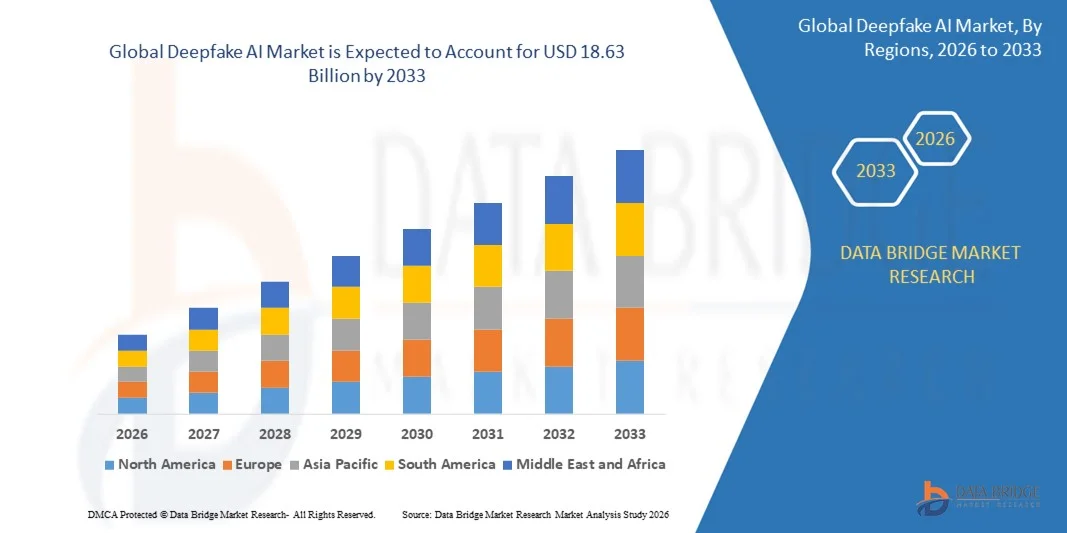
- The global deepfake AI market size was valued at USD 1.03 billion in 2025 and is expected to reach USD 18.63 billion by 2033, at a CAGR of 43.55% during the forecast period
- The market growth is largely fuelled by the increasing adoption of AI-powered content creation tools, rising demand for personalized and interactive media, and the growing use of synthetic media across entertainment, marketing, and social media platforms
- Advancements in deep learning algorithms and generative adversarial networks (GANs) are enabling the creation of highly realistic synthetic content, further driving market expansion
Deepfake AI Market Analysis
- Increasing utilization of deepfake AI in film, gaming, and virtual influencers is transforming content creation and enhancing audience engagement
- The growing focus on AI-driven personalization and automation in marketing campaigns is accelerating demand for deepfake technologies, while improvements in computing power and algorithm efficiency are enabling faster and more realistic content generation
- North America dominated the deepfake AI market with the largest revenue share of 39.30% in 2025, driven by increasing adoption of AI-powered content creation tools, rising awareness of deepfake technologies, and growing investments in media, entertainment, and cybersecurity solutions
- Asia-Pacific region is expected to witness the highest growth rate in the global deepfake AI market, driven by rapid technological adoption, increasing AI investments, growth in digital content consumption, and supportive government initiatives in countries such as China, Japan, and India
- The software segment held the largest market revenue share in 2025, driven by the increasing demand for AI-based content generation tools and deepfake detection solutions across multiple industries. Deepfake AI software provides automated video and image synthesis, enabling both creative applications in media and entertainment and practical applications in fraud detection and cybersecurity
Report Scope and Deepfake AI Market Segmentation
|
Attributes |
Deepfake AI Key Market Insights |
|
Segments Covered |
|
|
Countries Covered |
North America
Europe
Asia-Pacific
Middle East and Africa
South America
|
|
Key Market Players |
|
|
Market Opportunities |
|
|
Value Added Data Infosets |
In addition to the market insights such as market value, growth rate, market segments, geographical coverage, market players, and market scenario, the market report curated by the Data Bridge Market Research team includes in-depth expert analysis, import/export analysis, pricing analysis, production consumption analysis, and pestle analysis. |
Deepfake AI Market Trends
Rising Adoption Across Media, Entertainment, And Marketing
- The growing use of AI-generated synthetic content is significantly shaping the deepfake AI market, as businesses and creators increasingly prefer tools that enable realistic, customizable, and engaging digital content. Deepfake AI is gaining traction due to its ability to create highly convincing visual and audio media, driving adoption across entertainment, advertising, gaming, and social media industries
- Increasing demand for personalized marketing, virtual influencers, and interactive content has accelerated the adoption of deepfake AI in digital campaigns, film production, and social platforms. Brands and content creators are leveraging these technologies to enhance engagement, reduce production costs, and deliver novel user experiences, prompting partnerships between AI developers and media companies
- Ethical and regulatory trends are influencing deployment, with companies emphasizing transparency, consent, and authenticity while using deepfake technologies. These factors are helping organizations differentiate offerings in competitive markets and build audience trust, while also encouraging the development of detection and verification tools to ensure responsible use
- For instance, in 2025, Synthesia in the U.K. and DeepBrain AI in South Korea expanded their AI video and content creation platforms to incorporate advanced deepfake capabilities for marketing, e-learning, and entertainment purposes. These innovations were introduced to meet rising demand for realistic synthetic content across multiple channels and were positioned as cost-efficient, scalable solutions that improve audience engagement
- While the adoption of deepfake AI is increasing, sustained market growth depends on improving AI model accuracy, managing ethical concerns, and ensuring regulatory compliance. Companies are also focusing on cloud-based scalability, cross-platform integration, and advanced content creation tools to broaden adoption
Deepfake AI Market Dynamics
Driver
Growing Adoption Across Media, Entertainment, And Marketing
- Rising demand for personalized content, virtual influencers, and AI-driven media production is a major driver for the deepfake AI market. Organizations are increasingly leveraging deepfake technologies to create realistic videos, interactive advertisements, and synthetic media that enhance engagement and reduce production costs
- Expanding applications in film, gaming, marketing, e-learning, and social media platforms are influencing market growth. Deepfake AI helps generate high-quality synthetic content quickly while enabling innovative storytelling and immersive experiences, encouraging adoption across diverse industries
- Media and technology companies are actively promoting deepfake AI tools through product innovation, SaaS platforms, and marketing campaigns. These efforts are supported by the growing need for automation, personalization, and high-quality digital content, as well as by collaborations with AI developers to improve functionality and efficiency
- For instance, in 2024, Hour One in Israel and Rephrase.ai in India reported increased integration of deepfake AI in corporate training videos, marketing campaigns, and social media content. This expansion followed growing interest in cost-effective, scalable, and realistic digital media solutions, driving adoption and differentiation in content production
- Although rising demand supports growth, wider adoption depends on ethical AI practices, regulatory compliance, and content authenticity. Investment in advanced detection tools, responsible AI policies, and AI-driven content optimization will be critical for maintaining trust and accelerating global market expansion
Restraint/Challenge
Ethical Concerns And Regulatory Uncertainty
- Potential misuse of deepfake technology for misinformation, fraud, and privacy violations remains a significant challenge, limiting adoption in sensitive applications. Companies must implement safeguards, verification tools, and transparent practices to mitigate risks
- Awareness and acceptance of deepfake AI are uneven across regions and industries, particularly where regulatory frameworks are still developing. Limited understanding of benefits and ethical concerns may slow adoption in conservative or highly regulated sectors
- Infrastructure and computational requirements also impact market growth, as generating high-quality deepfake content demands advanced hardware, cloud resources, and skilled personnel. These factors increase costs and create barriers for smaller organizations or emerging markets
- For instance, in 2025, several media and advertising agencies in Europe and North America delayed deployment of deepfake AI campaigns due to legal uncertainties, privacy concerns, and fear of reputational damage. These challenges also prompted stricter internal review processes and content approval protocols, affecting speed of adoption
- Overcoming these challenges will require ethical guidelines, regulatory clarity, and robust detection mechanisms. Collaboration between AI developers, regulators, and end-users can help unlock long-term growth potential of the deepfake AI market, while companies focus on responsible innovation, transparency, and scalable solutions
Deepfake AI Market Scope
The market is segmented on the basis of offering, technology, application, and deployment mode.
- By Offering
On the basis of offering, the deepfake AI market is segmented into software and services. The software segment held the largest market revenue share in 2025, driven by the increasing demand for AI-based content generation tools and deepfake detection solutions across multiple industries. Deepfake AI software provides automated video and image synthesis, enabling both creative applications in media and entertainment and practical applications in fraud detection and cybersecurity.
The services segment is expected to witness the fastest growth rate from 2026 to 2033, driven by the rising need for consulting, integration, and managed services to deploy deepfake AI solutions effectively. Service-based offerings are particularly popular among enterprises for customized solutions, risk assessment, and compliance management, ensuring safe and efficient use of deepfake technologies.
- By Technology
On the basis of technology, the market is segmented into generative adversarial networks, transformer models, autoencoders, and other technologies. The generative adversarial networks (GANs) segment held the largest revenue share in 2025 due to its superior ability to produce highly realistic images and videos. GAN-based solutions are widely adopted in media production, content creation, and AI research for generating synthetic media with high fidelity.
The transformer models segment is projected to grow the fastest from 2026 to 2033, driven by advancements in natural language processing and multimodal AI capabilities. Transformer-based architectures enable more context-aware and coherent content generation, making them ideal for applications in voice synthesis, virtual avatars, and interactive media.
- By Application
On the basis of application, the market is segmented into media and entertainment, banking, financial services, and insurance (BFSI), government and defense, and other applications. The media and entertainment segment held the largest market share in 2025, fueled by the growing adoption of AI-generated content for films, advertisements, and social media campaigns. Deepfake AI enables cost-effective and creative production workflows while enhancing audience engagement.
The BFSI segment is expected to witness the fastest growth from 2026 to 2033, driven by the increasing use of deepfake AI for fraud detection, identity verification, and cybersecurity measures. Enterprises in financial sectors leverage deepfake technologies to detect anomalies, prevent fraudulent transactions, and enhance digital security protocols.
- By Deployment Mode
On the basis of deployment mode, the market is segmented into cloud and on-premises. The cloud segment held the largest revenue share in 2025 due to its scalability, cost-effectiveness, and ease of integration with existing IT infrastructure. Cloud-based deepfake AI solutions allow users to access advanced processing power and storage, enabling faster content generation and analysis.
The on-premises segment is projected to grow at the fastest rate from 2026 to 2033, driven by concerns over data privacy, regulatory compliance, and sensitive content handling. Organizations in defense, government, and BFSI sectors prefer on-premises deployment to maintain control over data and ensure secure and reliable AI operations.
Deepfake AI Market Regional Analysis
- North America dominated the deepfake AI market with the largest revenue share of 39.30% in 2025, driven by increasing adoption of AI-powered content creation tools, rising awareness of deepfake technologies, and growing investments in media, entertainment, and cybersecurity solutions
- Organizations in the region value the ability of deepfake AI to enhance creative workflows, improve marketing engagement, and detect fraudulent activities efficiently
- This widespread adoption is further supported by high digital infrastructure, a technology-savvy population, and strong corporate spending on AI initiatives, establishing deepfake AI as a critical solution across multiple industries
U.S. Deepfake AI Market Insight
The U.S. deepfake AI market captured the largest revenue share in 2025 within North America, fueled by rapid integration of AI in media production, social media, and fraud prevention systems. Companies are increasingly leveraging deepfake AI to generate synthetic content for marketing, entertainment, and training purposes. The rising emphasis on AI-driven identity verification, cybersecurity, and risk mitigation further propels the market. Moreover, widespread availability of cloud-based AI platforms and advanced computing resources is significantly contributing to the expansion of deepfake AI solutions.
Europe Deepfake AI Market Insight
The Europe deepfake AI market is expected to witness the fastest growth rate from 2026 to 2033, primarily driven by stringent regulatory frameworks for digital content, increasing adoption of AI in media and defense, and rising demand for secure and compliant AI tools. Organizations across media, BFSI, and government sectors are investing in deepfake AI for content creation, verification, and threat detection. The region is also experiencing growth in research and development initiatives, supporting the adoption of innovative deepfake technologies.
U.K. Deepfake AI Market Insight
The U.K. deepfake AI market is expected to witness the fastest growth rate from 2026 to 2033, driven by increasing investments in AI technologies, media innovation, and demand for enhanced digital security. Rising awareness of online fraud, cybersecurity threats, and AI-based content generation is encouraging enterprises to adopt deepfake AI solutions. The U.K.’s strong technology ecosystem and robust adoption of digital platforms are expected to continue fueling market growth.
Germany Deepfake AI Market Insight
The Germany deepfake AI market is expected to witness the fastest growth rate from 2026 to 2033, fueled by the country’s focus on AI innovation, research, and secure content generation. Organizations are increasingly adopting deepfake AI for media production, government, and defense applications, emphasizing privacy and regulatory compliance. Germany’s advanced digital infrastructure, coupled with growing investments in AI startups, supports the integration of deepfake AI into enterprise workflows.
Asia-Pacific Deepfake AI Market Insight
The Asia-Pacific deepfake AI market is expected to witness the fastest growth rate from 2026 to 2033, driven by rising digital content consumption, increasing adoption of AI technologies, and supportive government initiatives in countries such as China, Japan, and India. The region’s expanding tech ecosystem, combined with affordable AI solutions and increasing corporate awareness, is accelerating the use of deepfake AI across media, BFSI, and government sectors.
Japan Deepfake AI Market Insight
The Japan deepfake AI market is expected to witness the fastest growth rate from 2026 to 2033 due to the country’s strong AI research ecosystem, high digital penetration, and focus on innovative media and security solutions. Enterprises and content creators are leveraging deepfake AI for immersive media experiences, digital training, and fraud prevention. Moreover, Japan’s aging population is driving demand for AI-powered personalized content and secure identity verification solutions in both consumer and commercial applications.
China Deepfake AI Market Insight
The China deepfake AI market accounted for the largest market revenue share in Asia-Pacific in 2025, attributed to the country’s rapid AI adoption, growing digital economy, and high investment in media and security technologies. Deepfake AI is increasingly used in content generation, social media, advertising, and cybersecurity solutions. The government’s push for AI innovation, combined with strong local technology providers and cost-effective solutions, is a key factor driving market growth in China.
Deepfake AI Market Share
The Deepfake AI industry is primarily led by well-established companies, including:
- Amazon Web Services (U.S.)
- Attestiv Inc. (U.S.)
- Deepware A.S. (Estonia)
- D-ID (Israel)
- Google LLC (U.S.)
- iDenfyTM (Lithuania)
- Intel Corporation (U.S.)
- Kairos AR, Inc. (U.S.)
- Microsoft (U.S.)
- Oz Forensics (U.K.)
Latest Developments in Global Deepfake AI Market
- In September 2025, D-ID announced the acquisition of AI video company simpleshow, merging its interactive AI avatar technology with industry-leading explainer video creation tools. This integration allows enterprises to deploy personalized, real-time, two-way digital avatars for training, onboarding, and sales functions. The platform supports multiple languages and secure communication, making it scalable for global organizations. By combining interactive visual agents with explainer content, it enhances engagement, knowledge retention, and corporate communication efficiency. This move strengthens the enterprise adoption of AI-driven avatar solutions across industries
- In June 2025, Google launched the Safety Charter in India to address the growing risks of online fraud, deepfakes, and cybersecurity threats. The initiative utilizes AI-powered programs such as Digikavach and SynthID watermarking to detect and track AI-generated content, protecting users from scams. It also focuses on improving cybersecurity protocols for government and enterprise sectors. By promoting responsible AI development, the initiative enhances trust in AI applications. The program is expected to accelerate the adoption of AI-based security solutions and ethical content practices in India
- In April 2025, Intel Corporation updated the OpenVINO toolkit with optimized deepfake detection models for edge devices. This advancement allows real-time analysis of images and videos without relying on discrete GPUs, reducing hardware costs and energy consumption. The update enables developers and enterprises to deploy deepfake detection across multiple platforms efficiently. It supports applications in media verification, cybersecurity, and fraud prevention. By enhancing edge-level AI processing, Intel strengthens the global deepfake detection market and expands access to scalable solutions
- In March 2025, D-ID partnered with Zoom Video Communications to embed personalized AI avatars in virtual meetings and presentations. The integration allows users to interact via lifelike digital avatars, improving engagement, immersion, and communication effectiveness. This solution is particularly useful for remote training, corporate meetings, and online events. It demonstrates how AI avatars can be deployed at scale in professional settings. The partnership helps drive wider adoption of AI-driven visual communication tools in enterprise markets
- In February 2025, Truepic achieved SOC 2 Type II certification for its content authenticity platform. This certification validates the company’s controls for security, availability, and integrity, increasing trust among enterprise clients. It enables finance, healthcare, and government organizations to adopt Truepic solutions for secure content verification. The platform helps prevent fraud, misinformation, and manipulation of digital media. The certification strengthens Truepic’s market credibility and supports broader adoption of AI-based content authenticity tools
- In January 2025, Pindrop Security expanded deepfake voice detection support to 47 additional languages. The enhancement enables global call centers and enterprises to detect fraudulent voice activity across multiple regions. By addressing international security concerns, it enhances customer trust and reduces financial losses due to voice fraud. The multilingual capability broadens the applicability of AI-driven voice verification solutions. This expansion reinforces Pindrop’s position as a leader in global voice authentication and fraud prevention technologies
- In April 2024, Microsoft showcased its AI model VASA-1, capable of generating lifelike talking faces from a single static image and an audio clip. The model enhances digital avatars with appealing visual affective skills (VAS), creating more realistic and engaging user experiences. Applications include virtual meetings, gaming, social media, and educational platforms. VASA-1 pushes the boundaries of AI-generated interactive content, improving user immersion and personalization. This innovation reinforces Microsoft’s leadership in AI-driven avatar and synthetic media markets
- In January 2024, Deepbrain, in partnership with Lenovo and the Scott Morgan Foundation, unveiled an AI avatar designed to assist people with ALS in communication. The avatar interprets text and generates expressive speech and facial expressions, helping individuals interact more naturally. This technology demonstrates the potential of AI for social impact and accessibility. It highlights applications in healthcare, assistive technology, and human-computer interaction. The initiative supports market growth for AI avatars in medical and therapeutic use cases
- In January 2024, Icons8 launched Human Generator tools to enable the creation of AI-generated human images. This tool allows content creators and designers to produce realistic human portraits without photography, supporting media, advertising, and game development industries. The AI-generated content accelerates creative workflows and reduces production costs. By enhancing accessibility to synthetic imagery, Icons8 contributes to the growth of AI-driven content creation markets. The tool strengthens the adoption of deepfake and generative AI technologies in professional media production
- In December 2023, WOMBO released Wombo Me, an AI-powered application that converts self-portraits into lifelike avatars. The app allows users to generate multiple interactive and animated avatars for social media, entertainment, and gaming applications. It enhances personalization and user engagement by offering creative digital identity tools. Wombo Me demonstrates consumer-level adoption of AI avatar technology. Its popularity reinforces the expansion of AI-generated avatars in personal media and entertainment markets
- In September 2023, Botika partnered with Flipkart under the Flipkart Leap Innovation Network Cohort 2 to pilot AI solutions for e-commerce operations. The collaboration allowed Botika to deploy AI-driven chatbots, recommendation systems, and personalized engagement tools across Flipkart business units. This helped improve customer experience, operational efficiency, and digital interaction. The partnership demonstrates the integration of AI technologies in large-scale retail environments. It contributes to the growing adoption of AI-driven solutions in e-commerce and enterprise applications
- In March 2022, MyHeritage launched DeepStory, an AI feature that animates historical photos to create speaking portraits of ancestors. Users can generate videos where ancestors narrate life stories, blending AI with personal history and cultural preservation. The technology leverages multiple images and AI models to produce realistic animations. It expands consumer engagement in genealogy and personalized media experiences. DeepStory illustrates the market potential of AI-generated synthetic media in educational, entertainment, and personal applications

- Interactive Data Analysis Dashboard
- Company Analysis Dashboard for high growth potential opportunities
- Research Analyst Access for customization & queries
- Competitor Analysis with Interactive dashboard
- Latest News, Updates & Trend analysis
- Harness the Power of Benchmark Analysis for Comprehensive Competitor Tracking
Data collection and base year analysis are done using data collection modules with large sample sizes. The stage includes obtaining market information or related data through various sources and strategies. It includes examining and planning all the data acquired from the past in advance. It likewise envelops the examination of information inconsistencies seen across different information sources. The market data is analysed and estimated using market statistical and coherent models. Also, market share analysis and key trend analysis are the major success factors in the market report. To know more, please request an analyst call or drop down your inquiry.
The key research methodology used by DBMR research team is data triangulation which involves data mining, analysis of the impact of data variables on the market and primary (industry expert) validation. Data models include Vendor Positioning Grid, Market Time Line Analysis, Market Overview and Guide, Company Positioning Grid, Patent Analysis, Pricing Analysis, Company Market Share Analysis, Standards of Measurement, Global versus Regional and Vendor Share Analysis. To know more about the research methodology, drop in an inquiry to speak to our industry experts.
Data Bridge Market Research is a leader in advanced formative research. We take pride in servicing our existing and new customers with data and analysis that match and suits their goal. The report can be customized to include price trend analysis of target brands understanding the market for additional countries (ask for the list of countries), clinical trial results data, literature review, refurbished market and product base analysis. Market analysis of target competitors can be analyzed from technology-based analysis to market portfolio strategies. We can add as many competitors that you require data about in the format and data style you are looking for. Our team of analysts can also provide you data in crude raw excel files pivot tables (Fact book) or can assist you in creating presentations from the data sets available in the report.













