


What is the Degummed Silk Market Size and Growth Rate ?
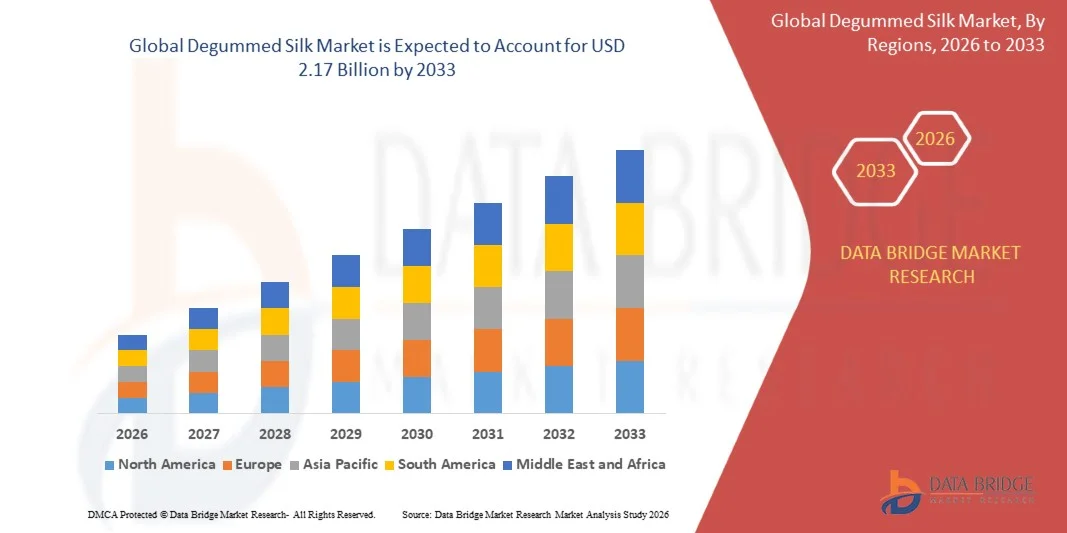
- As per Data Bridge Market Research Analysis the Global degummed silk market size was valued at USD 1.22 billion in 2025 and is expected to reach USD 2.17 billion by 2033, at a CAGR of 7.47% during the forecast period
- The market growth is largely fueled by the rising demand for natural and sustainable textile fibers, as consumers and manufacturers increasingly prefer eco-friendly materials in fashion, home textiles, and industrial applications. Degummed silk, known for its smooth texture, durability, and enhanced dye absorption after the removal of sericin, is gaining strong preference among textile producers seeking high-quality natural fibers for premium fabric production
- Furthermore, expanding applications of silk fibroin derived from degummed silk in biomedical and cosmetic industries are strengthening market growth. The material’s biocompatibility, biodegradability, and protein-based composition make it highly suitable for medical sutures, tissue engineering, wound healing products, and skincare formulations, thereby significantly boosting the adoption of degummed silk across multiple high-value industries
Market Size & Forecast
- Global Market Value (2025): USD 1.22 Billion
- Expected Market Value (2033): USD 2.17 Billion
- Forecast CAGR (2026–2033): 7.47%
Degummed Silk Market Analysis
- Degummed silk, produced through the removal of sericin coating from raw silk fibers, is widely used in textile manufacturing, biomedical materials, and cosmetic formulations due to its superior softness, improved luster, and enhanced compatibility with dyes and chemical treatments. The material plays a crucial role in the production of high-end silk fabrics, medical biomaterials, and premium personal care ingredients
- The escalating demand for degummed silk is primarily driven by increasing global consumption of luxury silk apparel, growing interest in sustainable natural fibers, and rising research activities focused on silk-based biomaterials. In addition, expanding textile manufacturing industries and continuous innovation in biomedical silk applications are further supporting the steady growth of the degummed silk market
- Asia-Pacific dominated the degummed silk market with a share of 62.42% in 2025, due to extensive sericulture activities, strong textile manufacturing infrastructure, and high demand for natural silk fibers across apparel and home textile applications
- North America is expected to be the fastest growing region in the degummed silk market during the forecast period due to increasing demand for sustainable textiles, expanding biomedical research using silk fibroin, and rising consumption of luxury fashion products
- Mulberry silk segment dominated the market with a market share of 64.8% in 2025, due to its superior fiber uniformity, smooth texture, and high tensile strength after the degumming process. Mulberry silk fibers provide consistent quality and enhanced luster, making them highly suitable for premium textile manufacturing and luxury apparel applications. The segment also benefits from well-established sericulture infrastructure and large-scale cultivation in major producing countries such as China and India
Report Scope and Degummed Silk Market Segmentation
|
Attributes |
Degummed Silk Key Market Insights |
|
Segments Covered |
|
|
Countries Covered |
North America
Europe
Asia-Pacific
Middle East and Africa
South America
|
|
Key Market Players |
|
|
Market Opportunities |
|
|
Value Added Data Infosets |
In addition to the insights on market scenarios such as market value, growth rate, segmentation, geographical coverage, and major players, the market reports curated by the Data Bridge Market Research also include import export analysis, production capacity overview, production consumption analysis, price trend analysis, climate change scenario, supply chain analysis, value chain analysis, raw material/consumables overview, vendor selection criteria, PESTLE Analysis, Porter Analysis, and regulatory framework. |
What is the Key Trend in Degummed Silk Market ?
“Rising Demand for Sustainable Silk Fibers”
- A significant trend in the degummed silk market is the rising demand for sustainable and eco-friendly silk fibers as textile manufacturers increasingly shift toward natural and biodegradable materials. Degummed silk, which removes sericin to produce a softer and more refined fiber, is gaining importance in sustainable textile production and premium fabric development
- For instance, Bolt Threads collaborates with global fashion brands to develop sustainable silk-based materials, while Kering promotes responsible silk sourcing through sustainability initiatives across its luxury apparel portfolio. Such developments are strengthening the role of degummed silk in environmentally responsible textile manufacturing and premium garment production
- The fashion industry is increasingly incorporating degummed silk in high-end garments and designer collections due to its smooth texture, superior dye absorption, and enhanced fabric quality. This growing preference is expanding its presence in luxury apparel, scarves, and premium home textiles
- The cosmetics and biomedical sectors are also exploring degummed silk fibroin for specialized applications due to its biocompatibility and protein-based structure. This trend is encouraging innovation in skincare formulations, wound dressing materials, and tissue engineering solutions
- Manufacturers are investing in advanced silk processing technologies to improve degumming efficiency while maintaining fiber strength and quality. These developments are supporting higher production consistency and enabling wider industrial adoption of refined silk fibers
- The growing global focus on sustainable fashion, natural textile materials, and biodegradable fibers is strengthening the market outlook for degummed silk. This shift toward environmentally responsible materials is reinforcing the role of degummed silk as an important component of sustainable luxury textiles and advanced biomaterial applications
Degummed Silk Market Dynamics
Driver
“Growing Demand for Premium and Luxury Silk-Based Apparel”
- The increasing global demand for premium and luxury apparel is a major factor driving the degummed silk market, as consumers continue to prefer high-quality fabrics that offer superior comfort, softness, and aesthetic appeal. Degummed silk provides a refined texture and enhanced luster, making it a preferred material for luxury clothing and high-end textile products
- For instance, luxury fashion houses under LVMH and Hermès incorporate high-grade silk fabrics in premium scarves, garments, and accessories that rely on refined degummed silk fibers for superior finish and durability. These products highlight the importance of high-quality silk processing in luxury fashion manufacturing
- The expansion of luxury fashion markets in emerging economies is further increasing the demand for premium silk fabrics used in couture apparel and designer accessories. This growth is encouraging textile producers to increase their production of high-quality degummed silk fibers
- The rise of premium home textile products such as silk bedding, decorative fabrics, and luxury upholstery is also contributing to the growing demand for degummed silk. Consumers seeking comfort-oriented and high-value textile products are supporting the expansion of silk-based materials
- The continuous expansion of luxury apparel markets and the sustained consumer preference for natural premium fabrics are reinforcing this driver. The growing importance of high-quality silk materials is supporting long-term demand for degummed silk across global fashion and textile industries
Restraint/Challenge
“High Production Costs and Complex Silk Processing”
- The degummed silk market faces significant challenges due to the complex processing steps required to remove sericin from raw silk fibers while preserving the strength and structure of fibroin. These specialized processing procedures require controlled chemical treatments, skilled labor, and advanced textile processing equipment, increasing overall production costs
- For instance, Wujiang First Textile Co., Ltd. and Central Silk Board highlight the technical complexity involved in degumming operations, where precise temperature control and chemical balance are required to maintain fiber quality during silk refinement. These requirements raise operational expenses and create barriers for smaller manufacturers
- The cost of high-quality raw silk cocoons significantly influences the overall production cost of degummed silk. Fluctuations in cocoon supply due to climatic conditions and sericulture challenges can impact manufacturing stability and pricing
- Maintaining consistent fiber quality during degumming requires strict process monitoring and advanced quality control systems. These requirements extend production time and increase operational complexity for silk processing companies
- The difficulty in balancing production efficiency, fiber quality, and cost competitiveness continues to present a challenge for manufacturers. These combined factors place pressure on industry participants to improve processing technologies while controlling expenses in the degummed silk market
Degummed Silk Market Scope
The market is segmented on the basis of source, form, application, and end-use industry.
• By Source
On the basis of source, the degummed silk market is segmented into mulberry silk, tussar silk, eri silk, muga silk, and others. The mulberry silk segment dominated the market with the largest market revenue share of 64.8% in 2025, driven by its superior fiber uniformity, smooth texture, and high tensile strength after the degumming process. Mulberry silk fibers provide consistent quality and enhanced luster, making them highly suitable for premium textile manufacturing and luxury apparel applications. The segment also benefits from well-established sericulture infrastructure and large-scale cultivation in major producing countries such as China and India. In addition, the refined properties of mulberry silk after sericin removal enhance dye absorption and softness, which increases its preference among textile manufacturers. The availability of large production volumes and strong demand from fashion and biomedical applications further reinforce the leading position of this segment in the market.
The tussar silk segment is anticipated to witness the fastest growth rate from 2026 to 2033, driven by increasing consumer demand for natural, eco-friendly, and organic silk varieties. Tussar silk is valued for its distinctive golden sheen and textured appearance, which makes it attractive for niche fashion products and premium handcrafted textiles. Growing interest in sustainable fabrics and traditional artisanal weaving techniques has further accelerated its demand in domestic and international markets. The segment is also supported by government initiatives promoting tribal sericulture and rural silk production in regions such as India. In addition, the durability and breathable nature of degummed tussar silk make it suitable for diversified textile and furnishing applications, contributing to its rising market growth.
• By Form
On the basis of form, the degummed silk market is segmented into degummed silk fiber, degummed silk yarn, and degummed silk fabric. The degummed silk yarn segment dominated the market with the largest market revenue share in 2025, driven by its widespread use as a primary raw material for textile weaving and knitting processes. Degummed yarn offers improved softness, flexibility, and dye uptake compared to raw silk yarn due to the removal of sericin. Textile manufacturers prefer degummed silk yarn for producing high-quality garments, scarves, and luxury fabrics with enhanced durability and finish. The segment also benefits from its compatibility with automated textile production technologies and modern weaving machinery. Increasing demand for premium silk apparel and fashion accessories further strengthens the dominance of degummed silk yarn in the market.
The degummed silk fiber segment is expected to witness the fastest growth rate from 2026 to 2033, fueled by expanding research and innovation in biomedical and advanced material applications. Degummed silk fibers exhibit excellent biocompatibility, biodegradability, and mechanical strength, making them highly suitable for medical sutures, tissue engineering scaffolds, and wound care materials. Growing investment in biomaterials research and regenerative medicine is accelerating the utilization of silk fibroin derived from degummed fibers. The segment also supports the development of sustainable composite materials and eco-friendly textiles. Increasing demand from both medical research institutions and technical textile manufacturers is expected to significantly drive the growth of degummed silk fiber during the forecast period.
• By Application
On the basis of application, the degummed silk market is segmented into textile and apparel, medical and biomedical, cosmetics and personal care, home furnishings, and industrial applications. The textile and apparel segment dominated the market with the largest market revenue share in 2025, driven by the extensive use of degummed silk in premium garments, sarees, dresses, scarves, and luxury fashion products. The removal of sericin enhances the softness, sheen, and dye absorption properties of silk, making it ideal for high-end textile production. Increasing consumer demand for natural and breathable fabrics in fashion further strengthens the demand for degummed silk in clothing applications. Designers and fashion brands increasingly prefer silk fabrics for their aesthetic appeal and comfort characteristics. The growth of global fashion industries and luxury textile exports further contributes to the strong market share of this segment.
The medical and biomedical segment is anticipated to witness the fastest growth rate from 2026 to 2033, supported by expanding research on silk-based biomaterials and regenerative medicine. Degummed silk primarily contains fibroin protein, which demonstrates excellent biocompatibility and minimal immune response in medical applications. These properties enable its use in surgical sutures, tissue scaffolds, drug delivery systems, and wound healing materials. Increasing healthcare research investments and advancements in biomaterial engineering are accelerating the adoption of silk-based medical products. In addition, the shift toward biodegradable and sustainable medical materials further supports the rapid expansion of degummed silk in biomedical applications.
• By End-Use Industry
On the basis of end-use industry, the degummed silk market is segmented into textile and fashion industry, healthcare and medical industry, cosmetics and personal care industry, home textile industry, and others. The textile and fashion industry segment dominated the market with the largest market revenue share in 2025, driven by the continuous demand for silk fabrics in premium apparel, designer garments, and luxury accessories. Degummed silk is widely preferred by fashion manufacturers due to its smooth texture, high durability, and superior dyeing characteristics. The segment also benefits from increasing global fashion trends favoring natural fibers and sustainable textile materials. Expanding luxury apparel markets and rising consumer preference for high-quality fabrics further support the extensive utilization of degummed silk within this industry. The strong presence of silk production and garment manufacturing hubs in Asia also reinforces the dominance of this segment.
The healthcare and medical industry segment is expected to witness the fastest growth rate from 2026 to 2033, driven by increasing adoption of silk-based biomaterials in advanced medical technologies. Degummed silk fibroin is extensively studied for its use in biomedical implants, regenerative tissue scaffolds, and biodegradable medical devices. The natural compatibility of silk with human tissues reduces risks of adverse reactions and enhances healing performance. Rising investments in biotechnology and medical research are encouraging the development of innovative silk-based medical solutions. In addition, the shift toward sustainable and biodegradable materials in healthcare manufacturing further accelerates the growth of degummed silk within the medical industry.
Degummed Silk Market Regional Analysis
- Asia-Pacific dominated the degummed silk market with the largest revenue share of 62.42% in 2025, driven by extensive sericulture activities, strong textile manufacturing infrastructure, and high demand for natural silk fibers across apparel and home textile applications
- The region benefits from a well-established silk production ecosystem, availability of raw silk cocoons, and a large number of textile processing facilities supporting degumming and silk fabric manufacturing
- Rising demand for premium silk garments, increasing exports of silk fabrics, and strong government initiatives supporting sericulture development are further accelerating regional market growth
China Degummed Silk Market Insight
China held the largest share in the Asia-Pacific degummed silk market in 2025, owing to its position as the world’s leading producer of raw silk and silk textiles. The country has a well-integrated sericulture and textile manufacturing supply chain, supported by large-scale mulberry cultivation and advanced silk processing facilities. Strong export demand for silk fabrics, garments, and home textiles further strengthens China’s dominant position in the global degummed silk market.
India Degummed Silk Market Insight
India is witnessing the fastest growth in the Asia-Pacific region, fueled by expanding sericulture activities, rising demand for traditional silk garments, and increasing government support for rural silk production. The country’s diverse silk varieties such as mulberry, tussar, eri, and muga contribute to a strong domestic and export market. Growing investments in textile infrastructure and increasing demand for natural and sustainable fabrics are further supporting the expansion of the degummed silk market in India.
Europe Degummed Silk Market Insight
The Europe degummed silk market is expanding steadily, supported by strong demand for luxury textiles, high-end fashion products, and premium home furnishings. The region emphasizes sustainable and natural textile materials, encouraging the use of silk fibers in fashion and interior design industries. Increasing interest in eco-friendly fabrics and growing collaboration between fashion brands and textile manufacturers are contributing to consistent market growth.
Germany Degummed Silk Market Insight
Germany’s degummed silk market is supported by its well-developed textile research infrastructure and strong demand for high-quality fabrics in fashion and technical textile applications. The country focuses on innovation in sustainable textile processing and advanced fiber technologies. Demand for premium silk fabrics in designer apparel, luxury accessories, and specialized textile products continues to drive market growth.
U.K. Degummed Silk Market Insight
The U.K. market is driven by a strong luxury fashion sector, increasing consumer interest in sustainable natural fibers, and growing demand for premium silk apparel and accessories. The country’s fashion industry emphasizes high-quality fabrics and innovative textile design. Rising adoption of eco-conscious fashion trends and increasing presence of luxury fashion brands are further strengthening demand for degummed silk.
North America Degummed Silk Market Insight
North America is projected to grow at the fastest CAGR from 2026 to 2033, driven by increasing demand for sustainable textiles, expanding biomedical research using silk fibroin, and rising consumption of luxury fashion products. Growing awareness regarding biodegradable and natural materials is encouraging the adoption of silk-based products across various industries. In addition, rising research investments in biomedical silk applications are supporting market expansion.
U.S. Degummed Silk Market Insight
The U.S. accounted for the largest share in the North America market in 2025, supported by strong demand for luxury apparel, advanced textile research, and increasing use of silk fibroin in biomedical applications. The country has a well-established fashion and healthcare innovation ecosystem, which supports the development of high-value silk-based products. Rising investments in sustainable textile technologies and growing interest in natural fibers further strengthen the market position of the U.S. in the region.
Degummed Silk Market Share
The degummed silk industry is primarily led by well-established companies, including:
- AMSilk GmbH (Germany)
- Spiber Inc. (Japan)
- Bolt Threads Inc. (U.S.)
- Kraig Biocraft Laboratories, Inc. (U.S.)
- Seiren Co., Ltd. (Japan)
- Zhejiang Golden Eagle Co., Ltd. (China)
- Wuxi Kingdery Silk Co., Ltd. (China)
- Anhui Silk Co., Ltd. (China)
- Nantong Haian Hengxin Silk Co., Ltd. (China)
- Suzhou Xiang Yao Biotechnology Co., Ltd. (China)
- Guangzhou Huafeng Biological Material Co., Ltd. (China)
- Xiamen Yizhong Biological Technology Co., Ltd. (China)
- Huzhou Xintiansi Bio-tech Co., Ltd. (China)
- Fibroheal Woundcare Pvt. Ltd. (India)
- Cocoon Biotech (India)
Latest Developments in Global Degummed Silk Market
- In September 2025, Evonik Industries expanded its strategic partnership with AMSilk to scale the industrial production of sustainable silk protein materials used in textiles and biomaterials. The collaboration includes expanding production capabilities for bio-engineered silk proteins, enabling higher supply for advanced textile applications and sustainable material innovation. This development strengthens the commercialization of silk-based biomaterials and supports the growing global demand for eco-friendly and high-performance silk derivatives
- In August 2025, VIVOLTA partnered with Fibrothelium to manufacture electrospun silk fibroin components for the SimplySilk membrane used in guided bone regeneration procedures. The collaboration focuses on large-scale automated production of silk fibroin membranes for medical and dental applications. This partnership accelerates commercialization of silk-based medical biomaterials and expands the utilization of degummed silk derivatives in advanced healthcare technologies
- In October 2025, Venusilk Medical Technology secured a Pre-A funding round led by Huaige Capital to support the development of pure silk fibroin gel for regenerative medicine and medical aesthetics. The investment is aimed at accelerating product commercialization, expanding clinical research, and scaling manufacturing capacity. This funding strengthens innovation in silk-based biomaterials and supports the broader adoption of degummed silk proteins in high-value biomedical applications
- In 2023, AMSilk entered a collaboration with BRAIN Biotech AG to develop sustainable silk protein fibers using advanced biotechnology and fermentation processes. The partnership focuses on improving production efficiency and enabling scalable manufacturing of bio-based silk materials for textile and industrial applications. This collaboration supports the transition toward sustainable fiber technologies and enhances the role of silk-based materials in innovative textile production
- In 2023, Evonik Industries signed a production agreement with AMSilk to manufacture industrial quantities of bio-engineered silk protein materials derived from renewable resources. The agreement allows large-scale supply of silk biomaterials for applications in textiles, cosmetics, and medical devices. This development strengthens the global supply chain for silk-derived biomaterials and supports increasing demand for sustainable and high-performance silk products across multiple industries

- Interactive Data Analysis Dashboard
- Company Analysis Dashboard for high growth potential opportunities
- Research Analyst Access for customization & queries
- Competitor Analysis with Interactive dashboard
- Latest News, Updates & Trend analysis
- Harness the Power of Benchmark Analysis for Comprehensive Competitor Tracking
Global Degummed Silk Market, Supply Chain Analysis and Ecosystem Framework
To support market growth and help clients navigate the impact of geopolitical shifts, DBMR has integrated in-depth supply chain analysis into its Global Degummed Silk Market research reports. This addition empowers clients to respond effectively to global changes affecting their industries. The supply chain analysis section includes detailed insights such as Global Degummed Silk Market consumption and production by country, price trend analysis, the impact of tariffs and geopolitical developments, and import and export trends by country and HSN code. It also highlights major suppliers with data on production capacity and company profiles, as well as key importers and exporters. In addition to research, DBMR offers specialized supply chain consulting services backed by over a decade of experience, providing solutions like supplier discovery, supplier risk assessment, price trend analysis, impact evaluation of inflation and trade route changes, and comprehensive market trend analysis.
Data collection and base year analysis are done using data collection modules with large sample sizes. The stage includes obtaining market information or related data through various sources and strategies. It includes examining and planning all the data acquired from the past in advance. It likewise envelops the examination of information inconsistencies seen across different information sources. The market data is analysed and estimated using market statistical and coherent models. Also, market share analysis and key trend analysis are the major success factors in the market report. To know more, please request an analyst call or drop down your inquiry.
The key research methodology used by DBMR research team is data triangulation which involves data mining, analysis of the impact of data variables on the market and primary (industry expert) validation. Data models include Vendor Positioning Grid, Market Time Line Analysis, Market Overview and Guide, Company Positioning Grid, Patent Analysis, Pricing Analysis, Company Market Share Analysis, Standards of Measurement, Global versus Regional and Vendor Share Analysis. To know more about the research methodology, drop in an inquiry to speak to our industry experts.
Data Bridge Market Research is a leader in advanced formative research. We take pride in servicing our existing and new customers with data and analysis that match and suits their goal. The report can be customized to include price trend analysis of target brands understanding the market for additional countries (ask for the list of countries), clinical trial results data, literature review, refurbished market and product base analysis. Market analysis of target competitors can be analyzed from technology-based analysis to market portfolio strategies. We can add as many competitors that you require data about in the format and data style you are looking for. Our team of analysts can also provide you data in crude raw excel files pivot tables (Fact book) or can assist you in creating presentations from the data sets available in the report.













