Denim Market Size
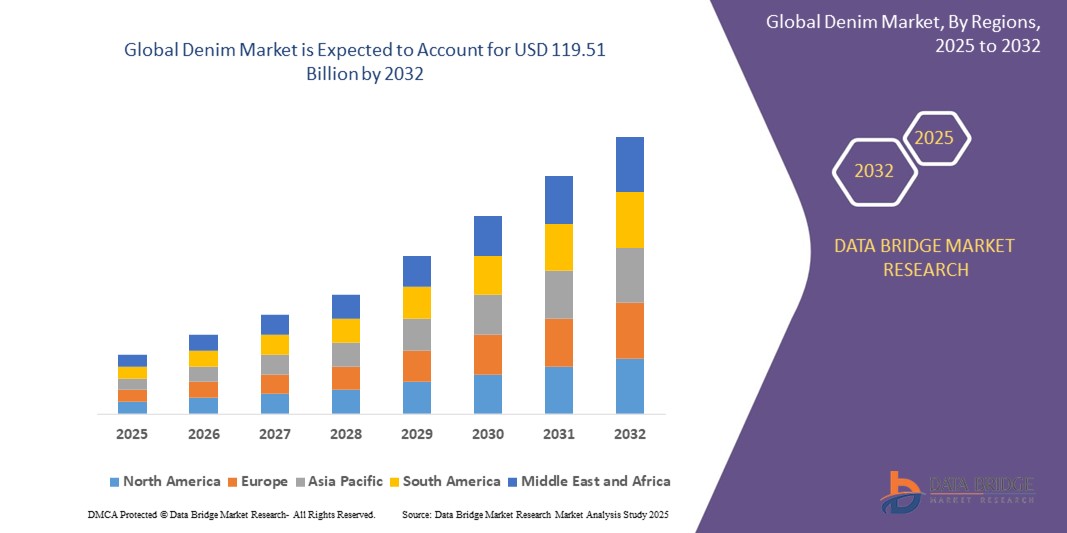
- The global denim market size was valued at USD 71.14 billion in 2024 and is expected to reach USD 119.51 billion by 2032, at a CAGR of 6.70% during the forecast period
- The market growth is primarily driven by the increasing popularity of casual and versatile fashion, rising demand for sustainable and eco-friendly denim products, and the growing influence of fast fashion trends
- In addition, consumer preference for comfortable, durable, and stylish clothing, coupled with the expansion of e-commerce platforms, is significantly boosting the denim industry's growth
Denim Market Analysis
- Denim products, particularly jeans, are a staple in casual fashion, offering durability, versatility, and style across various consumer segments, including men, women, and children
- The rising demand for denim is fueled by evolving fashion trends, increasing urbanization, and a growing preference for sustainable and ethically produced clothing, especially among younger demographics
- North America dominated the denim market with the largest revenue share of 38.5% in 2024, driven by a strong fashion-conscious consumer base, high disposable incomes, and the presence of major denim brands
- Asia-Pacific is expected to be the fastest-growing region during the forecast period, propelled by rapid urbanization, rising disposable incomes, and growing adoption of Western fashion trends in countries such as China and India
- The jeans segment dominated the largest market revenue share of 45% in 2024, driven by their widespread popularity, versatility, and timeless appeal across various consumer demographics
Report Scope and Denim Market Segmentation
|
Attributes |
Denim Key Market Insights |
|
Segments Covered |
|
|
Countries Covered |
North America
Europe
Asia-Pacific
Middle East and Africa
South America
|
|
Key Market Players |
|
|
Market Opportunities |
|
|
Value Added Data Infosets |
In addition to the insights on market scenarios such as market value, growth rate, segmentation, geographical coverage, and major players, the market reports curated by the Data Bridge Market Research also include in-depth expert analysis, pricing analysis, brand share analysis, consumer survey, demography analysis, supply chain analysis, value chain analysis, raw material/consumables overview, vendor selection criteria, PESTLE Analysis, Porter Analysis, and regulatory framework. |
Denim Market Trends
“Increasing Integration of AI and Big Data Analytics”
- The global denim market is experiencing a transformative trend with the integration of Artificial Intelligence (AI) and Big Data analytics
- These technologies enable advanced data processing and analysis, providing deeper insights into consumer preferences, purchasing behavior, and market trends
- AI-powered solutions allow for proactive trend forecasting, identifying emerging fashion preferences before they become mainstream, thus enabling brands to adapt their designs and inventory accordingly
- For instance, several companies are leveraging AI-driven platforms to analyze consumer buying patterns, optimize supply chain logistics, and personalize marketing strategies based on real-time data such as regional style preferences and online browsing habits
- This trend enhances the value proposition of denim products, making them more appealing to both individual consumers and retailers by offering tailored products and improved operational efficiency
- AI algorithms can analyze vast datasets on consumer behavior, including preferred fits, colors, and styles, as well as social media trends, to guide product development and marketing campaigns
Denim Market Dynamics
Driver
“Rising Demand for Sustainable and Fashion-Forward Denim”
- Increasing consumer demand for sustainable and eco-friendly denim products, such as those made from organic cotton or recycled materials, is a major driver for the global denim market
- Denim products enhance fashion versatility by offering a wide range of styles, including jeans, jackets, shirts, and dresses, catering to diverse consumer preferences across casual and semi-formal settings
- Government initiatives and regulations, particularly in regions such as Europe, promoting sustainable manufacturing practices are contributing to the widespread adoption of eco-friendly denim production techniques, such as waterless dyeing and reduced chemical usage
- The proliferation of e-commerce and advancements in digital platforms are further enabling the expansion of denim sales, offering faster and more convenient access to a wide range of products through online channels
- Brands are increasingly offering innovative denim designs, such as distressed, cropped, or high-waisted styles, as standard or premium features to meet consumer expectations and enhance product value
Restraint/Challenge
“High Production Costs and Environmental Concerns”
- The substantial investment required for sustainable production methods, such as organic cotton sourcing or water-recycling technologies, can be a significant barrier to adoption for many manufacturers, especially in cost-sensitive markets
- Integrating sustainable practices into existing production processes can be complex and costly, requiring significant upgrades to manufacturing facilities
- In addition, environmental concerns pose a major challenge. Denim production involves high water and chemical consumption, raising concerns about environmental impact and compliance with stringent sustainability regulations
- The fragmented regulatory landscape across different countries regarding environmental standards and labor practices further complicates operations for international manufacturers and brands
- These factors can deter potential market growth, particularly in regions where environmental awareness is high or where cost sensitivity is a significant factor
Denim market Scope
The market is segmented on the basis of product, consumer type, distribution channel, and type
- By Product
On the basis of product, the global denim market is segmented into jeans, jackets & shirts, trousers, dresses, shorts and track pants, jumpsuits, dungarees, and others. The jeans segment held the largest market revenue share of 45% in 2024, driven by their widespread popularity, versatility, and timeless appeal across various consumer demographics. Jeans are a staple in casual fashion, with increasing demand for sustainable and customized designs.
The dresses segment is anticipated to witness the fastest growth rate from 2025 to 2032, fueled by rising consumer interest in denim dresses for their stylish yet comfortable appeal. Innovations in lightweight and stretchable denim fabrics, coupled with evolving fashion trends, are driving adoption, particularly among younger consumers.
- By Consumer Type
On the basis of consumer type, the global denim market is segmented into men, women, and children. The women’s segment dominated the market with a revenue share of 52% in 2024, driven by the high demand for fashionable denim products such as skinny jeans, high-waisted trousers, and denim dresses. Women’s denim benefits from frequent style innovations and a strong focus on aesthetics and fit.
The children’s segment is expected to experience the fastest growth rate from 2025 to 2032, driven by increasing demand for durable, comfortable, and trendy denim clothing for kids. Parents’ preference for long-lasting and versatile clothing, combined with the rise of kid-friendly sustainable denim, supports this segment’s growth.
- By Distribution Channel
On the basis of distribution channel, the global denim market is segmented into specialty stores, department stores, online, hypermarkets & supermarkets, and exclusive stores. The online segment held the largest market revenue share of 38% in 2024, driven by the convenience of e-commerce platforms, wide product availability, and the growing trend of online shopping. Major brands leverage digital platforms to offer personalized shopping experiences and exclusive collections.
The exclusive stores segment is anticipated to witness the fastest growth rate from 2025 to 2032, driven by the rising popularity of brand-specific retail outlets. These stores offer premium denim products, customized fittings, and immersive in-store experiences, appealing to fashion-conscious consumers.
- By Type
On the basis of type, the global denim market is segmented into light denim, medium denim, and heavy denim. The medium denim segment held the largest market revenue share of 50% in 2024, owing to its versatility, comfort, and suitability for a wide range of products such as jeans, jackets, and dresses. Medium denim strikes a balance between durability and flexibility, making it a preferred choice for manufacturers and consumers.
The light denim segment is expected to witness significant growth from 2025 to 2032, driven by increasing demand for breathable and lightweight fabrics suitable for warm climates and casual fashion. The rise of sustainable and eco-friendly light denim further accelerates its adoption in regions such as Asia-Pacific.
Denim Market Regional Analysis
- North America dominated the denim market with the largest revenue share of 38.5% in 2024, driven by a strong fashion-conscious consumer base, high disposable incomes, and the presence of major denim brands
- Consumers prioritize denim for its durability, versatility, and style, with increasing demand for sustainable and eco-friendly denim options, particularly in regions with high fashion consciousness
- Growth is supported by advancements in denim production technologies, including stretch fabrics and eco-friendly dyeing processes, alongside rising adoption in both premium and mass-market segments
U.S. Denim Market Insight
The U.S. denim market captured the largest revenue share of 66.87% in 2024 within North America, fueled by strong demand for denim jeans and jackets in both retail and online channels. Growing consumer interest in sustainable fashion and customization trends, such as distressed or tailored denim, boosts market expansion. The presence of major denim brands and increasing adoption of eco-friendly materials complement growth in both premium and affordable segments.
Europe Denim Market Insight
The Europe denim market is expected to witness significant growth, supported by a strong emphasis on sustainable fashion and innovative designs. Consumers seek denim products that offer comfort, durability, and eco-conscious production. Growth is prominent in both premium and mass-market segments, with countries such as Germany and France showing significant uptake due to rising environmental awareness and urban fashion trends.
U.K. Denim Market Insight
The U.K. market for denim is expected to witness rapid growth, driven by demand for stylish and sustainable denim products in urban and suburban settings. Increased interest in personalized fashion and eco-friendly materials encourages adoption. Evolving consumer preferences for versatile denim items, such as jumpsuits and dresses, alongside compliance with sustainability standards, further support market growth.
Germany Denim Market Insight
Germany is expected to witness rapid growth in the denim market, attributed to its advanced fashion industry and high consumer focus on sustainability and quality. German consumers prefer technologically advanced denim, such as stretch and lightweight fabrics, that enhance comfort and reduce environmental impact. The integration of denim in premium fashion brands and growing online retail channels supports sustained market growth.
Asia-Pacific Denim Market Insight
The Asia-Pacific region is expected to witness the fastest growth rate, driven by expanding fashion industries and rising disposable incomes in countries such as China, India, and Japan. Increasing awareness of denim as a versatile and durable clothing option boosts demand. Government initiatives promoting sustainable manufacturing and growing e-commerce platforms further encourage the adoption of denim products.
Japan Denim Market Insight
Japan’s denim market is expected to witness rapid growth due to strong consumer preference for high-quality, innovative denim products that enhance style and comfort. The presence of major fashion brands and the integration of denim in both premium and casual segments accelerate market penetration. Rising interest in customized and artisanal denim also contributes to growth.
China Denim Market Insight
China holds the largest share of the Asia-Pacific denim market, propelled by rapid urbanization, rising clothing ownership, and increasing demand for stylish and sustainable denim solutions. The country’s growing middle class and focus on fashion-forward trends support the adoption of denim products. Strong domestic manufacturing capabilities and competitive pricing enhance market accessibility.
Denim Market Share
The denim industry is primarily led by well-established companies, including:
- Levi Strauss & Co. (U.S.)
- Gap, Inc. (U.S.)
- QuoteMedia. (U.S.)
- H & M Hennes & Mauritz AB. (Sweden)
- PVH Corp. (U.S.)
- Pepe Jeans (U.K.)
- U.S. Polo Assn. (U.S.)
- adidas India Marketing Pvt. Ltd (Germany)
- LNJ DENIM (India)
- Partap Group (India)
- Everlane (U.S.)
- KG Denim Ltd. (India)
- KERING (France)
- Raymond (India)
- Inditex, S.A. (Spain)
What are the Recent Developments in Global Denim Market?
- In June 2024, Arvind Limited inaugurated a state-of-the-art eco-efficient denim manufacturing plant in Gujarat, reinforcing its commitment to sustainable production. This facility boasts an annual capacity of 50 million meters, achieving an impressive 90% reduction in water usage through advanced recycling and conservation technologies. The initiative aligns with Arvind’s broader environmental goals, including reducing greenhouse gas emissions and promoting responsible textile manufacturing
- In May 2023, ISKO introduced its R-TWO 50+ collection, featuring denim fabrics made with over 50% reused and recycled materials. This launch highlights the industry’s shift towards circularity, reducing natural resource consumption and carbon footprint. The collection is GRS-certified, ensuring traceability and sustainability throughout the supply chain. Available in over 200 retail chains worldwide, R-TWO 50+ integrates innovative fiber technology, promoting responsible fashion
- In March 2024, QVC partnered with NYDJ to introduce the Marilyn Straight Adapt-Denim™ jean, the brand’s first wheelchair-fit design. This adaptive denim features adjusted fit points, including a higher back rise, lower front rise, flat seams, faux front pockets, and woven tags, ensuring comfort and accessibility for millions of wheelchair users. The jeans incorporate inner elastic adjustments, an elastic back waist, and a functional fly with snap closure, crafted from Sure Stretch® fabric with Lift Tuck® technology
- In August 2023, Cone Denim collaborated with Recover™ to launch denim yarns made from high-quality recycled fibers, significantly reducing virgin cotton usage by 40%. This partnership aligns with the industry’s shift toward circular fashion, integrating sustainable materials into denim production. The initiative supports environmental conservation, lowering water consumption and carbon footprint while maintaining fabric durability and quality. Available across global retail chains, these yarns promote responsible sourcing and textile innovation
- In March 2022, H&M Hennes & Mauritz AB launched the Capsule Collection, a denim line designed with a strong emphasis on water conservation. The brand collaborated with suppliers utilizing recycled water systems, ensuring minimal water usage throughout the manufacturing process. The collection features low-impact Environmental Impact Measurement (EIM) Score washes, water-saving dyeing technologies, and laser printing techniques to reduce chemical-intensive processes. Inspired by late 1990s and early Y2K fashion, it includes flared jeans, dungarees, mini-skirts, and denim shirts

- Interactive Data Analysis Dashboard
- Company Analysis Dashboard for high growth potential opportunities
- Research Analyst Access for customization & queries
- Competitor Analysis with Interactive dashboard
- Latest News, Updates & Trend analysis
- Harness the Power of Benchmark Analysis for Comprehensive Competitor Tracking
Data collection and base year analysis are done using data collection modules with large sample sizes. The stage includes obtaining market information or related data through various sources and strategies. It includes examining and planning all the data acquired from the past in advance. It likewise envelops the examination of information inconsistencies seen across different information sources. The market data is analysed and estimated using market statistical and coherent models. Also, market share analysis and key trend analysis are the major success factors in the market report. To know more, please request an analyst call or drop down your inquiry.
The key research methodology used by DBMR research team is data triangulation which involves data mining, analysis of the impact of data variables on the market and primary (industry expert) validation. Data models include Vendor Positioning Grid, Market Time Line Analysis, Market Overview and Guide, Company Positioning Grid, Patent Analysis, Pricing Analysis, Company Market Share Analysis, Standards of Measurement, Global versus Regional and Vendor Share Analysis. To know more about the research methodology, drop in an inquiry to speak to our industry experts.
Data Bridge Market Research is a leader in advanced formative research. We take pride in servicing our existing and new customers with data and analysis that match and suits their goal. The report can be customized to include price trend analysis of target brands understanding the market for additional countries (ask for the list of countries), clinical trial results data, literature review, refurbished market and product base analysis. Market analysis of target competitors can be analyzed from technology-based analysis to market portfolio strategies. We can add as many competitors that you require data about in the format and data style you are looking for. Our team of analysts can also provide you data in crude raw excel files pivot tables (Fact book) or can assist you in creating presentations from the data sets available in the report.