


What is the Dental Hand Tools Market Size and Growth Rate?
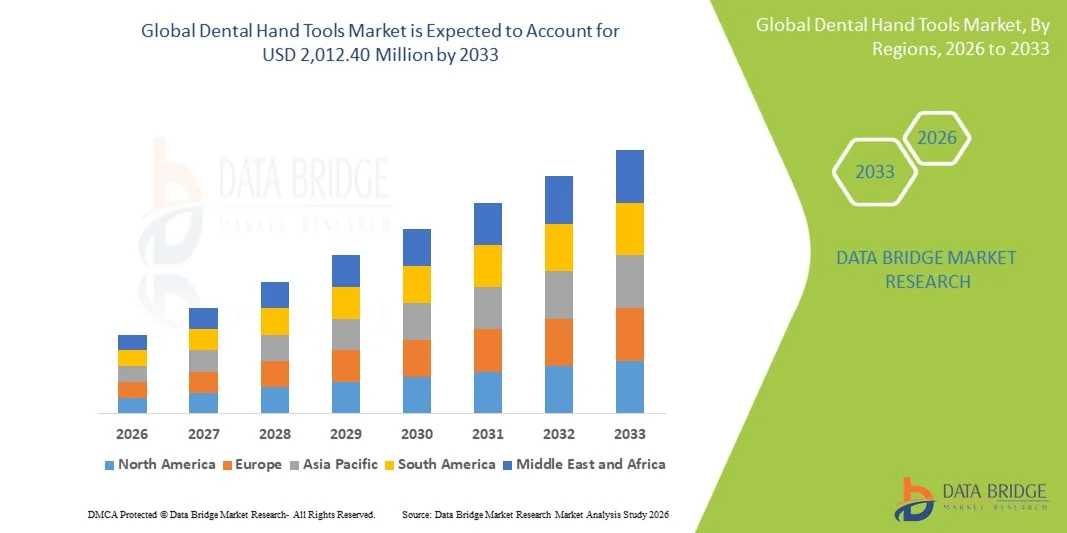
- As per market analysis, the global dental hand tools market was valued at USD 1,865.40 Million in 2025 and is projected to reach USD 2,012.40 Million by 2033, growing at a CAGR of 5.75% from 2026 to 2033.
- The market is witnessing growth driven by the increasing prevalence of dental disorders, rising demand for preventive and restorative dental care, growing number of dental procedures, and increasing adoption of advanced dental instruments. Dental hand tools are widely used across general dentistry, restorative dentistry, periodontics, oral surgery, orthodontics, endodontics, and prosthodontics, supporting their adoption across dental clinics, hospitals, and dental laboratories.
- Increasing dental healthcare expenditure, expansion of dental clinics, rising awareness regarding oral health, and growing demand for minimally invasive and precision-based dental procedures are creating further growth opportunities. The expansion of dental care infrastructure, increasing adoption of ergonomic and specialized hand instruments, rising demand for efficient clinical workflows, and advancements in instrument design, materials, durability, and sterilization technologies are supporting market development across developed and emerging healthcare markets.
Market Size & Forecast
- Market Value (2025): USD 1,865.40 Million
- Expected Market Value (2033): USD 8.79 Million
- Forecast CAGR (2026–2033): 5.75%
- Leading Region in 2025: North America
- Fastest Growing Region: Asia-Pacific
What are the Major Takeaways of the Dental Hand Tools Market?
- North America dominated the global dental hand tools market with 43.67% market share in 2025, supported by the high volume of dental procedures, established dental care infrastructure, strong presence of organized dental clinic networks, and continued demand for reliable examination, restorative, periodontal, and surgical instruments. High dental expenditure and standardized procurement practices across dental service organizations are further supporting regional market development.
- Asia-pacific is expected to witness strong growth in the global dental hand tools market during the forecast period, growing at a CAGR of 7.56% from 2026 to 2031, supported by the expansion of dental clinic networks, increasing awareness of oral health, rising dental treatment volumes, and growing demand for durable and cost-effective dental instruments. Increasing investments in dental healthcare infrastructure across China, India, Japan, South Korea, and other emerging economies are further supporting regional adoption.
- Examination instruments represented a key product segment of the global dental hand tools market with a 22.45% share in 2025, supported by their widespread use in routine dental examinations, diagnosis, preventive care, and treatment planning. Dental mirrors, explorers, probes, and related examination instruments are routinely used across dental clinics and hospitals, supporting consistent demand for this product category.
- Reusable instruments represented a key reusability segment of the global dental hand tools market with an 86.32% share in 2025, supported by their repeated use across dental procedures, cost efficiency over multiple treatment cycles, and established sterilization and reprocessing practices in dental facilities. The demand for durable instruments with validated reprocessing and traceability characteristics is further supporting the adoption of reusable dental hand tools.
- Dental clinics represented a key end-user segment of the global dental hand tools market with a 68.12% share in 2025, supported by the high volume of routine examinations, preventive procedures, restorative treatments, and other dental services conducted in clinic settings. The expansion of organized dental clinic networks and increasing procurement of standardized instrument sets are further supporting demand for dental hand tools.
Report Scope Dental Hand Tools Market Segmentation
|
Attributes |
Dental Hand Tools Market Key Market Insights |
|
Segments Covered |
|
|
Countries Covered |
North America
Europe
Asia-Pacific
Middle East and Africa
South America
|
|
Key Market Players |
|
|
Market Opportunities |
|
|
Value Added Data Infosets |
In addition to the insights on market scenarios such as market value, growth rate, segmentation, geographical coverage, and major players, the market reports curated by the Data Bridge Market Research also include in-depth expert analysis, patient epidemiology, pipeline analysis, pricing analysis, and regulatory framework. |
What is the Key Trend in the Dental Hand Tools Market?
- Increasing adoption of ergonomic, lightweight, and precision-designed dental hand instruments is emerging as a key trend in the global dental hand tools market. Manufacturers are increasingly focusing on instrument designs that reduce grip and pinch force, minimize hand fatigue, improve tactile control, and support comfortable positioning during prolonged dental procedures. The growing focus on clinician ergonomics is encouraging the development of wider, textured, lightweight, and balanced handles across scalers, curettes, restorative instruments, and other hand tools.
- The trend is particularly relevant to periodontics, restorative dentistry, preventive dentistry, and other procedures involving repetitive and precision-based hand movements, where instrument balance, handle design, tactile feedback, and ease of manipulation can influence practitioner comfort and workflow efficiency. The increasing attention to work-related musculoskeletal disorders among dental professionals is further encouraging manufacturers to incorporate ergonomic principles into dental instrument design.
- For instance, in March 2025, lM-dental launched several new hand instruments at ids 2025, expanding its ergonomic hand instrument portfolio. The company introduced new instruments for indirect adhesive restoration, expanded its lM-ARTE product line with the lM-ARTE Replica anterior, and introduced an instrument selection for periodontal microsurgery. The developments demonstrate the industry's movement toward specialized, ergonomic, and procedure-specific dental hand instruments.
- Infection control and reprocessing compatibility are also becoming increasingly important in dental hand tool design. Dental organizations recommend that reusable intraoral instruments, including periodontal probes, scalers, forceps, and other critical instruments, undergo appropriate cleaning and sterilization between patients. This is supporting demand for durable instruments designed to withstand repeated cleaning, sterilization, and clinical use while maintaining performance and functionality.
What are the Key Drivers of the Dental Hand Tools Market?
- Increasing adoption of ergonomic, precision-engineered, and lightweight dental hand instruments is emerging as a key trend in the dental hand tools market. Manufacturers are increasingly focusing on instrument designs that improve clinician comfort, handling precision, visibility, and procedural efficiency. Developments in handle design, grip technology, instrument balance, and specialized working ends are supporting the use of dental hand tools across routine and specialized procedures.
- The trend is particularly relevant to general dentistry, restorative dentistry, periodontics, endodontics, orthodontics, and oral surgery, where dentists require instruments that provide accurate control while reducing hand fatigue during repetitive procedures. The broader dental instruments market is also witnessing increasing emphasis on infection control, durability, corrosion resistance, and compatibility with automated cleaning and sterilization workflows.
- For instance, in June 2025, advancements in materials and manufacturing technologies are further supporting this trend. Manufacturers are increasingly using high-quality stainless steel, specialized alloys, advanced coatings, and precision manufacturing techniques to improve instrument durability, sharpness, corrosion resistance, and resistance to repeated sterilization cycles. These developments are supporting the transition toward longer-lasting and high-performance dental hand tools.
- The integration of ergonomic design with infection-control requirements is also supporting market development. Modern dental hand tools are increasingly designed with smooth surfaces, optimized handles, and materials that facilitate effective cleaning, disinfection, and sterilization. The combination of clinician-focused ergonomics, precision performance, durability, and infection-control characteristics is supporting the development of next-generation dental hand instruments.
Which Factors are Challenging the Growth of the Dental Hand Tools Market?
- Stringent sterilization and infection-control requirements are emerging as a key challenge in the dental hand tools market. Dental hand instruments, particularly reusable instruments that contact oral tissues or penetrate soft tissue, require appropriate cleaning, disinfection, and sterilization between patients. These requirements increase the operational burden on dental clinics and require compliance with validated manufacturer instructions and infection-control protocols.
- Repeated sterilization can also affect instrument durability and maintenance requirements. Heat-based sterilization is recommended for many reusable dental instruments, while repeated processing can contribute to wear or damage for certain instruments and components. Dental facilities therefore need to balance instrument longevity, reprocessing requirements, and patient safety, which can increase the overall cost of ownership.
- Ergonomic limitations associated with conventional hand instruments represent another challenge for market development. Dental professionals frequently perform repetitive, precise hand movements while maintaining static or awkward postures. Research has linked dental instrumentation and handle design with hand fatigue and work-related musculoskeletal disorders, creating increasing demand for lightweight, well-balanced, and ergonomically designed instruments.
- For instance, in May 2026, lM-dental has developed ergonomic dental hand instruments under its lM-duragrade max and related instrument ranges, focusing on handle design and clinician ergonomics. Such product development reflects the industry's response to the need for improved handling comfort while maintaining the precision required for dental procedures.
- The need for continuous product innovation while maintaining durability, precision, sterilization compatibility, and cost efficiency further challenges manufacturers. Dental hand tools must meet demanding clinical requirements while remaining suitable for repeated use and reprocessing, making material selection, handle design, manufacturing precision, and quality control important considerations in product development.
How is the Dental Hand Tools Market Segmented?
The market is segmented on the basis of product type, application, end user, and distribution channel.
- By Product type
On the basis of product type, the global dental hand tools market is segmented into Examination Instruments, Periodontal Instruments, Restorative Instruments, Extraction Instruments, Orthodontic Instruments, Prosthodontic Instruments, Surgical Instruments, and Other Dental Hand Tools. The Examination Instruments segment is expected to dominate the market with a share of 22.45% in 2025, supported by the widespread use of dental mirrors, explorers, probes, and other examination instruments during routine dental examinations and diagnosis. These instruments are used across dental specialties for oral examination, periodontal assessment, treatment planning, and evaluation of dental conditions, supporting consistent demand across dental care settings.
The Endodontic Instruments segment is expected to witness significant demand during the forecast period, growing at a CAGR of 6.89% from 2026 to 2033, supported by increasing demand for root canal treatments and tooth-preservation procedures. The recurring replacement requirements of endodontic file systems and increasing adoption of nickel-titanium instruments are further supporting segment growth.
- By Application
On the basis of application, the global dental hand tools market is segmented into General Dentistry, Restorative Dentistry, Periodontics, Endodontics, Oral Surgery, Orthodontics, Prosthodontics, Cosmetic Dentistry, and Other Applications. The General Dentistry segment is expected to account for a significant share of the market share of 32.12% in 2025, supported by the high volume of routine dental examinations, preventive procedures, diagnosis, scaling, restoration, and basic treatment activities performed in general dental practices. The broad utilization of examination, periodontal, restorative, and extraction instruments across routine dental care supports demand for dental hand tools.
The Endodontics segment is expected to witness strong growth during the forecast period fastest-growing product category at a CAGR of 6.89% from 2026 to 2031, supported by increasing demand for root canal procedures and tooth-preservation treatments. The increasing use of specialized endodontic instruments and recurring replacement requirements for certain endodontic tools are further supporting segment development.
- By End User
On the basis of end user, the global dental hand tools market is segmented into Dental Clinics, Hospitals, Dental Laboratories, Academic and Research Institutes, and Other End Users. The Dental Clinics segment dominated the market with a share of 68.12% in 2025, supported by the high volume of routine examinations, preventive procedures, restorative treatments, periodontal procedures, and other dental services conducted in clinic settings. Independent dental practices, group practices, and expanding dental service organizations contribute to the high utilization of dental hand tools in this segment.
The dental hospitals segment is expected to grow at a CAGR of 7.21% from 2026 to 2033, supported by increasing demand for specialized dental and oral surgical procedures. Dental hospitals and multispecialty referral centers require a broader range of instruments for endodontic, periodontal, surgical, orthodontic, and other complex procedures.
- By Distribution Channel
On the basis of distribution channel, the global dental hand tools market is segmented into Direct Sales, Distributor/Wholesaler, Online Sales, and Other Distribution Channels. The Distributor/Wholesaler segment is expected to account for a significant share of the market share of 32.00% in 2025, supported by the established role of dental equipment distributors in supplying instruments to independent dental practices, hospitals, laboratories, and institutional buyers. Distributors provide access to multiple brands and product categories while supporting product availability and procurement across different geographic markets.
The Online Sales segment is expected to witness increasing demand during the forecast period CAGR of 6.11% in 2026 to 2033, supported by the growing adoption of digital procurement platforms and e-commerce channels among dental professionals and healthcare institutions. Online channels provide convenient access to product specifications, multiple brands, pricing information, and replacement instruments, supporting their increasing role in dental hand tool procurement.
Which Region Holds the Largest Share of the Dental Hand Tools Market?
- North America dominated the global dental hand tools market with a 43.67% market share in 2025, supported by established dental healthcare infrastructure, high dental care expenditure, a large network of dental clinics, and consistent demand for examination, periodontal, restorative, extraction, and other specialized hand instruments. The presence of established dental manufacturers and organized dental service networks is further supporting regional market development.
- The region also benefits from the expansion of organized dental practices, standardized procurement across dental service organizations, and increasing demand for durable reusable instruments used in routine examination, periodontal, restorative, extraction, and endodontic procedures. Strong regulatory standards and established dental distribution networks further support the adoption of high-quality dental hand tools across North America.
U.S. Dental Hand Tools Market Insight
The U.S. dental hand tools market is supported by the country’s established dental care infrastructure, high utilization of professional dental services, and strong demand for precision instruments across general dentistry, restorative dentistry, periodontics, endodontics, orthodontics, and oral surgery. Increasing emphasis on preventive oral healthcare and routine dental examinations is supporting consistent instrument demand. The presence of established dental instrument manufacturers, organized dental practices, dental service organizations, and advanced sterilization infrastructure further contributes to market development. Growing preference for ergonomic, durable, and specialized hand instruments is also encouraging product innovation and replacement demand across U.S. dental care facilities.
Europe Dental Hand Tools Market Insight
The Europe dental hand tools market is supported by well-established dental healthcare infrastructure, high awareness of oral health, and increasing demand for preventive, restorative, periodontal, and surgical dental procedures. The presence of organized dental clinics, specialized dental practices, and established instrument manufacturers contributes to steady product adoption across the region. Growing emphasis on infection control, sterilization, instrument durability, and ergonomic designs is encouraging demand for advanced dental hand tools. In addition, rising dental care expenditure, an aging population, and increasing adoption of specialized dental treatments are supporting market development across major European countries.
U.K. Dental Hand Tools Market Insight
The U.K. dental hand tools market is supported by the country’s established dental care infrastructure, increasing demand for preventive and restorative dental procedures, and the presence of a large network of dental practices and hospitals. Rising awareness of oral health and regular dental examinations is contributing to consistent utilization of examination, periodontal, restorative, extraction, and surgical instruments. The growing adoption of ergonomically designed and durable dental hand tools is also supporting market development. In addition, technological advancements in instrument materials, precision manufacturing, sterilization compatibility, and infection-control practices are encouraging demand for high-quality dental instruments.
Germany Dental Hand Tools Market Insight
The Germany dental hand tools market is supported by the country’s well-established dental healthcare infrastructure, high utilization of dental services, and strong emphasis on preventive and restorative oral care. Demand for dental hand tools is driven by the widespread presence of dental practices, increasing adoption of precision instruments, and continued requirements for reliable examination, periodontal, restorative, extraction, and surgical tools. Growing focus on infection control, instrument sterilization, ergonomic design, and durable materials is encouraging product innovation. In addition, Germany’s strong medical-device manufacturing ecosystem and advanced healthcare standards support continued development and adoption of high-quality dental instruments.
Asia-Pacific Dental Hand Tools Market Insight
The Asia-Pacific dental hand tools market is experiencing steady expansion, supported by increasing dental care expenditure, growing awareness of oral health, and the expansion of dental clinics and hospitals across emerging economies. Rising dental treatment volumes, increasing demand for preventive and restorative procedures, and improvements in healthcare infrastructure are supporting instrument adoption. Countries such as China, India, Japan, and South Korea are contributing to regional development through expanding dental service networks and increasing access to specialized treatments. Growing demand for durable, ergonomic, and precision-designed instruments is further creating opportunities for dental hand tool manufacturers across the region.
Japan Dental Hand Tools Market Insight
The Japan dental hand tools market is supported by Japan’s well-established dental healthcare infrastructure, high utilization of dental services, and strong emphasis on preventive and restorative oral care. Demand for examination, periodontal, restorative, endodontic, and surgical hand instruments is supported by the country’s large network of dental clinics and advanced clinical practices. Increasing adoption of ergonomically designed, precision-engineered, and sterilization-compatible instruments is further supporting market development. In addition, Japan’s aging population and growing need for routine dental and periodontal care are contributing to sustained demand for reliable and durable dental hand tools.
China Dental Hand Tools Market Insight
The China dental hand tools market is supported by the expansion of dental healthcare infrastructure, increasing awareness of oral health, and rising demand for preventive and restorative dental procedures. Growing numbers of dental clinics and hospitals are contributing to the adoption of examination, periodontal, restorative, extraction, and other specialized hand instruments. Increasing healthcare expenditure and improvements in dental care accessibility are further supporting market development. In addition, local manufacturing capabilities, expanding dental equipment distribution networks, and increasing adoption of advanced and ergonomically designed instruments are creating opportunities for dental hand tool manufacturers in China.
Which are the Top Companies in Dental Hand Tools Market?
The Dental Hand Tools market industry is primarily led by well-established companies, including:
- Dentsply Sirona Inc. (U.S.)
- HuFriedyGroup (U.S.)
- COLTENE Holding AG (Switzerland)
- Integra LifeSciences Corporation (U.S.)
- Kerr Corporation (U.S.)
- American Eagle Instruments, Inc. (U.S.)
- Brasseler USA Dental, LLC (U.S.)
- LM-Instruments Oy (Finland)
- Medesy S.r.l. (Italy)
- Carl Martin GmbH (Germany)
- Young Innovations, Inc. (U.S.)
- ASA Dental S.p.A. (Italy)
- B. Braun SE (Germany)
- Nordent Manufacturing, Inc. (U.S.)
- Premier Dental Products Company (U.S.)
What are Latest Developments in Dental Hand Tools Market?
- In June 2026, HuFriedyGroup partnered with the International Team for Implantology (ITI) to strengthen evidence-based education, research, and clinical protocols in implant dentistry. The collaboration supports clinicians across implant placement and long-term implant maintenance, including the use of specialized dental instruments.
- In April 2026, HuFriedyGroup announced a strategic partnership with Seattle Study Club to advance dental education and clinical excellence. The partnership forms part of the company's broader focus on supporting clinicians through education and clinical solutions.
- In February 2026, HuFriedyGroup introduced PWR Air at the Chicago Midwinter Meeting. The new air-polishing solution is designed for biofilm disruption, stain removal, preventive care, and implant maintenance, expanding the company's dental care portfolio.
- In February 2026, Dentsply Sirona expanded its distribution partnership with Burkhart Dental Supply. Effective Burkhart added Dentsply Sirona's full dental technology portfolio to the preventive and restorative products it already distributed, expanding access to connected dental technologies in the U.S.
- In January 2026, Dentsply Sirona expanded its partnership with Benco Dental to include its broader dental technology portfolio alongside existing consumables distribution. The expanded relationship covers solutions such as CEREC, Primescan, Primescan 2, and imaging systems, strengthening integration between dental products and digital workflows.

- Interactive Data Analysis Dashboard
- Company Analysis Dashboard for high growth potential opportunities
- Research Analyst Access for customization & queries
- Competitor Analysis with Interactive dashboard
- Latest News, Updates & Trend analysis
- Harness the Power of Benchmark Analysis for Comprehensive Competitor Tracking
Data collection and base year analysis are done using data collection modules with large sample sizes. The stage includes obtaining market information or related data through various sources and strategies. It includes examining and planning all the data acquired from the past in advance. It likewise envelops the examination of information inconsistencies seen across different information sources. The market data is analysed and estimated using market statistical and coherent models. Also, market share analysis and key trend analysis are the major success factors in the market report. To know more, please request an analyst call or drop down your inquiry.
The key research methodology used by DBMR research team is data triangulation which involves data mining, analysis of the impact of data variables on the market and primary (industry expert) validation. Data models include Vendor Positioning Grid, Market Time Line Analysis, Market Overview and Guide, Company Positioning Grid, Patent Analysis, Pricing Analysis, Company Market Share Analysis, Standards of Measurement, Global versus Regional and Vendor Share Analysis. To know more about the research methodology, drop in an inquiry to speak to our industry experts.
Data Bridge Market Research is a leader in advanced formative research. We take pride in servicing our existing and new customers with data and analysis that match and suits their goal. The report can be customized to include price trend analysis of target brands understanding the market for additional countries (ask for the list of countries), clinical trial results data, literature review, refurbished market and product base analysis. Market analysis of target competitors can be analyzed from technology-based analysis to market portfolio strategies. We can add as many competitors that you require data about in the format and data style you are looking for. Our team of analysts can also provide you data in crude raw excel files pivot tables (Fact book) or can assist you in creating presentations from the data sets available in the report.













