


What is the Detection Tools Market Size and Growth Rate?
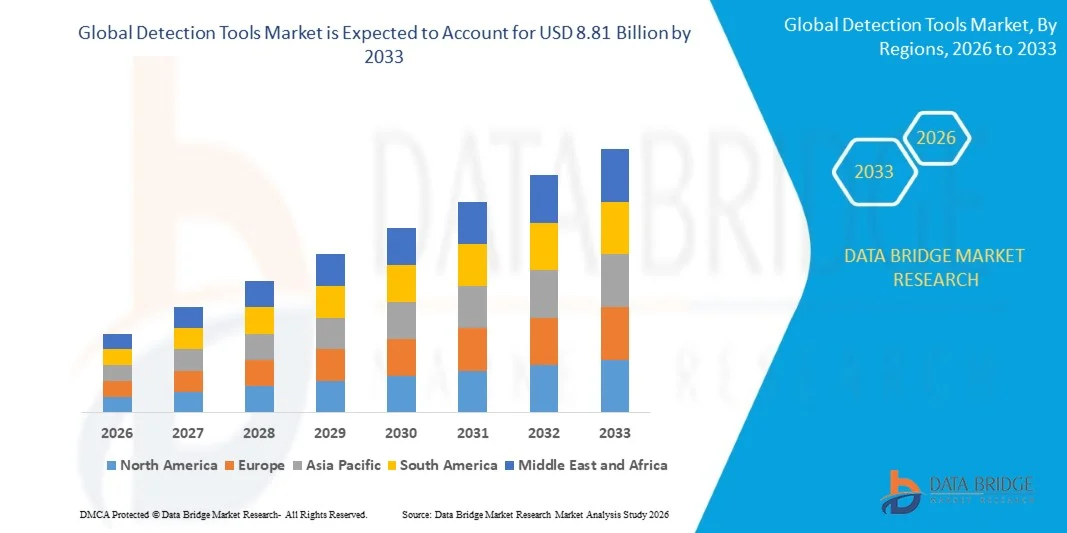
- As per Data Bridge Market Research analysis, the detection tools market was valued at USD 5.70 billion in 2025 and is projected to reach USD 8.81 billion by 2033, growing at a CAGR of 5.60% from 2026 to 2033.
- The market is experiencing consistent growth driven by increasing infrastructure development, expansion and modernization of utility networks, rising construction and renovation activity, and growing demand for accurate, non-destructive detection of concealed utilities, electrical wiring, pipes, and structural elements.
- The increasing emphasis on worker and excavation safety, combined with greater investments in transportation, commercial buildings, power grids, water pipelines, gas distribution systems, and telecommunications infrastructure, is compelling construction companies, utility operators, and industrial facilities to adopt advanced detection tools. Electromagnetic, radar-based, thermal-assisted, and inspection-camera technologies are increasingly being deployed to identify concealed assets, support preventive maintenance, reduce accidental damage, and improve inspection accuracy.
Market Size & Forecast
- Global Market Value (2025): USD 5.70 Billion
- Expected Market Value (2033): USD 8.81 Billion
- Forecast CAGR (2026–2033): 5.60%
- Leading Region in 2025: North America
- Fastest Growing Region: Asia Pacific
What are the Major Takeaways of the Detection Tools Market?
- North America dominated the detection tools market with the largest revenue share of 33.6% in 2025, supported by extensive underground utility networks, high construction and renovation activity, and strong emphasis on workplace and excavation safety.
- Asia-Pacific is expected to be the fastest-growing region at a CAGR of 8.4% from 2026 to 2033, fueled by rapid urbanization, infrastructure expansion, industrialization, and increasing construction activity across China, India, Japan, and other emerging economies.
- The utility & pipe detectors segment led the market with a 31.1% share in 2025, driven by increasing demand for locating buried cables, pipes, conduits, and other underground assets.
- Thermal-assisted detection tools are the fastest-growing product type, projected to register a CAGR of 9.5%, reflecting the surge in adoption of thermal imaging and temperature-based inspection technologies.
- The electromagnetic detection segment dominated the technology category with a 37.3% revenue share in 2025, led by its extensive use in locating metallic objects, electrical wiring, underground cables, and conductive pipes.
- Industrial facilities accounted for 35.2% of the market share in 2025, preferred by extensive use of detection equipment for preventive maintenance, equipment inspection, electrical diagnostics, and workplace safety.
- The infrastructure & public utilities segment is the fastest-growing industry category, with a CAGR of 6%, driven by increasing investment in transportation, energy, water, wastewater, gas, and telecommunications infrastructure
Report Scope and Detection Tools Market Segmentation
|
Attributes |
Detection Tools Key Market Insights |
|
Segments Covered |
|
|
Countries Covered |
North America
Europe
Asia-Pacific
Middle East and Africa
South America
|
|
Key Market Players |
|
|
Market Opportunities |
|
|
Value Added Data Infosets |
In addition to the insights on market scenarios such as market value, growth rate, segmentation, geographical coverage, and major players, the market reports curated by the Data Bridge Market Research also include in-depth expert analysis, geographically represented company-wise production and capacity, network layouts of distributors and partners, detailed and updated price trend analysis and deficit analysis of supply chain and demand. |
What is the Key Trend in the Detection Tools Market?
- Utility operators are increasingly adopting integrated detection and mapping tools to identify buried assets, improve survey accuracy, and reduce excavation risks across complex urban infrastructure projects before construction and maintenance activities.
- For instance, in May 2025, Radiodetection launched its MRX range, combining marker-ball detection with utility locating functionality, while the MRX SG added survey-grade mapping capabilities to one integrated device, improving locating efficiency and safety for utility professionals operating in complex sites.
- Integrated systems combine radar, electromagnetic locating, GNSS, and software to visualize buried utilities and support field decisions.
- Construction and utility professionals are using analysis, digital mapping, and multisensor detection to address congested underground networks and improve project planning.
- For instance, in June 2025, Leica Geosystems launched the DS4000 utility detection system, designed to identify underground assets up to 60% deeper than traditional systems and reveal smaller objects such as fibre optic cables.
- As underground utility networks become more congested and infrastructure projects expand, advanced detection tools are becoming increasingly important for locating assets accurately, preventing damage, and supporting safer excavation and maintenance activities across increasingly complex urban construction environments worldwide.
What are the Key Drivers of the Detection Tools Market?
- The rapid growth in construction, utility modernization, and urban infrastructure is increasing demand for detection tools that locate buried pipes, cables, and other assets before excavation and maintenance work across increasingly complex underground utility environments.
- For instance, in March 2024, Trimble and Radiodetection announced a collaboration integrating Trimble Catalyst GNSS with Radiodetection’s RD Map+ application and precision locators, enabling survey-grade positioning and more accurate underground utility mapping.
- Stricter excavation safety requirements and greater emphasis on asset documentation are encouraging contractors and utility operators to use accurate detection technologies before ground disturbance begins nationwide.
- For instance, in June 2025, Leica Geosystems launched the DS4000 utility detection system, which can identify underground assets up to 60% deeper than traditional systems and detect smaller assets such as fiber-optic cables.
- As infrastructure becomes denser and maintenance projects expand, accurate detection tools remain essential for reducing utility strikes, supporting safe excavation, and improving the efficiency of construction and asset-management activities worldwide.
Which Factors are Challenging the Growth of the Detection Tools Market?
- Advanced detection tools can require upfront investment because high-end GPR, thermal imaging, acoustic, and integrated mapping systems combine specialized hardware, software, and sensors.
- For instance, in June 2025, Leica Geosystems launched the DS4000 utility detection system, with the company’s official store listing the system at USD 23,305, illustrating the substantial upfront investment required for advanced GPR-based detection equipment.
- These costs can limit adoption among smaller contractors, local utilities, and organizations operating in price-sensitive markets.
- High capital requirements and recurring costs for calibration, software, training, and maintenance can restrict adoption, particularly among smaller organizations and contractors.
- For instance, in April 2026, a study published in Sensors identified complex radargram interpretation as a persistent barrier to GPR-based utility detection, noting that interpretation traditionally relies heavily on experienced operators and can be labor-intensive and prone to human error.
- This cost barrier can delay deployment in emerging markets, despite growing needs for accurate detection, safer excavation, and efficient infrastructure management where budgets and technical resources may be limited
How is the Detection Tools Market Segmented?
The detection tools market is segmented on the basis of product type, technology, industry, and distribution channel.
- By Product Type
On the basis of product type, the detection tools market is segmented into wall scanners, utility & pipe detectors, metal detectors, voltage & electrical detectors, thermal-assisted detection tools, and inspection cameras. The utility & pipe detectors segment dominated the market with a 31.1% share in 2025, owing to increasing demand for locating buried cables, pipes, conduits, and other underground assets. These tools are widely used across construction, excavation, infrastructure development, plumbing, telecommunications, and pipeline maintenance activities. Utility and pipe detection systems help contractors identify concealed infrastructure before drilling or excavation, reducing the likelihood of accidental utility damage. Increasing underground infrastructure density is further creating demand for accurate and reliable locating solutions. Growing emphasis on excavation safety and uninterrupted utility services is also supporting adoption across professional end users.
The thermal-assisted detection tools segment is projected to register the fastest growth at a CAGR of 9.5% from 2026 to 2033, driven by increasing adoption of thermal imaging and temperature-based inspection technologies. These tools enable non-contact identification of overheating components, electrical faults, insulation problems, moisture intrusion, and mechanical abnormalities. Their ability to identify developing problems before equipment failure supports growing use in preventive maintenance programs. Industrial facilities, electrical contractors, commercial buildings, utilities, and facility-management teams are increasingly incorporating thermal detection into routine inspection activities. Improvements in thermal sensor resolution, portability, image processing, and digital analysis are expanding the range of applications.
- By Technology
On the basis of technology, the detection tools market is segmented into electromagnetic detection, radar-based detection, ultrasonic detection, infrared detection, capacitive sensing, and AI-enabled smart detection. The electromagnetic detection segment dominated the market with a 37.3% share in 2025, supported by its extensive use in locating metallic objects, electrical wiring, underground cables, and conductive pipes. Electromagnetic detection provides a practical combination of portability, reliability, and ease of operation for professional field applications. Construction companies and utility operators widely use electromagnetic systems for locating concealed infrastructure before drilling, excavation, and maintenance activities. The technology is also incorporated into wall scanners, metal detectors, and utility-locating equipment, expanding its application across multiple product categories. Continuous improvements in sensing performance and signal processing are further supporting its use in complex detection environments.
The radar-based detection segment is projected to register the fastest growth at 8% CAGR from 2026 to 2033, driven by increasing demand for deeper and more comprehensive subsurface detection. Radar-based systems can identify both metallic and non-metallic objects, structural elements, voids, and underground utilities across a range of construction and infrastructure applications. Ground-penetrating radar technology is increasingly being used where conventional detection approaches provide insufficient information about concealed assets. Advances in signal processing, data visualization, and digital interpretation are improving the usability and accuracy of radar-based systems. The integration of advanced analytics and improved imaging capabilities is also helping users interpret complex subsurface conditions more effectively.
- By Industry
On the basis of industry, the detection tools market is segmented into residential, commercial, industrial facilities, infrastructure & public utilities, oil & gas, mining, and others. The industrial facilities segment dominated the market with a 35.2% share in 2025, driven by extensive use of detection equipment for preventive maintenance, equipment inspection, electrical diagnostics, and workplace safety. Manufacturing plants, processing facilities, power facilities, and other industrial sites require continuous monitoring of equipment and critical assets to prevent operational failures. Detection tools allow industrial operators to identify electrical faults, overheating components, structural elements, and other abnormalities without disrupting operations. The increasing emphasis on asset reliability and reduced unplanned downtime is encouraging more frequent inspection and maintenance activities. Growing industrial automation is also creating greater demand for accurate and efficient condition-monitoring solutions.
The infrastructure & public utilities segment is projected to register the fastest growth at 6% CAGR from 2026 to 2033, supported by increasing investment in transportation, energy, water, wastewater, gas, and telecommunications infrastructure. Detection tools are increasingly required to identify underground pipes, cables, conduits, and other buried assets before excavation and maintenance activities. Utility network modernization and smart-infrastructure development are creating additional demand for accurate, non-destructive inspection technologies. Expansion of electricity transmission, water distribution, telecommunications, and other critical infrastructure is further widening the application base. Stricter safety requirements and the need to reduce accidental utility damage are encouraging infrastructure operators to deploy advanced detection solutions.
- By Distribution Channel
On the basis of distribution channel, the detection tools market is segmented into manufacturer direct, industrial distributors, specialist trade channels, DIY super stores, and e-commerce. The industrial distributors segment dominated the market with 30% share in 2025, owing to their extensive reach among professional contractors, utility companies, industrial facilities, and construction organizations. Industrial distributors provide access to products from multiple manufacturers, allowing professional buyers to compare detection technologies according to their operational requirements. They also provide important value-added services such as technical support, calibration, product guidance, and after-sales assistance. Their established relationships with professional customers support recurring procurement across construction, utilities, industrial maintenance, and infrastructure projects. Broad product availability through established distribution networks further supports the adoption of specialized detection equipment.
The e-commerce segment is projected to register the fastest growth at 7% CAGR from 2026 to 2033, driven by increasing digital purchasing among professional and residential users. Online channels provide users with convenient access to a broad range of wall scanners, electrical detectors, inspection cameras, and other detection equipment. Customers can compare product specifications, technical features, reviews, and available options before making purchasing decisions. E-commerce also expands access to specialized detection products in markets where physical specialist retailers have limited coverage. Manufacturers and distributors are increasingly using online stores and digital marketplaces to reach smaller contractors, maintenance professionals, and individual buyers directly.
Which Region Holds the Largest Share of the Detection Tools Market?
- North America dominated the detection tools market with the largest revenue share of 33.6% in 2025, supported by extensive underground utility networks, high construction and renovation activity, and strong emphasis on workplace and excavation safety.
- The region also benefits from stringent workplace safety regulations, high adoption of electromagnetic and radar-based detection technologies, and growing use of detection tools across construction, utility mapping, electrical inspection, and infrastructure maintenance applications. Increasing focus on preventing utility damage, improving worker safety, and modernizing aging infrastructure continues to strengthen North America’s position in the global market.
U.S. Detection Tools Market Insight
The U.S. detection tools market is witnessing strong growth due to rising investments in infrastructure inspection, utility mapping, workplace safety, and advanced detection technologies. The country’s mature construction, utility, and industrial sectors, along with increasing adoption of electromagnetic, radar-based, and thermal-assisted detection systems, is driving demand across commercial, industrial, and infrastructure applications. In addition, growing emphasis on preventing utility damage, improving inspection accuracy, and strengthening worker safety standards is accelerating detection tool adoption across construction companies, utility providers, and industrial facilities.
Asia-Pacific Detection Tools Market Insight
The Asia-Pacific detection tools market is expected to witness rapid growth, driven by increasing urbanization, expanding construction activities, and rising investments in infrastructure development across countries such as China, India, and Japan. Growing awareness regarding workplace safety, rising adoption of advanced detection technologies, and increasing demand for efficient utility and structural inspection solutions are supporting regional market expansion. Additionally, the growing presence of manufacturing facilities, smart city projects, and transportation infrastructure development is accelerating detection tool adoption across commercial, industrial, and public infrastructure sectors.
Japan Detection Tools Market Insight
The Japan detection tools market is witnessing consistent growth due to rising investments in infrastructure maintenance, advanced inspection technologies, and workplace safety initiatives. Construction companies, utility providers, and industrial organizations are increasingly adopting high-precision detection tools for underground utility identification, electrical inspection, structural assessment, and maintenance activities. Moreover, increasing integration of radar-based, electromagnetic, and thermal detection technologies and the country’s focus on efficient infrastructure management are further contributing to market growth.
China Detection Tools Market Insight
The China detection tools market is growing rapidly, driven by increasing urbanization, expanding construction activities, and rising government focus on infrastructure safety and development. Growing adoption of electromagnetic, radar-based, and ultrasonic detection technologies across construction, industrial, and utility sectors is significantly boosting market demand. In addition, rising investments in smart city projects, increasing awareness regarding underground utility protection, and rapid technological advancements are positioning China as one of the important growth markets for detection tools globally.
U.K. Detection Tools Market Insight
The U.K. detection tools market is experiencing steady growth, supported by rising adoption of advanced inspection technologies in construction, utility management, industrial maintenance, and infrastructure applications. Increasing investments in underground utility detection and growing demand for accurate, efficient, and non-destructive inspection solutions are contributing to market growth. Furthermore, integration of radar, electromagnetic, thermal, and digital sensing technologies is improving detection performance and operational efficiency, positioning the U.K. as an important market for detection tools.
Germany Detection Tools Market Insight
The Germany detection tools market is expanding steadily due to the country’s strong industrial manufacturing base, advanced engineering capabilities, and increasing adoption of next-generation detection technologies. Construction companies, utility providers, and industrial organizations are increasingly utilizing detection tools for underground utility mapping, electrical inspection, structural assessment, and maintenance activities. Continuous advancements in radar-based detection, electromagnetic sensing, and thermal inspection technologies, along with strong industry focus on workplace safety and infrastructure reliability, are further driving market growth in Germany.
Which are the Top Companies in Detection Tools Market?
The detection tools industry is primarily led by well-established companies, including:
- Robert Bosch Power Tools GmbH (Germany)
- Hilti Aktiengesellschaft (Liechtenstein)
- Leica Geosystems AG (Switzerland)
- Radiodetection Ltd. (U.K.)
- Teledyne FLIR LLC (U.S.)
- Fluke Corporation (U.S.)
- Garrett Electronics, Inc. (U.S.)
- Minelab Electronics Pty Ltd (Australia)
- SARL XPLORER (France)
- Nokta Dedektör Elektronik A.Ş. (Türkiye)
- Zircon Corporation (U.S.)
- Klein Tools, Inc. (U.S.)
- Ridge Tool Company (U.S.)
- Schonstedt Instrument Company (U.S.)
- Vivax-Metrotech Corporation (U.S.)
- Walabot (Israel)
- Seek Thermal, Inc. (U.S.)
- Testo SE & Co. KGaA (Germany)
- 3M (U.S.)
- Milwaukee Tool (U.S.)
What are Latest Developments in Detection Tools Market?
- In May 2025, Radiodetection announced the launch of its new RF Marker Ball Locator range, comprising the MRX, MRX G, and MRX SG locators, designed to improve the efficiency and accuracy of underground utility detection. The devices combine marker-ball detection with utility locating, while the MRX SG adds survey-grade mapping capabilities for buried infrastructure. The launch strengthens the use of integrated locating and mapping technologies for utility maintenance and infrastructure management.
- In March 2025, Sensors & Software, part of Radiodetection, announced the availability of its new GPR-SG GNSS positioning system for LMX, Noggin, and pulseEKKO ground-penetrating radar systems. The solution provides high-accuracy positioning for GPR surveys and supports the mapping of buried assets and subsurface objects. Its plug-and-play design enables users to integrate precise GNSS positioning into existing GPR workflows, enhancing underground detection and mapping capabilities.
- In September 2024, Radiodetection announced its new RD510 Water Pipe Locator & Leak Detector, developed to locate underground water pipes and identify subsurface leaks. The handheld solution combines water-pipe locating and leak-detection functionality and is designed to address challenges associated with detecting non-metallic pipes. The development expands detection-tool applications into water infrastructure maintenance and repair.
- In November 2023, Radiodetection announced the new RD8200SG survey-grade precision locator, designed to locate and digitally map buried utilities in a single operation. The solution integrates utility locating with real-time mapping and can connect with mobile mapping applications to create digital records of underground pipes and cables. This development supports more accurate utility mapping and helps improve field workflows for infrastructure operators.
- In October 2022, Radiodetection expanded its ground-penetrating radar portfolio with the LMX150 FINDAR, a compact high-resolution GPR system designed for underground utility locating and mapping. The system can identify both metallic and non-metallic utilities, including pipes, cables, storm and sewer systems, and other subsurface structures. Its line, grid, and 3D depth-slicing capabilities support more detailed subsurface inspection and detection.

- Interactive Data Analysis Dashboard
- Company Analysis Dashboard for high growth potential opportunities
- Research Analyst Access for customization & queries
- Competitor Analysis with Interactive dashboard
- Latest News, Updates & Trend analysis
- Harness the Power of Benchmark Analysis for Comprehensive Competitor Tracking
Global Detection Tools Market, Supply Chain Analysis and Ecosystem Framework
To support market growth and help clients navigate the impact of geopolitical shifts, DBMR has integrated in-depth supply chain analysis into its Global Detection Tools Market research reports. This addition empowers clients to respond effectively to global changes affecting their industries. The supply chain analysis section includes detailed insights such as Global Detection Tools Market consumption and production by country, price trend analysis, the impact of tariffs and geopolitical developments, and import and export trends by country and HSN code. It also highlights major suppliers with data on production capacity and company profiles, as well as key importers and exporters. In addition to research, DBMR offers specialized supply chain consulting services backed by over a decade of experience, providing solutions like supplier discovery, supplier risk assessment, price trend analysis, impact evaluation of inflation and trade route changes, and comprehensive market trend analysis.
Data collection and base year analysis are done using data collection modules with large sample sizes. The stage includes obtaining market information or related data through various sources and strategies. It includes examining and planning all the data acquired from the past in advance. It likewise envelops the examination of information inconsistencies seen across different information sources. The market data is analysed and estimated using market statistical and coherent models. Also, market share analysis and key trend analysis are the major success factors in the market report. To know more, please request an analyst call or drop down your inquiry.
The key research methodology used by DBMR research team is data triangulation which involves data mining, analysis of the impact of data variables on the market and primary (industry expert) validation. Data models include Vendor Positioning Grid, Market Time Line Analysis, Market Overview and Guide, Company Positioning Grid, Patent Analysis, Pricing Analysis, Company Market Share Analysis, Standards of Measurement, Global versus Regional and Vendor Share Analysis. To know more about the research methodology, drop in an inquiry to speak to our industry experts.
Data Bridge Market Research is a leader in advanced formative research. We take pride in servicing our existing and new customers with data and analysis that match and suits their goal. The report can be customized to include price trend analysis of target brands understanding the market for additional countries (ask for the list of countries), clinical trial results data, literature review, refurbished market and product base analysis. Market analysis of target competitors can be analyzed from technology-based analysis to market portfolio strategies. We can add as many competitors that you require data about in the format and data style you are looking for. Our team of analysts can also provide you data in crude raw excel files pivot tables (Fact book) or can assist you in creating presentations from the data sets available in the report.













