


Dialyzer Reprocessing Machines Market Size
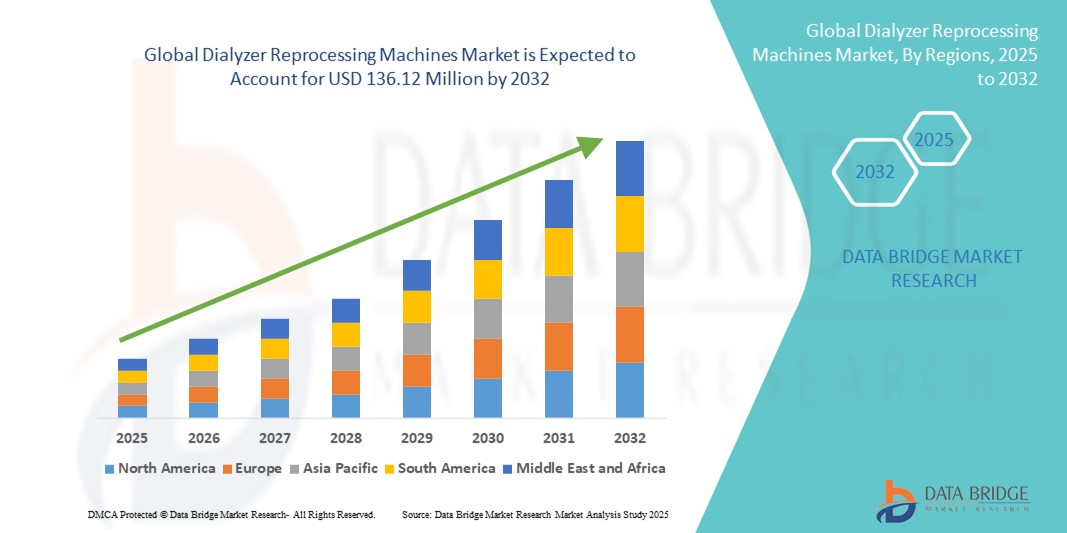
- The global dialyzer reprocessing machines market size was valued at USD 103.37 million in 2024 and is expected to reach USD 136.12 million by 2032, at a CAGR of 3.5% during the forecast period
- The market growth is largely driven by increasing demand for cost-effective and sustainable dialysis solutions, rising prevalence of chronic kidney disease, and the growing adoption of automated reprocessing systems in dialysis centers
- In addition, healthcare providers are focusing on reducing medical waste and operational costs, which is boosting the preference for dialyzer reprocessing machines. These combined trends are accelerating the adoption of reprocessing technologies, thereby significantly propelling the industry’s growth
Dialyzer Reprocessing Machines Market Analysis
- Dialyzer reprocessing machines, designed to clean, disinfect, and prepare dialyzers for reuse, are increasingly vital in dialysis centers and hospitals due to their ability to reduce treatment costs, improve efficiency, and support sustainable dialysis practices amid rising patient volumes
- The escalating demand for these machines is primarily fueled by the growing global burden of chronic kidney disease, rising healthcare expenditure, and the need for cost-containment strategies in dialysis treatment, especially in developing economies
- North America dominated the dialyzer reprocessing machines market with the largest revenue share of 38.5% in 2024, supported by a well-established dialysis infrastructure, favorable reimbursement policies, and strong adoption of automated systems in the U.S. to improve workflow and safety
- Asia-Pacific is expected to be the fastest-growing region in the dialyzer reprocessing machines market during the forecast period due to increasing prevalence of kidney disorders, expanding dialysis patient base, and government initiatives aimed at improving access to affordable renal care
- The automatic segment dominated the dialyzer reprocessing machines market with a market share of 46.5% in 2024, driven by its efficiency, reduced labor dependency, and ability to meet stringent infection control standards compared to manual reprocessing methods
Report Scope and Dialyzer Reprocessing Machines Market Segmentation
|
Attributes |
Dialyzer Reprocessing Machines Key Market Insights |
|
Segments Covered |
|
|
Countries Covered |
North America
Europe
Asia-Pacific
Middle East and Africa
South America
|
|
Key Market Players |
|
|
Market Opportunities |
|
|
Value Added Data Infosets |
In addition to the insights on market scenarios such as market value, growth rate, segmentation, geographical coverage, and major players, the market reports curated by the Data Bridge Market Research also include in-depth expert analysis, pricing analysis, brand share analysis, consumer survey, demography analysis, supply chain analysis, value chain analysis, raw material/consumables overview, vendor selection criteria, PESTLE Analysis, Porter Analysis, and regulatory framework. |
Dialyzer Reprocessing Machines Market Trends
Automation and IoT Integration for Enhanced Efficiency
- A significant and accelerating trend in the global dialyzer reprocessing machines market is the increasing adoption of fully automated systems integrated with IoT-based monitoring and reporting. This combination enhances operational efficiency, ensures consistent disinfection quality, and reduces manual errors in dialysis centers
- For instance, the 3M Dialyzer Reprocessing System allows operators to track machine performance, cycle data, and dialyzer reuse statistics in real time, enabling predictive maintenance and better resource management. Similarly, Baxter’s AutoReg system integrates automated cleaning protocols with digital dashboards for monitoring compliance and workflow optimization
- IoT integration in reprocessing machines enables features such as remote monitoring of machine health, automated alerts for maintenance or malfunction, and data-driven insights to optimize reprocessing cycles. For instance, some Asahi Kasei models use automated sensors to ensure disinfection efficacy and alert staff if a cycle falls outside recommended parameters
- The seamless integration of these machines with hospital management systems allows centralized oversight of dialysis operations, ensuring patient safety, regulatory compliance, and cost-efficiency. Through a single interface, healthcare providers can manage multiple reprocessing units, track consumables, and optimize dialyzer reuse schedules
- This trend towards intelligent, interconnected, and automated reprocessing systems is reshaping operational standards in dialysis facilities. Consequently, companies such as Nipro and B. Braun are developing IoT-enabled, fully automated machines with predictive maintenance and compliance reporting capabilities
- The demand for automated and IoT-integrated dialyzer reprocessing machines is growing rapidly across hospitals and standalone dialysis centers, as providers increasingly prioritize efficiency, safety, and regulatory compliance
Dialyzer Reprocessing Machines Market Dynamics
Driver
Rising Chronic Kidney Disease Prevalence and Cost-Saving Needs
- The growing global burden of chronic kidney disease, coupled with the need to reduce dialysis treatment costs, is a major driver for the adoption of dialyzer reprocessing machines
- For instance, in March 2024, Fresenius Medical Care expanded its automated reprocessing systems in multiple U.S. dialysis centers to optimize operational efficiency and lower costs, supporting the wider adoption of reprocessing technologies
- As healthcare providers aim to balance patient safety with cost-effectiveness, automated reprocessing machines offer consistent sterilization, reduced labor requirements, and compliance with strict infection control standards, making them highly attractive for dialysis facilities
- Furthermore, government initiatives in emerging economies to improve dialysis accessibility and reduce medical waste are encouraging the adoption of reprocessing technologies
- The ability to manage dialyzer reuse cycles effectively, minimize consumable waste, and improve workflow efficiency continues to propel the market growth for reprocessing machines worldwide
Restraint/Challenge
Regulatory Compliance and Operational Safety Concern
- The stringent regulatory requirements and infection control standards pose a significant challenge for broader market penetration. Dialyzer reprocessing machines must comply with multiple international and regional standards to ensure patient safety and prevent cross-contamination
- For instance, high-profile cases of improper dialyzer reuse leading to adverse patient outcomes have made some healthcare providers cautious in adopting reprocessing technologies
- Ensuring compliance through advanced automated disinfection protocols, validation, and real-time monitoring is crucial for gaining trust among medical institutions. Companies such as Nipro and B. Braun emphasize regulatory adherence and safety features in their machines to reassure users
- In addition, the relatively high upfront cost of fully automated reprocessing systems compared to manual reprocessing methods can be a barrier, particularly for small dialysis centers or facilities in developing regions
- Overcoming these challenges through enhanced automation, compliance certifications, staff training, and cost-optimized solutions will be vital for sustained growth in the dialyzer reprocessing machines market
Dialyzer Reprocessing Machines Market Scope
The market is segmented on the basis of type, modality, station type, and end user.
- By Type
On the basis of type, the dialyzer reprocessing machines market is segmented into automatic and semi-automatic. The automatic segment dominated the market with a market share of 46.5% in 2024 due to its ability to deliver consistent sterilization, minimize human error, and handle high patient volumes efficiently. Hospitals and large dialysis centers prefer automatic machines as they streamline workflow and reduce labor dependency. These machines also support IoT-based monitoring, predictive maintenance, and data tracking, which ensures compliance with regulatory standards. The efficiency and reliability of automatic machines make them ideal for large-scale dialysis operations, enhancing patient safety and operational effectiveness. Furthermore, continuous technological advancements in automation and integration with hospital management systems reinforce the dominance of this segment.
The semi-automatic segment is expected to witness the fastest growth from 2025 to 2032, particularly in small-scale dialysis centers and emerging markets. Semi-automatic machines are cost-effective, require lower capital investment, and are simpler to operate. They provide sufficient control over the reprocessing cycle while being more accessible to clinics with limited budgets. The segment benefits from rising awareness of safe dialyzer reuse and increasing adoption in regions where automatic machines may be unaffordable. Semi-automatic systems also appeal to facilities seeking a balance between safety, compliance, and operational simplicity.
- By Modality
On the basis of modality, the dialyzer reprocessing machines market is segmented into benchtop and standalone machines. The standalone segment dominated the market in 2024, supported by its high capacity and robust design suitable for large-scale dialysis centers. These machines can process multiple dialyzers simultaneously, reducing downtime and improving patient throughput. They are ideal for facilities with high patient loads and stringent infection control requirements. Standalone machines also provide enhanced automation and integrated monitoring systems, ensuring safety and operational efficiency. Their durability and reliability make them a preferred choice for hospitals and large clinics. Continuous innovation and incorporation of digital controls further strengthen the dominance of this segment.
The benchtop segment is expected to witness the fastest growth during the forecast period, driven by increasing adoption in small clinics, home dialysis setups, and emerging regions. Benchtop machines are compact, portable, and easier to operate, making them suitable for low-volume dialysis centers. They offer flexibility without compromising disinfection quality, supporting safe and efficient dialyzer reuse. Rising patient awareness about cost-effective dialysis and the convenience of benchtop systems is fueling growth. In addition, compact designs reduce space requirements, making these systems practical for home or small facility installations.
- By Station Type
On the basis of station type, the dialyzer reprocessing machines market is segmented into single station and dual station machines. The dual station segment dominated the market in 2024, primarily due to its capacity to handle multiple dialyzers simultaneously. Dual station machines improve operational efficiency and reduce patient waiting times in busy dialysis centers. They are widely preferred in hospitals and large clinics for maintaining consistent sterilization and meeting regulatory standards. The ability to process two units concurrently lowers labor costs and enhances overall throughput. Dual station machines also support advanced monitoring features, ensuring quality and safety of each cycle. Their adoption continues to rise in regions with high patient volumes and advanced dialysis infrastructure.
The single station segment is expected to witness the fastest growth from 2025 to 2032, particularly in small clinics and emerging markets. Single station machines provide a cost-effective, flexible solution for facilities with moderate patient loads. They ensure safe and compliant dialyzer reprocessing while minimizing space and maintenance requirements. The segment benefits from growing adoption of home dialysis and smaller, decentralized dialysis facilities. Single station machines are easy to operate, maintain, and deploy, which accelerates their penetration in markets seeking affordable yet safe reprocessing options. Rising awareness about cost savings and efficiency further supports growth in this segment.
- By End User
On the basis of end user, the dialyzer reprocessing machines market is segmented into hospitals, dialysis centers, and home use. The dialysis centers segment dominated the market in 2024, owing to high patient volumes and the need for efficient, reliable reprocessing solutions. Dialysis centers prioritize automation, consistent sterilization, and compliance with stringent infection control standards. Advanced machines allow these facilities to improve workflow efficiency and reduce operational costs. Large dialysis chains also benefit from IoT-enabled monitoring and reporting systems, which enhance process transparency and traceability. The focus on patient safety, operational efficiency, and regulatory adherence strengthens the dominance of this segment.
The home use segment is expected to witness the fastest growth from 2025 to 2032, driven by rising adoption of home-based dialysis therapy and small-scale clinics. Home-use machines are compact, user-friendly, and designed for safe operation outside professional facilities. Advances in benchtop and semi-automatic systems make home use increasingly feasible, supporting patient autonomy and reducing hospital dependency. Growing awareness about cost-effective dialysis management and convenience further drives adoption. The segment benefits from innovation in lightweight, portable, and easy-to-clean designs tailored for home environments.
Dialyzer Reprocessing Machines Market Regional Analysis
- North America dominated the dialyzer reprocessing machines market with the largest revenue share of 38.5% in 2024, supported by a well-established dialysis infrastructure, favorable reimbursement policies, and strong adoption of automated systems in the U.S. to improve workflow and safety
- Healthcare providers in the region prioritize automation, consistent sterilization, and regulatory compliance, which has accelerated the adoption of advanced dialyzer reprocessing machines in hospitals and large dialysis centers
- This widespread adoption is further supported by favorable reimbursement policies, high healthcare expenditure, and a strong focus on operational efficiency and patient safety, making automated reprocessing systems the preferred choice across the U.S. and Canada
U.S. Dialyzer Reprocessing Machines Market Insight
The U.S. dialyzer reprocessing machines market captured the largest revenue share of over 35% in 2024 within North America, driven by well-established dialysis infrastructure, high patient volumes, and advanced healthcare facilities. Hospitals and dialysis centers are increasingly adopting automated and IoT-enabled reprocessing machines to improve operational efficiency, ensure consistent sterilization, and maintain strict regulatory compliance. The growing focus on cost-effective dialysis solutions, combined with advanced training for healthcare professionals, further propels market growth. Moreover, the integration of automated systems with hospital management software for tracking dialyzer reuse and compliance data is significantly enhancing operational effectiveness.
Europe Dialyzer Reprocessing Machines Market Insight
The Europe dialyzer reprocessing machines market is projected to expand at a substantial CAGR during the forecast period, primarily driven by rising awareness of cost-effective dialysis practices, stringent infection control regulations, and the increasing prevalence of chronic kidney disease. Hospitals and dialysis centers across Germany, France, and the UK are investing in automated and semi-automatic reprocessing systems to improve safety, reduce operational costs, and meet regulatory requirements. The emphasis on reducing medical waste and improving patient throughput supports the adoption of advanced dialyzer reprocessing machines.
U.K. Dialyzer Reprocessing Machines Market Insight
The U.K. dialyzer reprocessing machines market is anticipated to grow at a noteworthy CAGR during the forecast period, driven by increasing healthcare investments, demand for safe and efficient dialysis, and rising prevalence of chronic kidney disorders. The adoption of semi-automatic and automated machines is encouraged by hospitals and standalone dialysis centers seeking compliance with national healthcare standards. Furthermore, growing patient awareness of safe dialyzer reuse practices is contributing to the market expansion. The U.K.’s healthcare infrastructure and focus on quality care continue to support the adoption of advanced reprocessing solutions.
Germany Dialyzer Reprocessing Machines Market Insight
The Germany dialyzer reprocessing machines market is expected to expand at a considerable CAGR during the forecast period, fueled by strong healthcare infrastructure, awareness of infection control, and government initiatives promoting advanced dialysis practices. Hospitals and large dialysis chains are increasingly deploying automated dialyzer reprocessing machines to ensure consistent sterilization, reduce labor dependency, and optimize workflow. Germany’s emphasis on innovation and quality healthcare promotes adoption, particularly for integrated IoT-enabled systems that allow real-time monitoring and compliance reporting.
Asia-Pacific Dialyzer Reprocessing Machines Market Insight
The Asia-Pacific dialyzer reprocessing machines market is poised to grow at the fastest CAGR of 23% during the forecast period of 2025 to 2032, driven by rising prevalence of kidney disorders, growing dialysis patient base, and increasing healthcare investments in countries such as China, India, and Japan. The region’s adoption of semi-automatic and benchtop machines is increasing in small clinics and decentralized dialysis centers. Government initiatives supporting access to affordable renal care, along with growing awareness of safe dialyzer reuse, are fueling market expansion. Furthermore, the rising establishment of domestic manufacturers and production facilities is improving affordability and accessibility of reprocessing machines across APAC.
Japan Dialyzer Reprocessing Machines Market Insight
The Japan dialyzer reprocessing machines market is gaining momentum due to the country’s advanced healthcare infrastructure, growing dialysis population, and focus on patient safety. Adoption of automated dialyzer reprocessing machines is driven by hospitals and renal care centers seeking high efficiency and compliance with strict infection control standards. Integration with digital monitoring systems enables better tracking of reprocessing cycles and ensures quality outcomes. In addition, an aging population and increased home-based dialysis initiatives are such asly to drive further demand for user-friendly, automated reprocessing solutions.
India Dialyzer Reprocessing Machines Market Insight
The India dialyzer reprocessing machines market accounted for the largest revenue share in Asia-Pacific in 2024, attributed to the increasing number of dialysis centers, rapid urbanization, and rising prevalence of chronic kidney disease. Semi-automatic and benchtop machines are becoming increasingly popular in small clinics and emerging urban hospitals due to their affordability and ease of use. Government initiatives supporting dialysis accessibility, coupled with local manufacturing capabilities, are key factors propelling market growth. Moreover, rising awareness of safe dialyzer reuse and cost-effective dialysis solutions is accelerating adoption across residential and commercial renal care facilities.
Dialyzer Reprocessing Machines Market Share
The Dialyzer Reprocessing Machines industry is primarily led by well-established companies, including:
- Fresenius Medical Care (Germany)
- B. Braun SE (Germany)
- Baxter International Inc. (U.S.)
- Nipro Corporation (Japan)
- Medtronic (Ireland)
- CURA Healthcare (India)
- Medivators Inc. (U.S.)
- Anjue Medical Equipment Co., Ltd. (China)
- Cantel Medical (U.S.)
- Tuscano Medical (U.S.)
- W. L. Gore & Associates (U.S.)
- NephroPlus (India)
- Advin Health Care (India)
- Atlantic Biomedical (U.S.)
- Cliniva Healthcare (India)
- Nanotech (India)
- LABSMED (India)
- Hemant Surgical Industries Ltd. (India)
- WESLEY BIOTECH (China)
What are the Recent Developments in Global Dialyzer Reprocessing Machines Market?
- In February 2024, Fresenius Medical Care announced that it received a 510(k) clearance from the U.S. Food and Drug Administration (FDA) for its 5008X Hemodialysis System. This is a significant development because the introduction of this advanced hemodialysis system, which is capable of providing high-volume hemodiafiltration, influences the entire kidney care and dialysis market
- In April 2023, Medtronic and DaVita announced the official launch of their new, independent kidney care company, Mozarc Medical. The press release highlights the company's focus on transforming kidney health through patient-centered technology solutions, which will undoubtedly include advancements in dialysis and dialyzer technology
- In September 2022, NephroPlus, a leading dialysis network and a trailblazer in redefining dialysis care in India, announced the launch of the revolutionary all-digitalized dialyzer reprocessor Renova. The company also stated that it aims to enhance the technology and equipment associated with dialysis procedures to improve the efficiency and affordability of life-sustaining dialysis treatment for patients suffering from end-stage renal diseases (ESRD) worldwide
- In August 2022, W. L. Gore & Associates announced its acquisition of InnAVasc Medical, Inc. The acquisition, while focused on vascular grafts for dialysis, is part of a broader trend of companies expanding their portfolios to offer more integrated and comprehensive solutions in the kidney care market. These strategic moves often lead to a more consolidated and technologically advanced market, impacting all related segments, including reprocessing
- In June 2021, Max Healthcare's home services division, Max@Home, partnered with NephroPlus to launch home hemodialysis services. This partnership is a key development as it drives the demand for more compact, portable, and user-friendly dialysis and reprocessing equipment that can be used safely in a home environment

- Interactive Data Analysis Dashboard
- Company Analysis Dashboard for high growth potential opportunities
- Research Analyst Access for customization & queries
- Competitor Analysis with Interactive dashboard
- Latest News, Updates & Trend analysis
- Harness the Power of Benchmark Analysis for Comprehensive Competitor Tracking
Data collection and base year analysis are done using data collection modules with large sample sizes. The stage includes obtaining market information or related data through various sources and strategies. It includes examining and planning all the data acquired from the past in advance. It likewise envelops the examination of information inconsistencies seen across different information sources. The market data is analysed and estimated using market statistical and coherent models. Also, market share analysis and key trend analysis are the major success factors in the market report. To know more, please request an analyst call or drop down your inquiry.
The key research methodology used by DBMR research team is data triangulation which involves data mining, analysis of the impact of data variables on the market and primary (industry expert) validation. Data models include Vendor Positioning Grid, Market Time Line Analysis, Market Overview and Guide, Company Positioning Grid, Patent Analysis, Pricing Analysis, Company Market Share Analysis, Standards of Measurement, Global versus Regional and Vendor Share Analysis. To know more about the research methodology, drop in an inquiry to speak to our industry experts.
Data Bridge Market Research is a leader in advanced formative research. We take pride in servicing our existing and new customers with data and analysis that match and suits their goal. The report can be customized to include price trend analysis of target brands understanding the market for additional countries (ask for the list of countries), clinical trial results data, literature review, refurbished market and product base analysis. Market analysis of target competitors can be analyzed from technology-based analysis to market portfolio strategies. We can add as many competitors that you require data about in the format and data style you are looking for. Our team of analysts can also provide you data in crude raw excel files pivot tables (Fact book) or can assist you in creating presentations from the data sets available in the report.













