


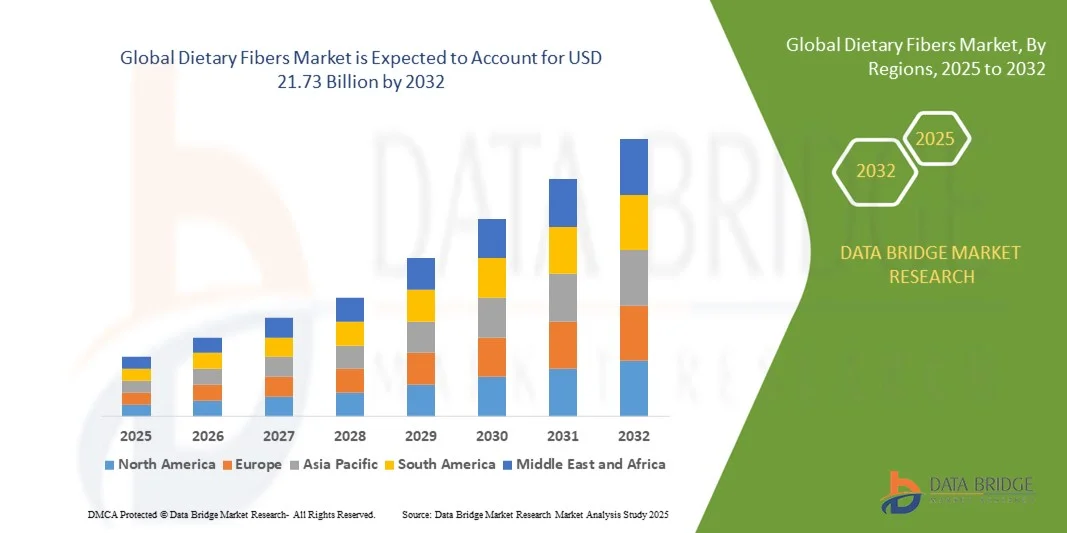
What is the Global Dietary Fibers Market Size and Growth Rate?
- The global dietary fibers market size was valued at USD 8.84 billion in 2024 and is expected to reach USD 21.73 billion by 2032, at a CAGR of 11.9% during the forecast period
- Major factors that are expected to boost the growth of the dietary fibers market in the forecast period are the health advantages provided by the dietary fibers. Furthermore, the rise in the need for fiber supplements is further anticipated to propel the growth of the dietary fibers market
- On the other hand, saturated water stability and reactivity is further estimated to impede the growth of the dietary fibers market in the timeline period
What are the Major Takeaways of Dietary Fibers Market?
- The rise in the applications of dietary fibers in the form of fortified snacks will further provide potential opportunities for the growth of the dietary fibers market in the coming years. However, the adjustable standards and guidelines across regional governing bodies might further challenge the growth of the dietary fibers market in the near future
- The Asia-Pacific region dominated the dietary fibers market with the largest revenue share of 34.16% in 2024, driven by rising health awareness, increasing disposable incomes, and rapid urbanization across countries such as China, India, and Japan
- The North America Dietary Fibers market is poised to grow at the fastest CAGR of 7.69% during the forecast period of 2025 to 2032, fueled by growing consumer interest in preventive healthcare, digestive wellness, and weight management
- The plant food segment dominated the dietary fibers market with the largest revenue share of 57.3% in 2024, driven by increasing consumer preference for natural and clean-label ingredients derived from fruits, vegetables, cereals, and legumes
Report Scope and Dietary Fibers Market Segmentation
|
Attributes |
Dietary Fibers Key Market Insights |
|
Segments Covered |
|
|
Countries Covered |
North America
Europe
Asia-Pacific
Middle East and Africa
South America
|
|
Key Market Players |
|
|
Market Opportunities |
|
|
Value Added Data Infosets |
In addition to the insights on market scenarios such as market value, growth rate, segmentation, geographical coverage, and major players, the market reports curated by the Data Bridge Market Research also include in-depth expert analysis, pricing analysis, brand share analysis, consumer survey, demography analysis, supply chain analysis, value chain analysis, raw material/consumables overview, vendor selection criteria, PESTLE Analysis, Porter Analysis, and regulatory framework. |
What is the Key Trend in the Dietary Fibers Market?
Rising Demand for Functional and Clean-Label Ingredients
- A significant and accelerating trend in the global Dietary Fibers market is the growing preference for functional fibers that support gut health, weight management, and cardiovascular well-being. Consumers increasingly seek dietary fibers that are natural, minimally processed, and aligned with clean-label and plant-based trends
- For instance, soluble fibers such as inulin and resistant starches are being incorporated into beverages, snacks, and dairy alternatives to enhance digestive health, improve satiety, and reduce sugar content. This trend highlights the increasing intersection of nutrition and convenience in daily diets
- Functional fibers are also being combined with prebiotics and probiotics, enabling synergistic health benefits. Product innovations include fiber-enriched cereals, bars, and bakery products that appeal to health-conscious consumers looking for easy ways to meet their daily fiber intake
- The demand for fibers with multiple benefits, such as cholesterol reduction, blood sugar control, and gut microbiota modulation, is driving R&D and product diversification across the global market
- This trend toward functional, clean-label, and multi-benefit fibers is reshaping consumer expectations and driving manufacturers such as Ingredion, Roquette, and DuPont to develop innovative fiber ingredients for diverse applications
- The rising consumer awareness of gut health and holistic nutrition is creating strong growth opportunities across both retail and foodservice sectors
What are the Key Drivers of Dietary Fibers Market?
- The growing awareness of dietary fiber’s role in digestive health, metabolic regulation, and disease prevention is a major driver of market growth. Consumers are increasingly prioritizing products that improve gut health and support overall well-being
- For instance, in 2024, Roquette expanded its prebiotic fiber portfolio to include resistant starches for inclusion in beverages, bakery, and nutritional supplements, targeting health-conscious consumers. This type of product innovation drives market expansion globally
- Rising incidence of lifestyle-related diseases such as obesity, diabetes, and cardiovascular disorders is fueling demand for fiber-enriched foods and beverages, pushing manufacturers to fortify everyday products with functional fibers
- Furthermore, the surge in vegan, plant-based, and clean-label products is accelerating dietary fiber adoption, as plant-based fibers are perceived as natural, sustainable, and health-promoting
- Convenience-oriented consumption, such as fiber-enriched bars, beverages, and ready-to-eat meals, supports the rapid adoption of dietary fibers in both retail and foodservice sectors, enhancing market penetration
- The increasing emphasis on regulatory approvals and health claims by companies is reinforcing consumer confidence and driving sustained growth in the Dietary Fibers market
Which Factor is Challenging the Growth of the Dietary Fibers Market?
- Challenges related to taste, texture, and product formulation remain significant, as high fiber content can negatively impact sensory attributes, limiting consumer acceptance. Manufacturers must invest in innovative technologies to improve solubility, mouthfeel, and integration in different foods
- For instance, some fiber-enriched bakery and beverage products face complaints regarding grittiness, viscosity, or off-flavors, which can hinder repeat purchases and market penetration
- The relatively high cost of specialty fibers compared to standard ingredients can also deter small manufacturers and price-sensitive consumers, especially in developing regions. While basic fibers such as wheat bran are widely affordable, functional fibers with targeted health benefits command a premium price
- Regulatory challenges, including approvals for novel fiber ingredients and permissible health claims, may slow product launches in some regions. Companies such as DuPont and Cargill focus on compliance and scientific substantiation to overcome these barriers
- Overcoming formulation, cost, and regulatory challenges through product innovation, education, and affordable fiber solutions is crucial for sustained growth and wider adoption across the global dietary fibers market
How is the Dietary Fibers Market Segmented?
The dietary fibers market is segmented on the basis of source, type, application, end use and processing treatment.
- By Source
On the basis of source, the dietary fibers market is segmented into plant food and waste products. The plant food segment dominated the dietary fibers market with the largest revenue share of 57.3% in 2024, driven by increasing consumer preference for natural and clean-label ingredients derived from fruits, vegetables, cereals, and legumes. Manufacturers prioritize plant-derived fibers due to their high nutritional value, functional benefits, and ease of incorporation into a wide variety of food, beverage, and supplement applications.
The waste products segment is expected to witness the fastest CAGR of 19.5% from 2025 to 2032, fueled by sustainability initiatives and the growing adoption of circular economy practices. Fibers extracted from by-products such as fruit peels, vegetable pomace, and cereal husks are gaining traction among eco-conscious consumers and manufacturers aiming to reduce food waste while providing functional benefits such as prebiotic effects, cholesterol reduction, and improved gut health.
- By Type
On the basis of type, the dietary fibers market is segmented into soluble and insoluble fibers. The soluble fiber segment held the largest market revenue share of 62% in 2024, owing to its ability to dissolve in water and provide multiple health benefits such as lowering blood cholesterol, improving glycemic control, and supporting gut microbiota. Soluble fibers are extensively used in beverages, dairy alternatives, and functional foods targeting cardiovascular and metabolic health.
The insoluble fiber segment is expected to witness the fastest CAGR of 17.8% from 2025 to 2032, driven by increasing consumer awareness about digestive health and the role of insoluble fibers in promoting bowel regularity and preventing constipation. Insoluble fibers are being incorporated into bakery, cereals, and snack products to meet rising demand for convenient, high-fiber solutions in daily diets.
- By Application
On the basis of application, the dietary fibers market is segmented into food, beverages, pharmaceutical and dietary supplements, companion animal nutrition, and others. The food segment dominated the market with a revenue share of 54% in 2024, driven by the growing fortification of bakery, cereals, snacks, and convenience foods with functional fibers. Manufacturers are leveraging dietary fibers to enhance nutritional profiles and meet the demand for healthier, high-fiber diets.
The pharmaceutical and dietary supplements segment is anticipated to witness the fastest CAGR of 18.2% from 2025 to 2032, fueled by increasing consumer focus on preventive health, weight management, and metabolic regulation. Fiber-based nutraceuticals, tablets, and powder formulations are gaining popularity due to their targeted health benefits and convenient delivery formats, making them a key growth driver for the market.
- By End Use
On the basis of end use, the dietary fibers market is segmented into waste management, weight management, cholesterol management, and sugar management. The weight management segment dominated with a market revenue share of 49% in 2024, driven by rising obesity rates, growing health consciousness, and demand for satiety-enhancing foods. Fibers are increasingly being incorporated into bars, beverages, and meal replacements to help reduce caloric intake and improve digestive comfort.
The sugar management segment is expected to witness the fastest CAGR of 20.1% from 2025 to 2032, fueled by the rising prevalence of diabetes, demand for low-glycemic foods, and the incorporation of soluble fibers in snacks, beverages, and fortified foods to control blood sugar levels. Growing health awareness and government initiatives to combat lifestyle diseases further propel this segment.
- By Processing Treatment
On the basis of processing treatment, the dietary fibers market is segmented into extrusion cooking, canning, grinding, boiling, and frying. The extrusion cooking segment held the largest market revenue share of 41.5% in 2024, driven by its versatility in producing high-fiber breakfast cereals, snacks, and bars with controlled texture, digestibility, and functional properties. Extrusion allows the incorporation of both soluble and insoluble fibers without compromising taste, making it highly favored by manufacturers.
The grinding segment is expected to witness the fastest CAGR of 16.9% from 2025 to 2032, fueled by demand for fine fiber powders suitable for beverages, nutraceuticals, and bakery products. Grinding provides a cost-effective and flexible method for producing high-quality fiber ingredients while maintaining their nutritional and functional properties.
Which Region Holds the Largest Share of the Dietary Fibers Market?
- The Asia-Pacific region dominated the dietary fibers market with the largest revenue share of 34.16% in 2024, driven by rising health awareness, increasing disposable incomes, and rapid urbanization across countries such as China, India, and Japan
- Consumers in the region are increasingly focusing on functional foods, nutraceuticals, and fortified dietary products, which are enriched with fibers to support digestive health, weight management, and metabolic wellness
- The widespread adoption of dietary fiber-enriched products is further supported by government initiatives promoting nutrition, growing e-commerce penetration, and the expanding retail and modern trade networks, establishing Asia-Pacific as a critical market for dietary fibers
China Dietary Fibers Market Insight
The China dietary fibers market captured the largest revenue share of 38% in 2024 within Asia-Pacific, fueled by rapid urbanization, increasing health consciousness, and the expanding middle-class population. Consumers are increasingly seeking functional foods, beverages, and supplements fortified with dietary fibers. The rise of health-focused e-commerce platforms, the growing popularity of low-calorie and high-fiber diets, and government campaigns promoting nutritional awareness are significantly driving market growth. China’s domestic manufacturing capabilities also contribute to the affordability and availability of dietary fiber products, strengthening the country’s leading position in the region.
Japan Dietary Fibers Market Insight
The Japan dietary fibers market is witnessing steady growth due to the country’s aging population, health-conscious consumers, and high adoption of functional foods. Japanese consumers emphasize digestive health, weight management, and nutritional supplementation, driving demand for soluble and insoluble fiber products in food, beverage, and supplement categories. The integration of dietary fibers in traditional and convenient foods, along with government-led nutrition initiatives, supports market expansion. Moreover, Japan’s advanced retail infrastructure and e-commerce platforms enhance product accessibility, boosting consumer adoption.
India Dietary Fibers Market Insight
The India dietary fibers market is expected to expand at a substantial CAGR during the forecast period, driven by increasing disposable incomes, urbanization, and rising awareness about lifestyle-related health issues such as obesity, diabetes, and digestive disorders. The growing popularity of fortified foods, functional beverages, and dietary supplements is propelling fiber demand. Regional initiatives promoting healthier nutrition, coupled with expanding retail networks and online sales channels, are supporting widespread adoption. India’s young population and rising preference for convenient, fiber-enriched food options further contribute to market growth.
Which Region is the Fastest Growing Region in the Dietary Fibers Market?
The North America dietary fibers market is poised to grow at the fastest CAGR of 7.69% during the forecast period of 2025 to 2032, fueled by growing consumer interest in preventive healthcare, digestive wellness, and weight management. Increasing demand for functional foods, dietary supplements, and fortified beverages is driving adoption. Moreover, health-conscious lifestyles, high disposable incomes, and robust R&D in nutritional products support market expansion. Retailers and manufacturers are introducing innovative fiber-enriched formulations to cater to the rising demand for convenient and health-focused food solutions, ensuring strong growth in North America.
U.S. Dietary Fibers Market Insight
The U.S. dietary fibers market accounted for the largest revenue share of 81% in North America in 2024, driven by rising health awareness, demand for weight management solutions, and increased consumption of functional foods and beverages. Consumers are seeking products that aid digestive health, cholesterol control, and sugar management. The strong presence of dietary supplement manufacturers, innovative product launches, and widespread retail and e-commerce availability are key growth factors. Government-led initiatives on nutrition labeling and consumer education on high-fiber diets further accelerate market adoption in the U.S., making it the fastest-growing market in the region.
Which are the Top Companies in Dietary Fibers Market?
The dietary fibers industry is primarily led by well-established companies, including:
- Ingredion Incorporated (U.S.)
- Grain Processing Corporation (U.S.)
- Grain Millers, Inc. (U.S.)
- Lonza (Switzerland)
- KFSU LTD (Australia)
- Roquette Frères (France)
- DuPont (U.S.)
- ADM (U.S.)
- Tate & Lyle (U.K.)
- J. RETTENMAIER & SÖHNE GmbH + Co KG (Germany)
- Tereos (France)
- CJ CheilJedang Corp. (South Korea)
- Fuji Nihon Seito Corporation (Japan)
- Novagreen Inc. (U.S.)
- Mengzhou Tailijie Co., Ltd. (China)
- Baolingbao Biology Co., Ltd. (China)
- Naturex (France)
- Cargill, Incorporated (U.S.)
- B&D Nutritional Ingredients, Inc. (U.S.)
- Dow (U.S.)
What are the Recent Developments in Global Dietary Fibers Market?
- In February 2023, Azelis, a leading specialty chemicals and food ingredients company, announced a new distribution agreement with Tereos, offering native starches, maltodextrin, gluten, dietary fibers, and other ingredients, strengthening Azelis’ portfolio in sugars, sweeteners, and native starches for the food and animal nutrition markets, supporting its regional growth ambitions
- In March 2022, Tate & Lyle, a prominent provider of food and beverage ingredients and solutions, acquired Quantum Hi-Tech (Guangdong) Biological Co., Ltd, one of China’s leading prebiotic dietary fiber businesses, enhancing its product offerings in prebiotic and functional fiber solutions and expanding its presence in the Asian market
- In April 2022, Ingredion Incorporated acquired Germany-based KaTech, a company providing advanced texture and stabilization solutions to the food and beverage industry, expanding Ingredion’s Food Systems platform with innovative solutions for product formulation, ingredient functionality, and technical support, further strengthening its global footprint
- In March 2021, BENEO established its chicory root fiber manufacturing unit in Chile, expanding production capacity to meet growing global demand and solidifying BENEO’s position in the international dietary fibers market
- In September 2020, Tate & Lyle opened a new Customer Innovation and Collaboration Center in Santiago, Chile, featuring application and rapid prototyping capabilities, allowing its food scientists to collaborate with customers on reducing sugar, fat, and calories while adding fiber to consumer products, driving regional innovation and customer engagement

- Interactive Data Analysis Dashboard
- Company Analysis Dashboard for high growth potential opportunities
- Research Analyst Access for customization & queries
- Competitor Analysis with Interactive dashboard
- Latest News, Updates & Trend analysis
- Harness the Power of Benchmark Analysis for Comprehensive Competitor Tracking
Table of Content
1 INTRODUCTION
1.1 OBJECTIVES OF THE STUDY
1.2 MARKET DEFINITION
1.3 OVERVIEW OF GLOBAL DIETARY FIBERS MARKET
1.4 CURRENCY AND PRICING
1.5 LIMITATION
1.6 MARKETS COVERED
2 MARKET SEGMENTATION
2.1 KEY TAKEAWAYS
2.2 ARRIVING AT THE GLOBAL DIETARY FIBERS MARKETSIZE
2.2.1 VENDOR POSITIONING GRID
2.2.2 TECHNOLOGY LIFE LINE CURVE
2.2.3 MARKET GUIDE
2.2.4 COMPANY POSITIONING GRID
2.2.5 COMAPANY MARKET SHARE ANALYSIS
2.2.6 MULTIVARIATE MODELLING
2.2.7 DEMAND AND SUPPLY-SIDE VARIABLES
2.2.8 TOP TO BOTTOM ANALYSIS
2.2.9 STANDARDS OF MEASUREMENT
2.2.10 VENDOR SHARE ANALYSIS
2.2.11 DATA POINTS FROM KEY PRIMARY INTERVIEWS
2.2.12 DATA POINTS FROM KEY SECONDARY DATABASES
2.3 GLOBAL DIETARY FIBERS MARKET: RESEARCH SNAPSHOT
2.4 ASSUMPTIONS
3 MARKET OVERVIEW
3.1 DRIVERS
3.2 RESTRAINTS
3.3 OPPORTUNITIES
3.4 CHALLENGES
4 EXECUTIVE SUMMARY
5 PREMIUM INSIGHTS
5.1 SUPPLY CHAIN ANALYSIS
5.2 VALUE CHAIN ANALYSIS
5.3 IMPORT EXPORT ANALYSIS
5.4 FACTORS INFLUENCING PURCHASING DECISION OF END USERS
5.5 GROWTH STRATEGIES ADOPTED BY KEY MARKET PLAYERS
5.6 INDUSTRY TRENS AND FUTURE PERSPECTIVE
6 REGULATORY FRAMEWORK AND GUIDELINES
7 POST COVID IMPACT ANALYSIS
8 GLOBAL DIETARY FIBERS MARKET, BY TYPE
8.1 OVERVIEW
8.2 SOLUBLE
8.2.1 GUMS
8.2.2 PECTIN
8.2.3 PSYLLIUM
8.2.4 BETA-GLUCANS
8.2.5 OTHERS
8.3 INSOLUBLE
8.3.1 LIGNIN
8.3.2 CELLULOSE
9 GLOBAL DIETARY FIBERS MARKET, BY PRODUCT TYPE
9.1 OVERVIEW
9.2 PEA FIBER
9.3 WHEAT FIBER
9.4 BAMBOO FIBER
9.5 SOY FIBER
9.6 POTATO FIBER
9.7 CITRUS FIBER
9.8 CELLULOSE
9.9 OAT FIBER
9.1 APPLE FIBER
9.11 COCOA FIBER
9.12 ACACIA FIBER
9.13 SUGAR CANE FIBER
9.14 CORN FIBER
9.15 CARROT FIBER
9.16 SUGAR BEET FIBER
9.17 OTHERS
10 GLOBAL DIETARY FIBERS MARKET, BY APPLICATION
10.1 OVERVIEW
10.2 FOOD & BEVERAGES
10.2.1 FOOD & BEVERAGES, BY TYPE
10.2.1.1. BAKERY
10.2.1.1.1. BAKERY, BY TYPE
10.2.1.1.1.1 BREAD & ROLLS
10.2.1.1.1.2 CAKES & PASTRIES
10.2.1.1.1.3 WAFERS
10.2.1.1.1.4 BISCUIT
10.2.1.1.1.5 COOKIES& CRACKERS
10.2.1.1.1.6 OTHERS
10.2.1.1.2. BAKERY, BY FIBER TYPE
10.2.1.1.2.1 PEA FIBER
10.2.1.1.2.2 WHEAT
10.2.1.1.2.3 BAMBOO FIBER
10.2.1.1.2.4 SOY FIBER
10.2.1.1.2.5 POTATO FIBER
10.2.1.1.2.6 CITRUS FIBER
10.2.1.1.2.7 CELLULOSE
10.2.1.1.2.8 OAT FIBER
10.2.1.1.2.9 APPLE FIBER
10.2.1.1.2.10 COCOA FIBER
10.2.1.1.2.11 ACACIA FIBER
10.2.1.1.2.12 SUGAR CANE FIBER
10.2.1.1.2.13 CORN FIBER
10.2.1.1.2.14 CARROT FIBER
10.2.1.1.2.15 SUGAR BEET FIBER
10.2.1.1.2.16 OTHERS
10.2.1.2. PRECOOKED CEREALS
10.2.1.2.1. PRECOOKED CERELAS, BY FIBER TYPE
10.2.1.2.1.1 PEA FIBER
10.2.1.2.1.2 WHEAT
10.2.1.2.1.3 BAMBOO FIBER
10.2.1.2.1.4 SOY FIBER
10.2.1.2.1.5 POTATO FIBER
10.2.1.2.1.6 CITRUS FIBER
10.2.1.2.1.7 CELLULOSE
10.2.1.2.1.8 OAT FIBER
10.2.1.2.1.9 APPLE FIBER
10.2.1.2.1.10 COCOA FIBER
10.2.1.2.1.11 ACACIA FIBER
10.2.1.2.1.12 SUGAR CANE FIBER
10.2.1.2.1.13 CORN FIBER
10.2.1.2.1.14 CARROT FIBER
10.2.1.2.1.15 SUGAR BEET FIBER
10.2.1.2.1.16 OTHERS
10.2.1.3. MEAT& POULTRY PRODUCTS
10.2.1.3.1. MEAT & POULTRY PRODUCTS, BY TYPE
10.2.1.3.1.1 MEATBALL
10.2.1.3.1.2 BURGERS
10.2.1.3.1.3 SAUSAGES
10.2.1.3.1.4 OTHERS
10.2.1.3.2. MEAT & POULTRY PTODUCTS, BY FIBER TYPE
10.2.1.3.2.1 PEA FIBER
10.2.1.3.2.2 WHEAT
10.2.1.3.2.3 BAMBOO FIBER
10.2.1.3.2.4 SOY FIBER
10.2.1.3.2.5 POTATO FIBER
10.2.1.3.2.6 CITRUS FIBER
10.2.1.3.2.7 CELLULOSE
10.2.1.3.2.8 OAT FIBER
10.2.1.3.2.9 APPLE FIBER
10.2.1.3.2.10 COCOA FIBER
10.2.1.3.2.11 ACACIA FIBER
10.2.1.3.2.12 SUGAR CANE FIBER
10.2.1.3.2.13 CORN FIBER
10.2.1.3.2.14 CARROT FIBER
10.2.1.3.2.15 SUGAR BEET FIBER
10.2.1.3.2.16 OTHERS
10.2.1.3.2.17 OTHERS
10.2.1.4. FISH & SURIMI PRODUCTS
10.2.1.4.1. MEAT & POULTRY PRODUCTS, BY TYPE
10.2.1.4.1.1 FISH STICKS
10.2.1.4.1.2 BURGERS
10.2.1.4.1.3 FISHBALLS
10.2.1.4.1.4 SURIMI PRODUCTS
10.2.1.4.1.5 OTHERS
10.2.1.4.2. MEAT & POULTRY PTODUCTS, BY FIBER TYPE
10.2.1.4.2.1 PEA FIBER
10.2.1.4.2.2 WHEAT
10.2.1.4.2.3 BAMBOO FIBER
10.2.1.4.2.4 SOY FIBER
10.2.1.4.2.5 POTATO FIBER
10.2.1.4.2.6 CITRUS FIBER
10.2.1.4.2.7 CELLULOSE
10.2.1.4.2.8 OAT FIBER
10.2.1.4.2.9 APPLE FIBER
10.2.1.4.2.10 COCOA FIBER
10.2.1.4.2.11 ACACIA FIBER
10.2.1.4.2.12 SUGAR CANE FIBER
10.2.1.4.2.13 CORN FIBER
10.2.1.4.2.14 CARROT FIBER
10.2.1.4.2.15 SUGAR BEET FIBER
10.2.1.4.2.16 OTHERS
10.2.1.5. CONFECTIONERY
10.2.1.5.1. CONFECTIONERY, BY FIBER TYPE
10.2.1.5.1.1 HARD CANDIES
10.2.1.5.1.2 CHEWING GUMS
10.2.1.5.1.3 JELLY
10.2.1.5.1.4 CHCOLATE SYRUPS
10.2.1.5.1.5 OTHERS
10.2.1.5.2. CONFECTIONERY, BY FIBER TYPE
10.2.1.5.2.1 PEA FIBER
10.2.1.5.2.2 WHEAT
10.2.1.5.2.3 BAMBOO FIBER
10.2.1.5.2.4 SOY FIBER
10.2.1.5.2.5 POTATO FIBER
10.2.1.5.2.6 CITRUS FIBER
10.2.1.5.2.7 CELLULOSE
10.2.1.5.2.8 OAT FIBER
10.2.1.5.2.9 APPLE FIBER
10.2.1.5.2.10 COCOA FIBER
10.2.1.5.2.11 ACACIA FIBER
10.2.1.5.2.12 SUGAR CANE FIBER
10.2.1.5.2.13 CORN FIBER
10.2.1.5.2.14 CARROT FIBER
10.2.1.5.2.15 SUGAR BEET FIBER
10.2.1.5.2.16 OTHERS
10.2.1.6. NUTRITION PRODUCTS
10.2.1.6.1. NUTRITION PRODUCTS, BY FIBER TYPE
10.2.1.6.1.1 NUTRION SUPPLEMENTS
10.2.1.6.1.2 NUTRION BARS
10.2.1.6.1.3 OTHERS
10.2.1.6.2. CONFECTIONERY, BY FIBER TYPE
10.2.1.6.2.1 PEA FIBER
10.2.1.6.2.2 WHEAT
10.2.1.6.2.3 BAMBOO FIBER
10.2.1.6.2.4 SOY FIBER
10.2.1.6.2.5 POTATO FIBER
10.2.1.6.2.6 CITRUS FIBER
10.2.1.6.2.7 CELLULOSE
10.2.1.6.2.8 OAT FIBER
10.2.1.6.2.9 APPLE FIBER
10.2.1.6.2.10 COCOA FIBER
10.2.1.6.2.11 ACACIA FIBER
10.2.1.6.2.12 SUGAR CANE FIBER
10.2.1.6.2.13 CORN FIBER
10.2.1.6.2.14 CARROT FIBER
10.2.1.6.2.15 SUGAR BEET FIBER
10.2.1.6.2.16 OTHERS
10.2.1.7. DAIRY PRODUCTS
10.2.1.7.1. DAIRY PRODUCTS, BY FIBER TYPE
10.2.1.7.1.1 QUARK
10.2.1.7.1.2 CHEESE
10.2.1.7.1.3 CHEESE SPREADS
10.2.1.7.1.4 READY TO EAT MILK DESSERTS
10.2.1.7.1.5 YOGURTS
10.2.1.7.1.5.1. REGULAR
10.2.1.7.1.5.2. FROZEN
10.2.1.7.2. OTHERS
10.2.1.7.3. DAIRY PRODUCTS, BY FIBER TYPE
10.2.1.7.4. PEA FIBER
10.2.1.7.5. WHEAT
10.2.1.7.6. BAMBOO FIBER
10.2.1.7.7. SOY FIBER
10.2.1.7.8. POTATO FIBER
10.2.1.7.9. CITRUS FIBER
10.2.1.7.10. CELLULOSE
10.2.1.7.11. OAT FIBER
10.2.1.7.12. APPLE FIBER
10.2.1.7.13. COCOA FIBER
10.2.1.7.14. ACACIA FIBER
10.2.1.7.15. SUGAR CANE FIBER
10.2.1.7.16. CORN FIBER
10.2.1.7.17. CARROT FIBER
10.2.1.7.18. SUGAR BEET FIBER
10.2.1.7.19. OTHERS
10.2.1.8. SANCKS& EXTRUDED SNACKS
10.2.1.8.1. SANCKS& EXTRUDED SNACKS, BY FIBER TYPE
10.2.1.8.2. PEA FIBER
10.2.1.8.3. WHEAT
10.2.1.8.4. BAMBOO FIBER
10.2.1.8.5. SOY FIBER
10.2.1.8.6. POTATO FIBER
10.2.1.8.7. CITRUS FIBER
10.2.1.8.8. CELLULOSE
10.2.1.8.9. OAT FIBER
10.2.1.8.10. APPLE FIBER
10.2.1.8.11. COCOA FIBER
10.2.1.8.12. ACACIA FIBER
10.2.1.8.13. SUGAR CANE FIBER
10.2.1.8.14. CORN FIBER
10.2.1.8.15. CARROT FIBER
10.2.1.8.16. SUGAR BEET FIBER
10.2.1.8.17. OTHERS
10.2.1.9. PASTA & NOODLES
10.2.1.9.1. PASTA & NOODLES, BY FIBER TYPE
10.2.1.9.2. PEA FIBER
10.2.1.9.3. WHEAT
10.2.1.9.4. BAMBOO FIBER
10.2.1.9.5. SOY FIBER
10.2.1.9.6. POTATO FIBER
10.2.1.9.7. CITRUS FIBER
10.2.1.9.8. CELLULOSE
10.2.1.9.9. OAT FIBER
10.2.1.9.10. APPLE FIBER
10.2.1.9.11. COCOA FIBER
10.2.1.9.12. ACACIA FIBER
10.2.1.9.13. SUGAR CANE FIBER
10.2.1.9.14. CORN FIBER
10.2.1.9.15. CARROT FIBER
10.2.1.9.16. SUGAR BEET FIBER
10.2.1.9.17. OTHERS
10.2.1.10. SOUP & SAUCES
10.2.1.10.1. SOUP & SAUCES, BY FIBER TYPE
10.2.1.10.2. PEA FIBER
10.2.1.10.3. WHEAT
10.2.1.10.4. BAMBOO FIBER
10.2.1.10.5. SOY FIBER
10.2.1.10.6. POTATO FIBER
10.2.1.10.7. CITRUS FIBER
10.2.1.10.8. CELLULOSE
10.2.1.10.9. OAT FIBER
10.2.1.10.10. APPLE FIBER
10.2.1.10.11. COCOA FIBER
10.2.1.10.12. ACACIA FIBER
10.2.1.10.13. SUGAR CANE FIBER
10.2.1.10.14. CORN FIBER
10.2.1.10.15. CARROT FIBER
10.2.1.10.16. SUGAR BEET FIBER
10.2.1.10.17. OTHERS
10.2.1.11. SPORTS NUTRITION
10.2.1.11.1. SPORTS NUTRITION, BY FIBER TYPE
10.2.1.11.2. PEA FIBER
10.2.1.11.3. WHEAT
10.2.1.11.4. BAMBOO FIBER
10.2.1.11.5. SOY FIBER
10.2.1.11.6. POTATO FIBER
10.2.1.11.7. CITRUS FIBER
10.2.1.11.8. CELLULOSE
10.2.1.11.9. OAT FIBER
10.2.1.11.10. APPLE FIBER
10.2.1.11.11. COCOA FIBER
10.2.1.11.12. ACACIA FIBER
10.2.1.11.13. SUGAR CANE FIBER
10.2.1.11.14. CORN FIBER
10.2.1.11.15. CARROT FIBER
10.2.1.11.16. SUGAR BEET FIBER
10.2.1.11.17. OTHERS
10.2.1.12. FROZEN & CONVENIENCE FOOD
10.2.1.12.1. FROZEN & CONVENIENCE FOOD, BY FIBER TYPE
10.2.1.12.2. PEA FIBER
10.2.1.12.3. WHEAT
10.2.1.12.4. BAMBOO FIBER
10.2.1.12.5. SOY FIBER
10.2.1.12.6. POTATO FIBER
10.2.1.12.7. CITRUS FIBER
10.2.1.12.8. CELLULOSE
10.2.1.12.9. OAT FIBER
10.2.1.12.10. APPLE FIBER
10.2.1.12.11. COCOA FIBER
10.2.1.12.12. ACACIA FIBER
10.2.1.12.13. SUGAR CANE FIBER
10.2.1.12.14. CORN FIBER
10.2.1.12.15. CARROT FIBER
10.2.1.12.16. SUGAR BEET FIBER
10.2.1.12.17. OTHERS
10.2.1.13. BEVERAGES
10.2.2 BEVERAGES, BY TYPE
10.2.2.1. SOFT DRINKS
10.2.2.2. FRUIT JUICES
10.2.2.3. INSTANT TEA & COFFEE
10.2.2.4. OTHERS
10.2.3 BEVERAGES, BY FIBER TYPE
10.2.3.1. PEA FIBER
10.2.3.2. WHEAT
10.2.3.3. BAMBOO FIBER
10.2.3.4. SOY FIBER
10.2.3.5. POTATO FIBER
10.2.3.6. CITRUS FIBER
10.2.3.7. CELLULOSE
10.2.3.8. OAT FIBER
10.2.3.9. APPLE FIBER
10.2.3.10. COCOA FIBER
10.2.3.11. ACACIA FIBER
10.2.3.12. SUGAR CANE FIBER
10.2.3.13. CORN FIBER
10.2.3.14. CARROT FIBER
10.2.3.15. SUGAR BEET FIBER
10.2.3.16. OTHERS
10.3 ANIMAL FEED
10.3.1 ANIMAL FEED, BY FEED TYPE
10.3.1.1. FOOD GRADE FIBER
10.3.1.2. AQUA FEED
10.3.1.3. SWINE FEED
10.3.1.4. POULTRY FEED
10.3.2 ANIMAL FEED, BY FIBER TYPE
10.3.2.1. PEA FIBER
10.3.2.2. WHEAT
10.3.2.3. BAMBOO FIBER
10.3.2.4. SOY FIBER
10.3.2.5. POTATO FIBER
10.3.2.6. CITRUS FIBER
10.3.2.7. CELLULOSE
10.3.2.8. OAT FIBER
10.3.2.9. APPLE FIBER
10.3.2.10. COCOA FIBER
10.3.2.11. ACACIA FIBER
10.3.2.12. SUGAR CANE FIBER
10.3.2.13. CORN FIBER
10.3.2.14. CARROT FIBER
10.3.2.15. SUGAR BEET FIBER
10.3.2.16. OTHERS
10.4 PHARAMACEUTICAL
10.4.1 PHARMACEUTICAL, BY FIBER TYPE
10.4.1.1. PEA FIBER
10.4.1.2. WHEAT
10.4.1.3. BAMBOO FIBER
10.4.1.4. SOY FIBER
10.4.1.5. POTATO FIBER
10.4.1.6. CITRUS FIBER
10.4.1.7. CELLULOSE
10.4.1.8. OAT FIBER
10.4.1.9. APPLE FIBER
10.4.1.10. COCOA FIBER
10.4.1.11. ACACIA FIBER
10.4.1.12. SUGAR CANE FIBER
10.4.1.13. CORN FIBER
10.4.1.14. CARROT FIBER
10.4.1.15. SUGAR BEET FIBER
10.4.1.16. OTHERS
10.5 OTHERS
11 GLOBAL DIETARY FIBERS MARKET, BY SOURCE
11.1 OVERVIEW
11.2 CEREALS & GRAINS
11.2.1 R
11.2.2 SOY
11.2.3 WHEAT
11.2.4 CORN
11.2.5 BARLEY
11.2.6 MILLET
11.2.7 OAT
11.2.8 RYE
11.2.9 OTHERS
11.3 LEGUMES
11.3.1 BEANS
11.3.2 PEAS
11.3.3 CHICKPEAS
11.3.4 LENTILS
11.3.5 LUPINS
11.3.6 OTHERS
11.4 FRUITS & VEGETABLES
11.4.1 GRAPES
11.4.2 ORANGE
11.4.3 APPLE
11.4.4 COCOA
11.4.5 PINEAPPLE
11.4.6 PEAR
11.4.7 BERRIES
11.4.8 CABBAGE
11.4.9 CAULIFLOWER
11.4.10 LETTUCE
11.4.11 SPINACH
11.4.12 KALE
11.4.13 COLLARD GREEN
11.4.14 BELL PEPPER
11.4.15 GREEN BELL PEPPER
11.4.16 POTATO
11.4.17 SWEET POTATO
11.4.18 SUGAR BEET
11.4.19 CARROT
11.4.20 GUAR
11.4.21 LOCUST BEAN
11.4.22 YAM
11.4.23 GINGER
11.4.24 GARLIC
11.4.25 ACACIA TREE
11.4.26 OTHERS
12 GLOBAL DIETARY FIBERS MARKET, BY GRADE
12.1 OVERVIEW
12.2 30 MICRON
12.3 75 MICRON
12.4 90 MICRON
12.5 200 MICRON
12.6 500 MICRON
12.7 OTHERS
13 GLOBAL DIETARY FIBERS MARKET, BY COLOR
13.1 OVERVIEW
13.2 WHITE
13.3 BEIGE
13.4 LIGHT YELLOW
13.5 CREAM
13.6 BROWN
13.7 OTHERS
14 GLOBAL DIETARY FIBERS MARKET, BY ODOR
14.1 OVERVIEW
14.2 NATURAL FLAVOR/ODOR
14.3 FLAVORLESS
15 GLOBAL DIETARY FIBERS MARKET, BY CATEGORY
15.1 OVERVIEW
15.2 GMO
15.3 NON-GMO
16 GLOBAL DIETARY FIBERS MARKET, BY NATURE
16.1 OVERVIEW
16.2 ORGANIC
16.3 INORGANIC
17 GLOBAL DIETARY FIBERS MARKET, COMPANY LANDSCAPE
17.1 COMPANY SHARE ANALYSIS: GLOBAL
17.2 COMPANY SHARE ANALYSIS: NORTH AMERICA
17.3 COMPANY SHARE ANALYSIS: EUROPE
17.4 COMPANY SHARE ANALYSIS: ASIA-PACIFIC
17.5 MERGERS & ACQUISITIONS
17.6 NEW PRODUCT DEVELOPMENT & APPROVALS
17.7 EXPANSIONS & PARTNERSHIP
17.8 REGULATORY CHANGES
18 GLOBAL DIETARY FIBERS MARKET, BY GEOGRAPHY
OVERVIEW (ALL SEGMENTATION PROVIDED ABOVE IS REPRESNTED IN THIS CHAPTER BY COUNTRY)
18.1 NORTH AMERICA
18.1.1 U.S.
18.1.2 CANADA
18.1.3 MEXICO
18.2 EUROPE
18.2.1 GERMANY
18.2.2 U.K.
18.2.3 ITALY
18.2.4 FRANCE
18.2.5 SPAIN
18.2.6 SWITZERLAND
18.2.7 NETHERLANDS
18.2.8 BELGIUM
18.2.9 RUSSIA
18.2.10 TURKEY
18.2.11 REST OF EUROPE
18.3 ASIA-PACIFIC
18.3.1 JAPAN
18.3.2 CHINA
18.3.3 SOUTH KOREA
18.3.4 INDIA
18.3.5 AUSTRALIA
18.3.6 SINGAPORE
18.3.7 THAILAND
18.3.8 INDONESIA
18.3.9 MALAYSIA
18.3.10 PHILIPPINES
18.3.11 REST OF ASIA-PACIFIC
18.4 SOUTH AMERICA
18.4.1 BRAZIL
18.4.2 ARGENTINA
18.4.3 REST OF SOUTH AMERICA
18.5 MIDDLE EAST AND AFRICA
18.5.1 SOUTH AFRICA
18.5.2 UAE
18.5.3 SAUDI ARABIA
18.5.4 KUWAIT
18.5.5 REST OF MIDDLE EAST AND AFRICA
19 GLOBAL DIETARY FIBERS MARKET, SWOT & DBMR ANALYSIS
20 GLOBAL DIETARY FIBERS MARKET, COMPANY PROFILE
20.1 DUPONT
20.1.1 COMPANY OVERVIEW
20.1.2 REVENUE ANALYSIS
20.1.3 GEOGRAPHICAL PRESENCE
20.1.4 PRODUCT PORTFOLIO
20.1.5 RECENT DEVELOPMENTS
20.2 INTERFIBER
20.2.1 COMPANY OVERVIEW
20.2.2 REVENUE ANALYSIS
20.2.3 GEOGRAPHICAL PRESENCE
20.2.4 PRODUCT PORTFOLIO
20.2.5 RECENT DEVELOPMENTS
20.3 CREAFILL FIBERS CORPORATION
20.3.1 COMPANY OVERVIEW
20.3.2 REVENUE ANALYSIS
20.3.3 GEOGRAPHICAL PRESENCE
20.3.4 PRODUCT PORTFOLIO
20.3.5 RECENT DEVELOPMENTS
20.4 HL AGRO PRODUCTS PVT. LTD.
20.4.1 COMPANY OVERVIEW
20.4.2 REVENUE ANALYSIS
20.4.3 GEOGRAPHICAL PRESENCE
20.4.4 PRODUCT PORTFOLIO
20.4.5 RECENT DEVELOPMENTS
20.5 ROQUETTE FRÈRES
20.5.1 COMPANY OVERVIEW
20.5.2 REVENUE ANALYSIS
20.5.3 GEOGRAPHICAL PRESENCE
20.5.4 PRODUCT PORTFOLIO
20.5.5 RECENT DEVELOPMENTS
20.6 CARGILL, INCORPORATED
20.6.1 COMPANY OVERVIEW
20.6.2 REVENUE ANALYSIS
20.6.3 GEOGRAPHICAL PRESENCE
20.6.4 PRODUCT PORTFOLIO
20.6.5 RECENT DEVELOPMENTS
20.7 J. RETTENMAIER & SÖHNE GMBH + CO KG
20.7.1 COMPANY OVERVIEW
20.7.2 REVENUE ANALYSIS
20.7.3 GEOGRAPHICAL PRESENCE
20.7.4 PRODUCT PORTFOLIO
20.7.5 RECENT DEVELOPMENTS
20.8 INGREDION INCORPORATED
20.8.1 COMPANY OVERVIEW
20.8.2 REVENUE ANALYSIS
20.8.3 GEOGRAPHICAL PRESENCE
20.8.4 PRODUCT PORTFOLIO
20.8.5 RECENT DEVELOPMENTS
20.9 GRAIN PROCESSING CORPORATION
20.9.1 COMPANY OVERVIEW
20.9.2 REVENUE ANALYSIS
20.9.3 GEOGRAPHICAL PRESENCE
20.9.4 PRODUCT PORTFOLIO
20.9.5 RECENT DEVELOPMENTS
20.1 UNIPEKTIN INGREDIENTS AG
20.10.1 COMPANY OVERVIEW
20.10.2 REVENUE ANALYSIS
20.10.3 GEOGRAPHICAL PRESENCE
20.10.4 PRODUCT PORTFOLIO
20.10.5 RECENT DEVELOPMENTS
20.11 BRENNTAG
20.11.1 COMPANY OVERVIEW
20.11.2 REVENUE ANALYSIS
20.11.3 GEOGRAPHICAL PRESENCE
20.11.4 PRODUCT PORTFOLIO
20.11.5 RECENT DEVELOPMENTS
20.12 QINGDAO CPI (ENTERPRISE)INTERNATIONAL CO., LTD.
20.12.1 COMPANY OVERVIEW
20.12.2 REVENUE ANALYSIS
20.12.3 GEOGRAPHICAL PRESENCE
20.12.4 PRODUCT PORTFOLIO
20.12.5 RECENT DEVELOPMENTS
20.13 UNIQUE SOY PRODUCTS INTERNATIONAL, LLC
20.13.1 COMPANY OVERVIEW
20.13.2 REVENUE ANALYSIS
20.13.3 GEOGRAPHICAL PRESENCE
20.13.4 PRODUCT PORTFOLIO
20.13.5 RECENT DEVELOPMENTS
20.14 EMSLAND GROUP
20.14.1 COMPANY OVERVIEW
20.14.2 REVENUE ANALYSIS
20.14.3 GEOGRAPHICAL PRESENCE
20.14.4 PRODUCT PORTFOLIO
20.14.5 RECENT DEVELOPMENTS
20.15 AGT FOOD AND INGREDIENTS
20.15.1 COMPANY OVERVIEW
20.15.2 REVENUE ANALYSIS
20.15.3 GEOGRAPHICAL PRESENCE
20.15.4 PRODUCT PORTFOLIO
20.15.5 RECENT DEVELOPMENTS
20.16 AVEBE
20.16.1 COMPANY OVERVIEW
20.16.2 REVENUE ANALYSIS
20.16.3 GEOGRAPHICAL PRESENCE
20.16.4 PRODUCT PORTFOLIO
20.16.5 RECENT DEVELOPMENTS
20.17 JELU-WERK J. EHRLER GMBH & CO. KG
20.17.1 COMPANY OVERVIEW
20.17.2 REVENUE ANALYSIS
20.17.3 GEOGRAPHICAL PRESENCE
20.17.4 PRODUCT PORTFOLIO
20.17.5 RECENT DEVELOPMENTS
20.18 INTERFIBER
20.18.1 COMPANY OVERVIEW
20.18.2 REVENUE ANALYSIS
20.18.3 GEOGRAPHICAL PRESENCE
20.18.4 PRODUCT PORTFOLIO
20.18.5 RECENT DEVELOPMENTS
20.19 ROLLIT PRODIMPEX
20.19.1 COMPANY OVERVIEW
20.19.2 REVENUE ANALYSIS
20.19.3 GEOGRAPHICAL PRESENCE
20.19.4 PRODUCT PORTFOLIO
20.19.5 RECENT DEVELOPMENTS
20.2 PRORICH AGRO FOODS
20.20.1 COMPANY OVERVIEW
20.20.2 REVENUE ANALYSIS
20.20.3 GEOGRAPHICAL PRESENCE
20.20.4 PRODUCT PORTFOLIO
20.20.5 RECENT DEVELOPMENTS
20.21 CFF GMBH & CO. KG
20.21.1 COMPANY OVERVIEW
20.21.2 REVENUE ANALYSIS
20.21.3 GEOGRAPHICAL PRESENCE
20.21.4 PRODUCT PORTFOLIO
20.21.5 RECENT DEVELOPMENTS
20.22 THE SCOULAR COMPANY
20.22.1 COMPANY OVERVIEW
20.22.2 REVENUE ANALYSIS
20.22.3 GEOGRAPHICAL PRESENCE
20.22.4 PRODUCT PORTFOLIO
20.22.5 RECENT DEVELOPMENTS
*NOTE: THE COMPANIES PROFILED IS NOT EXHAUSTIVE LIST AND IS AS PER OUR PREVIOUS CLIENT REQUIREMENT. WE PROFILE MORE THAN 100 COMPANIES IN OUR STUDY AND HENCE THE LIST OF COMPANIES CAN BE MODIFIED OR REPLACED ON REQUEST
21 RELATED REPORTS
22 CONCLUSION
23 QUESTIONNAIRE
24 ABOUT DATA BRIDGE MARKET RESEARCH

Global Dietary Fibers Market, Supply Chain Analysis and Ecosystem Framework
To support market growth and help clients navigate the impact of geopolitical shifts, DBMR has integrated in-depth supply chain analysis into its Global Dietary Fibers Market research reports. This addition empowers clients to respond effectively to global changes affecting their industries. The supply chain analysis section includes detailed insights such as Global Dietary Fibers Market consumption and production by country, price trend analysis, the impact of tariffs and geopolitical developments, and import and export trends by country and HSN code. It also highlights major suppliers with data on production capacity and company profiles, as well as key importers and exporters. In addition to research, DBMR offers specialized supply chain consulting services backed by over a decade of experience, providing solutions like supplier discovery, supplier risk assessment, price trend analysis, impact evaluation of inflation and trade route changes, and comprehensive market trend analysis.
Data collection and base year analysis are done using data collection modules with large sample sizes. The stage includes obtaining market information or related data through various sources and strategies. It includes examining and planning all the data acquired from the past in advance. It likewise envelops the examination of information inconsistencies seen across different information sources. The market data is analysed and estimated using market statistical and coherent models. Also, market share analysis and key trend analysis are the major success factors in the market report. To know more, please request an analyst call or drop down your inquiry.
The key research methodology used by DBMR research team is data triangulation which involves data mining, analysis of the impact of data variables on the market and primary (industry expert) validation. Data models include Vendor Positioning Grid, Market Time Line Analysis, Market Overview and Guide, Company Positioning Grid, Patent Analysis, Pricing Analysis, Company Market Share Analysis, Standards of Measurement, Global versus Regional and Vendor Share Analysis. To know more about the research methodology, drop in an inquiry to speak to our industry experts.
Data Bridge Market Research is a leader in advanced formative research. We take pride in servicing our existing and new customers with data and analysis that match and suits their goal. The report can be customized to include price trend analysis of target brands understanding the market for additional countries (ask for the list of countries), clinical trial results data, literature review, refurbished market and product base analysis. Market analysis of target competitors can be analyzed from technology-based analysis to market portfolio strategies. We can add as many competitors that you require data about in the format and data style you are looking for. Our team of analysts can also provide you data in crude raw excel files pivot tables (Fact book) or can assist you in creating presentations from the data sets available in the report.













