


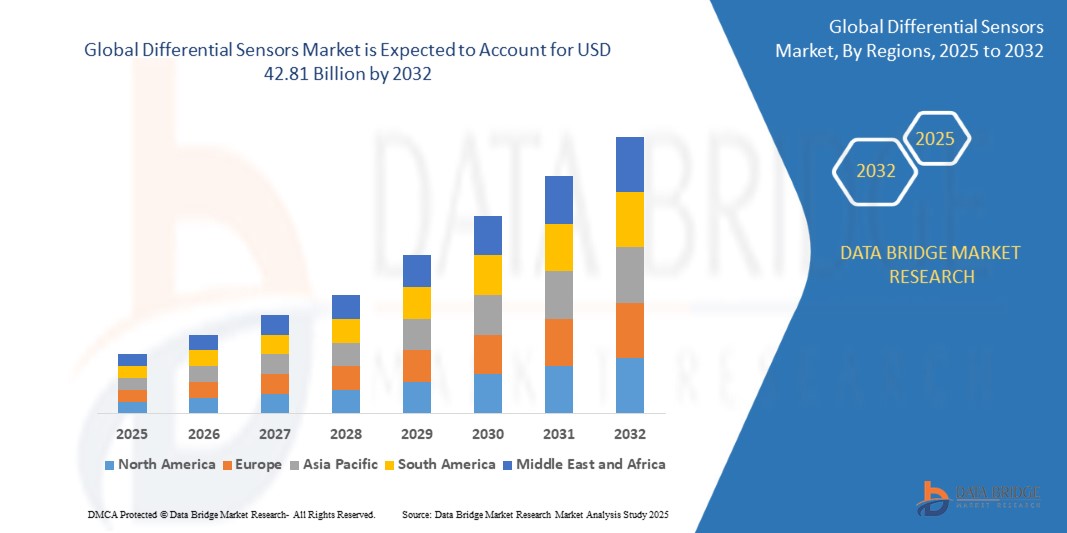
What is the Global Differential Sensors Market Size and Growth Rate?
- The global differential sensors market size was valued at USD 22.62 billion in 2024 and is expected to reach USD 42.81 billion by 2032, at a CAGR of 8.30% during the forecast period
- The differential sensors market has seen significant advancements with the integration of MEMS (Micro-Electro-Mechanical Systems) technology. MEMS-based differential sensors offer enhanced accuracy and miniaturization, crucial for applications in automotive and aerospace industries. These sensors use advanced piezoelectric materials to measure pressure differences with high precision, contributing to more reliable vehicle performance and improved safety features
- Another key development is the use of digital signal processing (DSP) in differential sensors. DSP enhances data accuracy and allows for real-time analysis, which is critical for applications requiring immediate feedback, such as in medical devices and industrial automation
What are the Major Takeaways of Differential Sensors Market?
- The growth of the differential sensors market is driven by the increasing demand for precise monitoring systems in various industries. The automotive sector's push for advanced driver-assistance systems (ADAS) and the expanding aerospace industry are significant contributors. As technology continues to evolve, the market is expected to see sustained growth, driven by innovations in sensor technology and increasing application areas
- North America dominated the differential sensors market with the largest revenue share of 33.28% in 2024, fueled by widespread enterprise adoption across industries such as healthcare, BFSI, and manufacturing
- Asia-Pacific differential sensors market is expected to grow at the fastest CAGR of 11.44% between 2025 and 2032, driven by rapid digitization, cloud adoption, and government support in countries such as China, India, Japan, and South Korea
- The Digital segment dominated the market with the largest market revenue share of 57.1% in 2024, attributed to its enhanced precision, ease of integration with IoT systems, and real-time data processing capabilities
Report Scope and Differential Sensors Market Segmentation
|
Attributes |
Differential Sensors Key Market Insights |
|
Segments Covered |
|
|
Countries Covered |
North America
Europe
Asia-Pacific
Middle East and Africa
South America
|
|
Key Market Players |
|
|
Market Opportunities |
|
|
Value Added Data Infosets |
In addition to the insights on market scenarios such as market value, growth rate, segmentation, geographical coverage, and major players, the market reports curated by the Data Bridge Market Research also include in-depth expert analysis, pricing analysis, brand share analysis, consumer survey, demography analysis, supply chain analysis, value chain analysis, raw material/consumables overview, vendor selection criteria, PESTLE Analysis, Porter Analysis, and regulatory framework. |
What is the Key Trend in the Differential Sensors Market?
“Integration of AI-Driven Sensing with Predictive Analytics”
- A major emerging trend in the differential sensors market is the integration of artificial intelligence (AI) with sensor systems to enable predictive analytics and anomaly detection across industrial, automotive, and healthcare applications. These smart sensors gather data and analyze patterns in real time to anticipate maintenance needs, performance anomalies, or system failures
- For instance, General Electric (GE) has deployed AI-enabled differential pressure sensors in its industrial IoT platforms to proactively detect performance drifts in turbines and compressors, significantly reducing downtime and maintenance costs
- AI-integrated differential sensors are increasingly being deployed in smart vehicles for advanced driver-assistance systems (ADAS), enabling functions such as tire pressure monitoring, engine diagnostics, and adaptive braking by processing sensor inputs in real time
- In healthcare, AI-enhanced pressure sensing platforms are being used in ventilators and patient monitoring systems to continuously adjust airflow or pressure based on patient vitals, improving clinical outcomes
- This fusion of sensing and intelligence enables more responsive, self-correcting systems across industries and is transforming how machines and infrastructure operate with minimal human intervention
- The trend toward predictive maintenance, real-time response, and intelligent diagnostics is positioning differential sensors as an indispensable tool in next-generation industrial and smart technology ecosystems
What are the Key Drivers of Differential Sensors Market?
- The expanding use of industrial automation and smart manufacturing is a primary driver, with differential sensors playing a key role in monitoring pressure variations, fluid levels, and mechanical stress in complex machinery
- In March 2024, Bosch Sensortec announced the launch of a new MEMS-based differential pressure sensor for HVAC systems, aimed at boosting energy efficiency and indoor air quality through real-time airflow monitoring
- The rise in electric vehicle (EV) adoption is boosting demand for differential sensors used in battery management systems (BMS), thermal control units, and electric drivetrain pressure monitoring
- Increasing investment in smart cities and infrastructure modernization is also supporting market growth, with differential sensors being deployed in environmental monitoring, pipeline systems, and building automation to ensure safety and compliance
- The adoption of miniaturized and wireless sensor technologies in consumer electronics and wearables is further fueling demand, especially where compact form factor and energy efficiency are critical
Which Factor is challenging the Growth of the Differential Sensors Market?
- Calibration complexity and signal drift remain key technical hurdles, particularly in applications requiring ultra-precise and stable readings over long periods. These issues can lead to inaccurate data and system malfunctions in safety-critical environments
- For instance, industries such as aerospace and medical devices require extremely tight tolerance limits, and even slight deviations in differential pressure can affect operational integrity, limiting wider adoption
- Another challenge lies in cost barriers for advanced sensors, especially those with AI-enabled features or multi-sensing capabilities. SMEs often find these systems financially unfeasible despite their long-term benefits
- The need for robust interoperability between sensors and legacy control systems adds integration overhead, particularly in older industrial setups not designed for smart technologies
- In addition, global supply chain disruptions and semiconductor shortages have affected the timely availability of critical sensor components, impacting production and deployment timelines
- Addressing these barriers will require advances in sensor calibration, affordable edge-processing units, and plug-and-play compatibility with industrial IoT platforms to accelerate broader market penetration
How is the Differential Sensors Market Segmented?
The market is segmented on the basis of product type, accuracy type, and end user.
• By Product Type
On the basis of product type, the differential sensors market is segmented into Analog and Digital. The Digital segment dominated the market with the largest market revenue share of 57.1% in 2024, attributed to its enhanced precision, ease of integration with IoT systems, and real-time data processing capabilities. Digital differential sensors are widely adopted in automotive and industrial automation sectors due to their ability to interface with modern control systems.
The Analog segment is expected to witness the fastest CAGR from 2025 to 2032, driven by its lower cost and simplicity in basic applications such as HVAC systems and medical devices, particularly in developing markets where cost-effectiveness is crucial.
• By Accuracy Type
On the basis of accuracy type, the differential sensors market is segmented into 1% to 2%, 2% to 5%, and Above 5%. The 1% to 2% segment held the largest market revenue share of 42.6% in 2024, owing to its wide adoption in industries requiring high reliability such as aerospace, medical instrumentation, and precision manufacturing. These sensors offer the right balance of performance and cost, making them a preferred choice across high-stakes applications.
The 2% to 5% segment is anticipated to register the highest growth rate from 2025 to 2032, driven by the increasing deployment in industrial machinery, automotive diagnostics, and HVAC systems where mid-range accuracy suffices and affordability is critical.
• By End User
On the basis of end user, the differential sensors market is segmented into Automotive, Medical, Industrial, Military and Defence, and Others. The Automotive segment accounted for the largest market revenue share of 30.8% in 2024, supported by growing applications in emission monitoring, engine control systems, and battery management systems. The surge in electric vehicle production and the need for precise environmental and internal vehicle pressure readings further boost adoption.
The Medical segment is expected to grow at the fastest CAGR from 2025 to 2032, driven by the expanding use of differential sensors in ventilators, infusion pumps, and minimally invasive devices. As healthcare providers increasingly invest in digital and connected medical infrastructure, demand for high-performance pressure sensors is rising.
Which Region Holds the Largest Share of the Differential Sensors Market?
- North America dominated the differential sensors market with the largest revenue share of 33.28% in 2024, fueled by widespread enterprise adoption across industries such as healthcare, BFSI, and manufacturing. The region's strong AI ecosystem, advanced digital infrastructure, and early investments in data analytics tools have driven market leadership
- Companies in the region are deploying differential sensors to enable real-time insights, automation, and decision augmentation at scale
- The presence of major technology leaders such as IBM, Google, Microsoft, and Amazon, alongside strong R&D initiatives and policy support, continues to enhance North America’s dominance in this space
U.S. Differential Sensors Market Insight
The U.S. held the largest share in the North American differential sensors market in 2024, driven by accelerated digital transformation across sectors such as public safety, healthcare diagnostics, and banking fraud detection. High adoption of predictive analytics, intelligent automation, and chatbots is supported by robust venture capital funding, academic research, and public-private partnerships. The U.S. continues to lead innovation through AI-focused government initiatives, regulatory clarity, and a skilled workforce.
Europe Differential Sensors Market Insight
The European differential sensors market is anticipated to grow at a strong CAGR during the forecast period, supported by GDPR compliance, ethical AI guidelines, and growing cross-border digital cooperation. Countries such as the U.K., Germany, and France are investing in intelligent automation and data-driven tools to modernize healthcare, automotive, and financial services. EU-backed initiatives and responsible AI frameworks are playing a crucial role in fostering adoption across industries.
U.K. Differential Sensors Market Insight
The U.K. market is projected to expand steadily due to rising public and private investments in AI, growth in tech startups, and a national focus on AI safety and governance. Applications such as customer service bots, HR analytics, and risk modeling are becoming mainstream, with academic and corporate collaborations fueling innovation. Government-backed institutions such as the AI Safety Institute are ensuring transparency and public trust in AI-driven decision tools.
Germany Differential Sensors Market Insight
Germany is witnessing stable growth in the differential sensors market, led by its push toward Industry 4.0 and AI in manufacturing. German firms are implementing differential sensors for automated quality checks, predictive supply chains, and energy management. The government’s “AI Made in Germany” initiative emphasizes trustworthy, human-centric AI, which aligns closely with local regulatory standards on privacy, sustainability, and cybersecurity.
Which Region is the Fastest Growing in the Differential Sensors Market?
Asia-Pacific differential sensors market is expected to grow at the fastest CAGR of 11.44% between 2025 and 2032, driven by rapid digitization, cloud adoption, and government support in countries such as China, India, Japan, and South Korea. Organizations are investing in AI tools to address workforce productivity, urbanization, and real-time intelligence across sectors including retail, education, and transportation. The region’s focus on affordable, scalable technology solutions is accelerating AI deployment.
Japan Differential Sensors Market Insight
Japan is rapidly adopting differential sensors due to its emphasis on automation, robotics, and addressing aging population needs. The government supports AI integration in healthcare, logistics, and public services through funding and ethical AI standards. Japan’s strengths in smart manufacturing, cybersecurity, and AI-human collaboration are positioning it as a key market in the region.
China Differential Sensors Market Insight
China led the Asia-Pacific market in revenue share in 2024, driven by its national AI strategy, government subsidies, and a thriving digital economy. The country is integrating differential sensors into smart city infrastructure, e-commerce platforms, and public administration systems. With strong domestic tech giants and a focus on AI-enabled governance, China continues to be a global innovator in intelligent decision systems.
Which are the Top Companies in Differential Sensors Market?
The differential sensors industry is primarily led by well-established companies, including:
- Honeywell International Inc. (U.S.)
- DENSO CORPORATION (Japan)
- OMNIVISION (U.S.)
- Alpha MOS (France)
- AMETEK Inc. (U.S.)
- AlphaSense Inc. (U.S.)
- BorgWarner Inc. (U.S.)
- Figaro Engineering Inc. (Japan)
- Emerson Electric Co. (U.S.)
- General Electric (U.S.)
- Industrial Scientific (U.S.)
- SAMSUNG (South Korea)
- Teledyne Monitor Labs (TML) (U.S.)
- STMicroelectronics (Switzerland)
- NXP Semiconductors (Netherlands)
- Infineon Technologies AG (Germany)
- Qualcomm Technologies, Inc. (U.S.)
- Microchip Technology Inc. (U.S.)
- Texas Instruments Incorporated (U.S.)
- Bosch Sensortec GmbH (Germany)
- Johnson Controls (Ireland)
- Sony Semiconductor Solutions Corporation (Japan)
What are the Recent Developments in Global Differential Sensors Market?
- In January 2024, Melexis introduced its Triphibian MEMS pressure sensor in Belgium, which supports measurement in both gas and liquid media ranging from 2 to 70 bar in a compact 16-pin SO16 package. This launch strengthens Melexis’ portfolio with a high-precision, multipurpose pressure sensor solution for industrial applications
- In October 2023, element14 announced a collaboration with Superior Sensor Technology to introduce next-generation pressure sensors offering enhanced accuracy and fully integrated sensing solutions. This partnership expands the availability of advanced sensing technologies for industrial and commercial customers
- In September 2023, Baker Hughes unveiled its Druck hydrogen-rated pressure sensors, capable of withstanding harsh environments and delivering long-term stability. Designed for critical applications such as hydrogen refueling stations, gas turbines, and electrolysis systems, this launch highlights the company's commitment to clean energy and reliability
- In April 2023, Valeport released the SwiFT Deep CTD, an advanced instrument for Conductivity, Temperature, and Depth (CTD) measurements up to 6,000 meters. With support for third-party sensor integration and density-corrected outputs, this innovation aims to meet the needs of scientific and deep-sea research operations
- In October 2021, Emerson Electric announced the strategic merger of two of its software businesses with Aspen Technology, in a deal valued at USD 11 billion. Emerson invested an additional USD 6 billion for a 55% ownership in the new entity, with the goal of creating a leading force in the industrial software market with enhanced digital capabilities

- Interactive Data Analysis Dashboard
- Company Analysis Dashboard for high growth potential opportunities
- Research Analyst Access for customization & queries
- Competitor Analysis with Interactive dashboard
- Latest News, Updates & Trend analysis
- Harness the Power of Benchmark Analysis for Comprehensive Competitor Tracking
Data collection and base year analysis are done using data collection modules with large sample sizes. The stage includes obtaining market information or related data through various sources and strategies. It includes examining and planning all the data acquired from the past in advance. It likewise envelops the examination of information inconsistencies seen across different information sources. The market data is analysed and estimated using market statistical and coherent models. Also, market share analysis and key trend analysis are the major success factors in the market report. To know more, please request an analyst call or drop down your inquiry.
The key research methodology used by DBMR research team is data triangulation which involves data mining, analysis of the impact of data variables on the market and primary (industry expert) validation. Data models include Vendor Positioning Grid, Market Time Line Analysis, Market Overview and Guide, Company Positioning Grid, Patent Analysis, Pricing Analysis, Company Market Share Analysis, Standards of Measurement, Global versus Regional and Vendor Share Analysis. To know more about the research methodology, drop in an inquiry to speak to our industry experts.
Data Bridge Market Research is a leader in advanced formative research. We take pride in servicing our existing and new customers with data and analysis that match and suits their goal. The report can be customized to include price trend analysis of target brands understanding the market for additional countries (ask for the list of countries), clinical trial results data, literature review, refurbished market and product base analysis. Market analysis of target competitors can be analyzed from technology-based analysis to market portfolio strategies. We can add as many competitors that you require data about in the format and data style you are looking for. Our team of analysts can also provide you data in crude raw excel files pivot tables (Fact book) or can assist you in creating presentations from the data sets available in the report.













