


What is the Digital Biomarker Platforms Market Size and Growth Rate?
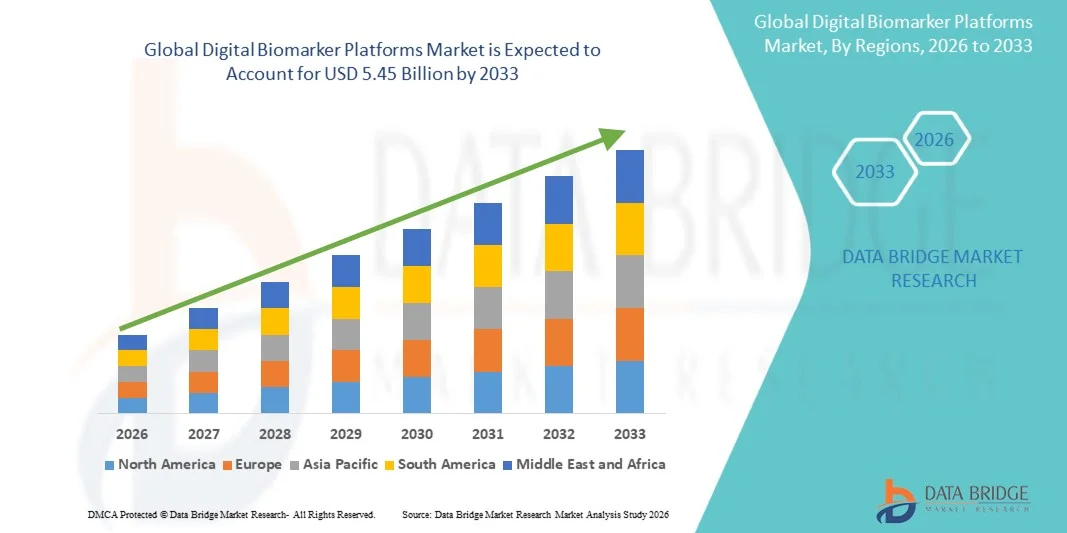
- As per Data Bridge Market Research analysis, the digital biomarker platforms market was valued at USD 1.86 billion in 2025 and is projected to reach USD 5.45 billion by 2033, growing at a CAGR of 14.40% from 2026 to 2033.
- The market is experiencing consistent growth driven by rising use of digital endpoints in clinical trials, increasing adoption of wearables and smartphones for remote data capture, and expanding applications across neurology, cardiology, respiratory care, and mental health among pharmaceutical companies, contract research organizations, and healthcare providers.
- The increasing shift toward decentralized and hybrid trials, continuous real-world monitoring, and AI-based analysis of sensor data, combined with growing regulatory engagement on digital health technologies, is supporting market adoption. Digital biomarker platforms are being applied across wearable medical device data capture, remote patient monitoring programs, and clinical data management workflows, offering sponsors and clinicians objective, continuous measures of disease status outside the clinic.
Market Size & Forecast
- Global Market Value (2025): USD 1.86 Billion
- Expected Market Value (2033): USD 5.45 Billion
- Forecast CAGR (2026–2033): 14.40%
- Leading Region in 2025: North America
- Fastest Growing Region: Asia Pacific
What are the Major Takeaways of the Digital Biomarker Platforms Market?
- North America dominated the digital biomarker platforms market with the largest revenue share of 40.21% in 2025, supported by the concentration of pharmaceutical sponsors, early regulatory engagement on digital health technologies, and strong adoption of wearables and connected devices.
- Asia-Pacific is expected to be the fastest-growing region at a CAGR of 17.62% from 2026 to 2033, fueled by expanding clinical research activity, rising smartphone and wearable penetration, and growing investment in digital health.
- The software segment led the market with a 61.31% share in 2025, driven by demand for data-ingestion engines, signal-processing algorithms, and analytics tools that convert sensor data into validated endpoints.
- Services are the fastest-growing component, projected to register a CAGR of 16.13%, reflecting rising demand for endpoint strategy, algorithm validation, and regulatory support.
- The physiological segment dominated the biomarker type category with a 46.85% revenue share in 2025, led by mature sensing of heart rate, activity, sleep, and gait through wearables.
- Neurology accounted for 38.76% of the market share in 2025, preferred by the need for objective measures of motor and cognitive function in Parkinson’s disease and Alzheimer’s disease.
- The mental health segment is the fastest-growing application category, with a CAGR of 17.44%, driven by growing use of speech, sleep, and behavioral patterns as objective indicators.
Report Scope and Digital Biomarker Platforms Market Segmentation
|
Attributes |
Digital Biomarker Platforms Key Market Insights |
|
Segments Covered |
|
|
Countries Covered |
North America
Europe
Asia-Pacific
Middle East and Africa
South America
|
|
Key Market Players |
|
|
Market Opportunities |
|
|
Value Added Data Infosets |
In addition to the insights on market scenarios such as market value, growth rate, segmentation, geographical coverage, and major players, the market reports curated by the Data Bridge Market Research also include in-depth expert analysis, patient epidemiology, pipeline analysis, pricing analysis, and regulatory framework. |
What is the Key Trend in the Digital Biomarker Platforms Market ?
- Digital biomarker platforms are increasingly evolving from single-sensor data collection tools into integrated systems that combine wearables, smartphone-based tasks, cloud analytics, and AI algorithms to generate validated digital endpoints across multiple disease areas.
- For instance, in June 2024, according to npj Parkinson’s Disease, the WATCH-PD study followed individuals with early, untreated Parkinson’s disease for 12 months using a commercially available smartwatch and smartphone application, and reported that gait and tremor measures hold promise for assessing therapeutic efficacy, highlighting the growing role of consumer-grade sensors in generating clinical trial endpoints
- Platform providers are increasingly packaging device qualification, signal processing, statistical validation, and regulatory submission support within single offerings, reducing the burden on sponsors that previously coordinated multiple separate vendors.
- Neurology and movement disorders are emerging as the leading proving ground for digital biomarkers, as gait, tremor, speech, and fine-motor measures can be captured passively at home between clinic visits.
- For instance, in June 2024, according to Empatica, the company announced a partnership with Mobilise-D, an initiative funded by the Innovative Medicines Initiative and coordinated by Newcastle University, to integrate validated Digital Mobility Outcomes into the Empatica Health Monitoring Platform, demonstrating the consolidation of validated algorithms within single digital endpoint platforms
- As sensor accuracy, AI-based analytics, and regulatory acceptance continue to advance, digital biomarker platforms are expected to expand beyond observational research into pivotal trial endpoints, clinical care, and personalized disease management.
What are the Key Drivers of the Digital Biomarker Platforms Market ?
- The growing need for objective, frequent, and patient-centric measures in clinical development has significantly increased demand for platforms that capture physiological and behavioral data outside the clinic while reducing reliance on episodic, rater-dependent assessments.
- For instance, in June 2021, according to npj Digital Medicine, a study of 525 participants in laboratory and clinical settings found that Altoida’s Digital Neuro Signature enabled cognitive evaluations in about 10 minutes compared with 45–120 minutes for conventional neuropsychological assessments, supporting the efficiency advantage of digital biomarker assessments.
- Pharmaceutical companies, contract research organizations, and healthcare providers are integrating digital measures to reduce site visits, improve participant retention, and detect subtle disease change earlier.
- For instance, in July 2026, according to the U.S. Food and Drug Administration (FDA), the agency opened a funding opportunity (RFA-FD-26-012) with a USD 1.1 million award ceiling and two expected awards to support projects comparing digital measurements with traditional measurements in clinical trials, signaling regulatory support for digital health technologies in drug development.
- With sponsors increasingly designing trials around remote data collection, digital biomarker platforms can support faster enrollment, richer datasets, and integration with clinical data and submission workflows.
What Factors Are Challenging the Growth of the Digital Biomarker Platforms Market?
- Digital biomarker platforms require the integration of sensors, mobile applications, cloud infrastructure, validated algorithms, and regulatory documentation, increasing implementation complexity and validation costs for sponsors and providers.
- For instance, in April 2023, according to npj Parkinson’s Disease, baseline results from the WATCH-PD study of 82 individuals with early Parkinson’s disease and 50 age-matched controls showed that device-derived features such as arm swing, proportion of time with tremor, and finger tapping differed significantly between groups but had variable correlation with traditional assessments, highlighting the validation challenge for new digital measures.
- Data privacy, security, and interoperability requirements add further cost, particularly when sensitive health data flows across devices, cloud systems, and multiple countries with different regulations.
- Establishing context of use, analytical validity, and clinical meaningfulness for each digital endpoint requires long studies and close engagement with regulators, which can slow commercial adoption.
- For instance, in September 2022, according to Frontiers in Medicine, the Mobilise-D Consortium noted that only very narrowly scoped requests for regulatory qualification of wearable-sensor mobility biomarkers had been successful to date, underscoring the limited regulatory precedent that can constrain broader platform adoption.
- The combination of validation requirements, uneven regulatory acceptance, data governance obligations, and integration complexity can constrain adoption among smaller sponsors and healthcare organizations with limited digital infrastructure.
How is the Digital Biomarker Platforms Market Segmented?
The digital biomarker platforms market is segmented on the basis of component, biomarker type, application, and end user.
- By Component
On the basis of component, the digital biomarker platforms market is segmented into software and services. The software segment dominated the market with 61.31% share in 2025, supported by demand for data-ingestion engines, signal-processing algorithms, analytics dashboards, and submission-ready reporting tools. Software allows sponsors and providers to standardize measures across devices, scale deployment across sites and countries, and update algorithms without replacing hardware. Cloud delivery supports remote participant monitoring and near-real-time quality checks. Integration with electronic data capture, clinical trial management, and electronic health record systems further strengthens adoption, while AI-based feature extraction continues to improve the sensitivity of digital endpoints.
The services segment is projected to register the fastest growth at a CAGR of 16.13% from 2026 to 2033, driven by growing need for expert support in endpoint strategy, device selection, algorithm validation, and regulatory interactions. Many sponsors lack in-house digital measurement science capabilities and prefer outsourced partners that can manage the full lifecycle from feasibility to submission. Demand is also rising for data science consulting, custom algorithm integration, and biometrics support that connect digital measures with traditional clinical data. Growth of decentralized trials and the need for audit-ready documentation are further expanding service engagements across therapeutic areas.
- By Biomarker Type
On the basis of biomarker type, the digital biomarker platforms market is segmented into physiological, behavioral, cognitive, and others. The physiological segment dominated the market with 46.85% share in 2025, supported by mature sensing of heart rate, heart rhythm, activity, sleep, respiration, and glucose-related signals through consumer and clinical-grade wearables. These measures can be captured continuously and passively with limited participant burden, making them attractive for long-term monitoring. Established regulatory clearances for several sensor-based measures increase sponsor confidence, while large datasets from consumer devices support algorithm development. Integration with remote monitoring programs further reinforces demand.
The cognitive segment is projected to register the fastest growth at a CAGR of 18.2% from 2026 to 2033, driven by the need for objective, brief, and repeatable assessments of memory, attention, and executive function. Smartphone and tablet-based tasks, including augmented-reality assessments, can be self-administered at home and compared against conventional neuropsychological tests that are lengthy and site-dependent. Rising Alzheimer’s disease research activity and the push toward earlier detection in clinical trials are increasing adoption. Self-administered tests also support enrichment and screening workflows, while longitudinal monitoring helps detect subtle change over time.
- By Application
On the basis of application, the digital biomarker platforms market is segmented into neurology, cardiology, respiratory, mental health, and others. The neurology segment dominated the application category with 38.76% share in 2025, supported by the need for objective, frequent measures of motor and cognitive function in Parkinson’s disease, Alzheimer’s disease, multiple sclerosis, and epilepsy. Traditional clinic-based rating scales are episodic and subject to rater variability, creating strong demand for continuous sensor-derived measures. Neurology programs also benefit from active research collaborations, regulatory dialogue on digital endpoints, and large observational cohorts that generate validation evidence.
The mental health segment is projected to register the fastest growth at a CAGR of 17.44% from 2026 to 2033, driven by interest in speech, sleep, activity, and smartphone-interaction patterns as objective indicators of mood, anxiety, and cognition. Digital markers can reduce reliance on self-report scales and enable frequent monitoring between visits. Pharmaceutical companies are exploring such measures to assess treatment response in psychiatric trials, while healthcare providers see potential for earlier identification of relapse. Remote delivery, privacy-preserving analysis, and integration with telehealth services further support adoption.
- By End User
On the basis of end user, the digital biomarker platforms market is segmented into pharmaceutical & biotechnology companies, contract research organizations, healthcare providers, and others. The pharmaceutical & biotechnology companies segment dominated the end-user category with 47.91% share in 2025, supported by the use of digital endpoints in clinical development to improve sensitivity, reduce site visits, and enrich participant selection. Sponsors increasingly build digital measures into protocols from early phases to generate evidence for later regulatory use. Investment in decentralized and hybrid trial models, together with partnerships with platform providers, is strengthening demand. Data quality, validation, and regulatory acceptability remain important purchasing criteria.
The contract research organizations segment is projected to register the fastest growth at a CAGR of 16.32% from 2026 to 2033, driven by outsourcing of digital endpoint deployment, device logistics, and data management by sponsors. CROs are expanding technology partnerships and in-house digital teams to support hybrid trials and remote monitoring. Their ability to manage devices, participant support, data pipelines, and regulatory documentation across multiple countries makes them important adopters. Growth in rare disease and neurology studies, where objective measures are particularly valuable, is creating additional demand.
Which Region Holds the Largest Share of the Digital Biomarker Platforms Market?
- North America dominated the digital biomarker platforms market with the largest revenue share of 40.21% in 2025, supported by the concentration of pharmaceutical sponsors, early regulatory engagement on digital health technologies, and strong adoption of wearables and connected devices.
- The region also benefits from the presence of established digital health and clinical research companies, active federal engagement on digital health technologies in drug development, strong venture investment, and extensive wearable penetration. Increasing use of digital biomarkers in neurology, cardiology, and decentralized trials continues to strengthen North America’s position in the global market.
U.S. Digital Biomarker Platforms Market Insight
The U.S. digital biomarker platforms market is witnessing strong growth due to the concentration of pharmaceutical sponsors, academic medical centers, and digital health companies pursuing digital endpoints in clinical development. Federal engagement on digital health technologies in drug development, including funding for studies that compare digital and traditional measures, is encouraging adoption. In addition, widespread use of smartphones and smartwatches, growing remote monitoring programs, and active collaboration between technology firms and research foundations are accelerating deployment of digital biomarker platforms across neurology, cardiology, and mental health studies.
Asia-Pacific Digital Biomarker Platforms Market Insight
The Asia-Pacific digital biomarker platforms market is expected to witness rapid growth, driven by expanding clinical trial activity, rising smartphone and wearable adoption, and increasing investments in digital health across countries such as China, India, and Japan. Growing prevalence of neurological and chronic diseases, aging populations, and interest in remote participant monitoring are supporting demand. In addition, the region’s growing contract research base and technology ecosystem are encouraging pharmaceutical sponsors to deploy sensor-based endpoints in multinational trials.
Japan Digital Biomarker Platforms Market Insight
The Japan digital biomarker platforms market is witnessing consistent growth due to a rapidly aging population, strong medical device and sensor manufacturing capabilities, and rising interest in objective monitoring of neurodegenerative and chronic conditions. Pharmaceutical companies, hospitals, and research institutions are exploring wearable and smartphone-based measures to improve early detection and treatment assessment. Moreover, emphasis on quality, data reliability, and integration with existing healthcare infrastructure is contributing to steady adoption of digital biomarker platforms in Japan.
China Digital Biomarker Platforms Market Insight
The China digital biomarker platforms market is growing rapidly, driven by large-scale wearable manufacturing, widespread smartphone use, expanding clinical research, and strong government support for digital health. Domestic technology companies and hospitals are increasingly applying sensor data and AI algorithms to chronic disease management and neurological assessment. In addition, growing participation of Chinese sites in global trials and rising investment in artificial intelligence are positioning China as a key growth market for digital biomarker platforms across Asia-Pacific.
U.K. Digital Biomarker Platforms Market Insight
The U.K. digital biomarker platforms market is experiencing steady growth, supported by a strong life sciences base, active academic research, and participation in international collaborations on digital mobility and neurological biomarkers. Health technology companies, universities, and clinical research organizations are developing and validating digital measures for neurodegenerative and respiratory conditions. Furthermore, the presence of established digital biomarker developers and growing use of remote monitoring in health research programs is supporting wider adoption of digital biomarker platforms in the U.K.
Germany Digital Biomarker Platforms Market Insight
The Germany digital biomarker platforms market is expanding steadily due to the country’s strong pharmaceutical and medical technology base, advanced clinical research infrastructure, and growing acceptance of digital health applications. Pharmaceutical companies, university hospitals, and research networks are increasingly using sensor-based measures to support trials in movement disorders, cardiology, and respiratory disease. Continuous advances in wearable sensors, along with Germany’s emphasis on data protection and regulatory compliance, are shaping demand for validated, privacy-conscious digital biomarker platforms.
Which are the Top Companies in Digital Biomarker Platforms Market?
The digital biomarker platforms industry is primarily led by well-established companies, including:
- Koneksa Health, Inc. (U.S.)
- Evidation Health, Inc. (U.S.)
- Altoida, Inc. (U.S.)
- Empatica Inc. (U.S.)
- IXICO plc (U.K.)
- AliveCor, Inc. (U.S.)
- ActiGraph LLC (U.S.)
- Biofourmis, Inc. (U.S.)
- Cambridge Cognition Holdings plc (U.K.)
- Aural Analytics, Inc. (U.S.)
- Huma Therapeutics Limited (U.K.)
- Verily Life Sciences LLC (U.S.)
- Apple Inc. (U.S.)
- Koninklijke Philips N.V. (Netherlands)
- Cogstate Ltd (Australia)
- Clario (U.S.)
- Sonde Health, Inc. (U.S.)
- Medidata Solutions, Inc. (U.S.)
- Abbott Laboratories (U.S.)
- Oura Health Oy (Finland)
What are Latest Developments in Digital Biomarker Platforms Market ?
- In June 2026, Koneksa Health announced the launch of Lodestar, which it described as the first intelligent submission software for clinical trials. The AI-assisted platform connects the clinical submission pipeline into a single 21 CFR Part 11 audit-trailed workflow supporting FDA and EMA submissions, helping sponsors move digital and traditional endpoint data from raw datasets to regulatory filing
- In January 2026, Evidation announced the launch of a temporal biospecimen collection platform with an initial autoimmune research cohort that includes proteomics sampling. The platform uses AI-enabled temporal data collection to study disease flares and the molecular drivers of treatment response, linking longitudinal digital health data with multiomics research in real-world settings.
- In January 2026, Altoida and Mindspan announced a research collaboration to conduct an investigational pilot study evaluating the clinical, operational, and potential economic impacts of integrating Altoida’s AI- and AR-powered digital NeuroMarker platform into Mindspan’s cognitive care delivery model for patients with Alzheimer’s disease and related conditions.
- In July 2025, IXICO and the Global Alzheimer’s Platform Foundation announced a strategic collaboration under which IXICO joined the Bio-Hermes-002 study as an imaging partner, providing a combination of financial investment and AI-driven neuroimaging analysis for a study that evaluates blood-based and digital biomarkers for Alzheimer’s disease.
- In May 2024, Empatica and McRoberts announced the integration of all 71 McRoberts endpoints into Empatica’s digital biomarker portfolio and FDA-cleared platform, bringing its total offering to over 200 digital measures and positioning the platform as a destination for other developers to implement algorithms without building dedicated hardware.

- Interactive Data Analysis Dashboard
- Company Analysis Dashboard for high growth potential opportunities
- Research Analyst Access for customization & queries
- Competitor Analysis with Interactive dashboard
- Latest News, Updates & Trend analysis
- Harness the Power of Benchmark Analysis for Comprehensive Competitor Tracking
Data collection and base year analysis are done using data collection modules with large sample sizes. The stage includes obtaining market information or related data through various sources and strategies. It includes examining and planning all the data acquired from the past in advance. It likewise envelops the examination of information inconsistencies seen across different information sources. The market data is analysed and estimated using market statistical and coherent models. Also, market share analysis and key trend analysis are the major success factors in the market report. To know more, please request an analyst call or drop down your inquiry.
The key research methodology used by DBMR research team is data triangulation which involves data mining, analysis of the impact of data variables on the market and primary (industry expert) validation. Data models include Vendor Positioning Grid, Market Time Line Analysis, Market Overview and Guide, Company Positioning Grid, Patent Analysis, Pricing Analysis, Company Market Share Analysis, Standards of Measurement, Global versus Regional and Vendor Share Analysis. To know more about the research methodology, drop in an inquiry to speak to our industry experts.
Data Bridge Market Research is a leader in advanced formative research. We take pride in servicing our existing and new customers with data and analysis that match and suits their goal. The report can be customized to include price trend analysis of target brands understanding the market for additional countries (ask for the list of countries), clinical trial results data, literature review, refurbished market and product base analysis. Market analysis of target competitors can be analyzed from technology-based analysis to market portfolio strategies. We can add as many competitors that you require data about in the format and data style you are looking for. Our team of analysts can also provide you data in crude raw excel files pivot tables (Fact book) or can assist you in creating presentations from the data sets available in the report.













