


Digital Cell Modeling Platforms Market Size
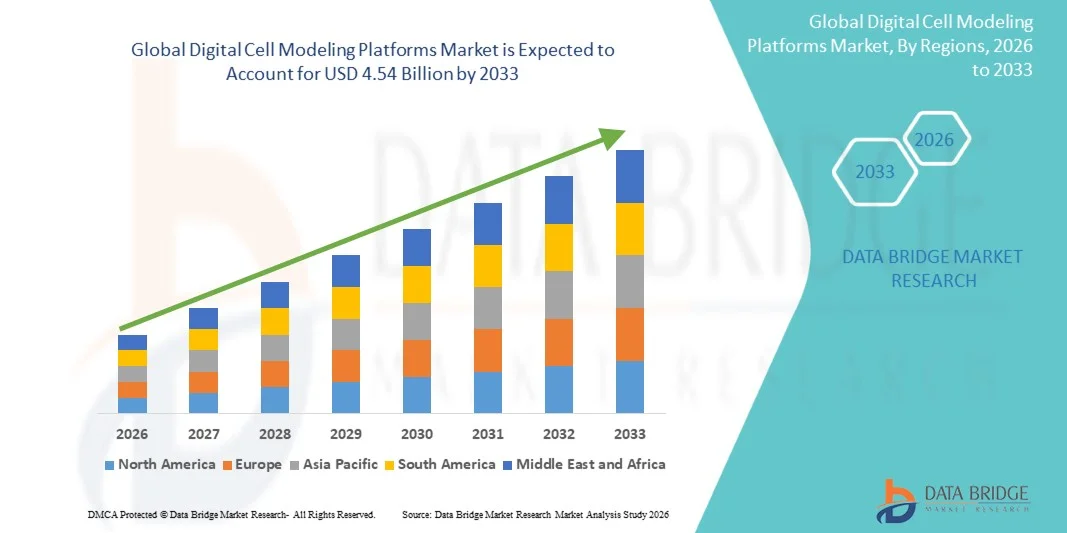
- The global digital cell modeling platforms market size was valued at USD 1.03 billion in 2025 and is expected to reach USD 4.54 billion by 2033, at a CAGR of 20.40% during the forecast period
- The market growth is largely fueled by the increasing integration of computational biology, artificial intelligence, and high-performance computing in life sciences research, enabling more accurate simulation and prediction of cellular behavior
- Furthermore, rising demand for advanced in silico modeling to accelerate drug discovery, reduce reliance on wet-lab experiments, and improve R&D efficiency is driving adoption among pharmaceutical, biotechnology, and academic research organizations, thereby significantly boosting the industry's growth
Digital Cell Modeling Platforms Market Analysis
- Digital cell modeling platforms, which enable in silico simulation and computational representation of cellular processes, are increasingly becoming essential tools in modern life sciences research and drug development workflows due to their ability to predict biological behavior, optimize experimental design, and reduce reliance on traditional laboratory methods
- The escalating demand for digital cell modeling platforms is primarily fueled by the growing adoption of artificial intelligence, machine learning, and systems biology approaches, along with the rising need to accelerate drug discovery timelines, lower R&D costs, and improve success rates in preclinical and clinical research
- North America dominated the digital cell modeling platforms market with the largest revenue share of 42.3% in 2025, supported by strong investments in biotechnology and pharmaceutical R&D, advanced computational infrastructure, and the presence of leading technology providers and research institutions, particularly in the United States where adoption is driven by collaborations between academia, biotech firms, and AI-focused life science companies
- Asia-Pacific is expected to be the fastest-growing region in the digital cell modeling platforms market during the forecast period due to increasing government funding for life sciences research, expanding biotechnology sector, and growing adoption of advanced digital and computational tools across emerging economies
- The drug discovery & development segment accounted for the largest share of 45.6% of the digital cell modeling platforms market in 2025, as pharmaceutical companies increasingly rely on computational screening and predictive modeling to reduce laboratory costs and accelerate early-stage research activities
Report Scope and Digital Cell Modeling Platforms Market Segmentation
|
Attributes |
Digital Cell Modeling Platforms Key Market Insights |
|
Segments Covered |
|
|
Countries Covered |
North America
Europe
Asia-Pacific
Middle East and Africa
South America
|
|
Key Market Players |
|
|
Market Opportunities |
|
|
Value Added Data Infosets |
In addition to the insights on market scenarios such as market value, growth rate, segmentation, geographical coverage, and major players, the market reports curated by the Data Bridge Market Research also include in-depth expert analysis, patient epidemiology, pipeline analysis, pricing analysis, and regulatory framework |
Digital Cell Modeling Platforms Market Trends
“Advancement Through AI-Driven Biological Simulation and Cloud Integration”
- A significant and accelerating trend in the global digital cell modeling platforms market is the increasing integration of artificial intelligence (AI), machine learning, and cloud computing with computational biology platforms, enabling more accurate and scalable simulation of complex cellular processes
- For instance, platforms such as IBM Watson and Schrödinger leverage AI-enabled modeling to predict molecular and cellular interactions, allowing researchers to simulate biological systems and optimize experimental outcomes with greater precision
- AI integration in digital cell modeling platforms enables capabilities such as pattern recognition in large biological datasets, automated hypothesis generation, and predictive modeling of cell behavior under different conditions
- The adoption of cloud-based infrastructures allows researchers and organizations to access high-performance computing resources remotely, facilitating collaboration, data sharing, and real-time simulation across geographically distributed teams
- Expansion of digital twin technology for cells and tissues allows modeling of patient-specific responses, supporting precision medicine initiatives and personalized therapeutic strategies
- This trend toward intelligent, data-driven, and cloud-enabled modeling environments is reshaping how life sciences research is conducted, enabling more efficient drug discovery, toxicity testing, and systems biology analysis
- The demand for platforms that combine AI, automation, and cloud scalability is growing rapidly across pharmaceutical, biotechnology, and academic sectors, as organizations increasingly prioritize speed, accuracy, and collaborative research capabilities
Digital Cell Modeling Platforms Market Dynamics
Driver
“Growing Demand Due to Accelerated Drug Discovery and Cost Reduction Needs”
- The increasing need to accelerate drug discovery timelines while reducing research and development costs is a significant driver for the growing adoption of digital cell modeling platforms across the life sciences industry
- For instance, in recent developments, pharmaceutical companies are increasingly adopting in silico modeling approaches to screen drug candidates virtually before progressing to laboratory and clinical testing, thereby improving efficiency and reducing experimental failures
- As organizations face rising pressure to improve success rates in drug pipelines, digital cell modeling platforms provide predictive insights into cellular responses, helping identify viable compounds earlier in the development process
- Furthermore, the growing complexity of biological research and the limitations of traditional experimental methods are pushing researchers toward computational models that can replicate and analyze cellular systems at scale
- The ability to integrate multi-omics data, simulate disease mechanisms, and evaluate therapeutic responses is making these platforms essential tools in modern biomedical research workflows
- Increasing collaborations between software developers, biotech firms, and academic institutions are expanding access to advanced modeling platforms and fostering innovation in predictive biology
- Government funding and grants for AI-driven drug discovery initiatives in regions such as North America and Europe are supporting the adoption of digital cell modeling platforms and accelerating market growth
- The increasing adoption of advanced analytics, coupled with investments in digital transformation within pharmaceutical and biotechnology companies, continues to drive the expansion of this market globally
Restraint/Challenge
“High Computational Complexity and Data Integration Challenges”
- Challenges related to high computational complexity and the need for large, high-quality biological datasets pose significant barriers to the widespread adoption of digital cell modeling platforms
- For instance, accurate simulation of cellular systems requires integration of multi-dimensional data such as genomics, proteomics, and metabolomics, which can be difficult to standardize and process effectively
- The lack of interoperability between different data sources and modeling tools often limits seamless workflow integration, creating inefficiencies in research processes
- Furthermore, the requirement for advanced computational infrastructure and specialized expertise increases implementation costs, making adoption more difficult for smaller research organizations and emerging market players
- Data privacy concerns and regulatory considerations related to sensitive biological and clinical data also add complexity to platform deployment and usage
- Limited validation of computational predictions in real-world biological settings can reduce confidence among end users, slowing adoption despite technological capabilities
- Continuous software updates and integration with evolving laboratory hardware can present logistical challenges, requiring dedicated IT and bioinformatics support
- Overcoming these challenges through improved data standardization, enhanced interoperability, and continued advancements in computing power and user-friendly interfaces will be essential for sustained market growth
Digital Cell Modeling Platforms Market Scope
The market is segmented on the basis of platform type, application, and end user.
- By Platform Type
On the basis of platform type, the digital cell modeling platforms market is segmented into cell simulation & modeling software, digital imaging & visualization tools, AI-based modeling platforms, cloud-based platforms, and on-premise platforms. The AI-based modeling platforms segment dominated the market with the largest revenue share of 36% in 2025, driven by the increasing integration of artificial intelligence and machine learning in biological modeling workflows. These platforms enable predictive simulations, pattern recognition in complex biological datasets, and automated hypothesis generation, making them highly valuable in drug discovery and systems biology. Their ability to process multi-omics data and improve model accuracy has significantly increased their adoption among pharmaceutical and biotechnology companies. In addition, continuous advancements in AI algorithms and computational biology are strengthening their role as core tools in modern research. The growing collaboration between AI technology providers and life science companies further supports the dominance of this segment.
The cloud-based platforms segment is anticipated to witness the fastest growth rate of 25% from 2026 to 2033, fueled by increasing demand for scalable computing resources and remote accessibility. Cloud deployment allows researchers to access high-performance computing environments without investing in expensive infrastructure, making it particularly attractive for small and mid-sized organizations. These platforms also support real-time collaboration, data sharing, and integration with distributed research teams across geographies. The flexibility to handle large datasets and run complex simulations efficiently is a key growth driver for cloud-based solutions. Furthermore, the rising adoption of SaaS-based life science tools and digital transformation initiatives in pharmaceutical R&D are accelerating the shift toward cloud-based modeling environments.
- By Application
On the basis of application, the digital cell modeling platforms market is segmented into drug discovery & development, cancer research, stem cell research, genomics & proteomics, and clinical diagnostics. The drug discovery & development segment dominated the market with the largest revenue share of 45.6% in 2025, driven by the critical need for predictive modeling to identify potential drug candidates and reduce reliance on costly laboratory experiments. Pharmaceutical companies increasingly use digital cell models to simulate drug-target interactions, toxicity, and efficacy before clinical trials, improving success rates in drug pipelines. These platforms help streamline early-stage research, reduce time-to-market, and minimize attrition rates in clinical development. The integration of AI and simulation tools further enhances the accuracy of predictions, making this segment central to market growth. Strong investment in R&D by leading pharmaceutical companies continues to reinforce its dominance.
The cancer research segment is expected to witness the fastest growth rate of 27% from 2026 to 2033, driven by the rising global burden of cancer and the need for advanced tools to understand tumor biology. Digital cell modeling platforms enable researchers to simulate cancer cell behavior, study tumor microenvironments, and evaluate therapeutic responses in silico. These capabilities are particularly valuable for developing personalized oncology treatments and precision medicine approaches. Increasing funding for oncology research and collaborations between research institutes and biotech firms are further accelerating adoption. In addition, the complexity of cancer biology makes computational modeling an essential complement to traditional experimental methods, supporting rapid growth in this segment.
- By End User
On the basis of end user, the digital cell modeling platforms market is segmented into pharmaceutical & biotechnology companies, academic & research institutes, contract research organizations (CROs), clinical laboratories, and others. The pharmaceutical & biotechnology companies segment dominated the market with the largest revenue share of 50% in 2025, driven by extensive investments in drug discovery, clinical research, and biologics development. These organizations rely heavily on digital cell modeling platforms to optimize R&D pipelines, reduce experimental costs, and enhance decision-making in early-stage research. The increasing adoption of AI-driven platforms and multi-omics integration tools has further strengthened their reliance on computational modeling. In addition, strategic partnerships with technology providers and continuous innovation in digital biology tools contribute to the dominance of this segment. The need for faster and more efficient drug development processes continues to drive demand within this end user category.
The contract research organizations (CROs) segment is expected to witness the fastest growth rate of 26% from 2026 to 2033, fueled by the outsourcing of research and development activities by pharmaceutical and biotechnology companies. CROs increasingly adopt digital cell modeling platforms to provide advanced simulation, predictive analytics, and preclinical testing services to their clients. The cost-effectiveness and scalability of these platforms allow CROs to enhance service offerings and improve operational efficiency. Growing demand for specialized research services, coupled with the need for faster drug development timelines, is encouraging CROs to integrate digital modeling technologies into their workflows. Furthermore, increasing collaboration between CROs and technology providers is accelerating the adoption of these platforms globally.
Digital Cell Modeling Platforms Market Regional Analysis
- North America dominated the digital cell modeling platforms market with the largest revenue share of 42.3% in 2025, supported by strong investments in biotechnology and pharmaceutical R&D, advanced computational infrastructure, and the presence of leading technology providers and research institutions
- Research institutions, biotech firms, and pharmaceutical companies in the region highly value the ability of digital cell modeling platforms to accelerate drug discovery, improve predictive accuracy, and reduce dependency on traditional laboratory experimentation
- This widespread adoption is further supported by advanced digital infrastructure, availability of high-performance computing resources, a strong presence of leading technology providers, and a highly skilled workforce, establishing digital cell modeling platforms as critical tools across life sciences and research-driven industries
U.S. Digital Cell Modeling Platforms Market Insight
The U.S. dominated the digital cell modeling platforms market with the largest revenue share of 42% in 2025, driven by strong investments in pharmaceutical and biotechnology R&D, along with early adoption of AI-driven computational biology tools. Research organizations and life sciences companies in the region highly value digital cell modeling platforms for their ability to accelerate drug discovery, improve predictive accuracy, and reduce dependency on traditional laboratory experimentation. This widespread adoption is further supported by advanced digital infrastructure, availability of high-performance computing resources, a strong presence of leading technology providers, and a highly skilled scientific workforce, establishing digital cell modeling platforms as essential tools across the regional life sciences ecosystem.
Europe Digital Cell Modeling Platforms Market Insight
The Europe digital cell modeling platforms market is projected to expand at a substantial CAGR throughout the forecast period, primarily driven by strong regulatory frameworks supporting research innovation and increasing investments in life sciences and computational biology. The region’s emphasis on precision medicine, coupled with growing adoption of AI and simulation-based research tools, is fostering demand for advanced modeling platforms. European research institutions and pharmaceutical companies are increasingly leveraging digital cell modeling to enhance drug development efficiency and reduce clinical trial risks. In addition, collaborations between academic institutions and industry players are accelerating innovation and adoption across multiple research applications.
U.K. Digital Cell Modeling Platforms Market Insight
The U.K. digital cell modeling platforms market is anticipated to grow at a noteworthy CAGR during the forecast period, driven by the country’s strong biotechnology sector and increasing focus on AI-enabled drug discovery. The presence of leading research universities and innovation hubs is encouraging the use of computational biology tools in both academic and commercial settings. In addition, government support for life sciences innovation and digital health initiatives is contributing to market expansion. The growing adoption of cloud-based research platforms and integration of digital modeling in clinical and preclinical workflows further supports the increasing demand for these solutions.
Germany Digital Cell Modeling Platforms Market Insight
The Germany digital cell modeling platforms market is expected to expand at a considerable CAGR during the forecast period, fueled by increasing investments in biotechnology, pharmaceuticals, and industrial research. Germany’s strong engineering and scientific ecosystem, combined with its focus on precision medicine and data-driven healthcare, is promoting the adoption of advanced computational modeling tools. Organizations in the country prioritize high-quality, secure, and efficient research methodologies, which aligns well with the capabilities of digital cell modeling platforms. Furthermore, the integration of these platforms with automation and advanced analytics is becoming increasingly common across research institutions and industrial applications.
Asia-Pacific Digital Cell Modeling Platforms Market Insight
The Asia-Pacific digital cell modeling platforms market is poised to grow at the fastest CAGR of 25% during the forecast period of 2026 to 2033, driven by increasing urbanization, rising investments in biotechnology, and expanding adoption of AI-driven research tools in countries such as China, Japan, and India. The region’s growing focus on digital transformation in healthcare and life sciences is accelerating the deployment of advanced modeling platforms. Furthermore, increasing government initiatives supporting research and innovation, along with the presence of emerging biotech startups, are contributing to rapid market expansion. The availability of cost-effective research solutions and growing access to cloud-based platforms are also enabling wider adoption across the region.
Japan Digital Cell Modeling Platforms Market Insight
The Japan digital cell modeling platforms market is gaining momentum due to the country’s strong technological foundation, advanced healthcare infrastructure, and emphasis on innovation in life sciences research. The increasing integration of AI, robotics, and digital technologies in research environments is driving the adoption of computational modeling tools. Japan’s aging population and focus on personalized medicine are further encouraging the use of digital cell modeling platforms to study disease mechanisms and therapeutic responses. In addition, collaborations between academic institutions, technology providers, and pharmaceutical companies are supporting the development and implementation of advanced modeling solutions.
India Digital Cell Modeling Platforms Market Insight
The India digital cell modeling platforms market accounted for a significant share in Asia Pacific in 2025, attributed to the country’s expanding biotechnology sector, growing research ecosystem, and increasing adoption of digital technologies in life sciences. India is witnessing rising investments in pharmaceutical R&D and academic research, which is driving demand for advanced computational tools such as digital cell modeling platforms. The availability of a skilled scientific workforce, along with government initiatives promoting digitalization and innovation, is further supporting market growth. In addition, the increasing presence of biotech startups and collaborations with global research organizations are enhancing the adoption of these platforms across the country.
Digital Cell Modeling Platforms Market Share
The Digital Cell Modeling Platforms industry is primarily led by well-established companies, including:
- Schrödinger, Inc. (U.S.)
- Recursion Pharmaceuticals, Inc. (U.S.)
- Insilico Medicine, Inc. (U.S.)
- Atomwise, Inc. (U.S.)
- Dotmatics Limited (U.K.)
- BenevolentAI (U.K.)
- Certara, Inc. (U.S.)
- Benchling, Inc. (U.S.)
- Absci Corporation (U.S.)
- Relay Therapeutics, Inc. (U.S.)
- Insitro, Inc. (U.S.)
- Deep Genomics Incorporated (Canada)
- XtalPi Inc. (U.S.)
- Valo Health, Inc. (U.S.)
- BioSymetrics, Inc. (U.S.)
- Cyclica Inc. (Canada)
- GNS Healthcare, Inc. (U.S.)
- Berg LLC (U.S.)
- SyntekaBio (South Korea)
- Owkin, Inc. (France)
What are the Recent Developments in Global Digital Cell Modeling Platforms Market?
- In January 2026, Schrödinger, Inc. announced the integration of AI-powered capabilities into its Maestro interface along with advancements in predictive toxicology modeling, enabling researchers to simulate complex biological interactions more efficiently. The company also highlighted collaborations that combine physics-based modeling with AI algorithms to enhance predictive accuracy and accelerate drug discovery workflows
- In October 2025, Eli Lilly partnered with NVIDIA to build one of the pharmaceutical industry’s most powerful AI supercomputing platforms, designed to train large-scale models on millions of biological experiments. This system enables advanced simulation of molecular and cellular interactions, accelerating drug discovery, predictive modeling, and digital cell simulation workflows across R&D pipelines
- In October 2025, researchers published in Nature Publishing Group highlighted the integration of artificial intelligence into small-molecule modeling for precision cancer therapies, emphasizing the use of digital simulations and multi-omics data to model cellular behavior and improve therapeutic design. This development underscores the growing importance of AI-driven digital cell modeling in precision medicine
- In July 2025, a study in ScienceDirect reported that AI-driven computational modeling platforms are significantly reducing drug discovery timelines and improving success rates by enabling virtual screening, molecular simulation, and predictive analytics. This reflects the increasing reliance on digital cell modeling platforms in pharmaceutical R&D
- In March 2024, the American Chemical Society highlighted the growing adoption of subscription-based (SaaS) AI platforms in drug discovery, where companies are increasingly offering cloud-based modeling environments for biological simulations. These platforms allow scalable access to computational tools, enabling researchers to perform digital cell modeling, molecular simulations, and predictive analytics without heavy infrastructure investments

- Interactive Data Analysis Dashboard
- Company Analysis Dashboard for high growth potential opportunities
- Research Analyst Access for customization & queries
- Competitor Analysis with Interactive dashboard
- Latest News, Updates & Trend analysis
- Harness the Power of Benchmark Analysis for Comprehensive Competitor Tracking
Data collection and base year analysis are done using data collection modules with large sample sizes. The stage includes obtaining market information or related data through various sources and strategies. It includes examining and planning all the data acquired from the past in advance. It likewise envelops the examination of information inconsistencies seen across different information sources. The market data is analysed and estimated using market statistical and coherent models. Also, market share analysis and key trend analysis are the major success factors in the market report. To know more, please request an analyst call or drop down your inquiry.
The key research methodology used by DBMR research team is data triangulation which involves data mining, analysis of the impact of data variables on the market and primary (industry expert) validation. Data models include Vendor Positioning Grid, Market Time Line Analysis, Market Overview and Guide, Company Positioning Grid, Patent Analysis, Pricing Analysis, Company Market Share Analysis, Standards of Measurement, Global versus Regional and Vendor Share Analysis. To know more about the research methodology, drop in an inquiry to speak to our industry experts.
Data Bridge Market Research is a leader in advanced formative research. We take pride in servicing our existing and new customers with data and analysis that match and suits their goal. The report can be customized to include price trend analysis of target brands understanding the market for additional countries (ask for the list of countries), clinical trial results data, literature review, refurbished market and product base analysis. Market analysis of target competitors can be analyzed from technology-based analysis to market portfolio strategies. We can add as many competitors that you require data about in the format and data style you are looking for. Our team of analysts can also provide you data in crude raw excel files pivot tables (Fact book) or can assist you in creating presentations from the data sets available in the report.













