


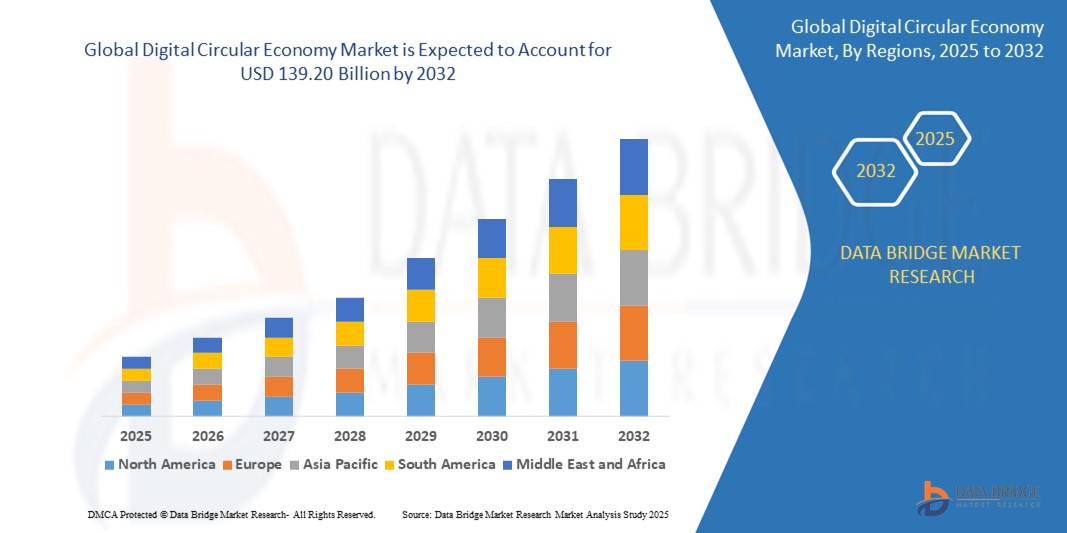
What is the Global Digital Circular Economy Market Size and Growth Rate?
- The global digital circular economy market size was valued at USD 2.34 billion in 2024 and is expected to reach USD 139.20 billion by 2032, at a CAGR of 24.35% during the forecast period
- Market expansion is primarily driven by increasing digital transformation across industries aimed at improving resource efficiency, reducing waste, and enhancing sustainability through data-driven circular practices
- In addition, supportive government policies, ESG commitments, and the integration of AI, blockchain, and IoT in waste tracking, product lifecycle analysis, and circular supply chains are accelerating adoption and creating new opportunities for market players
What are the Major Takeaways of Digital Circular Economy Market?
- Digital Circular Economy solutions enable the real-time monitoring, optimization, and reuse of materials and products, making them essential for businesses looking to transition to low-waste, circular models across manufacturing, retail, and logistics sectors
- The increasing emphasis on sustainability, carbon neutrality, and extended producer responsibility (EPR) is fueling demand for digital tools that enable closed-loop systems and regenerative business models
- Key enablers include digital twin technologies, blockchain-based material tracing, and predictive analytics platforms that help reduce overproduction, optimize reverse logistics, and enhance recycling processes
- Europe dominated the digital circular economy market with the largest revenue share of 41.37% in 2024, driven by rising demand for smart security systems, strict regulatory frameworks, and the widespread adoption of connected technologies in residential and commercial sectors
- Asia-Pacific digital circular economy market is expected to grow at the fastest CAGR of 12.28% from 2025 to 2032, driven by rapid urbanization, expanding middle-class populations, and increased government focus on digital transformation
- The software segment dominated the digital circular economy market with the largest market revenue share of 61.8% in 2024, owing to its ability to provide real-time insights, product lifecycle tracking, and seamless integration with circular supply chain systems
Report Scope and Digital Circular Economy Market Segmentation
|
Attributes |
Digital Circular Economy Key Market Insights |
|
Segments Covered |
|
|
Countries Covered |
North America
Europe
Asia-Pacific
Middle East and Africa
South America
|
|
Key Market Players |
|
|
Market Opportunities |
|
|
Value Added Data Infosets |
In addition to the insights on market scenarios such as market value, growth rate, segmentation, geographical coverage, and major players, the market reports curated by the Data Bridge Market Research also include in-depth expert analysis, pricing analysis, brand share analysis, consumer survey, demography analysis, supply chain analysis, value chain analysis, raw material/consumables overview, vendor selection criteria, PESTLE Analysis, Porter Analysis, and regulatory framework. |
What is the Key Trend in the Digital Circular Economy Market?
“Growing Integration of Blockchain for Transparency and Product Lifecycle Tracking”
- A significant and accelerating trend in the global digital circular economy market is the integration of blockchain technology to enhance transparency, traceability, and trust throughout the product lifecycle. This shift is enabling businesses to track material origins, usage, reuse cycles, and responsible disposal with high accuracy, thus reinforcing the foundations of circularity
- For instance, IBM’s blockchain-based supply chain platform helps companies monitor product lifecycles and material recovery, improving compliance with ESG goals and regulatory standards. Similarly, SAP’s blockchain-enabled digital product passports allow manufacturers to embed lifecycle data in products, ensuring circular usage and accountability
- Blockchain's decentralized ledger structure facilitates tamper-proof data sharing across stakeholders from raw material suppliers to recyclers enhancing operational efficiency and reducing greenwashing risks. Smart contracts within blockchain also automate compliance checks, certification processes, and ownership changes in reuse or remanufacturing scenarios
- The fusion of blockchain with IoT sensors and cloud platforms enables real-time circular tracking, giving manufacturers, regulators, and consumers actionable insights into product sustainability performance. This is particularly relevant in sectors such as electronics, textiles, and construction, where managing reverse logistics and second-life use is complex
- Companies such as Circularise and Everledger are deploying blockchain to authenticate recycled content, trace supply chains, and offer end-to-end visibility for brands aiming to meet circular economy benchmarks
- As demand for ethical sourcing, extended producer responsibility (EPR), and product circularity increases, blockchain’s role in ensuring data integrity and accountability will become a core pillar of digital circular economy frameworks globally
What are the Key Drivers of Digital Circular Economy Market?
- The rising global emphasis on sustainability, resource efficiency, and carbon reduction is a key driver of the digital circular economy market. Industries are increasingly turning to digital tools such as IoT, AI, and blockchain to facilitate circular practices such as product reuse, remanufacturing, and recycling
- For instance, in February 2024, Capgemini and SAP launched a circular economy analytics suite to help manufacturers design waste-free operations using real-time data across the product lifecycle. This aligns with policy momentum such as the EU Green Deal and U.S. Circular Economy Action Plan, further accelerating adoption
- In addition, the rise of Extended Producer Responsibility (EPR) and stricter environmental compliance rules are pushing businesses to adopt circular data systems that help track and report their sustainability metrics
- The transition from linear to circular models is also being driven by consumer demand for eco-conscious products and transparency. This trend is particularly evident in sectors such as fashion, electronics, and FMCG, where companies are leveraging digital platforms to promote product take-back, refurbishment, and second-life resale
- Moreover, digital circular solutions are helping companies unlock new revenue streams through product-as-a-service (PaaS) models, shared economy platforms, and closed-loop supply chains, offering both environmental and economic benefits
Which Factor is challenging the Growth of the Digital Circular Economy Market?
- One of the most significant challenges facing the digital circular economy market is the lack of standardization and interoperability across digital platforms, devices, and data systems. This fragmentation hinders seamless data sharing and collaboration across supply chain stakeholders
- For instance, many companies struggle to integrate legacy systems with new circular data platforms, leading to data silos, inefficiencies, and inconsistent tracking of material flows. Moreover, without unified frameworks or product passport standards, it becomes difficult to align industry-wide reporting or verification practices
- Another challenge is the initial cost and complexity of implementing digital circular solutions, especially for small and medium-sized enterprises (SMEs). Technologies such as IoT sensors, AI-driven material tracking, and blockchain infrastructure often require significant upfront investment and technical expertise, which can deter adoption
- Data privacy concerns, particularly related to sensitive environmental disclosures, also act as a deterrent for some organizations. In addition, differing regulatory requirements across regions complicate the scalability of circular data systems
- Addressing these challenges will require stronger collaboration between governments, tech providers, and industry consortia to develop standardized, interoperable platforms and provide incentives or technical support for SMEs. Without this, the full potential of the digital circular economy may remain limited in scope and impact
How is the Digital Circular Economy Market Segmented?
The market is segmented on the basis of offering, technology, application, and vertical.
By Offering
On the basis of offering, the market is segmented into software and services. The software segment dominated the Digital Circular Economy market with the largest market revenue share of 61.8% in 2024, owing to its ability to provide real-time insights, product lifecycle tracking, and seamless integration with circular supply chain systems. These platforms are essential for enabling compliance, automation, and resource efficiency across multiple sectors.
The services segment is anticipated to grow significantly during the forecast period, driven by rising demand for consultancy, implementation, and training support to facilitate circular transformation in businesses.
By Technology
On the basis of technology, the market is segmented into Blockchain and Distributed Ledger Technology (DLT), IoT, AI and ML, AR and VR, VR-Based Training, Cloud Computing, Big Data Analytics, and Other Technologies. The IoT segment accounted for the largest market share of 26.5% in 2024, as IoT enables connected asset tracking, real-time material flow monitoring, and predictive maintenance, which are vital for circular operations.
The AI and ML segment is expected to register the fastest CAGR from 2025 to 2032, fueled by its ability to optimize resource usage, automate sorting and recycling processes, and deliver intelligent sustainability insights.
By Application
On the basis of application, the market is segmented into Supply Chain and Materials Tracking, Resource Optimization and Efficiency, Digital Resale and Reuse, Reverse Logistics and Re-manufacturing, Circular Economy Reporting and Compliance, Circular Waste Management and Recycling, Smart Material Selection and Testing, and Other Applications. The Supply Chain and Materials Tracking segment held the highest market share of 27.4% in 2024, driven by the need for end-to-end transparency, traceability, and compliance in circular product flows.
The Digital Resale and Reuse segment is projected to witness the fastest CAGR, supported by growing consumer interest in refurbished goods and brands implementing resale platforms for extended product life cycles.
By Vertical
On the basis of vertical, the market is segmented into Consumer Electronics, IT and Telecom, Automotive, Manufacturing, Construction and Building, Healthcare and Medical Devices, Energy and Utilities, Chemicals and Materials, Fashion and Apparel, and Other Verticals. The Consumer Electronics segment led the market with a share of 19.3% in 2024, owing to increasing e-waste regulations and the proliferation of circular practices such as device take-back, refurbishment, and component reuse.
The Fashion and Apparel segment is expected to grow at the fastest pace during the forecast period, as sustainability-conscious consumers and global brands shift towards textile recycling, digital product passports, and closed-loop apparel systems.
Which Region Holds the Largest Share of the Digital Circular Economy Market?
- Europe dominated the digital circular economy market with the largest revenue share of 41.37% in 2024, driven by rising demand for smart security systems, strict regulatory frameworks, and the widespread adoption of connected technologies in residential and commercial sectors
- The region benefits from strong governmental support for energy-efficient, digital infrastructure and a growing focus on sustainability and home automation, particularly in countries such as Germany, France, and the U.K
- In addition, Europe's tech-savvy population, rapid urban development, and increasing investments in smart city projects are further boosting the adoption of Digital Circular Economy systems, making them a critical element in the evolving built environment
Germany Digital Circular Economy Market Insight
The Germany digital circular economy market held the largest revenue share in Europe in 2024, backed by the country’s innovation-driven economy and stringent data privacy regulations. German consumers prefer highly secure, efficient, and environmentally friendly access systems. Adoption is surging in new housing developments and office spaces, supported by robust integration with building automation and energy management platforms.
U.K. Digital Circular Economy Market Insight
The U.K. market is expanding steadily due to rising consumer demand for smart homes and the increasing importance of security and energy efficiency. U.K. homeowners and developers are adopting digital circular economys for their seamless integration with connected ecosystems and keyless control. The nation’s growing e-commerce footprint and DIY market are also encouraging adoption in residential upgrades.
France Digital Circular Economy Market Insight
France’s digital circular economy market is growing at a stable CAGR, driven by strong environmental policies and support for green building certifications. As French consumers seek connected, low-energy solutions for access control, digital circular economies are being widely adopted in both smart residential projects and public infrastructure renovations. Government incentives for home automation are accelerating market uptake.
Which Region is the Fastest Growing Region in the Digital Circular Economy Market?
Asia-Pacific digital circular economy market is expected to grow at the fastest CAGR of 12.28% from 2025 to 2032, driven by rapid urbanization, expanding middle-class populations, and increased government focus on digital transformation. Countries such as China, India, Japan, and South Korea are promoting smart cities and infrastructure upgrades, fostering strong demand for integrated, cost-effective, and easy-to-install digital circular economy systems. Growing investments in residential real estate, rising smartphone penetration, and local manufacturing advantages are making these products increasingly affordable and accessible across the region.
China Digital Circular Economy Market Insight
The China market held the largest share in Asia-Pacific in 2024, propelled by strong smart home adoption, domestic tech manufacturing, and the expansion of digital infrastructure. Affordable price points, wide product availability, and government-backed smart city initiatives are fostering mass adoption across urban and semi-urban areas.
Japan Digital Circular Economy Market Insight
The Japan market is advancing steadily, with adoption fueled by its aging population, urban housing density, and high technological literacy. Integration of digital circular economys with robotics, AI, and home automation platforms is becoming common, particularly in multi-family dwellings and compact urban residences. Security and accessibility remain key purchasing criteria.
India Digital Circular Economy Market Insight
India’s digital circular economy market is poised for strong growth, supported by rising disposable incomes, increasing smartphone use, and rapid development of smart cities. Government programs such as “Digital India” and expanding real estate demand in metros and Tier 2 cities are creating opportunities for widespread adoption in both residential and commercial segments.
Which are the Top Companies in Digital Circular Economy Market?
The digital circular economy industry is primarily led by well-established companies, including:
- Accenture (Ireland)
- Anthesis Group (U.K.)
- Amazon Web Services (U.S.)
- Capgemini (France)
- Cisco (U.S.)
- Dassault Systèmes (France)
- GeoFluxus (Netherlands)
- Honeywell (U.S.)
- IBM (U.S.)
- iPoint Systems (Germany)
- Ingram Micro (U.S.)
- KPMG (Netherlands)
- Landbell Group (Germany)
- SAP (Germany)
- Oracle (U.S.)
- Software AG (Germany)
- Siemens-Advanta (Germany)
- Rheaply (U.S.)
- One Click LCA (Finland)
- Lenzing (Austria)
What are the Recent Developments in Global Digital Circular Economy Market?
- In July 2024, Imperial launched the IceCube Lab, a cutting-edge research facility focused on advancing circular economy innovations. The lab aims to drive sustainability, optimize resource use, and support the adoption of circular economy principles across industrial sectors. This initiative marks a significant step toward research-led sustainability transformation
- In May 2024, Flex, a global supply chain solutions provider, completed the acquisition of FreeFlow, a leader in secondary market asset disposition and digital circular economy platforms. This acquisition boosts Flex’s expertise in circular practices through enhanced lifecycle and end-of-life asset recovery capabilities. The move reinforces Flex’s position as a key enabler of digital circularity
- In June 2023, Capgemini and AWS introduced a new technology platform at the International Paris Air Show (SIAE) aimed at extending the lifespan of aircraft components. The platform integrates digital circular economy strategies to support sustainability in aerospace. This collaboration highlights how circular solutions are reshaping legacy industries such as aviation

- Interactive Data Analysis Dashboard
- Company Analysis Dashboard for high growth potential opportunities
- Research Analyst Access for customization & queries
- Competitor Analysis with Interactive dashboard
- Latest News, Updates & Trend analysis
- Harness the Power of Benchmark Analysis for Comprehensive Competitor Tracking
Data collection and base year analysis are done using data collection modules with large sample sizes. The stage includes obtaining market information or related data through various sources and strategies. It includes examining and planning all the data acquired from the past in advance. It likewise envelops the examination of information inconsistencies seen across different information sources. The market data is analysed and estimated using market statistical and coherent models. Also, market share analysis and key trend analysis are the major success factors in the market report. To know more, please request an analyst call or drop down your inquiry.
The key research methodology used by DBMR research team is data triangulation which involves data mining, analysis of the impact of data variables on the market and primary (industry expert) validation. Data models include Vendor Positioning Grid, Market Time Line Analysis, Market Overview and Guide, Company Positioning Grid, Patent Analysis, Pricing Analysis, Company Market Share Analysis, Standards of Measurement, Global versus Regional and Vendor Share Analysis. To know more about the research methodology, drop in an inquiry to speak to our industry experts.
Data Bridge Market Research is a leader in advanced formative research. We take pride in servicing our existing and new customers with data and analysis that match and suits their goal. The report can be customized to include price trend analysis of target brands understanding the market for additional countries (ask for the list of countries), clinical trial results data, literature review, refurbished market and product base analysis. Market analysis of target competitors can be analyzed from technology-based analysis to market portfolio strategies. We can add as many competitors that you require data about in the format and data style you are looking for. Our team of analysts can also provide you data in crude raw excel files pivot tables (Fact book) or can assist you in creating presentations from the data sets available in the report.













