


What is the Digital Light Processing Chipset Market Size and Growth Rate?
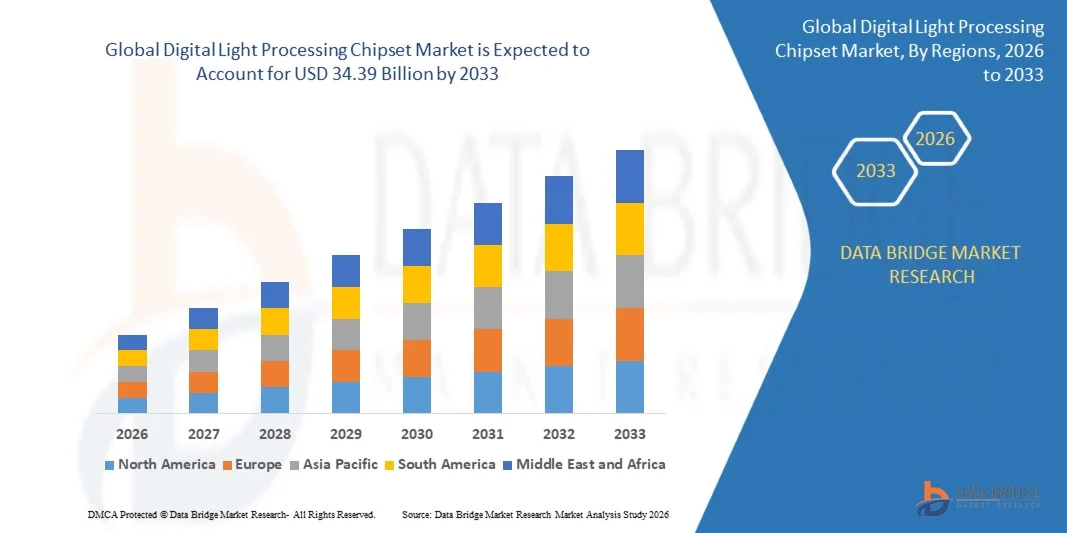
- As per Data Bridge Market Research analysis, the digital light processing chipset market was valued at USD 4.43 billion in 2025 and is projected to reach USD 34.39 billion by 2033, growing at a CAGR of 29.20% from 2026 to 2033.
- The market is experiencing consistent growth driven by rising demand for high-quality projection and display solutions, increasing adoption of compact DLP technologies, advancements in digital imaging, and expanding applications across consumer electronics, automotive, healthcare, and industrial systems.
- The increasing demand for high-resolution and energy-efficient display technologies, combined with the expansion of portable projection, automotive head-up displays, 3D printing, and medical imaging applications, is encouraging manufacturers and technology providers to adopt advanced DLP chipsets. Standard DLP chipsets continue to support established projection applications, while pico and other compact DLP solutions are gaining traction as demand grows for miniaturized and versatile imaging systems.
Market Size & Forecast
- Global Market Value (2025): USD 4.43 Billion
- Expected Market Value (2033): USD 34.39 Billion
- Forecast CAGR (2026–2033): 29.20%
- Leading Region in 2025: North America
- Fastest Growing Region: Asia Pacific
What are the Major Takeaways of the Digital Light Processing Chipset Market?
- North America dominated the digital light processing chipset market with the largest revenue share of 48.4% in 2025, supported by the strong presence of major technology companies, advanced display infrastructure, and high adoption of DLP-based projection systems.
- Asia-Pacific is expected to be the fastest-growing region at a CAGR of 8.8% from 2026 to 2033, fueled by increasing investments in digital infrastructure, expanding consumer electronics manufacturing, and growing adoption of advanced projection and display technologies.
- The DLP standard chipset segment led the market with a 58% share in 2025, driven by its widespread adoption in digital projectors and established display applications.
- DLP pico chipset are the fastest-growing type, projected to register a CAGR of 9.5%, reflecting the surge in demand for portable and miniaturized projection technologies.
- The one chip segment dominated the chip model category with a 60% revenue share in 2025, led by its cost-effective architecture and simpler system design.
- Lamp accounted for 55% of the market share in 2025, preferred by its established use across traditional projector systems.
- The short throw segment is the fastest-growing throw distance category, with a CAGR of 9.0%, driven by the increasing demand for projection in space-constrained environments.
Report Scope and Digital Light Processing Chipset Market Segmentation
|
Attributes |
Digital Light Processing Chipset Key Market Insights |
|
Segments Covered |
|
|
Countries Covered |
North America
Europe
Asia-Pacific
Middle East and Africa
South America
|
|
Key Market Players |
|
|
Market Opportunities |
|
|
Value Added Data Infosets |
In addition to the market insights such as market value, growth rate, market segments, geographical coverage, market players, and market scenario, the market report curated by the Data Bridge Market Research team includes in-depth expert analysis, import/export analysis, pricing analysis, production consumption analysis, and pestle analysis. |
What is the Key Trend in the Digital Light Processing Chipset Market?
- Digital Light Processing (DLP) chipsets are increasingly expanding beyond traditional projection into automotive displays, industrial imaging, 3D printing, and precision light-control applications, broadening their addressable use cases.
- For instance, in September 2025, Texas Instruments introduced the DLP991UUV digital micromirror device for high-precision digital lithography in advanced semiconductor packaging. The device provides 8.9 million pixels, sub-micron resolution capabilities, and data rates of up to 110 gigapixels per second, demonstrating the expansion of DLP technology into precision industrial manufacturing beyond conventional projection.
- The technology is also gaining traction in advanced industrial applications because DLP digital micromirror devices can provide rapid, programmable light modulation for high-resolution manufacturing, imaging, and measurement systems.
- Automotive manufacturers and industrial equipment developers are increasingly using compact DLP architectures where high brightness, resolution, switching speed, and precise optical control are important for next-generation systems.
- For instance, in January 2024, Texas Instruments published a 3.6-megapixel DLP 3D-printer reference design using a 2,560 × 1,440 DMD, demonstrating the growing use of DLP chipsets in high-resolution additive manufacturing and programmable light-based production.
- As DLP technology continues expanding across automotive projection, additive manufacturing, machine vision, spectroscopy, and advanced displays, demand for application-specific chipsets is expected to increase, reinforcing diversification beyond conventional projector systems.
What are the Key Drivers of the Digital Light Processing Chipset Market?
- The growing demand for high-resolution projection and advanced digital imaging is increasing adoption of DLP chipsets capable of delivering precise light modulation, high brightness, and enhanced image quality across professional and consumer applications.
- For instance, in August 2024, Texas Instruments introduced the DLPC8445 DLP display controller, which is 90% smaller than the previous generation and supports 4K UHD projectors, with frame rates up to 240 Hz, addressing growing demand for compact, high-performance projection systems.
- Increasing adoption of additive manufacturing and industrial imaging is further driving demand for specialized DLP chipsets that enable rapid pattern projection, accurate layer exposure, and high-resolution optical processing.
- For instance, in September 2025, Texas Instruments introduced the DLP991UUV digital micromirror device for advanced semiconductor packaging, offering more than 8.9 million pixels, sub-micron resolution capabilities, and processing speeds of up to 110 gigapixels per second. The technology enables maskless digital lithography, supporting higher-precision and scalable manufacturing of advanced semiconductor packages
- With demand increasing for high-performance projection, automotive displays, 3D printing, and industrial imaging, continued improvements in resolution, compactness, switching performance, and system integration are expected to support broader DLP chipset adoption.
Which Factors are Challenging the Growth of the Digital Light Processing Chipset Market?
- Advanced DLP systems can require substantial system-level investment because high-performance implementations involve specialized DMDs, controllers, illumination components, optics, thermal-management systems, and supporting electronics.
- For instance, in August 2024, Texas Instruments’ DLP472TP datasheet specified that the DMD array temperature must be calculated from electrical power, absorbed illumination heat load, and package thermal resistance, highlighting the thermal-design requirements involved in high-performance DLP projection systems.
- These requirements can increase development and deployment costs for manufacturers, particularly when applications require high brightness, high resolution, specialized wavelengths, or demanding industrial operating conditions.
- For instance, in December 2024, Texas Instruments’ DLP991U documentation stated that the DMD must be used with the applicable controller and other chipset components, while industrial implementations also require electrical, optical, and mechanical components. This illustrates the additional system-integration requirements beyond the DLP chip itself.
- Thermal management can also complicate DLP system design because illumination power and optical performance must be balanced against heat dissipation requirements, potentially increasing system size and engineering complexity.
How is the Digital Light Processing Chipset Market Segmented?
The digital light processing chipset market is segmented on the basis of type, resolution, chip model, light source, throw distance, application, and end user.
- By Type
On the basis of type, the digital light processing chipset market is segmented into DLP pico chipset and DLP standard chipset. The DLP standard chipset segment dominated the market with 58% share in 2025, owing to its widespread adoption in digital projectors and established display applications. Standard DLP chipsets are extensively used across business, education, entertainment, and professional projection environments. Their established optical architectures support a broad range of projector designs and display requirements. The segment also benefits from continued demand for high-brightness and high-resolution projection systems. Established deployment across conventional projection applications provides manufacturers with mature technology platforms.
The DLP pico chipset segment is projected to register the fastest growth at a CAGR of 9.5% from 2026 to 2033, driven by increasing demand for portable and miniaturized projection technologies. Pico chipsets enable projection capabilities to be integrated into compact and space-constrained devices. Their smaller form factor supports applications where portability and efficient system integration are important. Growing adoption of compact projectors and embedded display technologies is creating additional demand. Advances in illumination and optical-engine technologies are further improving the performance of pico-based systems.
- By Resolution
On the basis of resolution, the digital light processing chipset market is segmented into 800x600, 1024x768, 1920x1200, 1280x800, 854x480, and others. The 1920x1200 segment dominated the market with 45% share in 2025, supported by its strong adoption in high-definition professional display applications. The resolution provides a wide display format suitable for business presentations, education, visualization, and professional projection. It enables users to display detailed multimedia and productivity content with greater image clarity. Professional projection systems increasingly require higher-resolution formats to support detailed visual information. The resolution is also suitable for applications where screen real estate and image detail are important.
The 1280x800 segment is projected to register the fastest growth at a CAGR of 7.8% from 2026 to 2033, driven by increasing adoption in education and corporate environments. Its display format provides a practical balance between image quality and system affordability. Educational institutions can use this resolution for classroom presentations and digital learning content. Corporate environments also utilize compatible projection systems for meetings, presentations, and collaborative work. The format is supported by a broad range of projector designs and established display applications. Growing investments in digital classrooms and workplace presentation technologies are expected to support further adoption.
- By Chip Model
On the basis of chip model, the digital light processing chipset market is segmented into one chip and three chip. The one chip segment dominated the market with 60% share in 2025, primarily because of its cost-effective architecture and simpler system design. One-chip configurations are widely adopted across mainstream projection applications where compactness and affordability are important. Their simpler optical architecture can support efficient projector integration and lower system complexity. The configuration is extensively used in consumer, business, education, and home entertainment projectors. Manufacturers can develop compact projection products using established one-chip architectures
The three chip segment is projected to register the fastest growth at a CAGR of 8.2% from 2026 to 2033, driven by demand for high-performance projection systems. Three-chip configurations separately process primary color channels, supporting strong color performance and high brightness. These characteristics make the technology suitable for professional projection and high-end entertainment applications. Increasing demand for large-format and immersive visual experiences is supporting adoption. Digital cinema and professional audiovisual environments also require consistent image quality across extended operating periods.
- By Light Source
On the basis of light source, the digital light processing chipset market is segmented into lamp, LED, and laser. The lamp segment dominated the market with 55% share in 2025, owing to its established use across traditional projector systems. Lamp-based projectors have a large installed base across education, business, institutional, and entertainment environments. Existing projector infrastructure continues to generate replacement and maintenance demand for lamp-based systems. The technology also benefits from established manufacturing and optical-system architectures. Many conventional projection systems remain based on lamp illumination because of their mature deployment.
The laser segment is projected to register the fastest growth at a CAGR of 10.1% from 2026 to 2033, driven by increasing demand for energy-efficient and long-lasting projection solutions. Laser illumination offers extended operating life and reduces the need for frequent lamp replacement. It is increasingly suitable for professional projection environments requiring prolonged operation. High brightness and consistent illumination also support its use in large venues and digital cinema applications. Growing demand for lower-maintenance projection systems is encouraging users to transition toward laser illumination.
- By Throw Distance
On the basis of throw distance, the digital light processing chipset market is segmented into normal throw, short throw, and ultra-short throw. The normal throw segment dominated the market with an 50% share in 2025, supported by extensive use across conventional projection environments. Normal-throw projectors are widely deployed in classrooms, offices, conference rooms, entertainment venues, and other spaces with sufficient projection distance. Their established design is compatible with conventional room layouts and projection installations. The technology provides flexibility across medium and large display environments. Existing installed systems also create continuing replacement demand for normal-throw configurations.
The short throw segment is projected to register the fastest growth at a CAGR of 9.0% from 2026 to 2033, driven by increasing demand for projection in space-constrained environments. Short-throw systems can produce large images from relatively limited distances. This configuration reduces interference and shadowing when presenters or users operate close to the display surface. Educational institutions can benefit from improved classroom space utilization. Corporate meeting rooms can similarly use short-throw systems where conventional projector placement is difficult. Increasing demand for flexible projection solutions in compact spaces is expected to support continued growth.
- By Application
On the basis of application, the digital light processing chipset market is segmented into televisions, projectors, medical, home theatre systems, digital cinema systems, and other applications. The projectors segment dominated the market with 48% share in 2025, driven by extensive adoption of DLP technology across professional, educational, corporate, and entertainment projection systems. DLP chipsets provide precise micromirror control for generating high-quality projected images. Projectors remain an established application for DLP technology across multiple commercial and institutional environments. Demand for larger display experiences continues to support projection-system deployment. Increasing requirements for high-resolution and bright visual presentation further strengthen this application.
The medical segment is projected to register the fastest growth at a CAGR of 8.7% from 2026 to 2033, driven by increasing use of advanced optical technologies in medical imaging. DLP technology provides rapid and precise digital control of light through its micromirror architecture. This capability can support specialized imaging and optical-pattern applications. Growing demand for advanced visualization and image-guided technologies is creating additional application opportunities. Improvements in resolution and illumination technologies are expanding the potential uses of DLP systems in healthcare. Increasing investment in advanced medical technologies is expected to support further adoption.
- By End User
On the basis of end user, the digital light processing chipset market is segmented into FSR, QSR, institutional, and others. The institutional segment dominated the market with 50% share in 2025, supported by widespread use of DLP projection systems in educational and organizational environments. Institutions use projectors for teaching, training, presentations, meetings, and large-format information sharing. The technology provides clear visual presentation across classrooms, conference facilities, and training environments. Existing projector installations also support continuing replacement and upgrading demand. Increasing digitalization of education and workplace collaboration is creating additional demand for display technologies.
The QSR segment is projected to register the fastest growth at a CAGR of 9.2% from 2026 to 2032, driven by increasing use of digital technologies to enhance customer-facing environments. Quick-service restaurants are increasingly adopting digital displays and visual technologies for menus, promotions, branding, and customer engagement. DLP-based projection can support dynamic visual content and flexible display installations. Projection technology can also be incorporated into experiential environments and customized commercial installations. Increasing competition within the food-service sector is encouraging investment in differentiated customer experiences. Growing adoption of advanced digital display technologies across commercial spaces is therefore expected to support QSR demand for DLP chipset solutions.
Which Region Holds the Largest Share of the Digital Light Processing Chipset Market?
- North America dominated the digital light processing chipset market with the largest revenue share of 48.4% in 2025, supported by the strong presence of major technology companies, advanced display infrastructure, and high adoption of DLP-based projection systems.
- The region also benefits from strong demand for high-resolution projection systems, digital cinema technologies, medical applications, and advanced visualization solutions. Increasing investments in digital infrastructure, continued innovation in DLP technologies, and the presence of leading technology companies are supporting regional demand. The expanding use of DLP chipsets across professional, commercial, and consumer applications continues to strengthen North America’s leading position in the global market.
U.S. Digital Light Processing Chipset Market Insight
The U.S. digital light processing chipset market is witnessing strong growth due to rising adoption of advanced projection, display, and optical technologies across commercial, industrial, automotive, and entertainment applications. The country’s strong semiconductor ecosystem, along with the presence of Texas Instruments and increasing development of DLP-based solutions, is driving demand across multiple end-use industries. In addition, growing adoption of high-resolution projection, digital lithography, machine vision, and automotive lighting technologies is accelerating the integration of DLP chipsets into advanced systems.
Asia-Pacific Digital Light Processing Chipset Market Insight
The Asia-Pacific digital light processing chipset market is expected to witness rapid growth, driven by increasing adoption of digital projection, expanding electronics manufacturing, and rising investments in advanced display and imaging technologies across countries such as China, India, and Japan. Growing demand for high-resolution projection systems, industrial automation, medical imaging, and digital entertainment applications is supporting regional market expansion. In addition, increasing investments in semiconductor and electronics infrastructure, along with the adoption of DLP technologies for industrial and automotive applications, are accelerating chipset deployment across commercial and industrial sectors.
Japan Digital Light Processing Chipset Market Insight
The Japan digital light processing chipset market is witnessing consistent growth due to rising investments in advanced display technologies, industrial automation, and precision imaging applications. Manufacturers and research organizations are increasingly utilizing DLP-based systems for projection, machine vision, optical control, and other high-precision applications. Moreover, increasing integration of advanced semiconductor technologies, automation solutions, and high-resolution imaging systems is further contributing to market growth. The country’s strong electronics and technology ecosystem continues to support the development and adoption of sophisticated DLP-enabled applications.
China Digital Light Processing Chipset Market Insight
The China digital light processing chipset market is growing rapidly, driven by expanding electronics manufacturing, increasing demand for digital projection systems, and rising investments in industrial automation and advanced imaging technologies. Growing adoption of DLP-based solutions across commercial displays, entertainment, machine vision, and manufacturing applications is supporting market demand. In addition, increasing investment in smart manufacturing, advanced optical technologies, and automotive electronics is creating new application opportunities for DLP chipsets. The country’s large electronics ecosystem and expanding technology infrastructure are further supporting the adoption of DLP-enabled solutions.
U.K. Digital Light Processing Chipset Market Insight
The U.K. digital light processing chipset market is experiencing steady growth, supported by rising adoption of advanced projection, digital imaging, and industrial optical technologies. Increasing use of DLP-based systems across education, professional visualization, entertainment, and specialized industrial applications is contributing to market expansion. Furthermore, growing demand for high-resolution displays, machine vision, and precision light-control solutions is encouraging the adoption of advanced DLP technologies. Continued development of innovative imaging and projection applications is supporting the country's position within the digital light processing chipset industry.
Germany Digital Light Processing Chipset Market Insight
The Germany digital light processing chipset market is expanding steadily due to the country’s strong industrial base, advanced manufacturing capabilities, and increasing adoption of precision imaging technologies. Industrial companies and research organizations are increasingly utilizing DLP-based solutions for machine vision, industrial automation, projection, and optical applications. Continuous advancements in high-speed pattern projection, imaging, and light-control technologies, along with Germany’s strong focus on industrial innovation and automation, are further driving market growth. The expanding use of DLP technology in advanced manufacturing applications is also creating additional opportunities for chipset adoption.
Which are the Top Companies in Digital Light Processing Chipset Market?
The digital light processing chipset industry is primarily led by well-established companies, including:
- Texas Instruments Incorporated (U.S.)
- Panasonic Connect Co., Ltd. (Japan)
- BenQ Corporation (Taiwan)
- ViewSonic Corporation (U.S.)
- Acer Incorporated (Taiwan)
- Canon Inc. (Japan)
- Barco NV (Belgium)
- Optoma Corporation (Taiwan)
- Eiki International, Inc. (U.S.)
- SIM2 Multimedia s.r.l. (Italy)
- ASUSTeK COMPUTER INC. (Taiwan)
- XGIMI Technology Co. (China)
- JMGO (China)
- LG Electronics Inc. (South Korea)
- Samsung Electronics Co., Ltd. (South Korea)
- Ricoh Company, Ltd. (Japan)
- Sharp Corporation (Japan)
- CASIO COMPUTER CO., LTD. (Japan)
- Delta Electronics, Inc. (Taiwan)
- Coretronic Corporation (Taiwan)
What are Latest Developments in Digital Light Processing Chipset Market?
- In September 2025, Texas Instruments introduced the DLP991UUV digital micromirror device (DMD) for high-precision digital lithography in advanced semiconductor packaging. The new DMD provides maskless digital lithography capabilities for producing increasingly complex semiconductor packages, enabling equipment manufacturers to achieve high-resolution printing with greater flexibility, scalability, and precision. The development expands DLP technology beyond conventional display applications into advanced semiconductor manufacturing and supports the growing need for high-performance packaging technologies.
- In August 2024, Texas Instruments introduced the DLPC8445 DLP display controller to enable compact 4K UHD projectors for lifestyle and gaming applications. The new controller supports high-performance projection with ultra-low display latency and high refresh rates, while its compact design enables manufacturers to develop smaller projector systems. The development also supports applications such as immersive gaming, portable entertainment, and augmented-reality glasses, demonstrating the continued expansion of DLP chipset technology into compact high-performance display products.
- In January 2023, Texas Instruments demonstrated its DLP4620S-Q1 digital micromirror device for next-generation automotive augmented-reality head-up displays at CES 2023. The automotive DLP chipset enables high-resolution projection with a wide field of view, allowing important driving information to be displayed within the driver's field of view. This development highlights the increasing application of DLP technology in automotive displays, including AR HUDs, digital clusters, navigation, and infotainment windshield displays.
- In April 2022, Texas Instruments demonstrated the use of DLP technology for vehicle communication and customization through compact dynamic projection modules for automotive exterior lighting. The DLP3021-Q1 technology enables dynamic ground projection around vehicles, supporting applications such as vehicle-to-pedestrian communication, vehicle warnings, and customized lighting patterns. This development demonstrates the expansion of DLP chipsets into intelligent automotive lighting and communication applications beyond conventional projection systems.
- In November 2021, Texas Instruments published a technical article on its DLP2021-Q1 and DLP3021-Q1 chipsets and the evaluation modules and software tools available for dynamic ground projection. The development provided designers with resources to evaluate and develop automotive projection systems capable of displaying dynamic visual patterns around vehicles. This supported the use of DLP technology for vehicle communication, exterior lighting, customization, and other emerging automotive projection applications.

- Interactive Data Analysis Dashboard
- Company Analysis Dashboard for high growth potential opportunities
- Research Analyst Access for customization & queries
- Competitor Analysis with Interactive dashboard
- Latest News, Updates & Trend analysis
- Harness the Power of Benchmark Analysis for Comprehensive Competitor Tracking
Data collection and base year analysis are done using data collection modules with large sample sizes. The stage includes obtaining market information or related data through various sources and strategies. It includes examining and planning all the data acquired from the past in advance. It likewise envelops the examination of information inconsistencies seen across different information sources. The market data is analysed and estimated using market statistical and coherent models. Also, market share analysis and key trend analysis are the major success factors in the market report. To know more, please request an analyst call or drop down your inquiry.
The key research methodology used by DBMR research team is data triangulation which involves data mining, analysis of the impact of data variables on the market and primary (industry expert) validation. Data models include Vendor Positioning Grid, Market Time Line Analysis, Market Overview and Guide, Company Positioning Grid, Patent Analysis, Pricing Analysis, Company Market Share Analysis, Standards of Measurement, Global versus Regional and Vendor Share Analysis. To know more about the research methodology, drop in an inquiry to speak to our industry experts.
Data Bridge Market Research is a leader in advanced formative research. We take pride in servicing our existing and new customers with data and analysis that match and suits their goal. The report can be customized to include price trend analysis of target brands understanding the market for additional countries (ask for the list of countries), clinical trial results data, literature review, refurbished market and product base analysis. Market analysis of target competitors can be analyzed from technology-based analysis to market portfolio strategies. We can add as many competitors that you require data about in the format and data style you are looking for. Our team of analysts can also provide you data in crude raw excel files pivot tables (Fact book) or can assist you in creating presentations from the data sets available in the report.













