What is the Digital Talent Acquisition Market Size and Growth Rate?
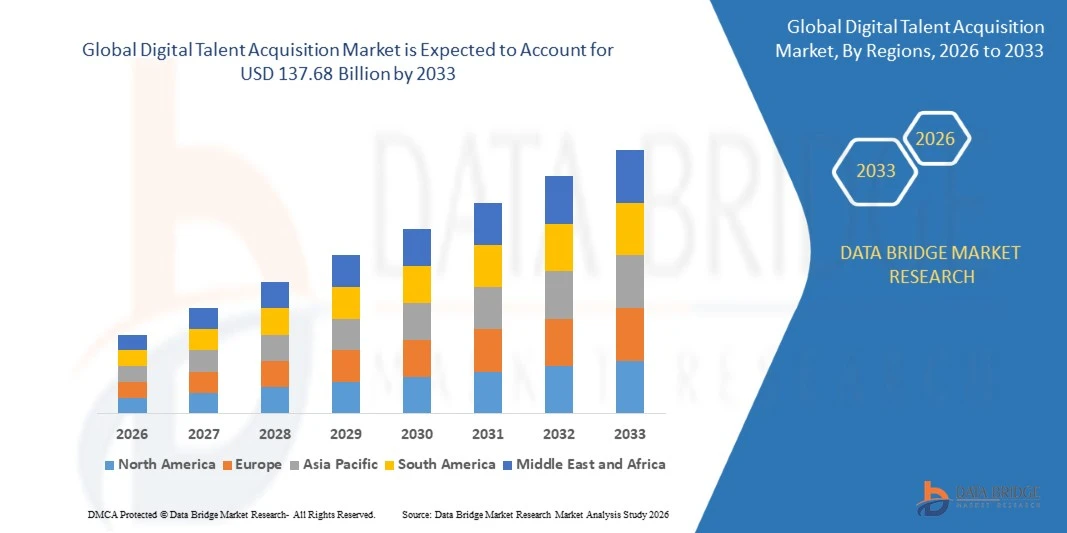
- As per Data Bridge Market Research analysis, the digital talent acquisition market was valued at USD 69.10 billion in 2025 and is projected to reach USD 137.68 billion by 2033, growing at a CAGR of 9.00% from 2026 to 2033.
- The market is experiencing consistent growth driven by rising demand for faster and data-driven hiring, increasing adoption of AI-enabled sourcing and screening tools, and expanding applications across IT & telecom, BFSI, healthcare, retail, manufacturing, and government sectors.
- The increasing shift toward skills-based hiring, remote and hybrid work, and candidate-experience automation, combined with growing integration of artificial intelligence with applicant tracking and cloud-based HR platforms, is supporting market adoption. Digital talent acquisition platforms are being applied across sourcing, screening, interview scheduling, and recruitment analytics, offering employers shorter hiring cycles and better quality of hire.
Market Size & Forecast
- Global Market Value (2025): USD 69.10 Billion
- Expected Market Value (2033): USD 137.68 Billion
- Forecast CAGR (2026–2033): 9.00%
- Leading Region in 2025: North America
- Fastest Growing Region: Asia-Pacific
What are the Major Takeaways of the Digital Talent Acquisition Market?
- North America dominated the digital talent acquisition market with the largest revenue share of 38.90% in 2025, supported by strong adoption of cloud HR platforms, early use of AI-enabled recruiting tools, and the presence of leading technology providers.
- Asia-Pacific is expected to be the fastest-growing region at a CAGR of 11.65% from 2026 to 2033, fueled by rapid digitalization of HR, expanding IT and services workforces, and rising adoption of mobile and AI-based recruiting platforms.
- The solutions segment led the market with a 61.70% share in 2025, driven by increasing adoption of applicant tracking, candidate relationship management, sourcing, and assessment platforms.
- Services are the fastest-growing component type, projected to register a CAGR of 10.40%, reflecting demand for implementation, integration, managed recruitment, and AI governance support.
- The cloud-based segment dominated the deployment mode category with a 66.80% revenue share in 2025, led by scalability, faster updates, and lower upfront cost.
- Large enterprises accounted for 63.45% of the market share in 2025, preferred owing to high-volume hiring needs, complex hiring workflows, and larger technology budgets.
- The small & medium enterprises segment is the fastest-growing enterprise size category, with a CAGR of 11.20%, driven by affordable subscription-based recruiting tools and growing need to compete for talent.
Report Scope and Digital Talent Acquisition Market Segmentation
|
Attributes |
Digital Talent Acquisition Key Market Insights |
|
Segments Covered |
|
|
Countries Covered |
North America
Europe
Asia-Pacific
Middle East and Africa
South America
|
|
Key Market Players |
|
|
Market Opportunities |
|
|
Value Added Data Infosets |
In addition to the market insights such as market value, growth rate, market segments, geographical coverage, market players, and market scenario, the market report curated by the Data Bridge Market Research team includes in-depth expert analysis, import/export analysis, pricing analysis, production consumption analysis, and pestle analysis. |
What is the Key Trend in the Digital Talent Acquisition Market?
- Digital talent acquisition platforms are increasingly evolving from applicant tracking systems into intelligent, agent-based hiring platforms, combining large language models, skills-based matching, conversational candidate engagement, and workflow automation to handle sourcing, screening, and scheduling tasks.
- For instance, in October 2024, according to HR Brew, LinkedIn launched Hiring Assistant, its first AI agent, at its Talent Connect event in Phoenix, Arizona, enabling recruiters to delegate repetitive tasks such as finding candidates and assisting in applicant review, initially to a select group of customers and LinkedIn’s internal recruiters.
- AI-powered interviewing and conversational assistants are enabling employers to respond to candidates instantly, run structured screening around the clock, and reduce dependence on manual scheduling and follow-up.
- Skills-based hiring and talent intelligence are emerging as important capabilities, as employers use skills data to match external candidates, internal employees, and contingent workers to open roles.
- For instance, in August 2025, according to Eightfold AI, the company unveiled its Recruiter Agent architecture featuring an AI Interviewer and an SMS-based Candidate Concierge Agent, with early deployments yielding up to 50% more candidate coverage and four hours saved per role, reflecting the move toward autonomous, agent-based recruiting.
- As large language models, skills intelligence, conversational interfaces, and integrations with HR systems continue to advance, digital talent acquisition platforms are expected to expand beyond job posting and tracking into end-to-end, AI-assisted talent acquisition and workforce planning.
What are the Key Drivers of the Digital Talent Acquisition Market?
- The rapid shift toward skills-based workforce planning and digital hiring has significantly increased demand for platforms that source, assess, and engage candidates at scale while reducing recruiter workload and time to hire.
- For instance, in January 2025, according to the World Economic Forum’s Future of Jobs Report 2025, employers expected 170 million new jobs to be created and 92 million displaced by 2030, with 39% of existing skill sets expected to be transformed or become outdated, intensifying demand for digital platforms that source, assess, and redeploy talent at scale.
- Enterprises, staffing firms, and public-sector employers are adopting AI-enabled recruiting tools to automate repetitive tasks, improve candidate response times, and widen access to qualified talent.
- For instance, in September 2025, according to LinkedIn, early adopters of its Hiring Assistant were saving more than four hours per role, reviewing 62% fewer profiles, and seeing a 69% improvement in InMail acceptance rates ahead of its global availability in English by the end of the month, demonstrating measurable recruiter productivity gains from AI-enabled sourcing.
- With organizations increasingly competing for scarce skills and managing high application volumes, cloud-based talent acquisition platforms that combine automation, analytics, and integration with HR systems are gaining preference across industries.
What Factors Are Challenging the Growth of the Digital Talent Acquisition Market?
- Digital talent acquisition platforms rely on large volumes of candidate data and machine-learning models, which raises concerns about algorithmic bias, transparency, data privacy, and the accuracy of automated candidate screening decisions.
- For instance, in October 2024, according to the University of Washington, researchers testing three open-source large language models across three million resume and job description comparisons found that resumes with white-associated names were favored 85% of the time and those with female-associated names only 11% of the time, highlighting bias risks in AI-based candidate screening.
- These concerns can increase compliance, audit, and governance requirements for employers and vendors, and may slow adoption in regulated sectors or among organizations with limited legal and data science resources.
- Integration with legacy HR systems, fragmented applicant data, and the need for recruiter training and change management can also make implementation complex and delay the realization of expected productivity benefits.
- For instance, in July 2023, according to the New York City Department of Consumer and Worker Protection, enforcement of Local Law 144 began, requiring employers using automated employment decision tools to obtain an independent bias audit and notify candidates, increasing compliance obligations for AI-enabled hiring platforms.
- The combination of regulatory scrutiny, bias and privacy risks, and integration complexity can constrain adoption among risk-averse and cost-sensitive employers, particularly where conventional job boards and manual screening already satisfy basic hiring requirements.
How is the Digital Talent Acquisition Market Segmented?
The digital talent acquisition market is segmented on the basis of component, deployment mode, enterprise size, and end user.
- By Component
On the basis of component, the digital talent acquisition market is segmented into solutions and services. The solutions segment dominated the market with 61.70% share in 2025, supported by increasing adoption of applicant tracking systems, candidate relationship management, sourcing, assessment, and interview scheduling platforms. Solutions allow employers to centralize hiring workflows and reduce manual effort. They are widely used by corporate talent teams, staffing firms, and public-sector employers. Integration of AI-based matching, chat-based engagement, and analytics is strengthening platform value. Regular product updates and subscription models also encourage continued investment in software.
The services segment is projected to register the fastest growth at a CAGR of 10.40% from 2026 to 2033, driven by increasing demand for implementation, integration, managed recruitment, and advisory support. Employers often need help configuring AI tools, connecting them to HR systems, and ensuring compliance with hiring regulations. Managed and outsourced recruitment models are also expanding as organizations seek flexible capacity. Training and change management services are becoming important for adoption. Growing focus on responsible AI governance and bias auditing is creating additional demand.
- By Deployment Mode
On the basis of deployment mode, the digital talent acquisition market is segmented into cloud-based, on-premises, and hybrid. The cloud-based segment dominated the market with 66.80% share in 2025, supported by scalability, faster feature updates, lower upfront cost, and ease of access for distributed hiring teams. Cloud platforms allow employers to add AI capabilities and integrations without major infrastructure investment. They also support mobile access for recruiters, hiring managers, and candidates. Continuous security and compliance improvements by vendors are strengthening confidence in cloud deployment.
The hybrid segment is projected to register the fastest growth at a CAGR of 10.70% from 2026 to 2033, driven by organizations that need to combine cloud-based AI tools with on-premises systems for sensitive data. Regulated industries and governments often keep certain candidate and employee records within controlled environments. Hybrid models enable phased migration from legacy platforms while still adopting modern capabilities. Data residency and privacy requirements across regions are also supporting this approach. Vendors are expanding flexible deployment options and secure integration layers.
- By Enterprise Size
On the basis of enterprise size, the digital talent acquisition market is segmented into large enterprises and small & medium enterprises. The large enterprises segment dominated the enterprise size category with 63.45% share in 2025, supported by high-volume hiring needs, complex approval workflows, global recruiting operations, and larger technology budgets. Large employers use digital platforms to standardize hiring processes across business units and countries. Integration with human capital management and analytics systems improves visibility into hiring performance. Employer branding, internal mobility, and diversity goals are also driving investment.
The small & medium enterprises segment is projected to register the fastest growth at a CAGR of 11.20% from 2026 to 2033, driven by the availability of affordable, subscription-based recruiting tools and the growing need to compete for talent. Smaller employers often lack large recruiting teams and benefit from automation of job posting, screening, and scheduling. Cloud-based platforms with simple setup and pay-as-you-grow pricing are lowering barriers to adoption. Integration with job marketplaces and messaging channels is improving reach. Increasing use of AI assistants is helping small teams manage applicant volumes.
- By End User
On the basis of end user, the digital talent acquisition market is segmented into IT & telecom, BFSI, healthcare & life sciences, retail & e-commerce, manufacturing, government & public sector, and others. The IT & telecom segment dominated the end-user category with 29.85% share in 2025, supported by continuous demand for specialized technical talent, high attrition, and early adoption of AI-enabled hiring tools. Technology employers use digital platforms for sourcing, skills assessment, and interview scheduling across global talent pools. Remote and hybrid work models further widen the candidate base. Competition for skilled engineers keeps investment in recruiting technology high.
The healthcare & life sciences segment is projected to register the fastest growth at a CAGR of 11.80% from 2026 to 2033, driven by persistent shortages of nurses, clinicians, and technical staff and the need for high-volume, compliance-driven hiring. Providers and life sciences companies use digital platforms to automate screening, credential verification, and scheduling. Conversational tools help manage large applicant volumes for shift-based roles. Expansion of healthcare services and research activity is creating additional demand. Compliance with licensing, privacy, and background-check requirements remains an important consideration.
Which Region Holds the Largest Share of the Digital Talent Acquisition Market?
- North America dominated the digital talent acquisition market with the largest revenue share of 38.90% in 2025, supported by strong adoption of cloud HR platforms, early use of AI-enabled recruiting tools, and a large base of enterprises with complex, high-volume hiring needs.
- The region also benefits from the presence of leading talent technology providers, high investment in HR technology, and a mature staffing industry. Increasing use of AI for sourcing and screening, strong focus on candidate experience, and active regulatory discussion on responsible hiring technology continue to strengthen North America’s position in the global market.
U.S. Digital Talent Acquisition Market Insight
The U.S. digital talent acquisition market is witnessing strong growth due to the large and competitive labor market, widespread use of cloud-based applicant tracking systems, and rapid adoption of AI-enabled recruiting tools. Employers across technology, healthcare, financial services, and retail are investing in platforms that automate sourcing, screening, and scheduling. In addition, growing emphasis on skills-based hiring, candidate experience, and compliance with emerging rules on automated hiring tools is accelerating adoption of digital talent acquisition solutions.
Asia-Pacific Digital Talent Acquisition Market Insight
The Asia-Pacific digital talent acquisition market is expected to witness rapid growth, driven by expanding IT and services workforces, rising smartphone and internet penetration, and increasing investments in HR technology across countries such as China, India, and Japan. Growing demand for scalable, mobile-first recruiting and affordable cloud platforms is supporting regional market expansion. In addition, the region’s large young workforce, growth of global capability centers, and rising adoption of AI-based screening are accelerating demand for digital talent acquisition solutions.
Japan Digital Talent Acquisition Market Insight
The Japan digital talent acquisition market is witnessing consistent growth due to labor shortages, an aging workforce, and increasing efforts to modernize recruitment processes. Employers are adopting applicant tracking systems, scouting platforms, and AI-based matching to widen candidate pools and improve hiring efficiency. Moreover, growing demand for mid-career and specialized talent, along with greater acceptance of digital HR tools, is further contributing to market growth in Japan.
China Digital Talent Acquisition Market Insight
The China digital talent acquisition market is growing rapidly, driven by a very large labor market, strong domestic internet recruitment platforms, and increasing use of AI and mobile channels for hiring. Technology, manufacturing, and consumer companies are using digital tools to manage high application volumes and fast-changing talent needs. In addition, supportive digital economy policies, advanced data and AI capabilities, and growing enterprise HR digitalization are positioning China as a key growth market for digital talent acquisition across Asia-Pacific.
U.K. Digital Talent Acquisition Market Insight
The U.K. digital talent acquisition market is experiencing steady growth, supported by a mature staffing and recruitment sector, strong adoption of cloud HR platforms, and increasing focus on diversity and inclusive hiring. Employers and recruitment agencies are increasingly using AI-enabled sourcing, screening, and engagement tools to improve efficiency and candidate experience. Furthermore, attention to data protection and fair use of automated decision-making is shaping demand for transparent and compliant digital talent acquisition solutions in the U.K.
Germany Digital Talent Acquisition Market Insight
The Germany digital talent acquisition market is expanding steadily due to skilled labor shortages, the country’s strong industrial and engineering employer base, and ongoing digital transformation of HR functions. Employers are adopting applicant tracking, employer branding, and talent pool management tools to attract specialized workers. Continuous advancements in cloud and AI technologies, together with strict data protection requirements and works council involvement, are encouraging secure, well-governed digital talent acquisition solutions and further driving market growth in Germany.
Which are the Top Companies in Digital Talent Acquisition Market?
The digital talent acquisition industry is primarily led by well-established companies, including:
- Workday, Inc. (U.S.)
- LinkedIn Corporation (U.S.)
- SAP SE (Germany)
- Oracle Corporation (U.S.)
- Randstad N.V. (Netherlands)
- iCIMS, Inc. (U.S.)
- Adecco Group AG (Switzerland)
- ManpowerGroup Inc. (U.S.)
- Recruit Holdings Co., Ltd. (Japan)
- Hays plc (U.K.)
- Cornerstone OnDemand, Inc. (U.S.)
- Eightfold AI (U.S.)
- HireVue, Inc. (U.S.)
- Greenhouse Software, Inc. (U.S.)
- Phenom People, Inc. (U.S.)
- Employ Inc. (U.S.)
- ZipRecruiter, Inc. (U.S.)
- Korn Ferry (U.S.)
- Info Edge (India) Limited (India)
- Beamery Limited (U.K.)
What are Latest Developments in Digital Talent Acquisition Market?
- In August 2026, hireEZ announced that it had rebuilt its platform on agents, debuting its new EZ Agent as an agentic AI layer across the platform, with availability for customers starting August 27, reflecting the shift from AI-assisted to autonomous sourcing.
- In October 2025, Workday completed its acquisition of Paradox, a candidate experience agent that uses conversational AI to simplify the job application journey, creating an end-to-end AI-powered talent acquisition suite together with HiredScore and Workday Recruiting.
- In August 2025, SAP announced plans to acquire SmartRecruiters, a talent acquisition software company recognized for high-volume recruiting, recruitment automation, and AI-powered candidate engagement, to bring sourcing and recruiting capabilities into its SuccessFactors portfolio.
- In June 2025, iCIMS announced the upcoming launch of iCIMS Agents, a purpose-built, domain-specific AI platform designed to accelerate the entire recruiting lifecycle, working alongside iCIMS Copilot, iCIMS Digital Assistant, and iCIMS AI Talent Explorer.
- In January 2026, Indeed was reported to run more than 100 AI-powered features across its job seeker and employer experiences, collaborating with OpenAI on more than a dozen of them, highlighting the integration of generative AI into large-scale hiring marketplaces.
- Interactive Data Analysis Dashboard
- Company Analysis Dashboard for high growth potential opportunities
- Research Analyst Access for customization & queries
- Competitor Analysis with Interactive dashboard
- Latest News, Updates & Trend analysis
- Harness the Power of Benchmark Analysis for Comprehensive Competitor Tracking
Data collection and base year analysis are done using data collection modules with large sample sizes. The stage includes obtaining market information or related data through various sources and strategies. It includes examining and planning all the data acquired from the past in advance. It likewise envelops the examination of information inconsistencies seen across different information sources. The market data is analysed and estimated using market statistical and coherent models. Also, market share analysis and key trend analysis are the major success factors in the market report. To know more, please request an analyst call or drop down your inquiry.
The key research methodology used by DBMR research team is data triangulation which involves data mining, analysis of the impact of data variables on the market and primary (industry expert) validation. Data models include Vendor Positioning Grid, Market Time Line Analysis, Market Overview and Guide, Company Positioning Grid, Patent Analysis, Pricing Analysis, Company Market Share Analysis, Standards of Measurement, Global versus Regional and Vendor Share Analysis. To know more about the research methodology, drop in an inquiry to speak to our industry experts.
Data Bridge Market Research is a leader in advanced formative research. We take pride in servicing our existing and new customers with data and analysis that match and suits their goal. The report can be customized to include price trend analysis of target brands understanding the market for additional countries (ask for the list of countries), clinical trial results data, literature review, refurbished market and product base analysis. Market analysis of target competitors can be analyzed from technology-based analysis to market portfolio strategies. We can add as many competitors that you require data about in the format and data style you are looking for. Our team of analysts can also provide you data in crude raw excel files pivot tables (Fact book) or can assist you in creating presentations from the data sets available in the report.