


What are the Digital Twin–Enabled Medical Device Platforms Market Size and Growth Rate?
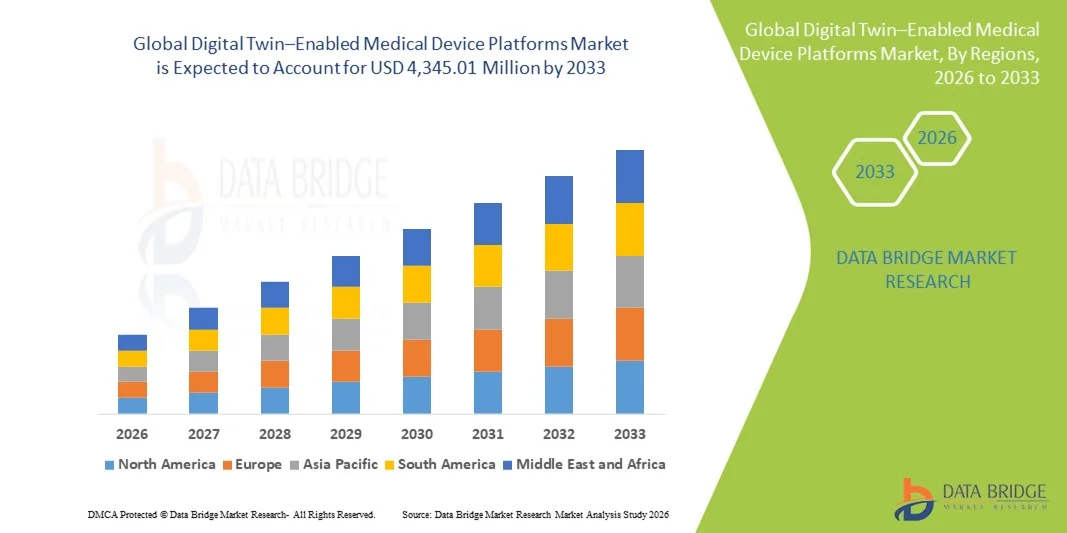
- As per Data Bridge Market Research Analysis the global digital twin–enabled medical device platforms market size was valued at USD 824.00 million in 2025 and is expected to reach USD 4,345.01 million by 2033, at a CAGR of 23.10% during the forecast period
- The market growth is largely driven by the increasing integration of digital twin technology with advanced healthcare systems and medical devices, enabling real-time monitoring, predictive analytics, and improved device lifecycle management across healthcare facilities
- Furthermore, the rising focus on personalized medicine, improved clinical outcomes, and efficient medical device performance optimization is encouraging healthcare providers and manufacturers to adopt digital twin platforms. These combined factors are accelerating the deployment of digital twin–enabled solutions, thereby significantly supporting the expansion of the global market
Market Size and Forecast:
- Global Market Value (2025): USD 824.00 million
- Expected Market Value (2033): USD 4,345.01 million
- Forecast CAGR (2026–2033): 23.10%
How Digital Twin–Enabled Medical Device Platforms Market Analysed?
- Digital twin–enabled medical device platforms, which create virtual replicas of physical medical devices to monitor performance, simulate outcomes, and optimize operations, are becoming increasingly important in modern healthcare systems due to their ability to enhance device efficiency, predictive maintenance, and data-driven clinical decision-making
- The growing demand for these platforms is primarily driven by the rising adoption of advanced digital health technologies, increasing integration of artificial intelligence and IoT in medical devices, and the need for real-time monitoring and performance optimization across healthcare infrastructures
- North America dominated the digital twin–enabled medical device platforms market with the largest revenue share of 38.6% in 2025, supported by strong healthcare IT infrastructure, high adoption of digital health solutions, and the presence of leading technology and medical device companies, with the U.S. witnessing substantial implementation of digital twin technologies in medical device development and hospital asset management
- Asia-Pacific is expected to be the fastest growing region in the digital twin–enabled medical device platforms market during the forecast period due to expanding healthcare digitalization, increasing investments in smart healthcare infrastructure, and growing adoption of AI-driven medical technologies
- Product digital twin segment dominated the digital twin–enabled medical device platforms market with a market share of 44.3% in 2025, driven by its extensive use in device design optimization, performance simulation, and lifecycle management in medical device manufacturing and clinical environments
Report Scope and Digital Twin–Enabled Medical Device Platforms Market Segmentation
|
Attributes |
Digital Twin–Enabled Medical Device Platforms Key Market Insights |
|
Segments Covered |
|
|
Countries Covered |
North America
Europe
Asia-Pacific
Middle East and Africa
South America
|
|
Key Market Players |
|
|
Market Opportunities |
|
|
Value Added Data Infosets |
In addition to the insights on market scenarios such as market value, growth rate, segmentation, geographical coverage, and major players, the market reports curated by the Data Bridge Market Research also include in-depth expert analysis, patient epidemiology, pipeline analysis, pricing analysis, and regulatory framework |
What are the Digital Twin–Enabled Medical Device Platforms Market Trends?
Rising Integration of AI and Real-Time Data Analytics in Digital Twin Platforms
- A significant and accelerating trend in the global digital twin–enabled medical device platforms market is the increasing integration of artificial intelligence (AI), advanced analytics, and real-time device data within healthcare systems, enabling more accurate simulation, monitoring, and optimization of medical device performance across clinical environments
- For instance, Siemens Healthineers integrates digital twin technology with AI-driven analytics in imaging and diagnostic equipment platforms, allowing healthcare providers to simulate device performance and improve operational efficiency across hospital systems. Similarly, GE HealthCare leverages digital twin capabilities to enhance predictive maintenance and optimize the lifecycle management of complex medical imaging systems.
- AI integration within digital twin platforms enables features such as predictive device performance modeling, early fault detection, and real-time simulation of operational scenarios, allowing healthcare providers and manufacturers to proactively optimize device performance and maintenance strategies. For instance, some advanced digital twin systems analyze device usage patterns to predict component wear and provide intelligent alerts before operational failures occur. Furthermore, real-time data connectivity enables continuous monitoring of medical devices, helping healthcare facilities maintain optimal operational conditions and improve patient safety
- The seamless integration of digital twin platforms with hospital information systems, cloud infrastructure, and connected medical devices enables centralized monitoring and management of complex healthcare equipment networks. Through a unified digital interface, healthcare administrators and biomedical engineers can monitor device health, simulate operational conditions, and manage maintenance schedules across multiple hospital facilities, creating a more efficient and data-driven healthcare infrastructure
- This trend toward more intelligent, predictive, and interconnected healthcare technologies is fundamentally transforming the way medical devices are designed, monitored, and maintained throughout their lifecycle. Consequently, companies such as Philips Healthcare are developing digital twin–enabled healthcare solutions that integrate device simulation, real-time analytics, and predictive maintenance capabilities within connected hospital ecosystems
- The demand for digital twin–enabled medical device platforms that offer advanced analytics, predictive modeling, and real-time device monitoring is growing rapidly across healthcare providers and medical device manufacturers, as organizations increasingly prioritize operational efficiency, patient safety, and data-driven healthcare management
- In addition, increasing collaboration between healthcare providers, technology companies, and medical device manufacturers is accelerating innovation in digital twin solutions, enabling the creation of more advanced platforms that support real-time simulation, remote device management, and improved clinical decision-making
Digital Twin–Enabled Medical Device Platforms Market Dynamics
Driver
Increasing Demand for Predictive Maintenance and Efficient Medical Device Management
- The increasing need for efficient medical device lifecycle management and predictive maintenance within healthcare facilities, coupled with the growing adoption of digital health technologies, is a significant driver for the rising demand for digital twin–enabled medical device platforms
- For instance, in 2024, Siemens Healthineers expanded its digital healthcare ecosystem by integrating digital twin capabilities into imaging equipment monitoring systems, enabling healthcare providers to analyze device performance and improve maintenance planning. Such strategic initiatives by key companies are expected to drive the digital twin–enabled medical device platforms market growth during the forecast period
- As healthcare facilities increasingly rely on complex and high-value medical equipment, digital twin platforms enable real-time monitoring, predictive analytics, and simulation-based maintenance planning, helping hospitals minimize equipment downtime and optimize operational efficiency
- Furthermore, the growing emphasis on improving patient outcomes and operational efficiency within healthcare systems is encouraging hospitals and medical device manufacturers to adopt digital twin technologies that can simulate device performance under various clinical conditions
- The ability to simulate device performance, detect potential failures early, and improve device design through virtual modeling is a key factor driving the adoption of digital twin platforms across the medical device ecosystem. The increasing investments in healthcare digitalization and smart hospital infrastructure are further contributing to market growth
- Increasing government and private investments in digital healthcare infrastructure and smart hospital initiatives are also encouraging healthcare institutions to implement digital twin platforms for advanced device monitoring and operational optimization
- In addition, the rising complexity of modern medical devices and the need for efficient asset management across large healthcare networks are motivating hospitals to deploy digital twin solutions that can track device usage, maintenance cycles, and performance in real time
Restraint/Challenge
Data Security Concerns and High Implementation Complexity
- Concerns related to data security, patient privacy, and the complexity of integrating digital twin platforms with existing healthcare IT infrastructure represent significant challenges to broader adoption of digital twin–enabled medical device platforms. As these platforms rely on continuous data exchange between connected medical devices, cloud systems, and hospital networks, they may be exposed to cybersecurity risks and unauthorized access if not properly secured
- For instance, reports highlighting vulnerabilities in connected healthcare devices and hospital networks have increased concerns among healthcare providers regarding the potential risks associated with connected digital health technologies
- Addressing these cybersecurity challenges through advanced encryption, secure data transmission protocols, and compliance with healthcare data protection regulations is essential for building trust among healthcare organizations. Companies such as IBM and Microsoft emphasize robust security architectures and secure cloud infrastructure within their healthcare digital twin solutions to help mitigate potential risks. In addition, the high implementation cost and technical complexity associated with deploying digital twin platforms can present barriers to adoption for smaller healthcare facilities with limited IT infrastructure
- While technological advancements are gradually reducing deployment complexity, the requirement for high-performance computing infrastructure, integration with legacy hospital systems, and skilled technical personnel can slow down adoption in certain healthcare markets
- Overcoming these challenges through improved cybersecurity frameworks, simplified platform integration, and the development of scalable digital twin solutions will be crucial for enabling wider adoption and sustained market growth
- Limited technical expertise within some healthcare organizations to manage advanced digital twin systems can also slow down implementation, particularly in developing healthcare markets with constrained digital infrastructure
- In addition, interoperability challenges between digital twin platforms and existing hospital IT systems may create integration difficulties, requiring significant customization and technical resources during deployment
Digital Twin–Enabled Medical Device Platforms Market Scope
The market is segmented on the basis of type, technology, application, and end user.
- By Type
On the basis of type, the digital twin–enabled medical device platforms market is segmented into product digital twin, process digital twin, and system digital twin. The product digital twin segment dominated the market with the largest revenue share of 44.3% in 2025, driven by its extensive use in medical device design, testing, and lifecycle management. Product digital twins allow manufacturers to create virtual models of medical devices, enabling simulation of device performance before physical production. This capability helps in reducing development time, improving device efficiency, and identifying potential technical issues at an early stage. Medical device companies are increasingly adopting product digital twins to optimize device functionality and enhance regulatory compliance processes. Furthermore, the ability to conduct virtual testing and performance optimization significantly reduces manufacturing costs and improves product reliability. The growing complexity of advanced medical devices such as imaging systems and surgical equipment is also contributing to the dominance of this segment.
The system digital twin segment is anticipated to witness the fastest growth rate during the forecast period, fueled by the increasing adoption of integrated healthcare management systems. System digital twins enable the creation of digital replicas of entire healthcare infrastructures, including multiple interconnected devices and hospital workflows. This technology allows healthcare providers to monitor equipment performance, simulate hospital operations, and improve decision-making processes. Hospitals are increasingly deploying system-level digital twins to optimize patient flow, equipment utilization, and operational efficiency. The growing trend toward smart hospitals and connected healthcare ecosystems is also driving demand for system digital twins. In addition, healthcare organizations are investing in system-level simulations to enhance operational planning and resource allocation across large healthcare networks.
- By Technology
On the basis of technology, the digital twin–enabled medical device platforms market is segmented into internet of things (IoT), artificial intelligence (AI) & machine learning, big data analytics, cloud computing, blockchain, extended reality, and others. The internet of things (IoT) segment dominated the market with the largest revenue share in 2025, primarily due to the increasing deployment of connected medical devices within healthcare environments. IoT technologies enable continuous data collection from medical devices, which is essential for creating accurate digital twin models. Hospitals and device manufacturers rely on IoT sensors and connectivity solutions to monitor device performance and transmit real-time operational data to digital twin platforms. This real-time connectivity helps healthcare organizations detect potential device failures and improve maintenance planning. The growing adoption of remote monitoring systems and connected healthcare infrastructure is further supporting the expansion of the IoT segment. In addition, IoT plays a critical role in enabling predictive analytics and device performance optimization in modern healthcare systems.
The artificial intelligence (AI) and machine learning segment is expected to witness the fastest CAGR during the forecast period due to its growing role in advanced analytics and predictive modeling within digital twin platforms. AI-powered algorithms can analyze large volumes of device data to identify patterns, predict potential malfunctions, and recommend maintenance actions. These technologies also enhance the accuracy of digital twin simulations by enabling dynamic learning and continuous model improvement. Healthcare providers and medical device manufacturers are increasingly integrating AI with digital twin platforms to improve clinical decision-making and operational efficiency. AI-driven digital twins can simulate complex clinical scenarios, enabling healthcare professionals to evaluate device performance under different conditions. Furthermore, ongoing advancements in AI technologies and increased investments in healthcare analytics are expected to accelerate the growth of this segment.
- By Application
On the basis of application, the digital twin–enabled medical device platforms market is segmented into medical device design & development, predictive maintenance, surgical planning & simulation, personalized treatment planning, remote patient monitoring, clinical trials support, and hospital asset & process management. The medical device design and development segment dominated the market with the largest revenue share in 2025, driven by the increasing use of digital twin technology in product innovation and device optimization. Digital twins allow manufacturers to create highly detailed virtual models of medical devices, enabling simulation and testing before physical prototypes are produced. This approach helps companies accelerate product development cycles while reducing development costs and risks. The technology also assists manufacturers in meeting regulatory requirements by enabling detailed performance testing and documentation. Medical device companies are using digital twin platforms to improve design accuracy, enhance device safety, and optimize product performance. The rising demand for technologically advanced medical equipment is further supporting the growth of this segment.
The predictive maintenance segment is expected to witness the fastest growth rate during the forecast period due to the increasing need for efficient medical equipment management in healthcare facilities. Digital twin platforms enable continuous monitoring of medical devices, allowing healthcare providers to predict equipment failures before they occur. This capability helps hospitals reduce equipment downtime and improve operational efficiency. Predictive maintenance also allows healthcare organizations to schedule maintenance activities more effectively, reducing unexpected repair costs. The growing reliance on complex medical equipment such as imaging systems and life-support devices is further driving the adoption of predictive maintenance solutions. In addition, hospitals are increasingly implementing predictive maintenance strategies to ensure patient safety and maintain consistent device performance.
- By End User
On the basis of end user, the digital twin–enabled medical device platforms market is segmented into hospitals & clinics, medical device manufacturers, pharmaceutical & biotechnology companies, research & academic institutes, and clinical research organizations. The medical device manufacturers segment dominated the market with the largest revenue share in 2025 due to the increasing adoption of digital twin technology in device design, testing, and lifecycle management. Manufacturers use digital twin platforms to simulate product performance and optimize device functionality before commercialization. This technology enables companies to reduce development costs, accelerate product launches, and improve overall product quality. Digital twins also help manufacturers monitor the real-world performance of their devices and gather valuable data for product improvement. The growing complexity of advanced medical devices is encouraging manufacturers to invest in digital twin solutions for enhanced product development capabilities. In addition, the rising emphasis on innovation and regulatory compliance is further strengthening the dominance of this segment.
The hospitals and clinics segment is expected to witness the fastest growth rate during the forecast period due to increasing investments in healthcare digitalization and smart hospital infrastructure. Healthcare facilities are adopting digital twin platforms to monitor medical equipment performance and improve operational efficiency. These platforms enable hospitals to manage device assets more effectively and reduce equipment downtime through predictive maintenance strategies. Digital twins also support clinical decision-making by providing real-time insights into device performance and patient-related data. The growing adoption of connected healthcare technologies and hospital automation solutions is further driving demand for digital twin platforms in healthcare facilities. Moreover, hospitals are increasingly using digital twin technologies to improve patient care outcomes and optimize healthcare resource utilization.
Digital Twin–Enabled Medical Device Platforms Market Regional Analysis
- North America dominated the digital twin–enabled medical device platforms market with the largest revenue share of 38.6% in 2025, supported by strong healthcare IT infrastructure, high adoption of digital health solutions, and the presence of leading technology and medical device companies
- Healthcare providers in the region highly value the operational efficiency, predictive maintenance capabilities, and data-driven insights offered by digital twin platforms for monitoring complex medical equipment and optimizing healthcare infrastructure
- This widespread adoption is further supported by advanced healthcare IT infrastructure, significant investments in healthcare digitalization, and the strong presence of leading medical device and technology companies, establishing digital twin platforms as a preferred solution for improving medical device performance and hospital operational management
U.S. Digital Twin–Enabled Medical Device Platforms Market Insight
The U.S. digital twin–enabled medical device platforms market captured the largest revenue share of 79% in 2025 within North America, fueled by the rapid adoption of digital health technologies and the increasing integration of advanced analytics in healthcare systems. Healthcare providers are increasingly focusing on improving clinical outcomes and operational efficiency through data-driven technologies. The growing adoption of connected medical devices, combined with strong demand for predictive maintenance and device lifecycle management, further supports market growth. Moreover, increasing investments in healthcare digitalization and the presence of major technology and medical device companies are significantly contributing to the market’s expansion.
Europe Digital Twin–Enabled Medical Device Platforms Market Insight
The Europe digital twin–enabled medical device platforms market is projected to expand at a substantial CAGR throughout the forecast period, primarily driven by increasing investments in healthcare digital transformation and the rising need for efficient medical device management. The growth of connected healthcare infrastructure and the adoption of advanced data analytics are supporting the deployment of digital twin technologies across hospitals and research institutions. European healthcare providers are also focusing on improving patient safety and operational efficiency through predictive analytics and device performance monitoring. The region is witnessing strong adoption across hospitals, medical device manufacturers, and research organizations, where digital twin platforms are being integrated into both existing and new healthcare systems.
U.K. Digital Twin–Enabled Medical Device Platforms Market Insight
The U.K. digital twin–enabled medical device platforms market is anticipated to grow at a noteworthy CAGR during the forecast period, driven by increasing adoption of digital health technologies and a growing emphasis on improving healthcare infrastructure efficiency. Healthcare organizations are actively exploring digital twin solutions to monitor medical equipment performance and enhance hospital operations. In addition, government initiatives promoting digital healthcare innovation and data-driven medical technologies are encouraging adoption across the country. The integration of digital twin platforms with connected healthcare systems and hospital management platforms is expected to further stimulate market growth.
Germany Digital Twin–Enabled Medical Device Platforms Market Insight
The Germany digital twin–enabled medical device platforms market is expected to expand at a considerable CAGR during the forecast period, fueled by the country’s strong focus on healthcare innovation and advanced manufacturing technologies. Germany’s well-established medical device industry and robust healthcare infrastructure are supporting the adoption of digital twin solutions. Healthcare providers and manufacturers are increasingly leveraging digital twin technologies to improve device design, predictive maintenance, and operational efficiency. The integration of digital twins with advanced analytics and connected medical devices is becoming increasingly common, aligning with the country’s emphasis on technological advancement and healthcare quality.
Asia-Pacific Digital Twin–Enabled Medical Device Platforms Market Insight
The Asia-Pacific digital twin–enabled medical device platforms market is poised to grow at the fastest CAGR of about 23% during the forecast period of 2026 to 2033, driven by expanding healthcare infrastructure, rising investments in digital health technologies, and increasing adoption of connected medical devices. Countries such as China, Japan, and India are experiencing rapid digital transformation in healthcare systems. Government initiatives supporting smart healthcare infrastructure and hospital modernization are also encouraging the adoption of digital twin platforms. Furthermore, as the region becomes a major hub for medical device manufacturing and healthcare innovation, the accessibility and implementation of digital twin technologies are expanding across healthcare facilities.
Japan Digital Twin–Enabled Medical Device Platforms Market Insight
The Japan digital twin–enabled medical device platforms market is gaining momentum due to the country’s strong technological capabilities, advanced healthcare infrastructure, and increasing focus on precision healthcare solutions. The Japanese healthcare system places a strong emphasis on technological innovation and patient safety, which is encouraging the adoption of digital twin platforms for monitoring medical devices and optimizing hospital operations. The integration of digital twins with connected healthcare technologies and AI-based analytics is supporting market growth. Moreover, Japan’s aging population is likely to increase demand for efficient healthcare management solutions and advanced medical device monitoring systems.
India Digital Twin–Enabled Medical Device Platforms Market Insight
The India digital twin–enabled medical device platforms market accounted for the largest market revenue share in Asia Pacific in 2025, attributed to the country’s rapidly expanding healthcare infrastructure, growing adoption of digital technologies, and increasing investments in healthcare innovation. India is emerging as a significant market for advanced healthcare technologies, with hospitals and medical device manufacturers exploring digital twin solutions for device monitoring and predictive maintenance. Government initiatives supporting digital health programs and smart hospital development are also contributing to market growth. The rising demand for efficient healthcare management systems and the growing presence of technology companies are further propelling the adoption of digital twin platforms in the country.
Which are the Top Companies in Digital Twin–Enabled Medical Device Platforms Market?
The Digital Twin–Enabled Medical Device Platforms industry is primarily led by well-established companies, including:
- Siemens Healthineers AG (Germany)
- GE HealthCare (U.S.)
- Koninklijke Philips N.V. (Netherlands)
- Dassault Systèmes SE (France)
- IBM Corporation (U.S.)
- Microsoft Corporation (U.S.)
- Oracle (U.S.)
- ANSYS, Inc. (U.S.)
- Altair Engineering Inc. (U.S.)
- PTC Inc. (U.S.)
- SAP SE (Germany)
- Accenture plc (Ireland)
- Medtronic (Ireland)
- Boston Scientific Corporation (U.S.)
- Brainlab AG (Germany)
- Twin Health, Inc. (U.S.)
- Rescale, Inc. (U.S.)
- Predixion Software Holdings, Inc. (U.S.)
- PHYSNA INC (U.S.)
- Atos SE (France)
What are the Recent Developments in Global Digital Twin–Enabled Medical Device Platforms Market?
- In November 2025, Siemens Healthineers introduced new AI-enabled radiology services along with its ActExcell Operational Twin, a digital twin solution designed to simulate complex hospital and imaging department operations. The platform enables healthcare providers to model clinical workflows, predict operational bottlenecks, and optimize imaging services and patient throughput. The development highlights the growing adoption of digital twin technology in hospital operations and medical device management
- In October 2025, GE HealthCare highlighted the deployment of its purpose-built hospital digital twin platform, designed to simulate patient flow, staffing demand, and equipment utilization within healthcare facilities. The platform enables hospitals to test operational scenarios such as capacity planning, resource allocation, and facility design changes in a virtual environment before implementing them in real settings
- In July 2025, healthcare researchers and clinicians demonstrated advanced digital twin technology capable of simulating patient-specific treatment scenarios using real-time diagnostic and physiological data. The system enables physicians to test multiple treatment strategies virtually before actual clinical intervention, helping reduce surgical risks and improve personalized healthcare decision-making. This development highlights the expanding role of digital twins in clinical planning and precision medicine
- In February 2025, HEALWELL AI announced that its subsidiary VeroSource Solutions launched digital twin capabilities within its VS Data-as-a-Service healthcare platform. The solution integrates healthcare data and creates virtual replicas of healthcare environments to enable real-time insights, operational simulation, and improved decision-making for healthcare systems. The technology helps healthcare organizations optimize resources, reduce operational costs, and enhance patient care outcomes
- In March 2023, GE HealthCare unveiled an AI-enabled digital twin platform at the HIMSS Global Health Conference designed to model patient-specific conditions and simulate treatment outcomes. The platform supports applications in cardiovascular and oncology diagnostics, enabling clinicians to use predictive simulations for more accurate clinical decisions. This innovation demonstrates how digital twin technology is being integrated with AI to advance precision medicine

- Interactive Data Analysis Dashboard
- Company Analysis Dashboard for high growth potential opportunities
- Research Analyst Access for customization & queries
- Competitor Analysis with Interactive dashboard
- Latest News, Updates & Trend analysis
- Harness the Power of Benchmark Analysis for Comprehensive Competitor Tracking
Data collection and base year analysis are done using data collection modules with large sample sizes. The stage includes obtaining market information or related data through various sources and strategies. It includes examining and planning all the data acquired from the past in advance. It likewise envelops the examination of information inconsistencies seen across different information sources. The market data is analysed and estimated using market statistical and coherent models. Also, market share analysis and key trend analysis are the major success factors in the market report. To know more, please request an analyst call or drop down your inquiry.
The key research methodology used by DBMR research team is data triangulation which involves data mining, analysis of the impact of data variables on the market and primary (industry expert) validation. Data models include Vendor Positioning Grid, Market Time Line Analysis, Market Overview and Guide, Company Positioning Grid, Patent Analysis, Pricing Analysis, Company Market Share Analysis, Standards of Measurement, Global versus Regional and Vendor Share Analysis. To know more about the research methodology, drop in an inquiry to speak to our industry experts.
Data Bridge Market Research is a leader in advanced formative research. We take pride in servicing our existing and new customers with data and analysis that match and suits their goal. The report can be customized to include price trend analysis of target brands understanding the market for additional countries (ask for the list of countries), clinical trial results data, literature review, refurbished market and product base analysis. Market analysis of target competitors can be analyzed from technology-based analysis to market portfolio strategies. We can add as many competitors that you require data about in the format and data style you are looking for. Our team of analysts can also provide you data in crude raw excel files pivot tables (Fact book) or can assist you in creating presentations from the data sets available in the report.













