What is the Digital Utility Market Size and Growth Rate?
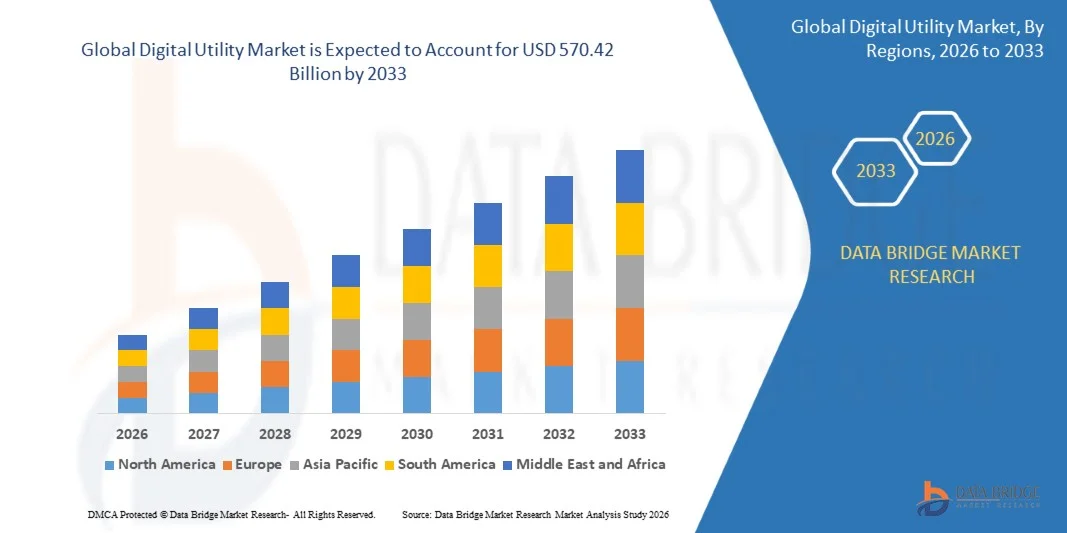
- As per Data Bridge Market Research analysis, the digital utility market was valued at USD 240.50 billion in 2025 and is projected to reach USD 570.42 billion by 2033, growing at a CAGR of 11.40% from 2026 to 2033.
- The market is experiencing rapid growth driven by rising demand for grid modernization, increasing adoption of smart meters and analytics, and expanding use of cloud, artificial intelligence, and connected devices across electricity, water, and gas utilities.
- The increasing shift toward smart grids, distributed energy resources, and data-driven asset management, combined with growing integration of advanced metering, sensors, and cloud platforms, is supporting market adoption. Digital utility solutions are being applied across power generation, grid operations, water networks, and customer engagement, offering utilities greater visibility and control through smart utilities, smart electric meters, and smart grid technologies.
Market Size & Forecast
- Global Market Value (2025): USD 240.50 Billion
- Expected Market Value (2033): USD 570.42 Billion
- Forecast CAGR (2026–2033): 11.40%
- Leading Region in 2025: North America
- Fastest Growing Region: Asia-Pacific
What are the Major Takeaways of the Digital Utility Market?
- North America dominated the digital utility market with the largest revenue share of 36.80% in 2025, supported by early smart grid adoption, large utility investments, and a strong base of technology and software providers.
- Asia-Pacific is expected to be the fastest-growing region at a CAGR of 13.60% from 2026 to 2033, fueled by national smart metering programs, rapid electricity demand growth, and large grid and renewable energy investments.
- The transmission & distribution segment led the market with a 46.80% share in 2025, driven by grid automation, outage management, and large-scale modernization of aging networks.
- Retail is the fastest-growing network segment, projected to register a CAGR of 12.60%, reflecting rising demand for customer analytics, digital billing, and personalized energy services.
- The hardware segment dominated the component category with a 44.20% revenue share in 2025, led by smart meters, sensors, communication devices, and grid-edge equipment.
- Electricity utilities accounted for 71.30% of the market share in 2025, preferred for large grid infrastructure, high digital investment, and renewable energy integration needs.
- The cloud deployment segment is the fastest-growing deployment mode, with a CAGR of 14.10%, driven by scalability, lower upfront costs, and demand for AI-enabled analytics platforms.
Report Scope and Digital Utility Market Segmentation
|
Attributes |
Digital Utility Key Market Insights |
|
Segments Covered |
|
|
Countries Covered |
North America
Europe
Asia-Pacific
Middle East and Africa
South America
|
|
Key Market Players |
|
|
Market Opportunities |
|
|
Value Added Data Infosets |
In addition to the market insights such as market value, growth rate, market segments, geographical coverage, market players, and market scenario, the market report curated by the Data Bridge Market Research team includes in-depth expert analysis, import/export analysis, pricing analysis, production consumption analysis, and pestle analysis. |
What is the Key Trend in the Digital Utility Market?
- Digital utilities are increasingly evolving from basic metering and billing systems into intelligent, software-defined grid platforms, combining sensors, digital twins, artificial intelligence, and cloud analytics to orchestrate supply and demand in real time.
- For instance, in June 2026, according to GE Vernova, the company introduced GridOS for Transmission and released two AI whitepapers on grid planning and grid-edge autonomy at its Orchestrate 2026 conference, highlighting how software is reshaping grid modernization as electricity demand surges and grid complexity rises, and encouraging utilities to adopt unified digital platforms
- Edge intelligence is gaining traction, as utilities deploy advanced meters and grid sensors that process data locally, enabling faster outage detection, voltage management, and coordination of distributed energy resources.
- Vendors are increasingly bundling hardware, software, and managed services into unified platforms, as utilities compare solutions on interoperability, cybersecurity, scalability, and total cost of ownership across electricity, water, and gas networks.
- For instance, in January 2026, according to Itron, the company is enhancing its Grid Edge Intelligence portfolio to enable AI and machine learning at the edge with partners including NVIDIA, Microsoft, AWS, and Snowflake, and has created a new Resiliency Solutions segment, showing the growing convergence of data platforms and utility operations
- As artificial intelligence, edge computing, cloud adoption, and electrification continue to advance, digital utility solutions are expected to expand beyond metering into predictive maintenance, flexible demand orchestration, and customer-centric energy services.
What are the Key Drivers of the Digital Utility Market?
- The rapid growth of electricity demand, renewable energy, and electric vehicles has significantly increased the need for digital tools that improve grid visibility, reliability, and efficiency across utility networks.
- For instance, in April 2025, according to the International Energy Agency (IEA), its Energy and AI report projected that global data centre electricity consumption will more than double to around 945 TWh by 2030, adding new load that utilities must forecast, manage, and balance using digital grid technologies.
- Electric, water, and gas utilities, regulators, and technology providers are investing in smart meters, analytics, and automation to reduce losses, improve customer service, integrate distributed generation, and meet reliability and sustainability targets.
- For instance, in March 2025, according to Siemens, the company partnered with CPFL Energia to modernize approximately 1.6 million residential smart meters in São Paulo by 2029, using its Gridscale X Meter Data Management software to strengthen grid reliability and accelerate distribution digitalization across a major Brazilian utility network.
- With governments, regulators, and utilities funding grid modernization and cloud providers expanding energy-focused offerings, digital utility solutions can gain wider visibility, adoption, and recurring revenue across generation, network, and retail operations.
What Factors Are Challenging the Growth of the Digital Utility Market?
- Digital utility projects require large upfront investments in meters, sensors, communication networks, and software, and long regulatory approval and payback cycles can delay deployment, particularly for smaller utilities.
- For instance, in February 2026, according to the U.S. Cybersecurity and Infrastructure Security Agency (CISA), an alert on the December 2025 energy-sector incident in Poland highlighted vulnerable edge devices and gaps in operational technology and industrial control system security, underlining cyber risk in connected utility networks.
- These security and cost pressures can slow adoption among utilities with limited budgets and skills, while integration with legacy systems and fragmented standards may extend project timelines and increase implementation risk.
- Data privacy, interoperability, and workforce skill gaps further restrict growth, requiring utilities and vendors to invest in secure architectures, data governance, and training that may increase deployment and operating costs.
- The combination of high capital costs, cybersecurity risks, legacy system integration, and regulatory delays can constrain adoption among smaller utilities and cost-sensitive markets, particularly where existing infrastructure still meets basic reliability requirements and budgets remain tight.
How is the Digital Utility Market Segmented?
The digital utility market is segmented on the basis of network, component, utility type, and deployment mode.
- By Network
On the basis of network, the digital utility market is segmented into generation, transmission & distribution, and retail. The transmission & distribution segment dominated the market with 46.80% share in 2025, supported by large-scale grid modernization, automation, and the need to manage distributed energy resources and growing electricity demand. Utilities deploy advanced distribution management systems, sensors, and digital substations to improve reliability. Smart meters and monitoring devices provide real-time visibility into loads and outages. Regulatory support for resilience and loss reduction further strengthens investment. Integration of analytics, digital twins, and remote control is improving operational efficiency and reducing outage durations, while aging asset replacement cycles sustain long-term demand for digital upgrades.
The retail segment is projected to record the fastest growth at a CAGR of 12.60% from 2026 to 2033, driven by increasing demand for customer analytics, digital billing, personalized tariffs, and self-service platforms. Utilities use customer data to offer demand response, energy efficiency programs, and time-of-use pricing. Mobile apps and portals improve engagement and reduce call center costs. Growth of rooftop solar, electric vehicles, and home batteries is creating additional opportunities for retail services. Advances in artificial intelligence are improving forecasting, fraud detection, and customer segmentation. Competition among retailers is encouraging investment in loyalty programs, bundled services, and transparent digital experiences that reduce customer churn.
- By Component
On the basis of component, the digital utility market is segmented into hardware, software, and services. The hardware segment dominated the market with 44.20% share in 2025, supported by large-scale deployment of smart meters, sensors, communication devices, and grid-edge equipment. National metering programs and replacement of aging meters create steady demand. Hardware provides the data foundation that software and analytics platforms require. The segment benefits from long product lifecycles, regulatory mandates, and established supplier relationships. Continuous improvements in meter intelligence, connectivity, and security further strengthen its leadership, while rising volumes in emerging economies add scale.
The software segment is projected to record the fastest growth at a CAGR of 13.80% from 2026 to 2033, driven by rising demand for analytics, grid orchestration, asset management, and AI-enabled decision tools. Utilities are shifting investment toward platforms that convert meter and sensor data into operating decisions. Cloud-native architecture, digital twins, and distributed energy resource management are expanding use cases. Subscription models are improving cost predictability and speed of deployment. Vendors are also adding cybersecurity, interoperability, and over-the-air update capabilities to meet procurement requirements, while open standards and application programming interfaces simplify integration with existing systems.
- By Utility Type
On the basis of utility type, the digital utility market is segmented into electricity, water, and gas. The electricity segment dominated the market with 71.30% share in 2025, driven by large grid infrastructure, rising demand, renewable integration, and high investment in smart grid projects. Electric utilities face pressure from electrification, data center load, and extreme weather, which require advanced monitoring and control. Regulatory incentives for reliability and modernization support spending. Distributed solar, storage, and electric vehicle charging add complexity that digital tools help manage. Established vendor ecosystems and mature technology standards continue to reinforce this segment's leadership.
The water segment is projected to record the fastest growth at a CAGR of 12.40% from 2026 to 2033, supported by increasing focus on leakage reduction, water conservation, and aging infrastructure replacement. Smart water meters, pressure sensors, and analytics help utilities detect leaks and reduce non-revenue water. Climate stress and drought risk are encouraging investment in monitoring and demand management. Public funding programs and sustainability targets are accelerating projects. Cybersecurity, budget limits, and fragmented ownership remain important considerations for adoption. Pilot projects and performance-based contracts are helping smaller water utilities test solutions before scaling them.
- By Deployment Mode
On the basis of deployment mode, the digital utility market is segmented into cloud and on-premises. The on-premises segment dominated the market with 54.60% share in 2025, supported by strict security requirements, regulatory compliance, and the need for low-latency control of critical operations. Many utilities keep core operational systems within private networks. Existing investments in control centers, servers, and legacy applications also favor on-premises deployment. Data sovereignty rules and concerns about outages further support this model. Established relationships with long-standing vendors continue to reinforce the segment, and long asset lifecycles slow migration. Dedicated communication networks and air-gapped environments are also preferred for sensitive substations and control rooms.
The cloud segment is projected to record the fastest growth at a CAGR of 14.10% from 2026 to 2033, driven by scalability, lower upfront costs, and demand for AI-enabled analytics platforms. Cloud platforms allow utilities to process large volumes of meter and sensor data and deploy new applications quickly. Hyperscalers are adding energy-specific tools and partnerships with grid software vendors. Hybrid models are helping utilities combine local control with cloud analytics. Security certifications and sovereign cloud options are improving confidence among cautious operators. Pay-as-you-go pricing is also helping smaller utilities access advanced capabilities.
Which Region Holds the Largest Share of the Digital Utility Market?
- North America dominated the digital utility market with the largest revenue share of 36.80% in 2025, supported by early smart grid adoption, large utility investments, and a strong base of technology and software providers.
- The region also benefits from large utility capital programs, strong regulatory support for grid modernization, and the presence of leading technology, software, and equipment suppliers. Increasing data center load, extreme weather resilience needs, and adoption of distributed energy resources, along with active venture investment in grid technology, continue to strengthen North America’s position in the global market.
U.S. Digital Utility Market Insight
The U.S. digital utility market is witnessing strong growth due to rising electricity demand, aging grid infrastructure, and strong investment in grid modernization and resilience. The country’s large base of investor-owned utilities, along with increasing adoption of advanced metering, distribution management, and cloud analytics, is driving demand for digital solutions. In addition, growing data center load, wildfire and storm risk, cybersecurity requirements, supportive state-level regulation, and active partnerships between utilities and technology companies are accelerating adoption across electric, water, and gas utilities.
Canada Digital Utility Market Insight
Canada’s digital utility market is experiencing steady growth, driven by smart grid modernization, renewable energy integration, and increasing demand for energy efficiency. Utilities are adopting advanced metering infrastructure, cloud platforms, artificial intelligence, and IoT technologies to optimize operations and improve customer experiences. Government decarbonization targets and infrastructure investments further support digital transformation. However, cybersecurity risks, regulatory complexity, legacy systems, and high implementation costs remain key challenges, creating opportunities for innovative technology providers and digital solution developers.
Asia-Pacific Digital Utility Market Insight
The Asia-Pacific digital utility market is expected to witness rapid growth, driven by national smart metering programs, rapid electricity demand growth, and large grid and renewable energy investments across countries such as China, India, and Japan. Growing urbanization, rising industrial output, and expanding electric vehicle adoption are supporting regional market expansion. In addition, government digitalization initiatives, distribution reform, growing participation of local technology providers, and falling costs of sensors and communication modules are accelerating availability and adoption.
Japan Digital Utility Market Insight
The Japan digital utility market is witnessing consistent growth due to strong smart meter coverage, disaster resilience needs, and rising renewable energy integration. Utilities, grid operators, and technology firms are increasingly adopting analytics, automation, and demand response tools. Moreover, strong demand for reliable power, advanced sensing technology, and efficient energy management, along with ongoing liberalization of power retail, is further contributing to market growth in Japan.
China Digital Utility Market Insight
The China digital utility market is growing rapidly, driven by large grid investment, renewable energy expansion, electric vehicle growth, and advanced transmission infrastructure. Growing deployment of smart meters and digital substations is significantly boosting market demand. In addition, strong domestic technology suppliers, government support for smart grids, ultra-high-voltage networks, and rapid adoption of cloud and artificial intelligence are positioning China as a key growth market across Asia-Pacific, with large pilot projects in major cities.
Which are the Top Companies in Digital Utility Market?
The digital utility industry is primarily led by well-established companies, including:
- Siemens AG (Germany)
- Schneider Electric SE (France)
- ABB Ltd. (Switzerland)
- General Electric Company (U.S.)
- Oracle Corporation (U.S.)
- Accenture plc (Ireland)
- Capgemini SE (France)
- SAP SE (Germany)
- International Business Machines Corporation (U.S.)
- Microsoft Corporation (U.S.)
- Cisco Systems, Inc. (U.S.)
- Itron, Inc. (U.S.)
- Landis+Gyr Group AG (Switzerland)
- Honeywell International Inc. (U.S.)
- Eaton Corporation plc (Ireland)
- Hitachi Energy Ltd. (Switzerland)
- Huawei Technologies Co., Ltd. (China)
- Cognizant Technology Solutions Corporation (U.S.)
- Infosys Limited (India)
- Wipro Limited (India)
What are Latest Developments in Digital Utility Market?
- In June 2026, GE Vernova introduced GridOS for Transmission, a unified grid intelligence solution for operating and orchestrating the transmission network as one system, at its Orchestrate 2026 conference in Atlanta. The company also released two AI whitepapers addressing grid planning and autonomous grid-edge operations, as electricity demand surges and grid complexity accelerates for utilities worldwide.
- In January 2026, Itron highlighted advancements in Grid Edge Intelligence and resiliency at DTECH 2026, including AI and machine learning at the edge developed with NVIDIA, Microsoft, AWS, Snowflake, and other partners. The company also introduced a Resiliency Solutions segment combining Urbint, Locusview, and its grid edge capabilities to help utilities manage critical systems, extreme weather risk, and construction workflows.
- In March 2025, Siemens partnered with CPFL Energia to modernize approximately 1.6 million residential smart meters in São Paulo by 2029. The project uses Siemens Gridscale X Meter Data Management software to support data collection, strengthen grid reliability, and accelerate the digitalization of Brazil’s electricity distribution network, while improving billing accuracy, loss detection, and customer service for the utility’s residential customers.
- In March 2024, Aclara partnered with Utilidata to integrate Utilidata’s distributed AI platform into Aclara smart meters. The collaboration aims to bring real-time edge analytics to the meter, helping utilities improve grid visibility, manage distributed energy resources, and support electrification, while giving operators more granular data on voltage, load, and power quality across residential feeders and distribution transformers.
- In February 2024, Itron and GE Vernova announced a collaboration to unify grid edge and grid operations data by integrating Itron’s Grid Edge Intelligence solutions with GE Vernova’s GridOS orchestration software. The partnership is designed to give utilities real-time insights to manage renewable generation and distributed energy resources such as solar, EV charging, and battery storage, improving reliability and resilience.

- Interactive Data Analysis Dashboard
- Company Analysis Dashboard for high growth potential opportunities
- Research Analyst Access for customization & queries
- Competitor Analysis with Interactive dashboard
- Latest News, Updates & Trend analysis
- Harness the Power of Benchmark Analysis for Comprehensive Competitor Tracking
Data collection and base year analysis are done using data collection modules with large sample sizes. The stage includes obtaining market information or related data through various sources and strategies. It includes examining and planning all the data acquired from the past in advance. It likewise envelops the examination of information inconsistencies seen across different information sources. The market data is analysed and estimated using market statistical and coherent models. Also, market share analysis and key trend analysis are the major success factors in the market report. To know more, please request an analyst call or drop down your inquiry.
The key research methodology used by DBMR research team is data triangulation which involves data mining, analysis of the impact of data variables on the market and primary (industry expert) validation. Data models include Vendor Positioning Grid, Market Time Line Analysis, Market Overview and Guide, Company Positioning Grid, Patent Analysis, Pricing Analysis, Company Market Share Analysis, Standards of Measurement, Global versus Regional and Vendor Share Analysis. To know more about the research methodology, drop in an inquiry to speak to our industry experts.
Data Bridge Market Research is a leader in advanced formative research. We take pride in servicing our existing and new customers with data and analysis that match and suits their goal. The report can be customized to include price trend analysis of target brands understanding the market for additional countries (ask for the list of countries), clinical trial results data, literature review, refurbished market and product base analysis. Market analysis of target competitors can be analyzed from technology-based analysis to market portfolio strategies. We can add as many competitors that you require data about in the format and data style you are looking for. Our team of analysts can also provide you data in crude raw excel files pivot tables (Fact book) or can assist you in creating presentations from the data sets available in the report.