


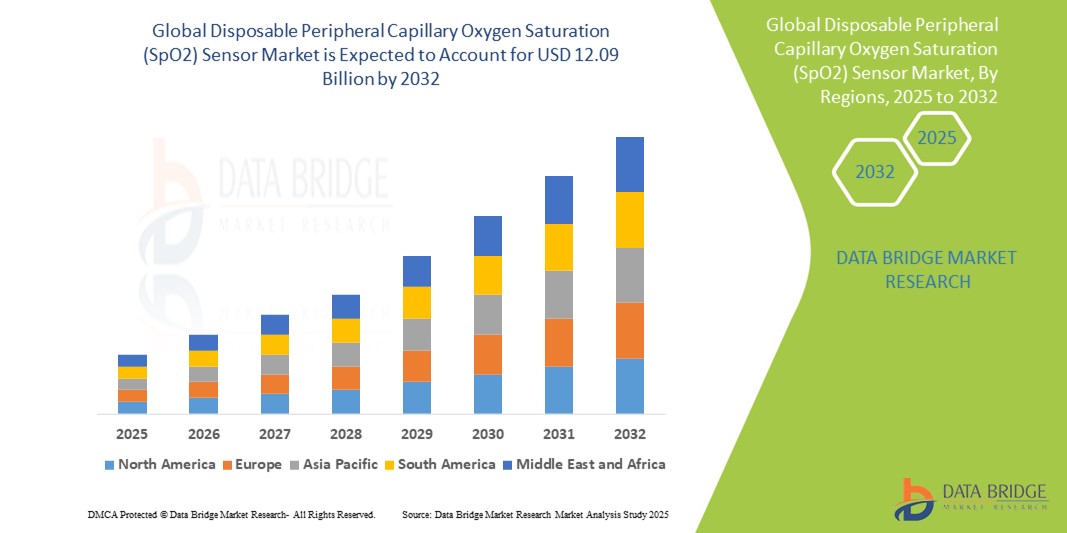
Disposable Peripheral Capillary Oxygen Saturation (SpO2) Sensor Market Size
- The global disposable peripheral capillary oxygen saturation (SpO2) sensor market size was valued at USD 4.48 billion in 2024 and is expected to reach USD 12.09 billion by 2032, at a CAGR of 13.20% during the forecast period
- The market growth is primarily driven by the rising demand for continuous patient monitoring, especially in critical care, emergency, and home care settings, where disposable sensors reduce infection risk and improve hygiene compliance
- In addition, the increasing prevalence of respiratory conditions, growing geriatric population, and advancements in non-invasive monitoring technologies are fostering the demand for single-use SpO2 sensors. These factors are collectively supporting market expansion and are expected to sustain long-term growth across healthcare systems globally
Disposable Peripheral Capillary Oxygen Saturation (SpO2) Sensor Market Analysis
- Disposable SpO2 sensors, designed for one-time use to monitor blood oxygen saturation levels non-invasively, are gaining prominence in both hospital and home care settings due to their effectiveness in minimizing cross-contamination risks and enhancing patient safety
- The growing demand for disposable SpO2 sensors is primarily driven by the rising incidence of respiratory disorders, increased focus on infection control protocols, and the expanding use of remote patient monitoring and telehealth services
- North America dominated the disposable peripheral capillary oxygen saturation (SpO2) sensor market with the largest revenue share of 35.5% in 2024, characterized by a well-established healthcare infrastructure, high awareness regarding patient safety, and extensive use of disposable medical devices in clinical settings across the U.S. and Canada
- Asia-Pacific is expected to be the fastest growing region in the disposable peripheral capillary oxygen saturation (SpO2) sensor market during the forecast period due to rapid healthcare modernization, rising hospital admissions, and growing government focus on healthcare hygiene standards
- Adult segment dominated the disposable peripheral capillary oxygen saturation (SpO2) sensor market with a market share of 50.5% in 2024, driven by its widespread use in monitoring chronic respiratory and cardiac conditions among the growing adult and elderly population
Report Scope and Disposable Peripheral Capillary Oxygen Saturation (SpO2) Sensor Market Segmentation
|
Attributes |
Disposable Peripheral Capillary Oxygen Saturation (SpO2) Sensor Key Market Insights |
|
Segments Covered |
|
|
Countries Covered |
North America
Europe
Asia-Pacific
Middle East and Africa
South America
|
|
Key Market Players |
|
|
Market Opportunities |
|
|
Value Added Data Infosets |
In addition to the insights on market scenarios such as market value, growth rate, segmentation, geographical coverage, and major players, the market reports curated by the Data Bridge Market Research also include in-depth expert analysis, pricing analysis, brand share analysis, consumer survey, demography analysis, supply chain analysis, value chain analysis, raw material/consumables overview, vendor selection criteria, PESTLE Analysis, Porter Analysis, and regulatory framework. |
Disposable Peripheral Capillary Oxygen Saturation (SpO2) Sensor Market Trends
“Increased Adoption of Disposable Sensors for Infection Control and Remote Monitoring”
- A prominent and accelerating trend in the global disposable SpO2 sensor market is the heightened emphasis on infection control and the expansion of remote patient monitoring solutions, particularly in post-pandemic healthcare systems. This trend is driving heightened emphasis on infection control and the expansion of remote patient monitoring solutions, particularly in post-pandemic healthcare systems hospitals and home care providers to adopt single-use sensors to minimize cross-contamination risks and enhance patient safety
- For instance, leading manufacturers such as Medtronic and Masimo offer a wide range of disposable SpO2 sensors designed specifically for one-time use in high-dependency units and home care settings, ensuring compliance with hygiene protocols while maintaining reliable oxygen saturation monitoring
- The trend is further supported by the growing prevalence of chronic respiratory and cardiac conditions, where regular monitoring of oxygen levels is critical. Disposable SpO2 sensors, integrated into wearable or portable monitoring systems, provide continuous, non-invasive tracking without compromising sterility
- In addition, the integration of these sensors with wireless health monitoring platforms enables real-time data transmission to healthcare providers, improving the efficiency of remote care and enabling earlier clinical interventions. This is especially relevant in telehealth applications, where disposable sensors ensure safe, short-term use across diverse patient groups
- The increasing focus on infection prevention and streamlined workflow in clinical environments is prompting hospitals to shift from reusable to disposable SpO2 sensors, thereby reducing the burden of sterilization and improving operational efficiency
- This trend is shaping procurement strategies across healthcare systems, with disposable SpO2 sensors becoming integral to both acute care and chronic disease management protocols, driving sustained demand in the global market
Disposable Peripheral Capillary Oxygen Saturation (SpO2) Sensor Market Dynamics
Driver
“Rising Demand for Infection Control and Non-Invasive Monitoring in Healthcare”
- The growing emphasis on infection prevention in healthcare settings, particularly following the COVID-19 pandemic, is a significant driver fueling demand for disposable SpO2 sensors across hospitals, clinics, and home care environments
- For instance, in February 2024, Medtronic expanded its line of single-use sensors with enhanced comfort and reliability features, specifically aimed at intensive care units and respiratory monitoring applications. Such innovations by key players are expected to support the market’s growth during the forecast period
- As healthcare providers prioritize reducing hospital-acquired infections and cross-contamination risks, disposable SpO2 sensors present an effective, hygienic alternative to reusable sensors, especially in critical care, neonatal, and surgical environments
- Furthermore, the surge in remote patient monitoring and home-based healthcare is driving adoption of single-use SpO2 sensors due to their ease of use, compatibility with portable devices, and ability to deliver continuous, non-invasive oxygen level tracking without the need for sterilization
Restraint/Challenge
“Skin Irritation Issues and Regulatory Compliance Hurdle”
- Concerns related to skin irritation caused by prolonged use of adhesive-based disposable SpO2 sensors, particularly in sensitive populations such as neonates and elderly patients, present a notable restraint for the market. Repeated use can lead to allergic reactions or discomfort, limiting sensor wear time and clinical applicability
- For instance, several healthcare institutions have reported cases of contact dermatitis linked to sensor adhesives, prompting stricter evaluation of materials and biocompatibility standards by regulatory agencies such as the FDA and the EU MDR
- Addressing these concerns requires manufacturers to invest in skin-friendly, hypoallergenic materials and continuously improve sensor designs to enhance comfort without compromising accuracy. Companies such as Masimo and Medtronic are actively developing softer, more breathable sensor materials to minimize skin-related issues
- In addition, navigating complex and evolving regulatory requirements for disposable medical devices across different regions can delay product approvals and market entry. Compliance with safety, performance, and labeling standards adds to development time and costs
- While innovations in materials and proactive regulatory alignment are underway, overcoming these barriers will be essential for achieving broader market penetration and ensuring user safety across all patient demographics
Disposable Peripheral Capillary Oxygen Saturation (SpO2) Sensor Market Scope
The market is segmented on the basis of connector, usage, technique, signal, application, end user, and sales channel.
- By Connector
On the basis of connector, the disposable peripheral capillary oxygen saturation (SpO₂) sensor market is segmented into less than 6 pins, 6 pins–10 pins, and more than 10 pins. The 6 pins–10 pins segment dominated the market with the largest revenue share in 2024, owing to its optimal balance between compact design and signal reliability. These connectors are widely used in standard hospital monitoring equipment, offering dependable connectivity and compatibility across multiple device brands.
The more than 10 pins segment is expected to grow at the fastest CAGR from 2025 to 2032, driven by increasing demand for high-resolution signal transmission in advanced and multi-parameter monitors, especially in critical care and surgical applications.
- By Usage
On the basis of usage, the market is segmented into adult, paediatric, neonate, animal, and others. The adult segment dominated the market with the largest market share of 50.5% in 2024, driven by its extensive use in general inpatient monitoring, emergency care, and home-based chronic disease management. The growing elderly population and prevalence of respiratory disorders significantly contribute to the strong demand for adult-use SpO₂ sensors.
The neonate segment is projected to witness the fastest growth rate from 2025 to 2032, fueled by the increasing focus on neonatal intensive care and early-life respiratory monitoring, particularly in developed healthcare systems and emerging economies investing in infant health.
- By Technique
On the basis of technique, the market is segmented into reflectance and transflectance. The reflectance segment held the largest revenue share in 2024, driven by its suitability for diverse placement areas such as the forehead and chest, making it ideal for neonatal and surgical monitoring. Reflectance sensors provide reliable readings even in low-perfusion and motion-sensitive conditions.
The transflectance segment is expected to exhibit steady growth during the forecast period, supported by its role in wearable technologies and remote patient monitoring devices where sensor size, comfort, and power efficiency are critical.
- By Signal
On the basis of signal, the market is segmented into analog and digital. The digital segment dominated the market in 2024, driven by its higher data accuracy, noise resistance, and seamless compatibility with modern patient monitoring systems and telehealth platforms. Digital sensors facilitate real-time analytics and integration with electronic medical records (EMRs).
The analog segment is expected to grow at faster rate during forecast period retains relevance in lower-cost and legacy healthcare systems, particularly in resource-constrained settings where digital upgrades are limited by budget constraints.
- By Application
On the basis of application, the market is segmented into finger, ear, foot, toe, multi-position, and others. The finger segment accounted for the largest revenue share in 2024, owing to its non-invasive nature, ease of use, and suitability for both clinical and at-home monitoring. It remains the most widely adopted form of SpO₂ measurement.
The multi-position segment is anticipated to grow at the fastest pace from 2025 to 2032, supported by increasing demand in pediatric, veterinary, and mobile care scenarios where sensor flexibility and adaptability are crucial for accurate readings.
- By End User
On the basis of end user, the market is segmented into clinical, hospital, veterinary, and others. The hospital segment led the market in 2024, driven by the high volume of patient admissions and continuous monitoring requirements across ICUs, operating rooms, and emergency departments. Disposable sensors help reduce cross-contamination risks and ensure hygiene compliance.
The veterinary segment is expected to expand steadily during the forecast period, due to increasing demand for animal health monitoring during surgeries and recovery, coupled with the rise in pet ownership and veterinary facility modernization.
- By Sales Channel
On the basis of sales channel, the market is segmented into offline and online. The offline segment dominated the market with the largest revenue share in 2024, owing to established procurement patterns by hospitals and clinics through authorized medical distributors and supply chains. Trust in product quality and after-sales service sustains offline preference.
The online segment is anticipated to witness the fastest CAGR from 2025 to 2032, driven by the growing penetration of e-commerce in healthcare, rising demand from home care users, and the convenience of direct-to-consumer medical device purchases.
Disposable Peripheral Capillary Oxygen Saturation (SpO2) Sensor Market Regional Analysis
- North America dominated the disposable peripheral capillary oxygen saturation (SpO2) sensor market with the largest revenue share of 35.5% in 2024, driven by well-established healthcare infrastructure, high awareness regarding patient safety, and extensive use of disposable medical devices in clinical settings across the U.S. and Canada
- The region’s healthcare providers emphasize early diagnosis, continuous monitoring, and infection control factors that boost demand for disposable sensors in both hospital and home care settings
- In addition, the presence of leading medical device manufacturers, robust reimbursement structures, and growing investments in telehealth solutions contribute to the sustained expansion of the market across the U.S. and Canada
U.S. Disposable Peripheral Capillary Oxygen Saturation (SpO2) Sensor Market Insight
The U.S. disposable peripheral capillary oxygen saturation (SpO2) sensor market captured the largest revenue share of 79.2% in 2024 within North America, fueled by high hospitalization rates for chronic respiratory and cardiovascular conditions and growing emphasis on patient safety. The widespread adoption of disposable sensors in intensive care units, emergency settings, and outpatient monitoring supports market expansion. Moreover, stringent infection control protocols and the push for cost-effective, single-use monitoring tools drive demand, particularly across large healthcare networks and home care providers.
Europe Disposable Peripheral Capillary Oxygen Saturation (SpO2) Sensor Market Insight
The Europe disposable peripheral capillary oxygen saturation (SpO2) sensor market is projected to expand at a substantial CAGR throughout the forecast period, primarily driven by rising prevalence of chronic diseases and the focus on reducing hospital-acquired infections. Increased demand for remote monitoring solutions and government initiatives promoting digital health integration further enhance market growth. Key countries are witnessing increased sensor adoption across elderly care and home-based medical support programs. Disposable variants are gaining traction due to convenience and regulatory support for single-patient-use products.
U.K. Disposable Peripheral Capillary Oxygen Saturation (SpO2) Sensor Market Insight
The U.K. disposable peripheral capillary oxygen saturation (SpO2) sensor market is anticipated to grow at a noteworthy CAGR during the forecast period, supported by rising patient admissions with respiratory complications and national health policies that prioritize infection control. Hospitals and clinics are shifting toward disposable sensors to mitigate cross-contamination risks. Furthermore, the UK's growing focus on remote diagnostics, particularly post-COVID-19, enhances demand for user-friendly, disposable pulse oximetry devices across both public and private healthcare systems.
Germany Disposable Peripheral Capillary Oxygen Saturation (SpO2) Sensor Market Insight
The Germany disposable peripheral capillary oxygen saturation (SpO2) sensor market is expected to expand at a considerable CAGR during the forecast period, driven by increased awareness regarding hygiene in clinical environments and strong investment in hospital infrastructure. The country’s progressive healthcare system is facilitating adoption of disposable monitoring solutions across ICUs, surgical wards, and emergency care. Germany also demonstrates growing acceptance of SpO₂ sensors in telehealth applications, with a preference for data-accurate and skin-friendly sensor options aligned with local quality standards.
Asia-Pacific Disposable Peripheral Capillary Oxygen Saturation (SpO2) Sensor Market Insight
The Asia-Pacific disposable peripheral capillary oxygen saturation (SpO2) sensor market is poised to grow at the fastest CAGR of 26.5% during the forecast period of 2025 to 2032, fueled by growing healthcare expenditure, rising incidence of respiratory conditions, and increasing adoption of affordable monitoring technologies. Countries such as China, India, and Japan are driving innovation and localization of disposable sensor production. With governments encouraging digital health expansion and preventive care models, disposable sensors are increasingly utilized in both public health programs and home monitoring environments.
Japan Disposable Peripheral Capillary Oxygen Saturation (SpO2) Sensor Market Insight
The Japan disposable peripheral capillary oxygen saturation (SpO2) sensor market is gaining momentum due to the country's aging population and widespread use of non-invasive diagnostic tools. The demand for high-precision, disposable sensors is rising across elderly care centers and hospitals, where infection control is prioritized. Japan's strong focus on healthcare technology and telemonitoring supports adoption of disposable sensors that offer real-time oxygen saturation data. In addition, integration with home-use monitoring kits contributes to steady market growth.
India Disposable Peripheral Capillary Oxygen Saturation (SpO2) Sensor Market Insight
The India disposable peripheral capillary oxygen saturation (SpO2) sensor market accounted for the largest market revenue share in Asia Pacific in 2024, supported by increasing awareness of respiratory health, a high burden of chronic illness, and rising demand for low-cost diagnostic solutions. Disposable sensors are becoming essential in both urban and rural healthcare settings, where infection risk and affordability are key concerns. Government initiatives promoting digitized health infrastructure and indigenous manufacturing further propel the availability and acceptance of single-use SpO₂ monitoring products.
Disposable Peripheral Capillary Oxygen Saturation (SpO2) Sensor Market Share
The disposable peripheral capillary oxygen saturation (SpO2) Sensor industry is primarily led by well-established companies, including:
- Medtronic (Ireland)
- Masimo (U.S.)
- Unimed Medical (China)
- MEDKE (China)
- Hisern Medical (China)
- TE Connectivity (Switzerland)
- NIHON KOHDEN CORPORATION (Japan)
- Nonin (U.S.)
- Koninklijke Philips N.V. (Netherlands)
- Shenzhen Lontek Electronic Technology Co., Limited (China)
- Honeywell International Inc. (U.S.)
- Criticare Technologies, Inc. (U.S)
- Digicare Biomedical (U.S.)
- Avante Health Solutions (U.S.)
- PROACT Medical Ltd (U.K.)
- Guangdong Biolight Meditech Co., Ltd. (China)
- Spacelabs Healthcare (U.S.)
- General Electric Company (U.S.)
What are the Recent Developments in Global Disposable Peripheral Capillary Oxygen Saturation (SpO2) Sensor Market?
- In April 2023, Masimo Corporation, a leader in non-invasive monitoring technologies, launched its next-generation disposable SpO₂ sensors designed for enhanced accuracy and patient comfort. The new sensors incorporate advanced signal processing algorithms, reducing motion artifacts and improving reliability in critical care environments. This development highlights Masimo’s dedication to improving patient monitoring outcomes across diverse healthcare settings
- In March 2023, Medtronic introduced a cost-effective disposable SpO₂ sensor aimed at expanding access to pulse oximetry in emerging markets. Tailored for high-volume hospital use, the sensor offers reliable oxygen saturation measurement while adhering to strict infection control protocols. This initiative supports Medtronic’s mission to enhance healthcare delivery by providing scalable, disposable monitoring solutions globally
- In March 2023, Nonin Medical announced a partnership with a major telehealth provider to integrate disposable SpO₂ sensors with remote patient monitoring platforms. This collaboration facilitates real-time oxygen saturation tracking for chronic respiratory patients at home, reducing hospital visits and improving disease management. The initiative underscores the growing role of disposable sensors in telemedicine and remote healthcare
- In February 2023, Smiths Medical unveiled a new line of single-use SpO₂ sensors featuring hypoallergenic materials and ergonomic designs to reduce skin irritation during prolonged use. These sensors target neonatal and pediatric care units, where patient comfort and safety are paramount. The product launch reflects Smiths Medical’s commitment to specialized disposable sensor innovation
- In January 2023, GE Healthcare introduced an upgraded disposable SpO₂ sensor compatible with its latest bedside monitors, incorporating improved adhesive technology to ensure secure placement during patient movement. The new sensor enhances monitoring accuracy in critical and surgical care, reaffirming GE Healthcare’s leadership in patient monitoring solutions

- Interactive Data Analysis Dashboard
- Company Analysis Dashboard for high growth potential opportunities
- Research Analyst Access for customization & queries
- Competitor Analysis with Interactive dashboard
- Latest News, Updates & Trend analysis
- Harness the Power of Benchmark Analysis for Comprehensive Competitor Tracking
Data collection and base year analysis are done using data collection modules with large sample sizes. The stage includes obtaining market information or related data through various sources and strategies. It includes examining and planning all the data acquired from the past in advance. It likewise envelops the examination of information inconsistencies seen across different information sources. The market data is analysed and estimated using market statistical and coherent models. Also, market share analysis and key trend analysis are the major success factors in the market report. To know more, please request an analyst call or drop down your inquiry.
The key research methodology used by DBMR research team is data triangulation which involves data mining, analysis of the impact of data variables on the market and primary (industry expert) validation. Data models include Vendor Positioning Grid, Market Time Line Analysis, Market Overview and Guide, Company Positioning Grid, Patent Analysis, Pricing Analysis, Company Market Share Analysis, Standards of Measurement, Global versus Regional and Vendor Share Analysis. To know more about the research methodology, drop in an inquiry to speak to our industry experts.
Data Bridge Market Research is a leader in advanced formative research. We take pride in servicing our existing and new customers with data and analysis that match and suits their goal. The report can be customized to include price trend analysis of target brands understanding the market for additional countries (ask for the list of countries), clinical trial results data, literature review, refurbished market and product base analysis. Market analysis of target competitors can be analyzed from technology-based analysis to market portfolio strategies. We can add as many competitors that you require data about in the format and data style you are looking for. Our team of analysts can also provide you data in crude raw excel files pivot tables (Fact book) or can assist you in creating presentations from the data sets available in the report.













