


Dopamine Agonist Drug Market Size
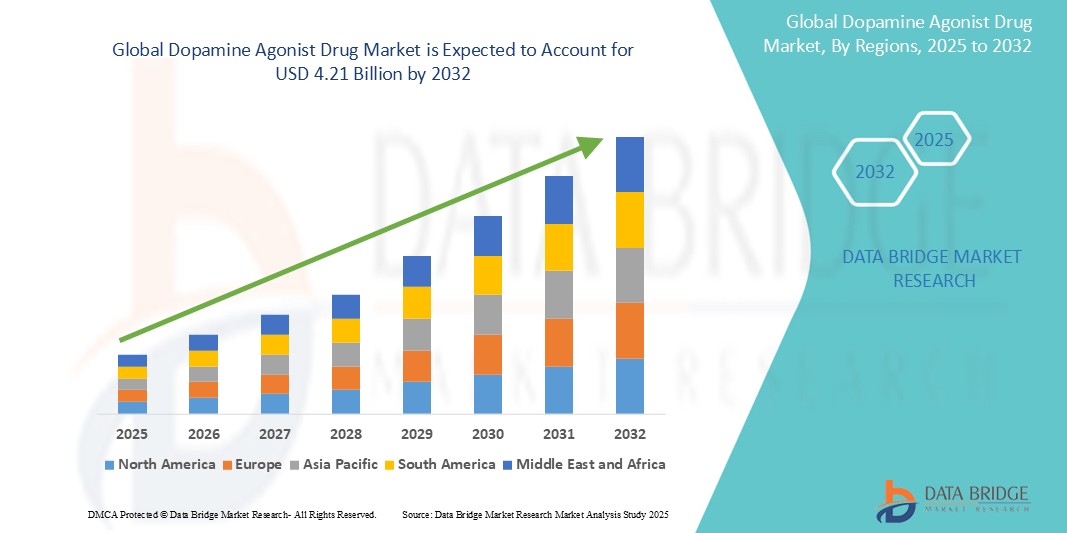
- The global dopamine agonist drug market size was valued at USD 2.9 billion in 2024 and is expected to reach USD 4.21 billion by 2032, at a CAGR of 4.8% during the forecast period
- The market growth is primarily driven by rising prevalence of neurological disorders such as Parkinson’s disease and restless leg syndrome, coupled with increasing geriatric population and advancements in pharmacological research
- In addition, growing awareness regarding early diagnosis and treatment of dopamine-related disorders, along with favorable reimbursement policies and expanding healthcare infrastructure, are expected to further accelerate market growth throughout the forecast period
Dopamine Agonist Drug Market Analysis
- Dopamine agonist drug therapy is primarily used to stimulate dopamine receptors and manage symptoms of neurological disorders such as Parkinson’s disease, restless leg syndrome (RLS), and hyperprolactinemia. It plays a critical role in improving patient mobility, reducing motor symptoms, and enhancing quality of life, making it a cornerstone treatment in neurology
- The escalating demand for dopamine agonist drugs is primarily fueled by the growing prevalence of Parkinson's disease globally, increasing aging population, and continuous advancements in drug formulations and delivery mechanisms
- North America dominates the dopamine agonist drug market with the largest revenue share of 42.21% in 2024, attributed to well-established healthcare infrastructure, high diagnosis rates, presence of major pharmaceutical companies, and favorable reimbursement policies
- Asia-Pacific is expected to be the fastest growing region in the dopamine agonist drug market during the forecast period, with a projected CAGR of 7.5%, fueled by expanding healthcare access, growing geriatric population, increased investments in neurology care, and rising regulatory emphasis on treatment standardization in countries
- Non-ergoline dopamine agonists segment is expected to dominate the dopamine agonist drug market with a market share of 48.2% in 2024, owing to patient preference for non-invasive administration routes, wide availability, and consistent demand for chronic condition management
Report Scope and Dopamine Agonist Drug Market Segmentation
|
Attributes |
Dopamine Agonist Drug Key Market Insights |
|
Segments Covered |
|
|
Countries Covered |
North America
Europe
Asia-Pacific
Middle East and Africa
South America
|
|
Key Market Players |
|
|
Market Opportunities |
|
|
Value Added Data Infosets |
In addition to the insights on market scenarios such as market value, growth rate, segmentation, geographical coverage, and major players, the market reports curated by the Data Bridge Market Research also include depth expert analysis, patient epidemiology, pipeline analysis, pricing analysis, and regulatory framework. |
Dopamine Agonist Drug Market Trends
“Increasing Focus on Personalized and Advanced Dopamine Agonist Therapies”
- A significant and accelerating trend in the global dopamine agonist drug market is the growing emphasis on personalized medicine and advanced drug formulations tailored to individual patient needs, improving therapeutic outcomes and minimizing side effects
- For instance, development of targeted non-ergoline dopamine agonists with fewer adverse effects and customizable dosing regimens is gaining traction among neurologists and patients managing Parkinson’s disease and restless leg syndrome
- Technological advancements such as extended-release formulations, transdermal patches, and novel drug delivery systems are enhancing drug bioavailability and patient compliance, expanding treatment options beyond traditional oral medications
- The integration of digital health tools—including telemedicine platforms, mobile apps for symptom tracking, and AI-based dosage optimization—is enabling real-time monitoring and adjustment of therapy, fostering a more dynamic and responsive care model
- This shift toward patient-centric, technology-enabled therapies is reshaping the dopamine agonist treatment landscape, encouraging pharmaceutical companies to invest in R&D focused on safer, more effective, and more convenient therapeutic options
- As healthcare systems increasingly prioritize precision medicine and value-based care, dopamine agonist drugs aligned with these trends are witnessing robust adoption and fueling market growth globally
Dopamine Agonist Drug Market Dynamics
Driver
“Rising Prevalence of Neurological Disorders and Aging Population”
- The increasing global prevalence of neurological disorders such as Parkinson’s disease, restless leg syndrome, and other dopamine-related conditions, alongside a rapidly aging population, is a major driver for the dopamine agonist drug market
- For instance, dopamine agonists are widely prescribed to manage motor symptoms and improve quality of life in Parkinson’s patients, while also being used to alleviate symptoms in patients with restless leg syndrome and hyperprolactinemia. The aging demographic is particularly vulnerable to these disorders, driving sustained demand for effective therapies
- As healthcare systems focus on chronic disease management and improving patient outcomes, dopamine agonist drugs offer a targeted, pharmacological solution that helps delay disease progression and reduce symptom severity, making them highly valuable in neurological care
- The growing geriatric population worldwide, with increased life expectancy and rising incidence of neurodegenerative diseases, further fuels the need for innovative, safe, and long-term treatment options such as dopamine agonists
- In addition, ongoing advancements in drug formulations, such as extended-release and non-ergoline compounds with improved safety profiles, are expanding patient acceptance and driving broader adoption across clinical settings
Restraint/Challenge
“Side Effects and Safety Concerns Associated with Dopamine Agonist Drugs”
- One of the key challenges in the dopamine agonist drug market is the risk of side effects and safety concerns linked to the use of dopamine agonist medications, which can limit patient compliance and physician prescribing.
- For instance, ergoline-derived dopamine agonists have been associated with adverse effects such as cardiac valvulopathy, fibrosis, hallucinations, and impulse control disorders, raising caution among healthcare providers. Even non-ergoline dopamine agonists, while safer, can cause nausea, dizziness, hypotension, and somnolence, impacting patient quality of life
- In addition, long-term use of dopamine agonists may lead to tolerance or diminished efficacy, requiring careful dose management and monitoring that can complicate treatment regimens
- These safety concerns necessitate rigorous regulatory oversight and patient education, increasing the complexity and cost of therapy management
- Consequently, such adverse effects and the need for close monitoring hinder wider adoption, especially in geriatric patients or those with comorbidities
- Overcoming these barriers through the development of safer drug formulations, enhanced monitoring tools, and physician awareness programs will be crucial to improving market growth and patient outcomes globally
Dopamine Agonist Drug Market Scope
The market is segmented on the basis of type, indication, drugs, route of administration, distribution channel, and end user.
By Type
On the basis of type, the dopamine agonist drug market is segmented into non-ergoline dopamine agonists, ergot-derived dopamine agonists, recombinant factor VIII, and others. The non-ergoline dopamine agonists segment dominated the market with an estimated revenue share of 48.2% in 2024, driven by a better safety profile and increasing preference over ergot derivatives, which have been linked to adverse effects.
The ergot-derived dopamine agonists segment is anticipated to witness the fastest growth rate of 30.7%% from 2025 to 2032 due to the progressive nature of the disease and the continuous need for long-term pharmacological and supportive care.
• By Indication
On the basis of indication, the market is segmented into Parkinson’s disease, restless leg syndrome (RLS), and others. Parkinson’s disease leads the market with 65% revenue share in 2024, driven by the high prevalence of the disease and extensive clinical use of dopamine agonists for motor symptom management.
The restless leg syndrome (RLS) segment is expected to witness the fastest CAGR from 2025 to 2032, fueled by improved awareness, early diagnosis, and growing availability of targeted dopaminergic therapies. As RLS increasingly gains recognition as a serious neurological disorder affecting quality of life, treatment demand is expected to rise steadily.
• By Drugs
On the basis of drugs, the market is categorized into carbidopa and levodopa, ropinirole, pramipexole, cabergoline, bromocriptine, and others. The carbidopa and levodopa combination dominated the market share of with 35% share in 2024, as it remains the gold standard for Parkinson’s disease treatment.
The pramipexole segment is expected to witness the fastest CAGR from 2025 to 2032, owing to its favorable safety profile and dual indication for both Parkinson's and RLS. Its neuroprotective potential and extended-release formulations support its growing adoption among clinicians and patients.
• By Route of Administration
On the basis of route of administration, the market is divided into oral and injectable. The Oral route dominated the market in 2024, owing to ease of administration and patient preference.
The injectable segment is expected to witness the fastest CAGR from 2025 to 2032, due to its importance in advanced-stage treatment, especially for patients with swallowing difficulties or requiring continuous dopaminergic stimulation. Innovations such as subcutaneous pumps and long-acting injectables are further fueling growth in this segment.
• By Distribution Channel
On the basis of distribution channel, the market is segmented into hospital pharmacies and retail pharmacies. Retail pharmacies held the majority share of 56% in 2024, as oral dopamine agonists are widely dispensed for outpatient use.
The Hospital Pharmacies segment is expected to witness the fastest CAGR from 2025 to 2032, supported by the demand for acute care interventions, inpatient dosing, and access to specialty injectable therapies, particularly for advanced Parkinson’s disease
• By End User
On the basis of end user, the market is classified into hospitals, homecare, specialty clinics, and others. The hospitals segment dominated the market with share in 2024, being primary centers for diagnosis and management of neurological disorders.
The homecare segment is expected to witness the fastest CAGR from 2025 to 2032, reflecting a rising preference for personalized care at home, advancements in home-administered therapies, and a growing elderly population that benefits from managed home-based neurological care.
Dopamine Agonist Drug Market Regional Analysis
- North America dominates the global dopamine agonist drug market with the largest revenue share of 42.21% in 2024, driven by stringent regulatory frameworks, high healthcare expenditure, and a strong presence of leading pharmaceutical and medical device companies
- The region’s well‑established healthcare infrastructure, emphasis on quality care, and early adoption of advanced dopamine agonist drug technologies contribute to its market leadership
U.S. Dopamine Agonist Drug Market Insight
The U.S. dopamine agonist drug market captured 83% of North America’s revenue in 2024, fueled by the increasing prevalence of chronic neurological disorders, a rising geriatric population, and growing demand for safe, effective medical treatments. The presence of numerous leading solution providers drives continuous innovation in drug formulations and delivery systems. Moreover, stringent FDA oversight and the rising focus on personalized medicine further bolster market expansion.
Europe Dopamine Agonist Drug Market Insight
The Europe dopamine agonist drug market is projected to expand at a substantial CAGR throughout the forecast period, primarily driven by the adoption of advanced dopamine agonist drugs, growing healthcare expenditure, and rising awareness of non-invasive and targeted treatment alternatives. Stringent regulatory standards set by the European Medicines Agency (EMA) and robust healthcare systems also enhance market growth.
U.K. Dopamine Agonist Drug Market Insight
The U.K. dopamine agonist drug market is anticipated to grow at a noteworthy rate, driven by a strong emphasis on patient safety, rising incidence of neurodegenerative disorders, and expansion of private healthcare facilities. Government-led health improvement initiatives and growing acceptance of advanced therapeutics in neurological care are boosting adoption.
Germany Dopamine Agonist Drug Market Insight
The Germany dopamine agonist drug market is expected to expand at a considerable CAGR, fueled by strong demand for quality-driven medical care, innovation in drug therapies, and a thriving pharmaceutical manufacturing sector. The country’s focus on R&D and healthcare digitization supports the uptake of advanced dopamine agonist drugs, while a growing geriatric population and high incidence of Parkinson’s disease and related disorders further drive utilization.
Asia-Pacific Dopamine Agonist Drug Market Insight
The Asia-Pacific dopamine agonist drug market is poised to grow at the fastest CAGR of 7.5% during the forecast period of 2025 to 2032, driven by rapid expansion of the pharmaceutical and healthcare sectors, rising healthcare investment, and greater regulatory focus on medical innovation in key markets such as China, Japan, and India. Rising disposable incomes, growing awareness of alternative therapies, and increasing medical tourism also underpin strong regional growth.
Japan Dopamine Agonist Drug Market Insight
The Japan dopamine agonist drug market is gaining momentum due to technological advancement in healthcare, a rapidly aging population, and increasing preference for non-invasive treatments. High standards for clinical precision and safety are driving adoption of advanced dopamine agonist drugs. A growing prevalence of neurodegenerative diseases such as Parkinson’s and Alzheimer’s further fuels demand.
China Dopamine Agonist Drug Market Insight
The China dopamine agonist drug market is experiencing substantial growth, supported by rapid industrialization of the healthcare sector, increased government funding, and rising consumer awareness of advanced medical therapies. An expanding middle class and growing healthcare needs are pushing adoption of dopamine agonist drugs in hospitals, specialty clinics, and rehabilitation centers. China’s role as a pharmaceutical manufacturing hub and a high incidence of chronic neurological disorders further bolster market development.
Dopamine Agonist Drug Market Share
The dopamine agonist drug industry is primarily led by well-established companies, including:
- Intas Pharmaceuticals Ltd (India)
- Amarin Corporation plc (U.S.)
- USWM, LLC. (U.S.)
- Kirin Holdings Company, Limited (Japan)
- UCB S.A. (Belgium)
- Bausch Health Companies Inc. (Canada)
- Boehringer Ingelheim International GmbH (Germany)
- Merck & Co., Inc (U.S.)
- Novartis AG (Switzerland)
- Apotex Inc. (Canada)
- Teva Pharmaceutical Industries Ltd (Israel)
- GLENMARK PHARMACEUTICALS LTD. (India)
- Torrent Pharmaceuticals Ltd. (India)
- Sun Pharmaceutical Industries Ltd. (India)
- Dr. Reddy’s Laboratories Ltd (India)
Latest Developments in Global Dopamine Agonist Drug Market
- In December 2024, AbbVie Inc. announced positive topline results from its pivotal Phase III TEMPO-2 trial evaluating tavapadon, a first-in-class D1/D5 partial dopamine agonist, as a flexible-dose monotherapy for early Parkinson’s disease. Tavapadon is being investigated as a once-daily treatment, potentially offering a novel approach to PD management
- In October 2024, Supernus Pharmaceuticals has received FDA approval for ONAPGO, a continuous subcutaneous infusion device delivering apomorphine hydrochloride. This device is designed to manage motor fluctuations in adults with advanced Parkinson’s disease
- In May 2021, AffaMed Therapeutics announced that China's National Medical Products Administration (NMPA) has approved the Clinical Trial Application (CTA) for a Phase IIb global clinical trial led by AffaMed, to evaluate the safety and efficacy of AM006 in patients with early Parkinson’s Disease (PD)
- In January 2019, Ligand Pharmaceuticals Incorporated partner with Seelos Therapeutics, Inc. The companies will focus on the development and commercialization of central nervous system (CNS) therapeutics including dopamine agonists with known mechanisms of action in areas with high unmet medical need

- Interactive Data Analysis Dashboard
- Company Analysis Dashboard for high growth potential opportunities
- Research Analyst Access for customization & queries
- Competitor Analysis with Interactive dashboard
- Latest News, Updates & Trend analysis
- Harness the Power of Benchmark Analysis for Comprehensive Competitor Tracking
Table of Content
1 INTRODUCTION
1.1 OBJECTIVES OF THE STUDY
1.2 MARKET DEFINITION
1.3 OVERVIEW OF GLOBAL DOPAMINE AGONIST DRUGS MARKET
1.4 CURRENCY AND PRICING
1.5 LIMITATION
1.6 MARKETS COVERED
2 MARKET SEGMENTATION
2.1 KEY TAKEAWAYS
2.2 ARRIVING AT THE GLOBAL DOPAMINE AGONIST DRUGS MARKET SIZE
2.2.1 VENDOR POSITIONING GRID
2.2.2 TECHNOLOGY LIFE LINE CURVE
2.2.3 TRIPOD DATA VALIDATION MODEL
2.2.4 MARKET GUIDE
2.2.5 MULTIVARIATE MODELLING
2.2.6 TOP TO BOTTOM ANALYSIS
2.2.7 CHALLENGE MATRIX
2.2.8 APPLICATION COVERAGE GRID
2.2.9 STANDARDS OF MEASUREMENT
2.2.10 VENDOR SHARE ANALYSIS
2.2.11 SALES VOLUME DATA
2.2.12 DATA POINTS FROM KEY PRIMARY INTERVIEWS
2.2.13 DATA POINTS FROM KEY SECONDARY DATABASES
2.3 GLOBAL DOPAMINE AGONIST DRUGS MARKET: RESEARCH SNAPSHOT
2.4 ASSUMPTIONS
3 MARKET OVERVIEW
3.1 DRIVERS
3.2 RESTRAINTS
3.3 OPPORTUNITIES
3.4 CHALLENGES
4 EXECUTIVE SUMMARY
5 PREMIUM INSIGHTS
6 INDUSTRY INSIGHTS
7 EPIDEMIOLOGY
8 REGULATORY FRAMEWORK: GLOBAL DOPAMINE AGONIST DRUGS MARKET
9 PIPELINE ANALYSIS
9.1 PHASE III CANDIDATES
9.2 PHASE II CANDIDATES
9.3 PHASE I CANDIDATES
9.4 OTHERS (PRE-CLINICAL AND RESEARCH)
10 IMPACT OF COVID-19 PANDEMIC ON GLOBAL DOPAMINE AGONIST DRUGS MARKET
10.1 ANALYSIS ON IMPACT OF COVID-19 ON THE MARKET
10.2 AFTERMATH OF COVID-19 AND GOVERNMENT INITIATIVE TO BOOST THE MARKET
10.3 STRATEGIC DECISIONS FOR MANUFACTUERS AFTER COVID-19 TO GAIN COMPETITIVE MARKET SHARE
10.4 PRICE IMPACT
10.5 IMPACT ON DEMAND
10.6 IMPACT ON SUPPLY CHAIN
10.7 CONCLUSION
11 GLOBAL DOPAMINE AGONIST DRUGS MARKET, BY TYPE
11.1 OVERVIEW
11.2 D-1 LIKE DOPAMINE RECEPTORS
11.2.1 D1 RECEPTOR SUBTYPE
11.2.2 D5 RECEPTOR SUBTYPE
11.3 D-2 LIKE DOPAMINE RECEPTORS
11.3.1 D2 RECEPTOR SUBTYPE
11.3.2 D3 RECEPTOR SUBTYPE
11.3.3 D4 RECEPTOR SUBTYPE
12 GLOBAL DOPAMINE AGONIST DRUGS MARKET, BY DRUGS TYPE
12.1 OVERVIEW
12.2 ERGOLINE
12.2.1 BROMOCRIPTINE
12.2.2 CABERGOLINE
12.2.3 LISURIDE
12.2.4 PERGOLIDE
12.2.5 DIHYDROERGOCRYPTINE
12.2.6 OTHERS
12.3 NON-ERGOLINE
12.3.1 CARBIDOPA & LEVODOPA
12.3.2 ROPINIROLE
12.3.3 PRAMIPIXOLE
12.3.4 ROTIGOTINE
12.3.5 APOMORPHINE
12.3.6 PIRIBEDIL
12.3.7 FENOLDOPAM
12.3.8 OTHERS
12.4 OTHERS
13 GLOBAL DOPAMINE AGONIST DRUGS MARKET, BY INDICATION
13.1 OVERVIEW
13.2 PARKINSON’S DISEASE
13.2.1 FAMILIAL PARKINSON’S
13.2.2 EARLY-ONSET PARKINSON’S
13.2.3 SECONDARY PARKINSONISM
13.2.3.1. DEMENTIA WITH LEWY BODIES
13.2.3.2. COTICOABASAL DEGENERATION
13.2.3.3. PROGRESSIVE SUPRANUCLEAR PALSY
13.2.3.4. MULTIPLE SYSTEM ATROPHY
13.3 RESTLESS LEG SYNDROME
13.3.1 MOVEMENT DISORDERS
13.3.2 SLEEP DISORDERS
13.3.3 HYPERKINETIC DISORDERS
13.4 DEPRESSION
13.5 DIABETES
13.6 NEUROLEPTIC MALIGNANT SYNDROME
13.7 HYPERPROLACTINEMIA
13.8 HYPERTENSION
13.9 SCHIZOPHRENIA
13.1 OTHERS
14 GLOBAL DOPAMINE AGONIST DRUGS MARKET, BY ROUTE OF ADMINISTRATION
14.1 OVERVIEW
14.2 ORAL
14.2.1 LIQUID
14.2.2 CAPSULES
14.2.3 TABLETS
14.3 INJECTABLE
14.3.1 SUBCUTANEOUS (UNDER THE SKIN)
14.3.2 INTRAMUSCULAR (IN A MUSCLE)
14.3.3 INTRAVENOUS (IN A VEIN)
15 GLOBAL DOPAMINE AGONIST DRUGS MARKET, BY END USER
15.1 OVERVIEW
15.2 HOSPITAL
15.3 HOMECARE
15.4 SPECIALTY CLINICS
15.5 OTHERS
16 GLOBAL DOPAMINE AGONIST DRUGS MARKET, BY DISTRIBUTION CHANNEL
16.1 OVERVIEW
16.2 PHARMACIES
16.2.1 HOSPITAL
16.2.2 RETAIL
16.2.3 OTHERS
16.3 ONLINE STORES
16.4 OTHERS
17 GLOBAL DOPAMINE AGONIST DRUGS MARKET, COMPANY LANDSCAPE
17.1 COMPANY SHARE ANALYSIS: GLOBAL
17.2 COMPANY SHARE ANALYSIS: NORTH AMERICA
17.3 COMPANY SHARE ANALYSIS: EUROPE
17.4 COMPANY SHARE ANALYSIS: ASIA-PACIFIC
17.5 MERGERS & ACQUISITIONS
17.6 NEW PRODUCT DEVELOPMENT & APPROVALS
17.7 EXPANSIONS
17.8 REGULATORY CHANGES
17.9 PARTNERSHIP AND OTHER STRATEGIC DEVELOPMENTS
18 GLOBAL DOPAMINE AGONIST DRUGS MARKET, BY REGION
GLOBAL DOPAMINE AGONIST DRUGS MARKET, (GLOBAL SEGMENTATION PROVIDED ABOVE IS REPRESENTED IN THIS CHAPTER BY COUNTRY)
18.1 NORTH AMERICA
18.1.1 U.S.
18.1.2 CANADA
18.1.3 MEXICO
18.2 EUROPE
18.2.1 GERMANY
18.2.2 FRANCE
18.2.3 U.K.
18.2.4 ITALY
18.2.5 SPAIN
18.2.6 RUSSIA
18.2.7 TURKEY
18.2.8 BELGIUM
18.2.9 HUNGARY
18.2.10 NETHERLANDS
18.2.11 SWITZERLAND
18.2.12 LITHUANIA
18.2.13 AUSTRIA
18.2.14 IRELAND
18.2.15 NORWAY
18.2.16 POLAND
18.2.17 REST OF EUROPE
18.3 ASIA-PACIFIC
18.3.1 JAPAN
18.3.2 CHINA
18.3.3 SOUTH KOREA
18.3.4 INDIA
18.3.5 AUSTRALIA
18.3.6 SINGAPORE
18.3.7 THAILAND
18.3.8 MALAYSIA
18.3.9 INDONESIA
18.3.10 PHILIPPINES
18.3.11 VIETNAM
18.3.12 REST OF ASIA-PACIFIC
18.4 SOUTH AMERICA
18.4.1 BRAZIL
18.4.2 ARGENTINA
18.4.3 PERU
18.4.4 REST OF SOUTH AMERICA
18.5 MIDDLE EAST AND AFRICA
18.5.1 SOUTH AFRICA
18.5.2 SAUDI ARABIA
18.5.3 UAE
18.5.4 EGYPT
18.5.5 ISRAEL
18.5.6 KUWAIT
18.5.7 REST OF MIDDLE EAST AND AFRICA
18.6 KEY PRIMARY INSIGHTS: BY MAJOR COUNTRIES
19 GLOBAL DOPAMINE AGONIST DRUGS MARKET, SWOT ANALYSIS
20 GLOBAL DOPAMINE AGONIST DRUGS MARKET, COMPANY PROFILE
20.1 GLAXOSMITHKLINE
20.1.1 COMPANY OVERVIEW
20.1.2 REVENUE ANALYSIS
20.1.3 PRODUCT PORTFOLIO
20.1.4 RECENT UPDATES
20.2 INTAS PHARMACEUTICALS LTD
20.2.1 COMPANY OVERVIEW
20.2.2 REVENUE ANALYSIS
20.2.3 PRODUCT PORTFOLIO
20.2.4 RECENT UPDATES
20.3 AMARIN PHARMACEUTICLAS
20.3.1 COMPANY OVERVIEW
20.3.2 REVENUE ANALYSIS
20.3.3 PRODUCT PORTFOLIO
20.3.4 RECENT UPDATES
20.4 ACORDA THERAPEUTICS INC
20.4.1 COMPANY OVERVIEW
20.4.2 REVENUE ANALYSIS
20.4.3 PRODUCT PORTFOLIO
20.4.4 RECENT UPDATES
20.5 US WORLDMEDS
20.5.1 COMPANY OVERVIEW
20.5.2 REVENUE ANALYSIS
20.5.3 GEOGRAPHIC PRESENCE
20.5.4 PRODUCT PORTFOLIO
20.5.5 RECENT UPDATES
20.6 KIRIN HOLDINGS COMPANY LTD
20.6.1 COMPANY OVERVIEW
20.6.2 REVENUE ANALYSIS
20.6.3 GEOGRAPHIC PRESENCE
20.6.4 PRODUCT PORTFOLIO
20.6.5 RECENT UPDATES
20.7 UCB
20.7.1 COMPANY OVERVIEW
20.7.2 REVENUE ANALYSIS
20.7.3 PRODUCT PORTFOLIO
20.7.4 RECENT UPDATES
20.8 BAUSCH HEALTH COMPANIES INC
20.8.1 COMPANY OVERVIEW
20.8.2 REVENUE ANALYSIS
20.8.3 PRODUCT PORTFOLIO
20.8.4 RECENT UPDATES
20.9 BOEHRINGER INGELHEIMCOMPANY OVERVIEW
20.9.1 REVENUE ANALYSIS
20.9.2 PRODUCT PORTFOLIO
20.9.3 RECENT UPDATES
20.1 INTEC PHARMA
20.10.1 COMPANY OVERVIEW
20.10.2 REVENUE ANALYSIS
20.10.3 PRODUCT PORTFOLIO
20.10.4 RECENT UPDATES
20.11 MERCK
20.11.1 COMPANY OVERVIEW
20.11.2 REVENUE ANALYSIS
20.11.3 PRODUCT PORTFOLIO
20.11.4 RECENT UPDATES
20.12 NOVARTIS AG
20.12.1 COMPANY OVERVIEW
20.12.2 REVENUE ANALYSIS
20.12.3 PRODUCT PORTFOLIO
20.12.4 RECENT UPDATES
20.13 SERINA THERAPEUTICS
20.13.1 COMPANY OVERVIEW
20.13.2 REVENUE ANALYSIS
20.13.3 PRODUCT PORTFOLIO
20.13.4 RECENT UPDATES
20.14 APOTEX INC
20.14.1 COMPANY OVERVIEW
20.14.2 REVENUE ANALYSIS
20.14.3 PRODUCT PORTFOLIO
20.14.4 RECENT UPDATES
20.15 TEVA PHARMACEUTICALS INDUSTRIES LTD
20.15.1 COMPANY OVERVIEW
20.15.2 REVENUE ANALYSIS
20.15.3 PRODUCT PORTFOLIO
20.15.4 RECENT UPDATES
20.16 MYLAN NV
20.16.1 COMPANY OVERVIEW
20.16.2 REVENUE ANALYSIS
20.16.3 PRODUCT PORTFOLIO
20.16.4 RECENT UPDATES
20.17 GLENMARK PHARMACEUTICALS
20.17.1 COMPANY OVERVIEW
20.17.2 REVENUE ANALYSIS
20.17.3 PRODUCT PORTFOLIO
20.17.4 RECENT UPDATES
20.18 SUN PHARMACEUTICALS
20.18.1 COMPANY OVERVIEW
20.18.2 REVENUE ANALYSIS
20.18.3 PRODUCT PORTFOLIO
20.18.4 RECENT UPDATES
20.19 DR REDDYS LABORATORIES.
20.19.1 COMPANY OVERVIEW
20.19.2 REVENUE ANALYSIS
20.19.3 PRODUCT PORTFOLIO
20.19.4 RECENT UPDATES
20.2 CIPLA LTD
20.20.1 COMPANY OVERVIEW
20.20.2 REVENUE ANALYSIS
20.20.3 PRODUCT PORTFOLIO
20.20.4 RECENT UPDATES
21 RELATED REPORTS
22 CONCLUSION
23 QUESTIONNAIRE
24 ABOUT DATA BRIDGE MARKET RESEARCH

Data collection and base year analysis are done using data collection modules with large sample sizes. The stage includes obtaining market information or related data through various sources and strategies. It includes examining and planning all the data acquired from the past in advance. It likewise envelops the examination of information inconsistencies seen across different information sources. The market data is analysed and estimated using market statistical and coherent models. Also, market share analysis and key trend analysis are the major success factors in the market report. To know more, please request an analyst call or drop down your inquiry.
The key research methodology used by DBMR research team is data triangulation which involves data mining, analysis of the impact of data variables on the market and primary (industry expert) validation. Data models include Vendor Positioning Grid, Market Time Line Analysis, Market Overview and Guide, Company Positioning Grid, Patent Analysis, Pricing Analysis, Company Market Share Analysis, Standards of Measurement, Global versus Regional and Vendor Share Analysis. To know more about the research methodology, drop in an inquiry to speak to our industry experts.
Data Bridge Market Research is a leader in advanced formative research. We take pride in servicing our existing and new customers with data and analysis that match and suits their goal. The report can be customized to include price trend analysis of target brands understanding the market for additional countries (ask for the list of countries), clinical trial results data, literature review, refurbished market and product base analysis. Market analysis of target competitors can be analyzed from technology-based analysis to market portfolio strategies. We can add as many competitors that you require data about in the format and data style you are looking for. Our team of analysts can also provide you data in crude raw excel files pivot tables (Fact book) or can assist you in creating presentations from the data sets available in the report.













