What is the Drone-as-a-Service (DaaS) Market Size and Growth Rate?
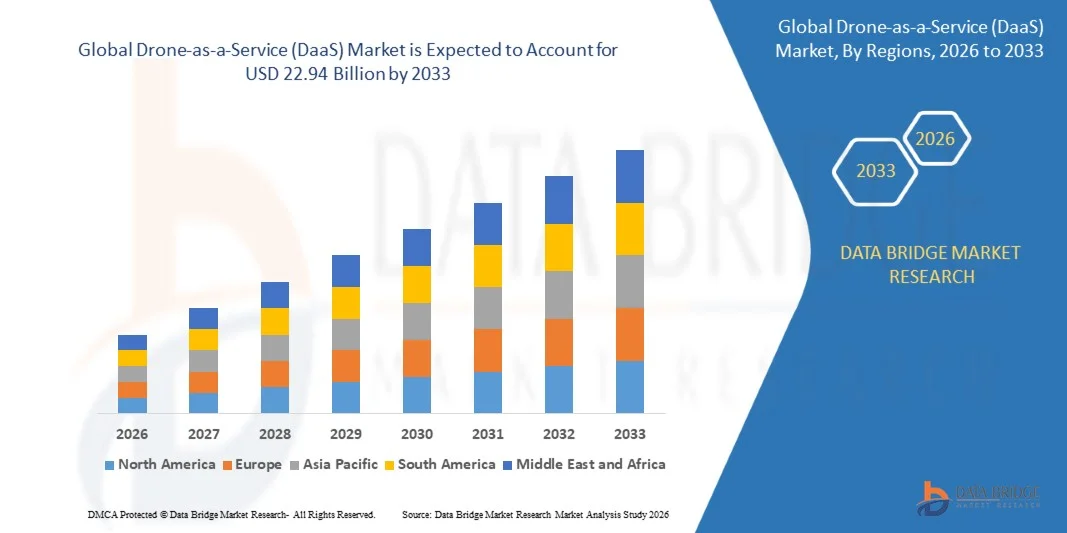
- As per Data Bridge Market Research analysis, the drone-as-a-service market was valued at USD 6.40 billion in 2025 and is projected to reach USD 22.94 billion by 2033, growing at a CAGR of 17.3% from 2026 to 2033.
- The market is experiencing consistent growth driven by rising demand for outsourced aerial data collection, inspection, and delivery services, as enterprises seek to avoid drone ownership, pilot training, and regulatory compliance costs.
- The increasing shift toward subscription-based aerial services, advances in autonomy, artificial intelligence, and beyond visual line of sight operations, and supportive regulatory frameworks are supporting market adoption. Drone-as-a-service is being applied across infrastructure inspection, mapping, precision agriculture, and drone package delivery, offering organizations safer, faster, and lower-cost access to aerial data and logistics through commercial drone fleets operated by specialist providers.
Market Size & Forecast
- Global Market Value (2025): USD 6.40 Billion
- Expected Market Value (2033): USD 22.94 Billion
- Forecast CAGR (2026–2033): 17.3%
- Leading Region in 2025: North America
- Fastest Growing Region: Asia Pacific
What are the Major Takeaways of the Drone-as-a-Service (DaaS) Market?
- North America dominated the drone-as-a-service market with the largest revenue share of 39.22% in 2025, supported by strong adoption of commercial drones, a mature regulatory framework, and rapid growth of drone delivery and infrastructure inspection services.
- Asia-Pacific is expected to be the fastest-growing region at a CAGR of 20.18% from 2026 to 2033, fueled by rapid adoption of agricultural drone services, government support for drone ecosystems, and expanding infrastructure development.
- The rotary-wing segment led the market with a 61.84% share in 2025, driven by increasing adoption of multirotor drones for inspection, mapping, photography, and short-range delivery.
- Hybrid drones are the fastest-growing drone type, projected to register a CAGR of 20.42%, reflecting the surge in demand for vertical takeoff aircraft with longer range and endurance.
- The VLOS segment dominated the operation mode category with a 63.54% revenue share in 2025, led by extensive deployment of drones within operator line of sight under established regulations.
- Inspection & monitoring accounted for 33.76% of the market share in 2025, preferred by increasing need for safe, low-cost inspection of power lines, pipelines, wind turbines, and civil infrastructure.
- The delivery & logistics segment is the fastest-growing service category, with a CAGR of 24.81%, driven by increasing expansion of retail, food, and healthcare drone delivery networks.
Report Scope and Drone-as-a-Service (DaaS) Market Segmentation
|
Attributes |
Drone-as-a-Service (DaaS) Key Market Insights |
|
Segments Covered |
|
|
Countries Covered |
North America
Europe
Asia-Pacific
Middle East and Africa
South America
|
|
Key Market Players |
|
|
Market Opportunities |
|
|
Value Added Data Infosets |
In addition to the market insights such as market value, growth rate, market segments, geographical coverage, market players, and market scenario, the market report curated by the Data Bridge Market Research team includes in-depth expert analysis, import/export analysis, pricing analysis, production consumption analysis, and pestle analysis. |
What is the Key Trend in the Drone-as-a-Service (DaaS) Market?
- Drone-as-a-service is increasingly evolving from piloted, project-based flights into autonomous, subscription-based aerial platforms, combining drones, docking stations, cloud software, and artificial intelligence to deliver recurring data, inspection, and logistics services at scale.
- For instance, in July 2026, according to Zipline, the company had completed more than 2.5 million commercial deliveries, including 1 million in the preceding 12 months, and flown more than 135 million autonomous miles, highlighting the rapid scaling of drone delivery as a service model across multiple countries.
- Artificial intelligence is enabling automated flight planning, defect detection, and analytics, reducing dependence on skilled pilots and allowing service providers to turn raw aerial imagery into actionable insights for customers.
- Regulatory progress toward routine beyond visual line of sight operations is another important trend, as authorities move from case-by-case waivers to standardized authorizations that allow operators to scale remote and automated missions.
- For instance, in August 2025, according to the Federal Register, the U.S. Federal Aviation Administration and Transportation Security Administration published the Part 108 notice of proposed rulemaking, a 731-page framework that would replace waiver-based beyond visual line of sight approvals with a permit and certificate model for routine drone operations.
- As autonomy, docking stations, and regulatory frameworks continue to mature, drone-as-a-service is expected to expand beyond inspection and mapping into continuous monitoring, on-demand logistics, public safety response, and integrated enterprise data workflows.
What are the Key Drivers of the Drone-as-a-Service (DaaS) Market?
- The growing need for cost-effective, safe, and fast aerial data collection has significantly increased demand for outsourced drone services, allowing organizations to access advanced capabilities without investing in fleets, pilots, and compliance infrastructure.
- For instance, in November 2024, according to arXiv, researchers developed an automated UAV trajectory planning method for wind turbine inspection that reduced inspection time by 78% and cut deviations from optimal flight paths by 68% using a PID controller to compensate for wind, demonstrating the efficiency gains of automated drone inspection.
- Energy, construction, agriculture, mining, and logistics companies are adopting drone-as-a-service to reduce worker exposure to hazardous sites, shorten inspection cycles, and improve decision-making through frequent, high-resolution aerial data.
- For instance, in November 2023, according to the Press Information Bureau (Government of India), the Union Cabinet approved a scheme with an outlay of INR 1,261 crore to provide drones to 15,000 women self-help groups for rental services to farmers, with central assistance of 80% of drone cost up to INR 8 lakh.
- With organizations increasingly digitizing field operations, drone-as-a-service can support faster inspections, lower operating costs, and integration with analytics, digital twins, and asset management platforms.
What Factors Are Challenging the Growth of the Drone-as-a-Service (DaaS) Market?
- Drone-as-a-service providers must manage aircraft maintenance, pilot certification, insurance, airspace authorizations, and data security across multiple jurisdictions, increasing operational complexity compared with in-house, single-site drone programs.
- For instance, in July 2026, according to DroneXL, the FAA filed the final Part 108 beyond visual line of sight rule with the White House Office of Information and Regulatory Affairs on July 10, after missing a February 1, 2026 deadline set by Executive Order 14307, prolonging regulatory uncertainty for operators planning scalable remote operations.
- These regulatory and operational requirements can increase service costs and create challenges related to waiver approvals, airspace integration, weather limitations, battery endurance, payload constraints, and community acceptance of noise and privacy.
- Concerns over data security, drone supply chain restrictions, and rules governing flights near critical infrastructure and public venues can also limit where and how services are deployed.
- For instance, in May 2026, according to DroneXL, the FAA proposed a rule creating unmanned aircraft flight restrictions over fixed-site facilities, a requirement ordered by Congress in 2016, illustrating how slowly airspace security rules evolve and the compliance uncertainty providers face when planning operations near critical infrastructure.
- The combination of regulatory uncertainty, operating complexity, limited drone endurance, and economic pressure to match the cost of conventional inspection and delivery methods can constrain adoption among cost-sensitive customers, particularly where manual or ground-based alternatives already meet requirements.
How is the Drone-as-a-Service (DaaS) Market Segmented?
The drone-as-a-service market is segmented on the basis of drone type, operation mode, service type, and end user.
- By Drone Type
On the basis of drone type, the drone-as-a-service market is segmented into rotary-wing, fixed-wing, and hybrid. The rotary-wing segment dominated the market with 61.84% share in 2025, supported by extensive use of multirotor drones for inspection, mapping, photography, and short-range delivery. Rotary-wing aircraft can hover, take off vertically, and operate in confined spaces, making them suitable for structures, construction sites, and urban environments. Their lower cost, ease of operation, and broad payload compatibility expand the customer base. Docking stations and automated flight software are further improving utilization and enabling repeatable, scheduled missions.
The hybrid segment is projected to register the fastest growth at a CAGR of 20.42% from 2026 to 2033, driven by increasing demand for vertical takeoff aircraft that combine hover capability with the range and endurance of fixed-wing designs. Hybrid drones can cover pipelines, power corridors, farmland, and delivery routes without runways or launch equipment. Their applications include long-range inspection, mapping, medical logistics, and parcel delivery. Advances in batteries, propulsion, and detect-and-avoid technology are improving reliability, while certification and airspace integration remain important considerations.
- By Operation Mode
On the basis of operation mode, the drone-as-a-service market is segmented into visual line of sight (VLOS) and beyond visual line of sight (BVLOS). The VLOS segment dominated the market with 63.54% share in 2025, supported by well-established regulations, lower approval complexity, and widespread use in inspection, mapping, construction monitoring, and agricultural spraying. Operators can deploy VLOS missions quickly with smaller crews and lower equipment requirements. Their predictable compliance pathway makes them attractive for enterprises that need dependable services, while availability of trained pilots and mature software tools helps providers scale routine operations.
The BVLOS segment is projected to register the fastest growth at a CAGR of 22.71% from 2026 to 2033, driven by increasing demand for remote, automated operations that lower cost per mission and allow coverage of large assets. BVLOS enables long pipelines, transmission lines, rail corridors, and delivery routes to be served from remote operations centers. Advances in detect-and-avoid systems, command links, and traffic management are improving safety cases. Regulatory initiatives moving from waivers toward standardized permits are creating additional momentum, while cybersecurity and operator accountability remain key considerations.
- By Service Type
On the basis of service type, the drone-as-a-service market is segmented into mapping & surveying, inspection & monitoring, precision agriculture, delivery & logistics, and others. The inspection & monitoring segment dominated the service category with 33.76% share in 2025, supported by increasing need for safe, low-cost inspection of power lines, pipelines, wind turbines, bridges, and industrial facilities. Drones reduce the need for scaffolding, rope access, and manned aircraft while delivering high-resolution visual, thermal, and LiDAR data. Integration with analytics and asset management systems improves maintenance planning, and owners increasingly prefer recurring service contracts.
The delivery & logistics segment is projected to register the fastest growth at a CAGR of 24.81% from 2026 to 2033, driven by increasing expansion of retail, food, and healthcare drone delivery networks. Drone delivery can shorten delivery times, reach remote locations, and reduce emissions compared with vehicle-based last-mile services. Partnerships between drone operators, retailers, and delivery platforms are widening customer access. Improvements in autonomy, payload handling, and fleet management software are supporting higher volumes, while regulatory approvals, community acceptance, and unit economics remain important factors.
- By End User
On the basis of end user, the drone-as-a-service market is segmented into agriculture, construction & infrastructure, energy & utilities, mining, public safety & government, and others. The energy & utilities segment dominated the end-user category with 27.64% share in 2025, supported by increasing requirements for inspection of transmission lines, substations, solar farms, wind turbines, and pipelines. Utilities use drone services to reduce outages, improve worker safety, and meet maintenance requirements. Thermal and LiDAR data help identify faults and vegetation risks early, while growing renewable capacity and aging grid assets create continuing demand for outsourced inspection.
The agriculture segment is projected to register the fastest growth at a CAGR of 21.32% from 2026 to 2033, driven by increasing use of drones for crop spraying, field mapping, and crop health monitoring. Service providers allow farmers to access spraying and imaging capabilities on a pay-per-use basis without buying aircraft. Government support, such as subsidies for drones provided to women self-help groups in India, is widening adoption. Precision application can reduce input use and labor requirements, while seasonal demand, pilot availability, and payload approvals remain important considerations.
Which Region Holds the Largest Share of the Drone-as-a-Service (DaaS) Market?
- North America dominated the drone-as-a-service market with the largest revenue share of 39.22% in 2025, supported by strong adoption of commercial drones, a mature regulatory framework, and rapid growth of drone delivery and infrastructure inspection services.
- The region also benefits from the presence of leading drone operators, retailers, and technology providers, along with active regulatory programs that support beyond visual line of sight trials and delivery expansion. Increasing use of drones for infrastructure inspection, public safety, and e-commerce delivery continues to strengthen North America’s position in the global market.
U.S. Drone-as-a-Service (DaaS) Market Insight
The U.S. drone-as-a-service market is witnessing strong growth due to rising adoption of drone delivery, utility and infrastructure inspection, and enterprise drone programs across retail, energy, construction, and public safety. The country’s large retail and logistics networks, along with increasing partnerships between drone operators and delivery platforms, are driving demand for automated aerial services. In addition, growing emphasis on beyond visual line of sight regulation, docking station automation, and domestic drone supply chains is accelerating adoption of drone-as-a-service across commercial and government applications.
Asia-Pacific Drone-as-a-Service (DaaS) Market Insight
The Asia-Pacific drone-as-a-service market is expected to witness rapid growth, driven by expanding agricultural drone services, rising infrastructure investment, and supportive government programs across countries such as China, India, and Japan. Growing demand for affordable pay-per-use aerial solutions, precision farming, and large-scale inspection is supporting regional market expansion. In addition, the region’s strong drone manufacturing ecosystem and increasing number of service startups are accelerating demand for drone-as-a-service across agriculture, energy, and construction applications.
Japan Drone-as-a-Service (DaaS) Market Insight
The Japan drone-as-a-service market is witnessing consistent growth due to rising use of drones for infrastructure inspection, disaster response, agriculture, and labor shortages caused by an aging workforce. Utilities, construction firms, and local governments are increasingly adopting drone services for safe and efficient asset monitoring. Moreover, strong demand for reliability, supportive regulation for advanced operations, and growing domestic service providers are further contributing to market growth in Japan.
China Drone-as-a-Service (DaaS) Market Insight
The China drone-as-a-service market is growing rapidly, driven by large-scale agricultural spraying, extensive infrastructure networks, and a strong domestic drone manufacturing base. Growing use of drones in farming, power grid inspection, surveying, and emergency response is significantly boosting market demand. In addition, favorable policy support for the low-altitude economy, rapid commercialization of drone delivery, and strong integration with cloud platforms are positioning China as a key growth market for drone-as-a-service across Asia-Pacific.
U.K. Drone-as-a-Service (DaaS) Market Insight
The U.K. drone-as-a-service market is experiencing steady growth, supported by increasing adoption of drones for utility inspection, offshore energy, construction monitoring, and healthcare logistics. Service providers, utilities, and public agencies are increasingly using drones to reduce costs and improve safety in asset inspection. Furthermore, growing support for beyond visual line of sight trials and integration of drones with digital asset management platforms is supporting wider adoption of drone-as-a-service in the U.K.
Germany Drone-as-a-Service (DaaS) Market Insight
The Germany drone-as-a-service market is expanding steadily due to the country’s strong industrial base, advanced energy infrastructure, and growing interest in automated inspection and logistics. Utilities, manufacturers, and infrastructure owners are increasingly utilizing drone services for inspection, surveying, and plant monitoring. Continuous advancements in autonomy, docking stations, and data analytics, along with Germany’s focus on safety and data protection, are further driving market growth in the country.
Which are the Top Companies in Drone-as-a-Service (DaaS) Market?
The drone-as-a-service industry is primarily led by well-established companies, including:
- SZ DJI Technology Co., Ltd. (China)
- Zipline International Inc. (U.S.)
- Wing Aviation LLC (U.S.)
- Skydio, Inc. (U.S.)
- Terra Drone Corporation (Japan)
- Aerodyne Group (Malaysia)
- Garuda Aerospace Pvt. Ltd. (India)
- Flytrex (Israel)
- Matternet, Inc. (U.S.)
- Manna Drone Delivery (Ireland)
- XAG Co., Ltd. (China)
- Wingcopter GmbH (Germany)
- Parrot SA (France)
- DroneDeploy, Inc. (U.S.)
- Cyberhawk Innovations Ltd. (U.K.)
- ideaForge Technology Ltd. (India)
- Amazon Prime Air (U.S.)
- Volatus Aerospace Corp. (Canada)
- Avy B.V. (Netherlands)
- AgEagle Aerial Systems Inc. (U.S.)
What are Latest Developments in Drone-as-a-Service (DaaS) Market?
- In August 2026, Uber and Zipline announced a strategic partnership to bring Zipline drone deliveries to Uber Eats across the U.S., with first deployments expected in Dallas and Houston before the end of 2026. The companies set a target of one million drone deliveries per day by the end of 2029, and Uber will make an undisclosed strategic investment in Zipline as part of the arrangement.
- In May 2026, Walmart announced that it had passed one million cumulative drone deliveries across 66 stores in four U.S. states, using aircraft from both Wing and Zipline. The milestone highlights the growing role of drone delivery services in retail logistics and the shift of drone delivery from pilot programs to scaled commercial operations across multiple metropolitan markets.
- In January 2026, Zipline announced that it had raised USD 600 million in a new funding round, valuing the company at USD 7.6 billion, with participation from Fidelity Management & Research Company, Baillie Gifford, Valor Equity Partners, and Tiger Global. The company said it had surpassed two million commercial deliveries and planned to expand to Houston and Phoenix in early 2026.
- In April 2025, Garuda Aerospace, an Indian company that offers drone-as-a-service alongside drone manufacturing, announced a Series B funding round of INR 100 crore led by Venture Catalysts, placing its valuation at USD 250 million. The funds are directed toward expanding production facilities, defense drone research and development, and establishing a new design centre.
- In November 2024, Skydio, a U.S. drone manufacturer serving public safety, utility, and defense customers, raised a USD 170 million extension round, adding to the USD 230 million Series E it had closed earlier. The funding reflects growing investor interest in autonomous drone platforms that underpin enterprise inspection, monitoring, and drone-as-a-service deployments.

- Interactive Data Analysis Dashboard
- Company Analysis Dashboard for high growth potential opportunities
- Research Analyst Access for customization & queries
- Competitor Analysis with Interactive dashboard
- Latest News, Updates & Trend analysis
- Harness the Power of Benchmark Analysis for Comprehensive Competitor Tracking
Data collection and base year analysis are done using data collection modules with large sample sizes. The stage includes obtaining market information or related data through various sources and strategies. It includes examining and planning all the data acquired from the past in advance. It likewise envelops the examination of information inconsistencies seen across different information sources. The market data is analysed and estimated using market statistical and coherent models. Also, market share analysis and key trend analysis are the major success factors in the market report. To know more, please request an analyst call or drop down your inquiry.
The key research methodology used by DBMR research team is data triangulation which involves data mining, analysis of the impact of data variables on the market and primary (industry expert) validation. Data models include Vendor Positioning Grid, Market Time Line Analysis, Market Overview and Guide, Company Positioning Grid, Patent Analysis, Pricing Analysis, Company Market Share Analysis, Standards of Measurement, Global versus Regional and Vendor Share Analysis. To know more about the research methodology, drop in an inquiry to speak to our industry experts.
Data Bridge Market Research is a leader in advanced formative research. We take pride in servicing our existing and new customers with data and analysis that match and suits their goal. The report can be customized to include price trend analysis of target brands understanding the market for additional countries (ask for the list of countries), clinical trial results data, literature review, refurbished market and product base analysis. Market analysis of target competitors can be analyzed from technology-based analysis to market portfolio strategies. We can add as many competitors that you require data about in the format and data style you are looking for. Our team of analysts can also provide you data in crude raw excel files pivot tables (Fact book) or can assist you in creating presentations from the data sets available in the report.