


What is the Dual Fuel Engine Market Size and Growth Rate?
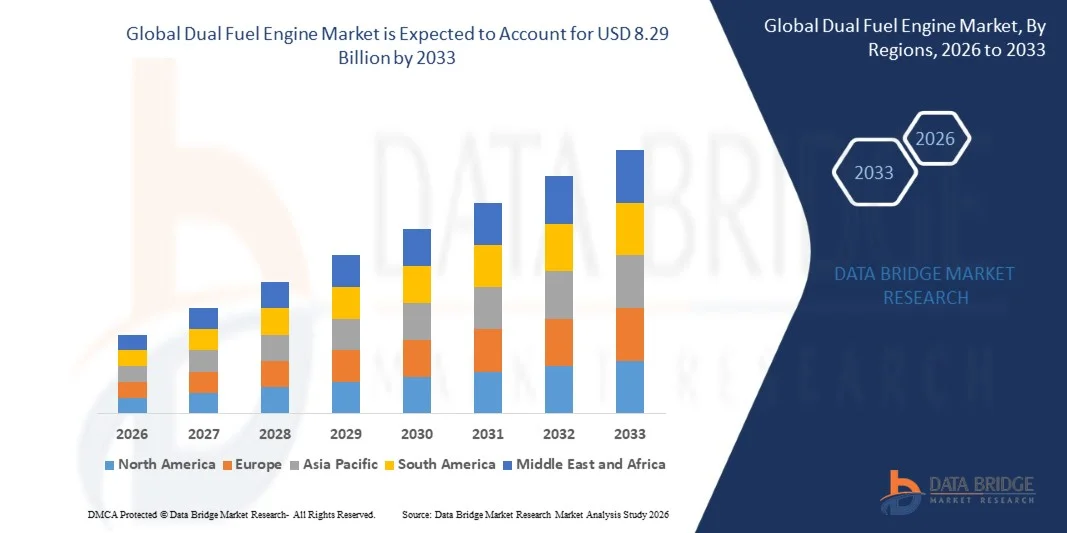
- As per Data Bridge Market Research analysis, the dual fuel engine market was valued at USD 4.90 billion in 2025 and is projected to reach USD 8.29 billion by 2033, growing at a CAGR of 6.80% from 2026 to 2033.
- The market is experiencing consistent growth driven by rising demand for fuel-flexible and low-emission engine technologies, increasing adoption of natural gas and LNG as alternative fuels, and expanding applications across marine transportation, power generation, oil and gas, and industrial sectors.
- The increasing implementation of stringent emission regulations globally, combined with growing efforts to reduce fuel costs and carbon emissions, is compelling marine operators, power producers, and industrial users to adopt dual fuel engines. Advanced four-stroke and two-stroke systems are increasingly replacing conventional single-fuel engines, offering greater fuel flexibility, operational efficiency, and the ability to transition toward cleaner fuels while maintaining reliable engine performance.
Market Size & Forecast
- Global Market Value (2025): USD 4.90 Billion
- Expected Market Value (2033): USD 8.29 Billion
- Forecast CAGR (2026–2033): 6.80%
- Leading Region in 2025: North America
- Fastest Growing Region: Asia Pacific
What are the Major Takeaways of the Dual Fuel Engine Market?
- North America dominated the dual fuel engine market with the largest revenue share of 32.4% in 2025, supported by well-established natural gas infrastructure, stringent emission regulations, and increasing adoption of fuel-flexible engine technologies across marine, power generation, and industrial applications.
- Asia-Pacific is expected to be the fastest-growing region at a CAGR of 5.2% from 2026 to 2033, fueled by expanding maritime activity, increasing LNG infrastructure, rapid industrialization, and rising adoption of cleaner fuel technologies across China, Japan, South Korea, and India
- The diesel–LNG segment led the market with a 46% share in 2025, driven by its established adoption across marine propulsion, power generation, and industrial applications.
- Diesel–hydrogen are the fastest-growing fuel type, projected to register a CAGR of 12%, reflecting the surge in investments in hydrogen-based decarbonization technologies.
- The compression ignition segment dominated the technology category with a 60% revenue share in 2025, led by its extensive use across marine propulsion, power generation, oil & gas, and industrial applications
- Marine accounted for 38.7% of the market share in 2025, preferred by increasing adoption of lower-emission propulsion systems and stricter maritime emissions requirements.
- The two-stroke segment is the fastest-growing engine type category, with a CAGR of 9%, driven by increasing adoption in large ocean-going vessels
Report Scope and Dual Fuel Engine Market Segmentation
Attributes |
Dual Fuel Engine Key Market Insights |
|
Segments Covered |
|
|
Countries Covered |
North America
Europe
Asia-Pacific
Middle East and Africa
South America
|
|
Key Market Players |
|
|
Market Opportunities |
|
|
Value Added Data Infosets |
In addition to the market insights such as market value, growth rate, market segments, geographical coverage, market players, and market scenario, the market report curated by the Data Bridge Market Research team includes in-depth expert analysis, import/export analysis, pricing analysis, production consumption analysis, and pestle analysis. |
What is the Key Trend in the Dual Fuel Engine Market?
- Dual-fuel engine manufacturers are increasingly developing multi-fuel platforms capable of operating with LNG, methanol, ammonia, hydrogen, and other lower-carbon fuels, allowing shipowners and power producers to future-proof long-life engine assets while maintaining fuel flexibility.
- For instance, in February 2025, MITSUI E&S began full-scale testing of the world’s first commercial two-stroke dual-fuel ammonia engine, the MAN B&W 7S60ME-LGIA, which is planned for installation on a 200,000-dwt bulk carrier, demonstrating the industry’s shift toward ammonia-capable dual-fuel propulsion.
- Engine manufacturers are increasingly integrating advanced combustion controls and fuel-management systems to improve efficiency, reduce emissions, and enable reliable switching between conventional and alternative fuels during vessel or power-plant operations.
- Marine operators are accelerating adoption of alternative-fuel engines as LNG, methanol, ammonia, and hydrogen-ready technologies become increasingly available for newbuild vessels and engine-conversion projects.
- For instance, in November 2024, Reuters reported that 522 dual-fuel container ships were on order as of October 2024, including 303 LNG-fuelled and 216 methanol-fuelled vessels, highlighting the growing adoption of fuel-flexible engines as shipping companies prepare for the transition toward lower-carbon fuels.
- As shipping and power-generation industries increasingly prioritize fuel flexibility, emissions reduction, and long-term asset adaptability, multi-fuel dual-fuel platforms are expected to become an increasingly important pathway for the transition toward cleaner energy systems.
What are the Key Drivers of the Dual Fuel Engine Market?
- The tightening of global emissions regulations and decarbonization targets is significantly increasing demand for dual-fuel engines that can operate on cleaner fuels while retaining conventional-fuel capability for operational reliability.
- For instance, in April 2025, the International Maritime Organization (IMO) approved draft Net-Zero Framework regulations introducing mandatory greenhouse-gas fuel standards and global emissions pricing for large ocean-going ships, strengthening the regulatory push toward cleaner fuels and accelerating demand for dual-fuel engine technologies.
- Shipowners, utilities, and industrial operators are integrating dual-fuel systems to lower emissions, improve fuel flexibility, reduce exposure to fuel-price volatility, and maintain reliable operations as alternative-fuel availability expands.
- For instance, in June 2024, Wärtsilä reported that LNG produces 20–30% less CO₂ than heavy fuel oil when burned and that methane slip from its dual-fuel engines had been reduced by around 90% since 1993, reaching below 2 grams per kWh, supporting the adoption of LNG-capable dual-fuel engines for lower-emission marine operations
- With maritime and energy industries increasingly transitioning toward lower-carbon fuels while requiring dependable power and propulsion, dual-fuel engines will remain an important technology for balancing decarbonization objectives with operational flexibility.
Which Factors are Challenging the Growth of the Dual Fuel Engine Market?
- The environmental performance of LNG-based dual-fuel engines remains challenged by methane slip, in which unburned methane escapes through the exhaust and can reduce the overall greenhouse-gas benefits of switching from conventional marine fuels.
- For instance, in March 2024, MAN Energy Solutions announced that ammonia-fuelled ship engines would require further trial phases, infrastructure development, and stringent safety measures because ammonia is toxic, while green ammonia production was not expected to scale significantly before 2030, highlighting the high infrastructure and technology requirements associated with next-generation dual-fuel engines
- This challenge is particularly significant for low-pressure four-stroke engines operating at lower loads, where methane emissions can increase substantially and require advanced combustion controls and after-treatment technologies.
- The development of methane-reduction technologies, onboard monitoring systems, and alternative fuels such as ammonia and hydrogen increases technology complexity and can raise engine development, installation, fuel-storage, and maintenance costs.
- For instance, in March 2024, Reuters reported that the shipping industry was facing uncertainty over alternative-fuel investments because different fuel options, infrastructure requirements, and emerging emissions regulations were complicating decisions on future vessel and engine technologies
- These technical, economic, and infrastructure challenges can slow adoption, particularly where LNG bunkering or alternative-fuel supply networks remain limited and operators face uncertainty regarding the long-term availability and cost of cleaner fuels
How is the Dual Fuel Engine Market Segmented?
The dual fuel engine market is segmented on the basis of fuel type, technology, application, and engine type.
- By Fuel Type
On the basis of fuel type, the dual fuel engine market is segmented into diesel–natural gas, diesel–LNG, diesel–LPG, diesel–hydrogen, diesel–biogas, gasoline–CNG/LPG, and other fuel combinations. The diesel–LNG segment dominated the market with 46% share in 2025, owing to its established adoption across marine propulsion, power generation, and industrial applications. LNG offers lower emissions than conventional marine fuels while allowing engines to retain conventional-fuel capability. The availability of LNG bunkering infrastructure is also supporting deployment across commercial shipping. Major vessel operators are increasingly selecting LNG-capable dual-fuel engines to comply with tightening emissions requirements. The technology provides fuel flexibility while supporting improved operating efficiency.
The diesel–hydrogen segment is projected to register the fastest growth at CAGR of 12% during the forecast period, driven by increasing investments in hydrogen-based decarbonization technologies. Hydrogen can significantly reduce carbon emissions when used as a supplementary or replacement fuel in combustion engines. Engine manufacturers are developing hydrogen-capable platforms that retain diesel as a pilot or backup fuel. This configuration provides operational flexibility while hydrogen infrastructure continues to expand. Demand is emerging across marine propulsion, power generation, heavy-duty transportation, and industrial applications. Government support for hydrogen production and clean-energy infrastructure is further encouraging development.
- By Technology
On the basis of technology, the dual fuel engine market is segmented into compression ignition and spark ignition. The compression ignition segment dominated the market with 60% share in 2025, supported by its extensive use across marine propulsion, power generation, oil & gas, and industrial applications. Compression-ignition dual-fuel engines generally use diesel as a pilot fuel to ignite natural gas or another gaseous fuel. This configuration enables substantial substitution of conventional diesel while maintaining reliable engine operation. The technology is particularly suitable for high-load applications requiring strong torque, durability, and continuous performance. Existing diesel-engine platforms can also be adapted for dual-fuel operation, supporting retrofit opportunities.
The spark ignition segment is projected to register the fastest growth at CAGR of 8% during the forecast period, supported by increasing deployment of gaseous-fuel engines in stationary and distributed power applications. Spark-ignition systems are well suited to natural gas, hydrogen, and biogas because these fuels can be effectively combusted through controlled ignition. Growing demand for lower-emission electricity generation is encouraging their adoption in commercial and industrial facilities. Advances in electronic engine controls are improving combustion management and operational efficiency. Increasing availability of renewable gases and hydrogen is creating additional opportunities for this technology. The segment is also benefiting from growing demand for flexible distributed generation.
- By Application
On the basis of application, the dual fuel engine market is segmented into marine, power generation, oil & gas, industrial, automotive, mining & construction, and others. The marine segment dominated the market with 38.7% share in 2025, driven by increasing adoption of lower-emission propulsion systems and stricter maritime emissions requirements. Dual-fuel engines allow vessels to operate using LNG and other alternative fuels while retaining conventional-fuel capability. Shipping companies are increasingly investing in dual-fuel vessels to address decarbonization requirements and improve fuel flexibility. LNG-capable engines are being deployed across container ships, tankers, bulk carriers, LNG carriers, and other commercial vessels. Expanding alternative-fuel bunkering infrastructure is further supporting marine adoption.
The power generation segment is projected to register the fastest growth at CAGR of 8% during the forecast period, driven by rising electricity demand and increasing requirements for flexible, lower-emission generation. Dual-fuel engines allow power producers to switch between natural gas, diesel, and other fuels according to availability and operating conditions. They are increasingly suitable for distributed generation, backup power, captive generation, and remote power applications. Natural gas availability in major markets improves the attractiveness of gas-capable generation systems. Integration of renewable electricity is also increasing demand for flexible generation that can compensate for intermittent renewable output. Increasing investments in resilient and cleaner power infrastructure are creating additional opportunities.
- By Engine Type
On the basis of engine type, the dual fuel engine market is segmented into four-stroke and two-stroke. The four-stroke segment dominated the market with a 52% share in 2025, supported by widespread adoption across power generation, commercial marine vessels, oil & gas operations, and industrial applications. Four-stroke engines provide strong fuel flexibility and are suitable for medium-speed and high-speed operating requirements. They are widely used in generator sets and auxiliary marine propulsion systems where reliability and flexible operation are important. Established manufacturing and maintenance infrastructure also supports their adoption. Continuous improvements in combustion technologies, digital engine management, and emission-control systems are strengthening their performance
The two-stroke segment is projected to register the fastest growth at CAGR of 9% during the forecast period, primarily due to increasing adoption in large ocean-going vessels. Two-stroke engines provide high propulsion efficiency and are particularly suitable for ships requiring substantial power over extended operating periods. Leading manufacturers are developing two-stroke platforms capable of operating with LNG, methanol, ammonia, and other alternative fuels. Growing orders for alternative-fuel container ships, tankers, bulk carriers, and gas carriers are creating strong demand. The transition toward ammonia and methanol as marine fuels is further encouraging investment in next-generation two-stroke technology. Increasing pressure to reduce shipping emissions is expected to accelerate deployment.
Which Region Holds the Largest Share of the Dual Fuel Engine Market?
- North America dominated the dual fuel engine market with the largest revenue share of 32.4% in 2025, supported by well-established natural gas infrastructure, stringent emission regulations, and increasing adoption of fuel-flexible engine technologies across marine, power generation, and industrial applications.
- The region also benefits from stringent emissions regulations, strong demand for fuel-efficient propulsion systems, and growing investments in LNG and alternative-fuel technologies. Increasing focus on reducing carbon emissions and improving engine efficiency across maritime, energy, and industrial sectors continues to strengthen North America’s leadership position in the global market.
U.S. Dual Fuel Engine Market Insight
The U.S. dual fuel engine market is witnessing strong growth due to rising investments in cleaner energy systems, natural gas infrastructure, and advanced engine technologies. The country’s established energy, maritime, and industrial ecosystem, along with increasing adoption of LNG- and hydrogen-capable engine systems, is driving demand across power generation, marine, oil & gas, and industrial applications. In addition, growing emphasis on reducing emissions and improving fuel efficiency is accelerating dual fuel engine adoption across energy companies, fleet operators, and industrial facilities.
Asia-Pacific Dual Fuel Engine Market Insight
The Asia-Pacific dual fuel engine market is expected to witness rapid growth, driven by expanding maritime transportation, increasing industrialization, and rising investments in cleaner power-generation infrastructure across countries such as China, Japan, South Korea, and India. Growing adoption of LNG-powered engines, rising environmental awareness, and increasing demand for efficient propulsion systems are supporting regional market expansion. In addition, the strong presence of shipbuilding industries, energy companies, and manufacturing facilities is accelerating dual fuel engine adoption across marine, industrial, and power-generation sectors.
Japan Dual Fuel Engine Market Insight
The Japan dual fuel engine market is witnessing consistent growth due to rising investments in cleaner marine propulsion, advanced engine technologies, and energy-efficiency initiatives. Shipping companies, shipbuilders, power-generation operators, and industrial organizations are increasingly adopting dual fuel engines to improve fuel flexibility, reduce emissions, and enhance operational efficiency. Moreover, increasing development of LNG-, ammonia-, and hydrogen-capable technologies and the country’s focus on low-carbon maritime transportation are further contributing to market growth.
China Dual Fuel Engine Market Insight
The China dual fuel engine market is growing rapidly, driven by expanding maritime transportation, increasing industrial activity, and rising government focus on cleaner energy and emissions reduction. Growing adoption of LNG-, methanol-, ammonia-, and other alternative-fuel engine technologies across marine, power generation, and industrial sectors is significantly boosting market demand. In addition, rising investments in shipbuilding, energy infrastructure, advanced engine manufacturing, and low-carbon technologies are positioning China as one of the fastest-growing markets for dual fuel engines globally.
U.K. Dual Fuel Engine Market Insight
The U.K. dual fuel engine market is experiencing steady growth, supported by rising adoption of cleaner propulsion technologies in maritime, power generation, and industrial applications. Increasing investments in alternative-fuel infrastructure and growing demand for fuel-flexible, efficient engine systems are contributing to market growth. Furthermore, integration of LNG, hydrogen, ammonia, and advanced digital engine-management technologies is improving operational efficiency and emissions performance, positioning the U.K. as a key innovation hub in the dual fuel engine industry.
Germany Dual Fuel Engine Market Insight
The Germany dual fuel engine market is expanding steadily due to the country’s strong industrial base, advanced engineering capabilities, and increasing adoption of next-generation alternative-fuel technologies. Marine operators, power-generation companies, industrial manufacturers, and engine developers are increasingly utilizing dual fuel systems to improve fuel flexibility, efficiency, and emissions performance. Continuous advancements in hydrogen, ammonia, LNG, and digital engine technologies, along with strong government focus on decarbonization and energy efficiency, are further driving market growth in Germany.
Which are the Top Companies in Dual Fuel Engine Market?
The dual fuel engine industry is primarily led by well-established companies, including:
- MAN Energy Solutions SE (Germany)
- Wärtsilä Corporation (Finland)
- WinGD Ltd. (Switzerland)
- Caterpillar Inc. (U.S.)
- YANMAR HOLDINGS CO., LTD. (Japan)
- Rolls-Royce plc (U.K.)
- Bergen Engines AS (Norway)
- DEUTZ AG (Germany)
- Kawasaki Heavy Industries, Ltd. (Japan)
- Mitsubishi Heavy Industries, Ltd. (Japan)
- IHI Power Systems Co., Ltd. (Japan)
- Mitsui E&S Co., Ltd. (Japan)
- Mitsui E&S DU Co., Ltd. (Japan)
- Doosan Enerbility Co., Ltd. (South Korea)
- Makita Corporation (Japan)
- Anglo Belgian Corporation nv (Belgium)
- Daihatsu Diesel Co., Ltd. (Japan)
- Fairbanks Morse Defense (U.S.)
- HD Hyundai Heavy Industries Co., Ltd. (South Korea)
- CSSC-MES Diesel Co., Ltd. (China)
What are Latest Developments in Dual Fuel Engine Market?
- In February 2025, MAN Energy Solutions and MITSUI E&S announced the commencement of full-scale testing of the world’s first commercial two-stroke, dual-fuel ammonia engine. The MAN B&W 7S60ME-LGIA Mk 10.5 prototype began ammonia-fuel testing at MITSUI E&S’s Tamano Factory in Japan, marking an important step toward commercial deployment of ammonia-powered marine engines. The development supports the maritime industry’s transition toward lower-carbon fuels while maintaining dual-fuel operating capability.
- In August 2024, Wärtsilä signed an agreement with Eidesvik Offshore to convert the Viking Energy platform supply vessel to operate on ammonia fuel. The project involves supplying the equipment required to retrofit the vessel for ammonia operation, with the conversion scheduled for 2026. The initiative is expected to make Viking Energy the world’s first in-service ammonia-fuelled vessel, demonstrating the expanding application of dual-fuel technology for lower-emission maritime operations.
- In November 2023, Wärtsilä introduced the marine sector’s first commercially available four-stroke engine-based solution for ammonia fuel. The ammonia solution was developed around the Wärtsilä 25 engine platform and was designed to provide ship operators with a fuel-flexible pathway toward lower-emission operations. The development strengthened the company’s portfolio of multi-fuel engine technologies and expanded the commercial availability of ammonia-capable dual-fuel systems.
- In September 2022, Wärtsilä advanced its fuel-flexible engine portfolio with the Wärtsilä 25, a next-generation medium-speed marine engine designed for multiple fuel options. The platform was developed to support adaptable power generation and future fuel transitions, with versions available for diesel, LNG, and ammonia applications. Its modular architecture enables marine operators to adopt cleaner fuels while maintaining operational flexibility, supporting the broader shift toward multi-fuel propulsion technologies.
- In March 2021, MAN Energy Solutions demonstrated its ME-GA engine technology, advancing the development of gas-fuelled dual-fuel propulsion for the maritime industry. The ME-GA platform was developed to provide efficient operation using gas while retaining the flexibility associated with dual-fuel engine technology. The demonstration supported wider adoption of lower-emission marine propulsion and strengthened the availability of gas-based alternatives to conventional marine fuels.

- Interactive Data Analysis Dashboard
- Company Analysis Dashboard for high growth potential opportunities
- Research Analyst Access for customization & queries
- Competitor Analysis with Interactive dashboard
- Latest News, Updates & Trend analysis
- Harness the Power of Benchmark Analysis for Comprehensive Competitor Tracking
Data collection and base year analysis are done using data collection modules with large sample sizes. The stage includes obtaining market information or related data through various sources and strategies. It includes examining and planning all the data acquired from the past in advance. It likewise envelops the examination of information inconsistencies seen across different information sources. The market data is analysed and estimated using market statistical and coherent models. Also, market share analysis and key trend analysis are the major success factors in the market report. To know more, please request an analyst call or drop down your inquiry.
The key research methodology used by DBMR research team is data triangulation which involves data mining, analysis of the impact of data variables on the market and primary (industry expert) validation. Data models include Vendor Positioning Grid, Market Time Line Analysis, Market Overview and Guide, Company Positioning Grid, Patent Analysis, Pricing Analysis, Company Market Share Analysis, Standards of Measurement, Global versus Regional and Vendor Share Analysis. To know more about the research methodology, drop in an inquiry to speak to our industry experts.
Data Bridge Market Research is a leader in advanced formative research. We take pride in servicing our existing and new customers with data and analysis that match and suits their goal. The report can be customized to include price trend analysis of target brands understanding the market for additional countries (ask for the list of countries), clinical trial results data, literature review, refurbished market and product base analysis. Market analysis of target competitors can be analyzed from technology-based analysis to market portfolio strategies. We can add as many competitors that you require data about in the format and data style you are looking for. Our team of analysts can also provide you data in crude raw excel files pivot tables (Fact book) or can assist you in creating presentations from the data sets available in the report.













