What is the Dynamically Tuned Gyroscopes Market Size and Growth Rate?
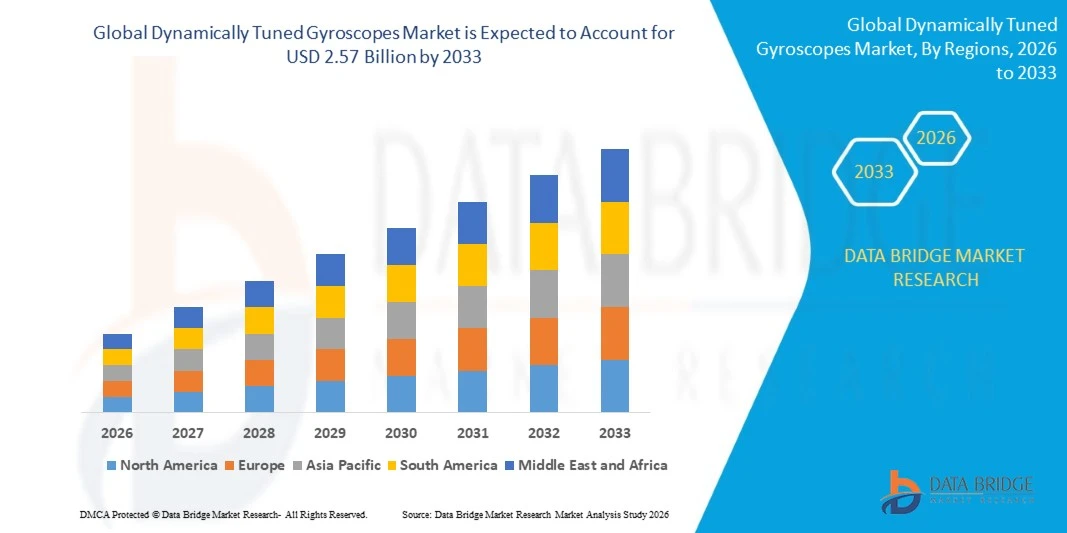
- As per Data Bridge Market Research analysis, the dynamically tuned gyroscopes market was valued at USD 1.59 billion in 2025 and is projected to reach USD 2.57 billion by 2033, growing at a CAGR of 6.20% from 2026 to 2033.
- The market is experiencing consistent growth driven by rising demand for accurate inertial navigation systems, advancements in gyroscope technology, and expanding applications across aircraft navigation, missile guidance, spacecraft, and unmanned aerial vehicles.
- The growing need for reliable navigation in GPS-denied environments, coupled with increasing investments in aerospace and defense modernization, is encouraging the adoption of dynamically tuned gyroscopes. These precision instruments support aircraft navigation, missile guidance, spacecraft orientation, and unmanned aerial vehicle stabilization, enabling accurate motion sensing and dependable performance in demanding operational conditions.
Market Size & Forecast
- Global Market Value (2025): USD 1.59 Billion
- Expected Market Value (2033): USD 2.57 Billion
- Forecast CAGR (2026–2033): 6.20%
- Leading Region in 2025: North America
- Fastest Growing Region: Asia Pacific
What are the Major Takeaways of the Dynamically Tuned Gyroscopes Market?
- North America dominated the dynamically tuned gyroscopes market with the largest revenue share of 38.2% in 2025, supported by strong defense procurement, advanced aerospace manufacturing, and investments in precision navigation technologies
- Asia-Pacific is expected to be the fastest-growing region at a CAGR of 8.45% from 2026 to 2033, fueled by expanding semiconductor manufacturing, defense modernization, and increasing demand for precision navigation systems.
- The analog segment led the market with a 55% share in 2025, driven by established use in conventional inertial navigation and stabilization systems
- Digital are the fastest-growing output type, projected to register a CAGR of 6.0%, reflecting the surge in integration of gyroscopes with computerized navigation and control systems.
- The 3-axis segment dominated the dimensions category with a 45% revenue share in 2025, led by demand for comprehensive angular-motion measurement in advanced navigation and stabilization systems
- Internal navigation sensors accounted for 32.5% of the market share in 2025, preferred by the established role of dynamically tuned gyroscopes in precision inertial navigation
- The brake force sensors and suspension control accelerometers segment is the fastest-growing application category, with a CAGR of 6.5%, driven by the broader adoption of electronic vehicle control and advanced chassis technologies.
Report Scope and Dynamically Tuned Gyroscopes Market Segmentation
|
Attributes |
Dynamically Tuned Gyroscopes Key Market Insights |
|
Segments Covered |
|
|
Countries Covered |
North America
Europe
Asia-Pacific
Middle East and Africa
South America
|
|
Key Market Players |
|
|
Market Opportunities |
|
|
Value Added Data Infosets |
In addition to the insights on market scenarios such as market value, growth rate, segmentation, geographical coverage, and major players, the market reports curated by the Data Bridge Market Research also include in-depth expert analysis, geographically represented company-wise production and capacity, network layouts of distributors and partners, detailed and updated price trend analysis and deficit analysis of supply chain and demand. |
What is the Key Trend in the Dynamically Tuned Gyroscopes Market?
- Manufacturers are increasingly focusing on high-precision dynamically tuned gyroscopes to improve navigation accuracy, spacecraft orientation, and stabilization performance while supporting reliable operations in demanding aerospace and defense environments.
- For instance, in March 2023, TDK Corporation introduced the GYPRO4300 high-stability digital MEMS gyroscope, featuring a measurement range of ±300°/s, 200 Hz bandwidth, and 1 ms latency, highlighting the industry's shift toward compact, vibration-resistant gyroscopes for precision navigation and stabilization applications.
- High-accuracy inertial sensing enables engineers to measure angular motion and maintain stable navigation performance during spacecraft maneuvers, aircraft operations, and other precision-guidance applications.
- Aerospace manufacturers and defense organizations are prioritizing compact, reliable inertial sensors for applications requiring accurate motion measurement, operational stability, and dependable performance under challenging conditions.
- For instance, in September 2024, Inertial Labs introduced its TAG-307 and TAG-207 tactical-grade MEMS gyroscopes for three-axis and two-axis stabilization, respectively, reflecting growing demand for compact, high-performance sensing solutions in guidance, navigation, electro-optical systems, and precision pointing applications
- As aerospace and defense platforms increasingly require precise motion sensing and reliable navigation, advances in dynamically tuned gyroscopes are expected to support continued demand for accurate inertial measurement and stabilization technologies.
What are the Key Drivers of the Dynamically Tuned Gyroscopes Market?
- The growing need for precise navigation and stabilization in aerospace and defense platforms is increasing demand for dynamically tuned gyroscopes capable of delivering reliable angular-motion measurements in challenging operating environments.
- For instance, in October 2023, Gladiator Technologies received a contract from Lockheed Martin to supply its G300D gyroscope for the Joint Air-to-Surface Standoff Missile (JASSM) program, replacing a dynamically tuned gyroscope facing obsolescence and demonstrating the growing demand for reliable, next-generation inertial sensing in precision-guided defense systems.
- Aerospace manufacturers, defense contractors, and spacecraft developers are integrating high-performance inertial sensors into guidance systems to improve positioning accuracy, operational reliability, and mission performance.
- For instance, in September 2023, Honeywell and Civitanavi Systems launched the HG2800 family of high-performance inertial measurement units for commercial and defense applications, supporting aircraft navigation, unmanned aerial vehicle surveys, radar antenna stabilization, and underwater autonomous vessels, highlighting rising demand for precise navigation and stabilization technologies.
- With increasing requirements for accurate guidance, dependable stabilization, and reliable navigation across aerospace and defense applications, dynamically tuned gyroscopes will continue to serve specialized high-precision sensing requirements.
What Factors are Challenging the Growth of the Dynamically Tuned Gyroscopes Market?
- Dynamically tuned gyroscopes require precision-engineered mechanical components, specialized manufacturing processes, and rigorous calibration to achieve high accuracy and reliable long-term performance.
- For instance, in August 2023, a study published in Microsystems & Nanoengineering highlighting that traditional dynamically tuned gyroscopes, ring laser gyroscopes, and fiber-optic gyroscopes can be bulky and expensive, creating challenges for applications requiring compact and cost-effective precision navigation systems.
- These technical requirements can increase production costs and limit adoption among cost-sensitive manufacturers, smaller equipment developers, and applications where lower-cost inertial sensing alternatives are sufficient.
- The availability of compact, low-power MEMS gyroscopes and other competing inertial sensing technologies creates pricing pressure and can discourage dynamically tuned gyroscope adoption in applications with strict size, weight, power, and cost requirements.
- For instance, in June 2024, researchers from South Korea's Agency for Defense Development published a study on gyro-bias compensation in strapdown inertial navigation systems, emphasizing that navigation accuracy depends heavily on sensor-error calibration and compensation, highlighting the additional technical requirements involved in maintaining reliable inertial navigation performance.
- These cost constraints and alternative technologies continue to challenge market expansion, particularly in commercial applications where manufacturers prioritize affordability and compact designs over the specialized performance of dynamically tuned gyroscopes.
How is the Dynamically Tuned Gyroscopes Market Segmented?
The dynamically tuned gyroscopes market is segmented on the basis of output type, dimensions, application, and end-user vertical.
- By Output Type
On the basis of output type, the dynamically tuned gyroscopes market is segmented into analog and digital. The analog segment is estimated to dominate the market with 55% share in 2025, supported by established use in conventional inertial navigation and stabilization systems. Analog outputs provide continuous electrical signals representing angular velocity, making them compatible with existing guidance and control architectures. These gyroscopes are used in specialized aerospace and defense equipment requiring reliable rotational measurements. Their established designs support integration into legacy navigation platforms. However, analog systems may require additional signal conditioning and noise management.
The digital segment is projected to register the fastest growth at CAGR of 6.0% from 2026 to 2033, driven by increasing integration of gyroscopes with computerized navigation and control systems. Digital interfaces facilitate communication with embedded processors and modern avionics equipment. They also support digital filtering, automated diagnostics, and real-time sensor-data processing. Increasing demand for connected navigation systems is encouraging manufacturers to develop digitally compatible sensing solutions. Advancements in electronic signal processing are further supporting this transition.
- By Dimensions
On the basis of dimensions, the dynamically tuned gyroscopes market is segmented into 1 axis, 2 axis, and 3 axis. The 3-axis segment is estimated to dominate the market with 45% share in 2025, supported by demand for comprehensive angular-motion measurement in advanced navigation and stabilization systems. Three-axis configurations measure rotational movement across multiple perpendicular axes. They are suitable for applications requiring detailed orientation information and accurate attitude estimation. Aerospace platforms, spacecraft, and sophisticated defense systems benefit from this measurement capability. Integration with inertial measurement units further supports their use in advanced navigation architectures.
The 2-axis segment is projected to register the fastest growth at CAGR of 5.5% from 2026 to 2033, driven by demand for specialized stabilization and navigation equipment. Two-axis gyroscopes measure angular movement along two axes, supporting applications where full three-axis sensing is unnecessary. They can be integrated into stabilized platforms, targeting equipment, and selected aerospace guidance systems. Their configuration can provide a balance between measurement capability and integration complexity. Modernization of defense equipment and specialized navigation platforms may support continued adoption.
- By Application
On the basis of application, the dynamically tuned gyroscopes market is segmented into internal navigation sensors, air conditioning compressor sensors, brake force sensors and suspension control accelerometers, fuel level and vapor pressure sensors, airbag sensors, intelligent tires, and others. The internal navigation sensors segment is estimated to dominate the market with 32.5% share in 2025, reflecting the established role of dynamically tuned gyroscopes in precision inertial navigation. These instruments measure angular rates to support orientation determination and navigation calculations. They are used in aircraft, spacecraft, and specialized defense guidance systems. Their ability to provide motion information without continuous reliance on external positioning signals supports their importance. Demand for reliable navigation and stabilization equipment further reinforces the segment.
The brake force sensors and suspension control accelerometers segment is projected to register the fastest growth at CAGR of 6.5% from 2026 to 2033, supported by the broader adoption of electronic vehicle control and advanced chassis technologies. Vehicle manufacturers are increasing the use of electronic sensing systems to improve handling, stability, and passenger safety. Active suspension and electronic stability-control technologies require accurate measurements from specialized sensors. Advances in vehicle electronics are supporting the integration of increasingly sophisticated control systems. However, brake force sensors and suspension accelerometers are generally distinct from dynamically tuned gyroscopes, which primarily measure angular motion.
- By End-User Vertical
On the basis of end-user vertical, the dynamically tuned gyroscopes market is segmented into consumer electronics, automotive, aerospace and defense, industrial, marine, and other end-user verticals. The aerospace and defense segment is estimated to dominate the market with 60.7% share in 2025, supported by demand for precision guidance, inertial navigation, and stabilization systems. Dynamically tuned gyroscopes are used in aircraft navigation, missile guidance, targeting equipment, and aerospace reference platforms. Their accuracy and stability support operation in demanding environments. Defense modernization programs and the development of advanced aerospace systems continue to sustain demand. The specialized performance requirements of these applications support the segment's leading position.
The industrial segment is projected to register the fastest growth at. CAGR of 5.8% from 2026 to 2033, driven by increasing demand for precision motion measurement and stabilization in specialized equipment. Industrial automation and advanced positioning systems require reliable motion-sensing capabilities. Dynamically tuned gyroscopes can support applications involving platform stabilization, navigation, and equipment operating under challenging conditions. Demand for accurate inertial measurements in specialized machinery may create additional growth opportunities. However, manufacturers must balance performance requirements with cost, size, and power consumption.
Which Region Holds the Largest Share of the Dynamically Tuned Gyroscopes Market?
- North America dominated the dynamically tuned gyroscopes market with the largest revenue share of 38.2% in 2025, supported by strong defense procurement, advanced aerospace manufacturing, and investments in precision navigation technologies
- The region also benefits from strong defense procurement, aircraft modernization programs, and increasing demand for precision guidance and stabilization systems. The presence of major aerospace and defense companies, including Honeywell International, Northrop Grumman, and other established navigation technology suppliers, strengthens North America's position. Continued investment in missile guidance, military aircraft, space exploration, and autonomous platforms is expected to support the region's leadership in the global market.
U.S. Dynamically Tuned Gyroscopes Market Insight
The U.S. dynamically tuned gyroscopes market is witnessing steady growth due to rising investments in aerospace and defense systems, precision navigation technologies, and advanced inertial sensing solutions. The country’s strong defense industry, established aerospace manufacturing base, and increasing demand for accurate guidance and stabilization systems are driving adoption across military aircraft, missiles, spacecraft, and marine applications. In addition, growing emphasis on navigation reliability in GPS-denied environments and modernization of defense platforms is supporting demand for dynamically tuned gyroscopes.
Asia-Pacific Dynamically Tuned Gyroscopes Market Insight
The Asia-Pacific dynamically tuned gyroscopes market is expected to witness rapid growth, driven by increasing defense expenditure, expanding aerospace capabilities, and rising investments in indigenous navigation technologies across countries such as China, India, and Japan. Growing demand for precision guidance systems, satellite navigation, and advanced stabilization technologies is supporting regional market expansion. In addition, the development of military aircraft, missile systems, spacecraft, and unmanned platforms is encouraging the adoption of high-accuracy inertial sensors across defense and industrial applications.
Japan Dynamically Tuned Gyroscopes Market Insight
The Japan dynamically tuned gyroscopes market is witnessing consistent growth due to rising investments in aerospace engineering, precision instrumentation, and advanced navigation systems. Aerospace manufacturers, defense organizations, and research institutions are increasingly focusing on high-accuracy inertial sensing technologies for spacecraft attitude control, guidance, and stabilization applications. Moreover, continued advancements in robotics, industrial automation, and space exploration, along with Japan’s emphasis on technological innovation and reliable navigation solutions, are supporting market development.
China Dynamically Tuned Gyroscopes Market Insight
The China dynamically tuned gyroscopes market is growing rapidly, driven by increasing investments in aerospace and defense modernization, satellite development, and precision navigation systems. Growing demand for advanced guidance and stabilization technologies across military aircraft, missile platforms, spacecraft, and marine applications is supporting market expansion. In addition, government initiatives promoting domestic aerospace manufacturing, improvements in inertial navigation capabilities, and rising investments in unmanned systems are strengthening China’s position in the dynamically tuned gyroscopes market.
U.K. Dynamically Tuned Gyroscopes Market Insight
The U.K. dynamically tuned gyroscopes market is experiencing steady growth, supported by rising demand for precision inertial navigation, aerospace modernization, and advanced defense technologies. The country’s established aerospace industry, defense research capabilities, and focus on reliable guidance and stabilization systems are contributing to market development. Furthermore, increasing investments in space technologies, autonomous platforms, and advanced navigation solutions are supporting the use of dynamically tuned gyroscopes across military, aerospace, marine, and research applications.
Germany Dynamically Tuned Gyroscopes Market Insight
The Germany dynamically tuned gyroscopes market is expanding steadily due to the country’s strong aerospace engineering base, advanced industrial capabilities, and increasing investments in defense and navigation technologies. Aerospace manufacturers, research institutions, and defense organizations are focusing on precision inertial sensing for aircraft navigation, platform stabilization, and space-related applications. Continuous advancements in sensor engineering, navigation systems, and industrial automation, along with growing emphasis on defense modernization and technological innovation, are further supporting market growth in Germany.
Which are the Top Companies in Dynamically Tuned Gyroscopes Market?
The dynamically tuned gyroscopes industry is primarily led by well-established companies, including:
- Safran Electronics & Defense (France)
- Northrop Grumman Corporation (U.S.)
- Honeywell International Inc. (U.S.)
- Japan Aviation Electronics Industry, Limited (Japan)
- Thales S.A. (France)
- L3Harris Technologies, Inc. (U.S.)
- Moog Inc. (U.S.)
- Kearfott Corporation (U.S.)
- KVH Industries, Inc. (U.S.)
- Analog Devices, Inc. (U.S.)
- Murata Manufacturing Co., Ltd. (Japan)
- STMicroelectronics N.V. (Switzerland)
- TDK Corporation (Japan)
- Seiko Epson Corporation (Japan)
- Trimble Inc. (U.S.)
- EMCORE Corporation (U.S.)
- Silicon Sensing Systems Limited (U.K.)
- SBG Systems SAS (France)
- Advanced Navigation Pty Ltd (Australia)
- Exail (France)
What are Latest Developments in Dynamically Tuned Gyroscopes Market?
- In May 2025, Inertial Labs, a VIAVI Solutions company, introduced the IMU-H100, a tactical-grade MEMS inertial measurement unit designed to enhance guidance and navigation for unmanned aerial vehicles, short-range missiles, and precision-guided munitions. The system integrates gyroscopes and accelerometers across three axes and is engineered to deliver reliable performance under challenging operating conditions. This development highlights continued innovation in inertial sensing technologies serving aerospace and defense applications.
- In January 2025, Murata Manufacturing launched the SCH16T-K10, a six-axis inertial measurement unit designed for demanding drone and robotics applications. The sensor features a high gyroscope measurement range and enhanced resistance to vibration and mechanical shock, supporting accurate motion sensing in challenging environments. The launch reflects continued development of compact, high-performance gyroscope technologies for navigation, positioning, and stabilization applications that overlap with markets served by dynamically tuned gyroscopes.
- In September 2024, Inertial Labs announced the launch of its TAG-307 and TAG-207 tactical-grade MEMS gyroscopes, designed for three-axis and two-axis stabilization applications, respectively. The products support guidance and navigation systems, electro-optical equipment, gimbals, and pointing platforms requiring precise stabilization. Their compact, low-power design demonstrates ongoing advances in gyroscope technology for high-performance aerospace, defense, and industrial systems.
- In March 2023, TDK Corporation, through Tronics Microsystems, introduced the GYPRO4300, a high-stability, vibration-tolerant digital MEMS gyroscope for dynamic applications. The device was developed for precise positioning, navigation, and stabilization in applications including railways, unmanned aerial vehicles, marine systems, and remotely operated equipment. TDK also highlighted the product’s solid-state architecture and reliability advantages compared with existing dynamically tuned and fiber-optic gyroscopes with similar performance, illustrating the competitive evolution of inertial sensing technologies.
- In March 2021, Silicon Sensing Systems introduced the CRH03, a high-performance, low-noise, single-axis silicon gyroscope positioned as a cost-effective alternative to fiber-optic and dynamically tuned gyroscope-based products. The device incorporated improvements to its MEMS technology and electronics, reduced power consumption compared with its predecessor, and offered enhanced tolerance to external vibration. Designed for applications such as aerospace, marine, rail, robotics, and autonomous vehicles, the launch demonstrated the growing development of alternative gyroscope technologies for precision guidance and stabilization.
- Interactive Data Analysis Dashboard
- Company Analysis Dashboard for high growth potential opportunities
- Research Analyst Access for customization & queries
- Competitor Analysis with Interactive dashboard
- Latest News, Updates & Trend analysis
- Harness the Power of Benchmark Analysis for Comprehensive Competitor Tracking
Global Dynamically Tuned Gyroscopes Market, Supply Chain Analysis and Ecosystem Framework
To support market growth and help clients navigate the impact of geopolitical shifts, DBMR has integrated in-depth supply chain analysis into its Global Dynamically Tuned Gyroscopes Market research reports. This addition empowers clients to respond effectively to global changes affecting their industries. The supply chain analysis section includes detailed insights such as Global Dynamically Tuned Gyroscopes Market consumption and production by country, price trend analysis, the impact of tariffs and geopolitical developments, and import and export trends by country and HSN code. It also highlights major suppliers with data on production capacity and company profiles, as well as key importers and exporters. In addition to research, DBMR offers specialized supply chain consulting services backed by over a decade of experience, providing solutions like supplier discovery, supplier risk assessment, price trend analysis, impact evaluation of inflation and trade route changes, and comprehensive market trend analysis.
Data collection and base year analysis are done using data collection modules with large sample sizes. The stage includes obtaining market information or related data through various sources and strategies. It includes examining and planning all the data acquired from the past in advance. It likewise envelops the examination of information inconsistencies seen across different information sources. The market data is analysed and estimated using market statistical and coherent models. Also, market share analysis and key trend analysis are the major success factors in the market report. To know more, please request an analyst call or drop down your inquiry.
The key research methodology used by DBMR research team is data triangulation which involves data mining, analysis of the impact of data variables on the market and primary (industry expert) validation. Data models include Vendor Positioning Grid, Market Time Line Analysis, Market Overview and Guide, Company Positioning Grid, Patent Analysis, Pricing Analysis, Company Market Share Analysis, Standards of Measurement, Global versus Regional and Vendor Share Analysis. To know more about the research methodology, drop in an inquiry to speak to our industry experts.
Data Bridge Market Research is a leader in advanced formative research. We take pride in servicing our existing and new customers with data and analysis that match and suits their goal. The report can be customized to include price trend analysis of target brands understanding the market for additional countries (ask for the list of countries), clinical trial results data, literature review, refurbished market and product base analysis. Market analysis of target competitors can be analyzed from technology-based analysis to market portfolio strategies. We can add as many competitors that you require data about in the format and data style you are looking for. Our team of analysts can also provide you data in crude raw excel files pivot tables (Fact book) or can assist you in creating presentations from the data sets available in the report.