


What is the E-Nose (Electronic Nose) Market Size and Growth Rate?
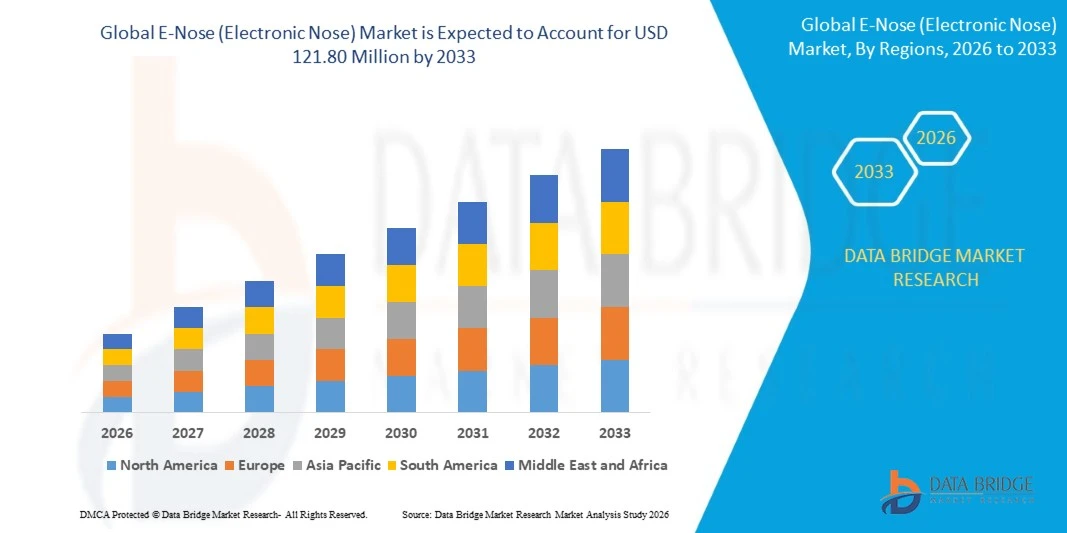
- As per Data Bridge Market Research analysis, the e-nose market was valued at USD 58.50 million in 2025 and is projected to reach USD 121.80 million by 2033, growing at a CAGR of 9.60% from 2026 to 2033.
- The market is experiencing consistent growth driven by rising demand for rapid odor and volatile compound detection, increasing adoption of AI-enabled sensor arrays, and expanding applications across food and beverage, healthcare, environmental, and industrial sectors.
- The increasing shift toward automated quality control, non-invasive diagnostics, and real-time air monitoring, combined with growing integration of miniaturized sensors with machine learning and connected devices, is supporting market adoption. Gas sensors are being applied across food freshness testing, breath analysis, and industrial safety, VOC sensors enable broad chemical pattern recognition, and smart sensing technologies offer users greater convenience in identifying odors without costly laboratory instruments.
Market Size & Forecast
- Global Market Value (2025): USD 58.50 Million
- Expected Market Value (2033): USD 121.80 Million
- Forecast CAGR (2026–2033): 9.60%
- Leading Region in 2025: North America
- Fastest Growing Region: Asia Pacific
What are the Major Takeaways of the E-Nose (Electronic Nose) Market?
- North America dominated the e-nose market with the largest revenue share of 38.40% in 2025, supported by strong research activity, established sensor manufacturers, and early adoption across healthcare and food quality applications.
- Asia-Pacific is expected to be the fastest-growing region at a CAGR of 11.80% from 2026 to 2033, fueled by expanding electronics manufacturing, rising food safety regulations, and growing healthcare investments.
- The stationary e-nose segment led the market with a 56.20% share in 2025, driven by laboratory quality control, high accuracy, and multi-sensor analytical capability.
- Portable e-nose devices are the fastest-growing product type, projected to register a CAGR of 11.70%, reflecting rising demand for handheld, on-site, and point-of-care odor detection.
- The metal oxide semiconductor sensors segment dominated the sensor technology category with a 46.80% revenue share in 2025, led by low cost and broad gas sensitivity.
- Food & beverage quality control accounted for 39.60% of the market share in 2025, preferred for rapid freshness testing, batch consistency checks, and spoilage detection.
- The healthcare & medical diagnostics segment is the fastest-growing application, with a CAGR of 12.30%, driven by breath-based screening research, non-invasive testing, and clinical validation studies.
Report Scope and E-Nose (Electronic Nose) Market Segmentation
|
Attributes |
E-Nose (Electronic Nose) Key Market Insights |
|
Segments Covered |
|
|
Countries Covered |
North America
Europe
Asia-Pacific
Middle East and Africa
South America
|
|
Key Market Players |
|
|
Market Opportunities |
|
|
Value Added Data Infosets |
In addition to the insights on market scenarios such as market value, growth rate, segmentation, geographical coverage, and major players, the market reports curated by the Data Bridge Market Research also include in-depth expert analysis, geographically represented company-wise production and capacity, network layouts of distributors and partners, detailed and updated price trend analysis and deficit analysis of supply chain and demand. |
What is the Key Trend in the E-Nose (Electronic Nose) Market?
- E-nose systems are increasingly evolving from bulky laboratory analyzers into compact, AI-enabled sensing platforms, combining semiconductor gas sensor arrays, pattern recognition algorithms, and cloud connectivity to digitize odors in real time.
- For instance, in November 2025, according to the National Library of Medicine (NLM), a pilot study of a low-cost e-nose using twelve metal oxide semiconductor sensors and machine learning detected lung cancer from breath samples with 96.26% accuracy in approximately five minutes, highlighting the potential of affordable, miniaturized sensor arrays
- Advances in MEMS fabrication, sensor miniaturization, and low-power electronics are enabling manufacturers to embed e-nose capability into handheld devices, appliances, robots, and industrial monitoring systems.
- Developers are increasingly pairing sensor arrays with machine learning and cloud analytics, as users compare e-nose solutions on detection sensitivity, response time, calibration stability, and ease of integration across industrial and clinical settings.
- For instance, in March 2025, according to the National Library of Medicine (NLM), a multicentre prospective external validation study published in Annals of Oncology confirmed that e-nose analysis of exhaled breath enables accurate lung cancer detection at thoracic oncology outpatient clinics, supporting wider clinical interest in breath-based sensing
- As sensor miniaturization, artificial intelligence, clinical validation, and connected deployment continue to advance, e-nose systems are expected to expand beyond laboratories into point-of-care diagnostics, smart manufacturing, and consumer devices.
What are the Key Drivers of the E-Nose (Electronic Nose) Market?
- The rapid shift toward automated, objective, and non-invasive sensing has significantly increased demand for e-nose systems that replace subjective human sniffing and slow laboratory chromatography.
- For instance, in May 2025, according to the National Library of Medicine (NLM), a systematic review and meta-analysis of e-nose devices for lung cancer diagnosis reported pooled sensitivity of 0.90 and pooled specificity of 0.89, with the best accuracy seen in devices combining metal oxide and quartz microbalance sensors, supporting the diagnostic potential of sensor-based breath analysis.
- Food producers, healthcare providers, environmental agencies, and electronics manufacturers are adopting e-nose systems to detect spoilage, monitor emissions, identify disease markers, and maintain cleanroom and production quality.
- For instance, in August 2025, according to Ainos, Inc., the company reported its first multi-year USD 2.1 million order and a planned pilot of approximately 1,400 AI Nose units in semiconductor manufacturing with ASE Holdings, with a further expansion to 5,000 units contemplated, illustrating rising industrial demand for AI-enabled electronic noses.
- With manufacturers expanding product portfolios and regulators emphasizing food safety and air quality, e-nose systems can gain wider visibility, trial, and repeat deployment across laboratories, factories, hospitals, and smart infrastructure.
What Factors Are Challenging the Growth of the E-Nose (Electronic Nose) Market?
- E-nose systems face technical limitations such as sensor drift, sensitivity to temperature and humidity, and cross-sensitivity, which require frequent calibration and can reduce reliability compared with established analytical instruments.
- For instance, in November 2021, according to the National Library of Medicine (NLM), a systematic review of e-nose breath tests concluded that standardized reporting of diagnostic accuracy, including accuracy in independent test sets, is needed, highlighting inconsistent evaluation practices across studies.
- These reliability and standardization concerns can slow regulatory approval and customer confidence, while high sensor, software, and training costs may limit adoption among small laboratories, start-ups, and price-sensitive industries.
- Data privacy, limited reference databases, and the need for large, high-quality training datasets further restrict deployment, requiring manufacturers to invest in algorithm validation, secure cloud platforms, and application-specific libraries that may increase development and compliance costs.
- For instance, in March 2026, according to the National Library of Medicine (NLM), a study of a low-cost metal-oxide e-nose for SARS-CoV-2 detection reported 86% accuracy for saliva samples and 89% for exhaled breath, but noted that the findings are preliminary and require confirmation in broader populations, highlighting the validation gap between early research and commercial clinical use.
- The combination of calibration challenges, standardization gaps, validation requirements, and competition from gas chromatography and mass spectrometry can constrain adoption among cost-sensitive users and smaller manufacturers, particularly where established laboratory methods already satisfy basic testing requirements.
How is the E-Nose (Electronic Nose) Market Segmented?
The e-nose market is segmented on the basis of product type, sensor technology, application, and end user.
- By Product Type
On the basis of product type, the e-nose market is segmented into stationary e-nose and portable e-nose. The stationary e-nose segment dominated the market with 56.20% share in 2025, supported by laboratory-grade accuracy, multi-sensor arrays, and strong use in quality control and research environments. Stationary systems provide controlled sampling, stable conditions, and advanced data analysis for consistent results. They are widely used for food aroma profiling, packaging checks, and pharmaceutical testing. Integration with automated sampling and analytics software is further strengthening demand among industrial users. Expanding sensor libraries and improved calibration tools are also improving reliability and repeat use.
The portable e-nose segment is projected to register the fastest growth at a CAGR of 11.70% from 2026 to 2033, driven by increasing demand for handheld, battery-powered, and cloud-connected odor detection devices. Compact systems allow on-site testing in warehouses, farms, hospitals, and field environments. Their applications include freshness checks, leak detection, and breath screening. Increasing interest in point-of-care testing and real-time monitoring is creating additional demand among healthcare, agriculture, and safety users. Advances in MEMS sensors, low-power chips, and embedded artificial intelligence are improving accuracy and affordability. Expansion into consumer appliances, drones, and robotics is also improving accessibility and creating new use cases.
- By Sensor Technology
On the basis of sensor technology, the e-nose market is segmented into metal oxide semiconductor sensors, conducting polymer sensors, and others. The metal oxide semiconductor sensors segment dominated the market with 46.80% share in 2025, supported by low cost, high sensitivity to a broad range of volatile compounds, and compatibility with semiconductor manufacturing processes. These sensors are widely used in commercial e-nose systems and benefit from established supply chains. The segment also benefits from strong research support and easy integration with microcontrollers and machine learning models. Continuous improvement in selectivity and power efficiency further strengthens its leadership.
The others segment, including field asymmetric ion mobility spectrometry, optical, biosensor, and nanomaterial-based sensors, is projected to register the fastest growth at a CAGR of 12.90% from 2026 to 2033, driven by rising demand for higher selectivity and lower drift. Silicon photonics, carbon nanotube, and bioelectronic sensing allow developers to differentiate products in a crowded sensor market. These technologies are increasingly used in medical diagnostics, fragrance analysis, and consumer devices. Growing demand for ultra-low detection limits and complex odor recognition is creating additional opportunities. Improvements in fabrication and data processing are enhancing performance, while OEM licensing models support wider commercialization.
- By Application
On the basis of application, the e-nose market is segmented into food & beverage quality control, healthcare & medical diagnostics, environmental monitoring, and others. The food & beverage quality control segment dominated the application category with 39.60% share in 2025, supported by rapid freshness testing, spoilage detection, and batch consistency monitoring. Producers use e-nose systems to reduce reliance on trained sensory panels and slow laboratory methods. Food safety regulations, traceability requirements, and brand protection further support adoption. Beverage, coffee, dairy, and packaging companies are also expanding use to verify aroma quality and detect off-odors. Established customer relationships and proven return on investment continue to reinforce this segment's leadership.
The healthcare & medical diagnostics segment is projected to register the fastest growth at a CAGR of 12.30% from 2026 to 2033, driven by increasing research into breath-based screening, non-invasive testing, and point-of-care diagnostics. E-nose devices can analyze volatile biomarkers in exhaled breath, saliva, and other samples within minutes. Clinical studies on lung cancer, respiratory disease, and infections are increasing awareness among providers. Hospitals and research institutes are exploring low-cost sensor arrays to support early screening where conventional tests are slow or invasive. Improved machine learning accuracy and external validation studies further support growth. Regulatory clearance and standardization remain key priorities for wider clinical adoption.
- By End User
On the basis of end user, the e-nose market is segmented into food & beverage manufacturers, healthcare providers, industrial facilities, cosmetics companies, government & defense, and others. The food & beverage manufacturers segment dominated the end-user category with 37.80% share in 2025, supported by rising quality expectations, food safety rules, and demand for objective sensory evaluation. These users prefer systems that deliver fast, repeatable results without extensive training. E-nose solutions help detect contamination and verify freshness across production lines. Growing automation in processing plants is creating further opportunities. Increasing availability of compact sensors is also expanding reach among mid-sized producers.
The healthcare providers segment is projected to register the fastest growth at a CAGR of 12.10% from 2026 to 2033, driven by increasing demand for rapid, non-invasive screening tools that support early detection and triage. Hospitals and clinics are evaluating breath-based e-nose devices for respiratory conditions, cancer screening, and infection testing. Researchers are promoting low-cost, portable systems to reach underserved settings. Partnerships with universities, medical device firms, and technology companies are supporting clinical validation. Cloud analytics and secure data platforms are improving usability. Regulatory approval, accuracy, and standardization remain important considerations for long-term adoption.
Which Region Holds the Largest Share of the E-Nose (Electronic Nose) Market?
- North America dominated the e-nose market with the largest revenue share of 38.40% in 2025, supported by strong research activity, established sensor manufacturers, and early adoption across healthcare and food quality applications.
- The region also benefits from strong university research, venture investment, and the presence of established sensor and diagnostics companies, along with early adoption in healthcare and food testing. Increasing use of e-nose systems in clinical research, industrial safety, semiconductor manufacturing, and smart devices continues to strengthen North America’s position in the global market.
U.S. E-Nose (Electronic Nose) Market Insight
The U.S. e-nose market is witnessing strong growth due to rising demand for rapid odor detection, non-invasive diagnostics, and AI-enabled sensing across research and industrial settings. The country’s mature semiconductor industry, along with increasing availability of portable and cloud-connected e-nose systems in laboratories, hospitals, and manufacturing plants, is driving demand for advanced sensing solutions. In addition, growing emphasis on food safety, breath-based diagnostics, smart manufacturing, and federally funded research is accelerating adoption of e-nose technology across commercial and research applications.
Canada E-Nose (Electronic Nose) Market Insight
Canada's E-Nose market is developing as electronic olfaction gains applications in healthcare, food quality, environmental monitoring, industrial safety, and VOC detection. Canada's research ecosystem and presence of specialized companies such as NOZE and Scentroid support domestic innovation in sensor arrays, AI-based odor recognition, and breath analysis. Demand is also supported by the need for portable, real-time, non-invasive chemical detection. Recent research identifies environmental monitoring, food processing, and healthcare as major application areas for E-Nose technology, while advances in machine learning are improving VOC classification and odor recognition.
Asia-Pacific E-Nose (Electronic Nose) Market Insight
The Asia-Pacific e-nose market is expected to witness rapid growth, driven by expanding electronics manufacturing, rising food safety standards, and increasing healthcare investment across countries such as China, India, and Japan. Growing demand for low-cost sensors, smart manufacturing, and environmental monitoring is supporting regional market expansion. In addition, the region’s strong semiconductor fabrication capacity, growing research output, expanding smart city programs, and rising adoption of connected devices are accelerating availability and demand for e-nose systems.
Japan E-Nose (Electronic Nose) Market Insight
The Japan e-nose market is witnessing consistent growth due to rising interest in preventive healthcare, robotics, and precision quality control. Food processors, research institutes, and electronics manufacturers are increasingly adopting e-nose systems for freshness testing, odor monitoring, and elder care applications. Moreover, strong demand for compact, reliable sensors, advanced robotics integration, collaboration between technology firms, and innovative sensing platforms is further contributing to market growth in Japan.
China E-Nose (Electronic Nose) Market Insight
The China e-nose market is growing rapidly, driven by large-scale electronics manufacturing, expanding food safety oversight, and increasing investment in healthcare and environmental monitoring. Growing domestic sensor production, artificial intelligence capability, and university research output are significantly boosting market demand. In addition, strong government support for smart manufacturing, expanding wafer fabrication capacity, and rising adoption of connected devices are positioning China as a key growth market for e-nose technology across Asia-Pacific.
Which are the Top Companies in E-Nose (Electronic Nose) Market?
The e-nose industry is primarily led by well-established companies, including:
- Alpha MOS (France)
- Aryballe Technologies (France)
- Bosch Sensortec GmbH (Germany)
- AIRSENSE Analytics GmbH (Germany)
- Sensigent LLC (U.S.)
- Owlstone Medical Ltd (U.K.)
- The eNose Company (Netherlands)
- Odotech Inc. (Canada)
- Stratuscent Inc. (Canada)
- Plasmion GmbH (Germany)
- Electronic Sensor Technology Inc. (U.S.)
- Comon Invent B.V. (Netherlands)
- Scentroid (Canada)
- RoboScientific Ltd (U.K.)
- Envirosuite Limited (Australia)
- SmartNanotubes Technologies GmbH (Germany)
- Ainos, Inc. (U.S.)
- Smiths Detection (U.K.)
- Vaporsens Inc. (U.S.)
- Sensirion AG (Switzerland)
What are Latest Developments in E-Nose (Electronic Nose) Market?
- In September 2025, Ainos, Inc. announced that it had secured seven new patents in Europe, Germany, Taiwan, and China for its AI Nose digital olfaction platform and showcased its AI Nose industrial module at SEMICON Taiwan 2025. The company positioned the platform for semiconductor fabrication, smart manufacturing, hospital infection control, and environmental monitoring, supporting scale-up of commercial deployment in 2026.
- In July 2025, Ainos, Inc. announced that its robotics partner ugo would pilot the world’s first service robots equipped with AI Nose technology at seven sites across Japan. The pilot is designed to demonstrate real-time robotic olfaction for elder care, smart infrastructure, and industrial safety, extending e-nose capability into mobile and autonomous systems.
- In March 2021, Bosch Sensortec launched the BME688, described as the first air quality MEMS sensor to combine gas, humidity, temperature, and pressure sensing with artificial intelligence, and added a gas scanning mode for volatile sulfur compounds. The BME AI-Studio tool lets customers train the sensor for custom applications such as bad breath and food freshness detection, strengthening embedded digital nose capability in consumer appliances, wearables, and IoT devices.
- In March 2020, Intel Labs and Cornell University partnered to build mathematical algorithms on computer chips as an electronic nose for a computer, reflecting growing interest in neuromorphic and chip-level approaches to machine olfaction. The collaboration highlighted the potential of applying semiconductor computing directly to odor recognition, beyond conventional sensor arrays and external processing.
- In January 2020, Aryballe announced a new high-volume, low-cost universal odor sensor capable of detecting odors in near real time, shown at CES. Smaller than a paperclip, the sensor was designed for integration into consumer appliances such as ovens and refrigerators, expanding the application of digital olfaction into household electronics.

- Interactive Data Analysis Dashboard
- Company Analysis Dashboard for high growth potential opportunities
- Research Analyst Access for customization & queries
- Competitor Analysis with Interactive dashboard
- Latest News, Updates & Trend analysis
- Harness the Power of Benchmark Analysis for Comprehensive Competitor Tracking
Global E Nose Electronic Nose Market, Supply Chain Analysis and Ecosystem Framework
To support market growth and help clients navigate the impact of geopolitical shifts, DBMR has integrated in-depth supply chain analysis into its Global E Nose Electronic Nose Market research reports. This addition empowers clients to respond effectively to global changes affecting their industries. The supply chain analysis section includes detailed insights such as Global E Nose Electronic Nose Market consumption and production by country, price trend analysis, the impact of tariffs and geopolitical developments, and import and export trends by country and HSN code. It also highlights major suppliers with data on production capacity and company profiles, as well as key importers and exporters. In addition to research, DBMR offers specialized supply chain consulting services backed by over a decade of experience, providing solutions like supplier discovery, supplier risk assessment, price trend analysis, impact evaluation of inflation and trade route changes, and comprehensive market trend analysis.
Data collection and base year analysis are done using data collection modules with large sample sizes. The stage includes obtaining market information or related data through various sources and strategies. It includes examining and planning all the data acquired from the past in advance. It likewise envelops the examination of information inconsistencies seen across different information sources. The market data is analysed and estimated using market statistical and coherent models. Also, market share analysis and key trend analysis are the major success factors in the market report. To know more, please request an analyst call or drop down your inquiry.
The key research methodology used by DBMR research team is data triangulation which involves data mining, analysis of the impact of data variables on the market and primary (industry expert) validation. Data models include Vendor Positioning Grid, Market Time Line Analysis, Market Overview and Guide, Company Positioning Grid, Patent Analysis, Pricing Analysis, Company Market Share Analysis, Standards of Measurement, Global versus Regional and Vendor Share Analysis. To know more about the research methodology, drop in an inquiry to speak to our industry experts.
Data Bridge Market Research is a leader in advanced formative research. We take pride in servicing our existing and new customers with data and analysis that match and suits their goal. The report can be customized to include price trend analysis of target brands understanding the market for additional countries (ask for the list of countries), clinical trial results data, literature review, refurbished market and product base analysis. Market analysis of target competitors can be analyzed from technology-based analysis to market portfolio strategies. We can add as many competitors that you require data about in the format and data style you are looking for. Our team of analysts can also provide you data in crude raw excel files pivot tables (Fact book) or can assist you in creating presentations from the data sets available in the report.













