Electric Facial Cleaners Market Overview
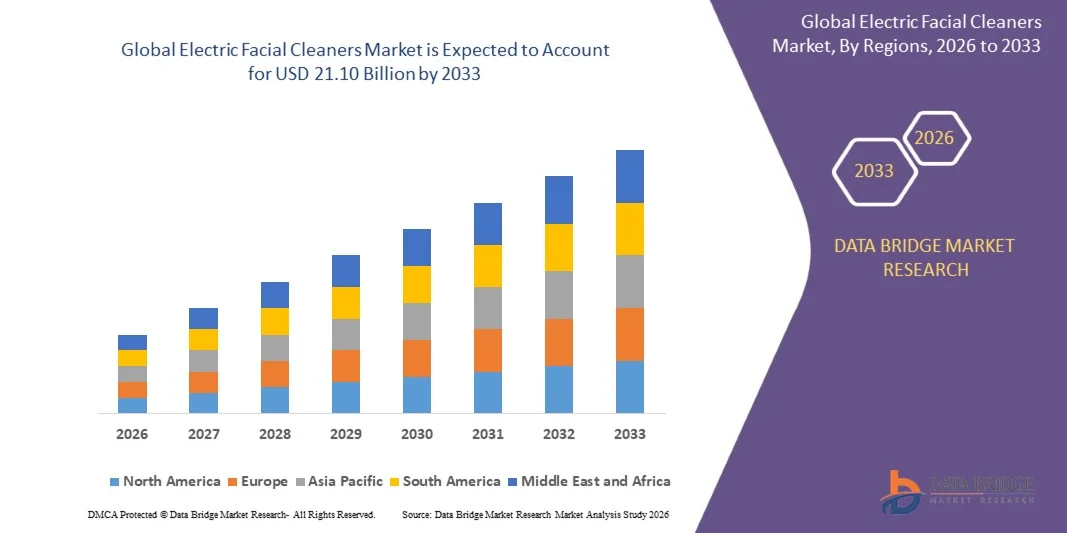
The Electric Facial Cleaners Market was valued at USD 9.99 billion in 2025 and is projected to reach USD 21.10 billion by 2033, growing at a CAGR of 9.80% from 2026 to 2033. The market is witnessing strong growth driven by increasing consumer focus on personal skincare, rising demand for advanced beauty devices, and growing awareness of skin hygiene and deep facial cleansing routines. The expansion of at-home skincare solutions and premium beauty device adoption is further accelerating market demand across both developed and emerging economies.
The rising influence of social media beauty trends, coupled with increasing spending on personal grooming and wellness products, is encouraging consumers to adopt electric facial cleansing devices as part of daily skincare routines. In addition, technological advancements such as sonic vibration technology, silicone-based cleansing brushes, and waterproof rechargeable designs are enhancing product efficiency and user convenience, supporting wider adoption across all age groups.
Key Market Trends & Insights
- North America dominated the electric facial cleaners market with the largest revenue share of 38.6% in 2025, supported by high consumer spending on premium skincare devices, strong awareness of dermatology-led beauty routines, and rapid adoption of at-home beauty technologies.
- Asia-Pacific electric facial cleaners market is expected to witness the fastest growth rate from 2026 to 2033, supported by rising disposable incomes, rapid urbanization, and strong influence of beauty and skincare culture in countries such as China, Japan, and South Korea.
- The Online Stores segment held the largest market revenue share of approximately 42.6% in 2025 driven by strong e-commerce penetration, rising digital purchasing behavior, and wide availability of global beauty device brands across platforms such as Amazon, Sephora online, and brand-owned websites. Consumers prefer online channels due to product comparisons, discounts, influencer-driven recommendations, and doorstep delivery convenience. The segment is further strengthened by targeted digital marketing campaigns and increasing adoption of direct-to-consumer beauty brands.
- The Specialty Beauty Stores segment is projected to register the fastest growth at a CAGR of 11.3% from 2026 to 2033, driven by rising demand for premium skincare consultation, experiential product testing, and professional beauty guidance. Increasing expansion of beauty retail chains and growing consumer preference for personalized skincare solutions are further accelerating segment growth.
- The Personal segment held the largest market revenue share of approximately 78.9% in 2025 driven by increasing adoption of at-home skincare routines, rising awareness of facial hygiene, and growing demand for affordable salon-like skincare devices. Consumers are increasingly investing in personal beauty devices to reduce dependency on salon treatments and maintain consistent skincare regimens.
- The Commercial segment is projected to register the fastest growth at a CAGR of 10.6% from 2026 to 2033, driven by rising usage in beauty salons, dermatology clinics, and wellness centers. Increasing demand for professional-grade skincare treatments and integration of advanced cleansing technologies in commercial beauty services are further supporting segment expansion.
Market Size & Forecast
- Global Market Value (2025): USD 9.99 Billion
- Expected Market Value (2033): USD 21.10 Billion
- Forecast CAGR (2026–2033): 9.80%
- Leading Region in 2025: North America
- Fastest Growing Region: Asia-Pacific
Report Scope and Electric Facial Cleaners Market Segmentation
|
Attributes |
Electric Facial Cleaners Key Market Insights |
|
Segments Covered |
|
|
Countries Covered |
North America
Europe
Asia-Pacific
Middle East and Africa
South America
|
|
Key Market Players |
• Samsung (South Korea) |
|
Market Opportunities |
• Expansion Of Smart Beauty Devices • Rising Demand For At-Home Skincare Solutions |
|
Value Added Data Infosets |
In addition to the insights on market scenarios such as market value, growth rate, segmentation, geographical coverage, and major players, the market reports curated by the Data Bridge Market Research also include in-depth expert analysis, pricing analysis, brand share analysis, consumer survey, demography analysis, supply chain analysis, value chain analysis, raw material/consumables overview, vendor selection criteria, PESTLE Analysis, Porter Analysis, and regulatory framework. |
Electric Facial Cleaners Market Trends
Trend: Rising Adoption Of Smart Skincare Devices And At-Home Beauty Technologies
Increasing consumer preference for advanced personal care solutions is driving demand for electric facial cleaners across global beauty and skincare markets. Traditional manual cleansing methods are being replaced by device-based skincare routines that offer deeper cleansing, improved skin texture, and enhanced hygiene outcomes. Growing awareness of dermatology-backed skincare practices and rising influence of social media beauty trends are further accelerating adoption of electric facial cleansing devices.
In modern skincare routines, brands are integrating sonic vibration and micro-pulsation technologies in electric facial cleaners, For instance devices from leading beauty brands are designed to remove up to 99% of impurities and makeup residues more effectively than manual cleansing, improving overall skin health and reducing pore congestion. In dermatology clinics and aesthetic centers, professional-grade cleansing devices are being used to prepare skin for treatments such as chemical peels and microdermabrasion, improving treatment absorption efficiency and outcomes.
The rapid expansion of e-commerce beauty platforms and direct-to-consumer skincare brands is also increasing accessibility of electric facial cleaners, particularly in emerging markets where beauty device penetration was previously low. In addition, premium beauty retail chains such as Sephora and Ulta Beauty are increasingly promoting device-based skincare systems through in-store demonstrations and experiential marketing campaigns. Clinical testing conducted in 2025 on silicone-based sonic cleansing devices showed up to 30–40% improvement in skin smoothness and reduction in oil buildup after four weeks of consistent use
Electric Facial Cleaners Market Dynamics
Key Market Driver: Rising Demand For Advanced Personal Skincare And Skin Health Awareness
Consumers worldwide are increasingly prioritizing skin health, hygiene, and preventive skincare routines, driven by rising pollution exposure, urban lifestyle stress, and growing dermatological concerns such as acne and clogged pores. Electric facial cleaners are gaining popularity as they offer deeper cleansing compared to traditional methods and support long-term skin maintenance.
Beauty brands and skincare companies are actively promoting electric cleansing devices as part of daily skincare regimens, For instance sonic cleansing brushes are widely recommended in combination with serums and moisturizers to improve product absorption and skin regeneration. Increasing dermatologist endorsements and clinical validation of device-based cleansing technologies are further supporting consumer trust and market expansion.
Key Restraint/Challenge: High Product Cost And Skin Sensitivity Concerns
Despite rising adoption, relatively high prices of premium electric facial cleaners limit accessibility among price-sensitive consumers, particularly in developing regions. Advanced models equipped with smart sensors, multiple speed settings, and app connectivity are often positioned at premium price points, restricting mass-market penetration.
In addition, skin sensitivity issues and improper usage can lead to irritation or over-exfoliation, particularly among first-time users with sensitive skin types. Limited consumer awareness regarding correct usage techniques and device compatibility with different skin conditions also restricts adoption. Clinical feedback suggests that inappropriate overuse of cleansing devices may increase skin barrier sensitivity in some users, impacting long-term satisfaction and repeat purchase rates.
Key Market Opportunity: Integration With AI-Based Skincare Diagnostics And Smart Beauty Ecosystems
Modern beauty technology companies are increasingly integrating artificial intelligence and skin analysis features into electric facial cleansing devices to provide personalized skincare recommendations. These innovations are enabling real-time skin condition tracking and adaptive cleansing intensity based on individual skin needs.
Manufacturers are also combining electric facial cleaners with broader smart beauty ecosystems, For instance devices are being paired with mobile applications that track skincare routines, analyze skin improvements, and recommend product combinations. Expansion of premium skincare subscription models and smart beauty device ecosystems is further opening opportunities in North America and Asia-Pacific markets. Pilot consumer studies conducted in 2025 showed that AI-assisted skincare devices improved routine adherence by nearly 25–35%, leading to better long-term skin condition management and higher consumer retention rates.
Electric Facial Cleaners Market Scope
The market is segmented on the basis of distribution channel and end user.
• By Distribution Channel
On the basis of distribution channel, the electric facial cleaners market is segmented into Hypermarkets/Supermarkets, Multi-brand Stores, Specialty Beauty Stores, Online Stores, Independent Small Stores, and Others. The Online Stores segment held the largest market revenue share of approximately 42.6% in 2025 driven by strong e-commerce penetration, rising digital purchasing behavior, and wide availability of global beauty device brands across platforms such as Amazon, Sephora online, and brand-owned websites. Consumers prefer online channels due to product comparisons, discounts, influencer-driven recommendations, and doorstep delivery convenience. The segment is further strengthened by targeted digital marketing campaigns and increasing adoption of direct-to-consumer beauty brands.
The Specialty Beauty Stores segment is projected to register the fastest growth at a CAGR of 11.3% from 2026 to 2033, driven by rising demand for premium skincare consultation, experiential product testing, and professional beauty guidance. Increasing expansion of beauty retail chains and growing consumer preference for personalized skincare solutions are further accelerating segment growth.
• By End User
On the basis of end user, the electric facial cleaners market is segmented into Personal and Commercial. The Personal segment held the largest market revenue share of approximately 78.9% in 2025 driven by increasing adoption of at-home skincare routines, rising awareness of facial hygiene, and growing demand for affordable salon-like skincare devices. Consumers are increasingly investing in personal beauty devices to reduce dependency on salon treatments and maintain consistent skincare regimens.
The Commercial segment is projected to register the fastest growth at a CAGR of 10.6% from 2026 to 2033, driven by rising usage in beauty salons, dermatology clinics, and wellness centers. Increasing demand for professional-grade skincare treatments and integration of advanced cleansing technologies in commercial beauty services are further supporting segment expansion.
Electric Facial Cleaners Market Regional Analysis
North America Electric Facial Cleaners Market Insight
North America dominated the electric facial cleaners market with the largest revenue share of 38.6% in 2025, supported by high consumer spending on premium skincare devices, strong awareness of dermatology-led beauty routines, and rapid adoption of at-home beauty technologies. Consumers in the region increasingly prefer device-based cleansing solutions that offer deep pore cleaning, exfoliation, and skin rejuvenation benefits compared to traditional manual skincare routines. The presence of leading beauty brands and strong e-commerce penetration further strengthens market expansion, while rising concerns around pollution, acne, and skin health continue to drive demand across both residential and professional use segments.
U.S. Electric Facial Cleaners Market Insight
The U.S. electric facial cleaners market captured the largest revenue share in 2025 within North America, driven by strong adoption of smart beauty devices, high disposable income, and increasing preference for personalized skincare solutions. Consumers are rapidly shifting toward sonic cleansing brushes and silicone-based facial cleansing devices integrated with app-based skincare tracking features. The expansion of retail beauty chains and digital platforms such as Sephora and Ulta Beauty has significantly improved product accessibility. In addition, growing influence of social media skincare trends and dermatologist recommendations is accelerating the replacement of manual cleansing routines with advanced electric alternatives.
Europe Electric Facial Cleaners Market Insight
The Europe electric facial cleaners market is expected to witness the fastest growth rate from 2026 to 2033, driven by rising demand for sustainable skincare technologies, increasing awareness of skin hygiene, and strong adoption of premium beauty devices. Consumers in the region are highly focused on skincare safety, ingredient transparency, and clinically tested beauty devices, supporting steady adoption of electric facial cleansing systems. Growth is further supported by expanding wellness culture, rising urban pollution levels, and increasing integration of skincare devices into professional dermatology and spa treatments across residential and commercial segments.
U.K. Electric Facial Cleaners Market Insight
The U.K. electric facial cleaners market is expected to witness strong growth from 2026 to 2033, driven by increasing consumer interest in advanced skincare routines and rising demand for at-home beauty solutions. Growing concerns around skin sensitivity, clogged pores, and aging skin are encouraging consumers to adopt sonic cleansing devices for daily use. The presence of strong beauty retail infrastructure and rising popularity of online beauty subscriptions are further supporting market penetration. In addition, increasing awareness of dermatologist-recommended skincare practices is boosting acceptance of electric cleansing technologies.
Germany Electric Facial Cleaners Market Insight
The Germany electric facial cleaners market is expected to witness strong growth from 2026 to 2033, driven by rising demand for high-quality, clinically tested, and eco-conscious skincare devices. Consumers in Germany prefer durable and technologically advanced beauty tools that support long-term skin health and hygiene. Increasing focus on sustainable personal care products and growing adoption of premium skincare routines in urban households are supporting market expansion. The integration of electric facial cleaners into professional spa and dermatology treatments is also contributing to rising product usage.
Asia-Pacific Electric Facial Cleaners Market Insight
The Asia-Pacific electric facial cleaners market is expected to witness the fastest growth rate from 2026 to 2033, supported by rising disposable incomes, rapid urbanization, and strong influence of beauty and skincare culture in countries such as China, Japan, and South Korea. Increasing penetration of e-commerce platforms and affordable device offerings is making electric facial cleaners accessible to a broader consumer base. Growing popularity of K-beauty trends and rising demand for multi-functional skincare devices are further accelerating market growth across both developed and emerging economies in the region.
Japan Electric Facial Cleaners Market Insight
The Japan electric facial cleaners market is expected to witness strong growth from 2026 to 2033 due to high consumer focus on skincare precision, advanced beauty technology adoption, and aging population-driven demand for gentle yet effective cleansing solutions. Japanese consumers strongly prefer compact, ergonomic, and high-performance skincare devices that align with minimalist beauty routines. Integration of sonic cleansing technologies with smart skincare systems is further enhancing adoption. Increasing use in both personal care routines and professional skincare clinics is supporting consistent market expansion.
China Electric Facial Cleaners Market Insight
The China electric facial cleaners market accounted for the largest market revenue share in Asia-Pacific in 2025, driven by a rapidly expanding middle class, high adoption of beauty technology, and strong e-commerce ecosystem. Consumers are increasingly investing in advanced skincare devices as part of daily beauty routines, supported by rising awareness of skin health and cosmetic wellness. Domestic manufacturing capabilities and competitive pricing of electric facial cleaners are further improving accessibility. In addition, strong influence of social media beauty trends and livestream commerce platforms is significantly accelerating product adoption across urban and semi-urban populations.
Electric Facial Cleaners Market Share
The Electric Facial Cleaners industry is primarily led by well-established companies, including:
• Samsung (South Korea)
• Clinique Laboratories, LLC (U.S.)
• Toshiba Corporation (Japan)
• Michael Todd, LP (U.S.)
• Etereauty Innovations Limited (U.K.)
• LAVO Skin Company (U.S.)
• Koninklijke Philips N.V. (Netherlands)
• LumaRx (U.S.)
• Pacific Bioscience Laboratories Inc. (U.S.)
• Procter & Gamble (U.S.)
• Panasonic Corporation (Japan)
• The Proactiv Company LLC (U.S.)
• DDF Skincare Company (U.S.)
• LVMH Moët Hennessy - Louis Vuitton (France)
• FOREO (Sweden)
• Nu Skin Enterprises Inc. (U.S.)
• Quasar Biotech (U.S.)
• KAKUSAN (Japan)
• Conair LLC (U.S.)
• YA-MAN LTD. (Japan)

- Interactive Data Analysis Dashboard
- Company Analysis Dashboard for high growth potential opportunities
- Research Analyst Access for customization & queries
- Competitor Analysis with Interactive dashboard
- Latest News, Updates & Trend analysis
- Harness the Power of Benchmark Analysis for Comprehensive Competitor Tracking
Data collection and base year analysis are done using data collection modules with large sample sizes. The stage includes obtaining market information or related data through various sources and strategies. It includes examining and planning all the data acquired from the past in advance. It likewise envelops the examination of information inconsistencies seen across different information sources. The market data is analysed and estimated using market statistical and coherent models. Also, market share analysis and key trend analysis are the major success factors in the market report. To know more, please request an analyst call or drop down your inquiry.
The key research methodology used by DBMR research team is data triangulation which involves data mining, analysis of the impact of data variables on the market and primary (industry expert) validation. Data models include Vendor Positioning Grid, Market Time Line Analysis, Market Overview and Guide, Company Positioning Grid, Patent Analysis, Pricing Analysis, Company Market Share Analysis, Standards of Measurement, Global versus Regional and Vendor Share Analysis. To know more about the research methodology, drop in an inquiry to speak to our industry experts.
Data Bridge Market Research is a leader in advanced formative research. We take pride in servicing our existing and new customers with data and analysis that match and suits their goal. The report can be customized to include price trend analysis of target brands understanding the market for additional countries (ask for the list of countries), clinical trial results data, literature review, refurbished market and product base analysis. Market analysis of target competitors can be analyzed from technology-based analysis to market portfolio strategies. We can add as many competitors that you require data about in the format and data style you are looking for. Our team of analysts can also provide you data in crude raw excel files pivot tables (Fact book) or can assist you in creating presentations from the data sets available in the report.