


What is the Electric Vehicle Battery Testing Equipment Market Size and Growth Rate?
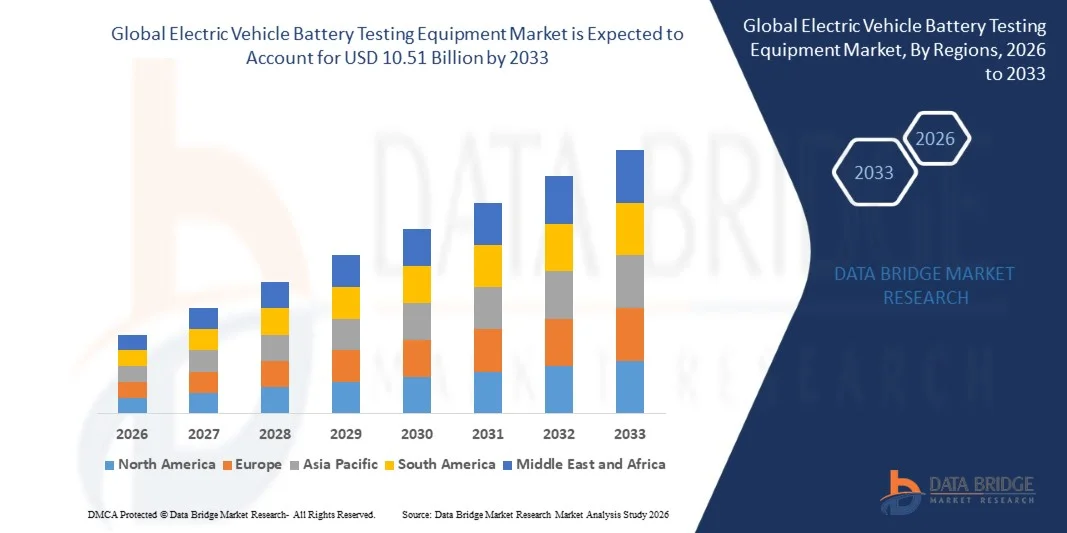
- As per Data Bridge Market Research analysis, the electric vehicle battery testing equipment market was valued at USD 3.10 billion in 2025 and is projected to reach USD 10.51 billion by 2033, growing at a CAGR of 16.50% from 2026 to 2033.
- The market is experiencing consistent growth driven by rising demand for electric vehicles and advanced battery systems, rapid advancements in battery testing technologies, and expanding applications across automotive OEMs, battery manufacturers, and research and testing laboratories.
- The increasing adoption of electric vehicles globally, combined with stricter requirements for battery safety, performance, reliability, and durability, is compelling automotive manufacturers and battery producers to adopt advanced testing equipment. Cell-, module-, and pack-level testing systems are increasingly being used to evaluate battery capacity, thermal behavior, charging performance, degradation, and safety, supporting efficient battery development and quality control.
Market Size & Forecast
- Global Market Value (2025): USD 3.10 Billion
- Expected Market Value (2033): USD 10.51 Billion
- Forecast CAGR (2026–2033): 16.50%
- Leading Region in 2025: North America
- Fastest Growing Region: Asia Pacific
What are the Major Takeaways of the Electric Vehicle Battery Testing Equipment Market?
- North America dominated the electric vehicle battery testing equipment market with the largest revenue share of 37% in 2025, supported by advanced battery manufacturing infrastructure, stringent safety standards, and strong investments in electric vehicle and battery technologies.
- Asia-Pacific is expected to be the fastest-growing region at a CAGR of 21.5% from 2026 to 2033, fueled by rapid electric vehicle production, expanding battery manufacturing capacity, increasing gigafactory investments, and growing adoption of advanced battery testing systems.
- The battery electric vehicles (BEVs) segment led the market with a 71.35% share in 2025, driven by the rapid expansion of fully electric vehicle production and increasing dependence on high-capacity battery systems
- Fuel cell electric vehicles (FCEVs) are the fastest-growing propulsion type, projected to register a CAGR of 23.1%, reflecting the surge in interest in hydrogen-powered mobility and heavy-duty electrification.
- The electrical tests segment dominated the testing type category with a 45.55% revenue share in 2025, led by the fundamental importance of electrical characterization throughout battery development and validation
- Battery safety testing equipment accounted for 30% of the market share in 2025, preferred by increasing requirements for validating battery safety under normal and abnormal operating conditions.
- The temperature testing equipment segment is the fastest-growing equipment type category, with a CAGR of 19%, driven by the increasing importance of thermal management in high-performance EV batteries
Report Scope and Electric Vehicle Battery Testing Equipment Market Segmentation
|
Attributes |
Electric Vehicle Battery Testing Equipment Key Market Insights |
|
Segments Covered |
|
|
Countries Covered |
North America
Europe
Asia-Pacific
Middle East and Africa
South America
|
|
Key Market Players |
|
|
Market Opportunities |
|
|
Value Added Data Infosets |
In addition to the market insights such as market value, growth rate, market segments, geographical coverage, market players, and market scenario, the market report curated by the Data Bridge Market Research team includes in-depth expert analysis, import/export analysis, pricing analysis, production consumption analysis, and pestle analysis. |
What is the Key Trend in the Electric Vehicle Battery Testing Equipment Market?
- Battery testing equipment is increasingly shifting toward automated, high-power, and software-driven systems capable of testing advanced EV batteries with greater accuracy, speed, and repeatability across cell, module, and pack levels.
- For instance, in July 2024, EA Elektro-Automatik introduced its enhanced EA BTS 10300 battery test system, delivering 300 kW in a single 42U rack while integrating automated battery cycling capabilities for high-power EV battery testing.
- Real-time monitoring and advanced data analytics enable engineers to evaluate battery voltage, current, temperature, charging behavior, degradation, and State of Health with greater precision throughout testing cycles.
- Battery manufacturers and automotive OEMs are increasingly integrating software-defined testing, automation, and data-management platforms to accelerate validation and reduce testing time across increasingly complex battery technologies.
- For instance, in May 2023, NI launched its Software-Defined Battery Lab solution, supporting EV battery validation from research and development through production, second-life applications, and remanufacturing while enabling centralized battery data management and analysis.
- As EV batteries become more powerful and incorporate advanced chemistries, demand for automated, scalable, and data-intensive testing systems is expected to accelerate, reinforcing sophisticated battery validation as a core component of EV development and manufacturing.
What are the Key Drivers of the Electric Vehicle Battery Testing Equipment Market?
- The rapid expansion of electric vehicle production and battery manufacturing capacity has significantly increased demand for sophisticated testing equipment capable of validating battery performance, reliability, safety, and lifecycle characteristics.
- For instance, in October 2024, AVL launched the AVL Cell Tester ECO, offering multiple power classes and configurations of up to 72 channels for scalable and efficient battery cell research and development.
- Battery manufacturers and automotive OEMs are integrating automated testing, high-voltage cycling, environmental simulation, and advanced analytics into development programs to improve battery quality and accelerate commercialization.
- For instance, in October 2025, Exeliq Solutions launched its VoltPRO Series, an AI-enabled EV battery testing system providing real-time State of Charge, State of Health, and lifecycle performance analysis with regenerative power capabilities.
- With battery capacities increasing and EV manufacturers pursuing faster development cycles, demand for automated and high-throughput testing equipment will remain strong, supporting more precise validation of next-generation battery technologies.
What Factors are Challenging the Growth of the Electric Vehicle Battery Testing Equipment Market?
- Advanced EV battery testing facilities require substantial capital investment because of high-power cyclers, environmental chambers, safety systems, specialized infrastructure, and sophisticated data-management technologies.
- For instance, in October 2025, Mahindra & Mahindra inaugurated its Advanced Cell Research Laboratory and Battery Proto Build Shop in Tamil Nadu as part of facilities developed with an investment of more than USD 31.1 million, demonstrating the substantial capital required for advanced battery research and testing infrastructure.
- These high costs can limit adoption among smaller battery manufacturers, startups, independent laboratories, and research organizations that may lack the financial resources required for comprehensive testing infrastructure.
- For instance, in August 2024, the National Test House announced that its Bengaluru EV battery and charger testing facility would require approximately USD 1.55 million, with specialized infrastructure for electrical safety, functional safety, climate, mechanical, material, and durability testing, highlighting the significant investment needed to establish comprehensive testing capabilities.
- The high capital and operational expenditure associated with sophisticated battery testing continues to restrict adoption, particularly among smaller organizations and emerging-market manufacturers, slowing deployment despite increasing requirements for battery safety, performance, and regulatory compliance.
How is the Electric Vehicle Battery Testing Equipment Market Segmented?
The electric vehicle battery testing equipment market is segmented on the basis of propulsion type, testing type, equipment type, and end user.
- By Propulsion Type
On the basis of propulsion type, the electric vehicle battery testing equipment market is segmented into battery electric vehicles (BEVs), plug-in hybrid electric vehicles (PHEVs), hybrid electric vehicles (HEVs), and fuel cell electric vehicles (FCEVs). The battery electric vehicles (BEVs) segment dominated the market with a 71.35% share in 2025, owing to the rapid expansion of fully electric vehicle production and increasing dependence on high-capacity battery systems. BEVs require extensive battery validation because the battery is the primary source of propulsion. Testing equipment is widely used to evaluate charging performance, electrical characteristics, durability, thermal behavior, and safety. Automotive OEMs and battery manufacturers are increasingly investing in dedicated testing capabilities to validate batteries before commercial deployment. The growing adoption of advanced battery chemistries is further increasing testing requirements across development and production stages. Increasing EV manufacturing capacity and the expansion of battery production facilities are also supporting demand for BEV-oriented testing systems.
The fuel cell electric vehicles (FCEVs) segment is projected to register the fastest growth at a CAGR of 23.1% during the forecast period, driven by increasing interest in hydrogen-powered mobility and heavy-duty electrification. FCEV testing requires specialized evaluation of fuel cell stacks, hydrogen storage systems, electrical integration, and overall powertrain performance. These systems require testing under different temperature, humidity, load, and operating conditions to ensure reliable performance. Increasing development of hydrogen infrastructure is encouraging automotive manufacturers and technology companies to expand fuel cell programs. Testing requirements are also becoming more sophisticated as manufacturers seek to improve fuel-cell efficiency, durability, and lifecycle performance. Specialized testing facilities are increasingly being developed to support fuel-cell development and validation.
- By Testing Type
On the basis of testing type, the electric vehicle battery testing equipment market is segmented into electrical tests, thermal tests, mechanical tests, abuse tests, and safety tests. The electrical tests segment dominated the market with a 45.55% share in 2025, owing to the fundamental importance of electrical characterization throughout battery development and validation. Electrical testing is used to evaluate voltage, current, capacity, power output, charging behavior, and battery efficiency. Automotive OEMs and battery manufacturers conduct electrical testing at different battery development stages to identify performance variations and validate battery-management functions. Increasing battery voltage and energy capacity are creating greater requirements for sophisticated high-power testing systems. Automated charge-discharge systems are also being increasingly integrated with software and data-acquisition platforms to improve testing consistency.
The abuse tests segment is projected to register the fastest growth at a CAGR of 18.74% during the forecast period, driven by increasing emphasis on battery safety and thermal-runaway prevention. Abuse testing evaluates battery behavior under abnormal electrical, thermal, mechanical, and environmental conditions. Growing concerns regarding battery fires and thermal events are encouraging manufacturers to strengthen validation procedures. Regulatory requirements are also increasing the importance of comprehensive abuse testing before batteries are integrated into production vehicles. Testing systems can evaluate conditions such as overcharging, short circuits, mechanical damage, penetration, and thermal exposure. Increasing battery energy density is further strengthening the need to understand failure behavior under extreme conditions. Automotive OEMs and battery manufacturers are therefore expanding specialized safety laboratories and testing capabilities.
- By Equipment Type
On the basis of equipment type, the electric vehicle battery testing equipment market is segmented into battery safety testing equipment, temperature testing equipment, resistance testing equipment, voltage monitoring equipment, fault tracking equipment, and other testing equipment. The battery safety testing equipment segment dominated the market with share of 30% in 2025, owing to increasing requirements for validating battery safety under normal and abnormal operating conditions. These systems are used to identify risks associated with overheating, overcharging, short circuits, thermal runaway, and other battery failures. Increasing battery energy density is making safety validation increasingly important throughout battery development. Automotive OEM laboratories and battery manufacturers are deploying specialized safety-testing systems to meet stringent performance and regulatory requirements. Advanced safety equipment can integrate electrical monitoring, environmental control, mechanical testing, and automated data acquisition. The growing number of battery chemistries and cell architectures is also increasing demand for flexible safety-testing platforms.
The temperature testing equipment segment is projected to register the fastest growth at a CAGR of 19% during the forecast period, driven by the increasing importance of thermal management in high-performance EV batteries. Battery temperature directly affects charging performance, energy efficiency, power output, degradation, and safety. Temperature-testing systems enable manufacturers to evaluate battery behavior under different operating and environmental conditions. The increasing adoption of fast-charging technologies is further increasing the need to evaluate heat generation during high-current charging. Advanced lithium-ion and next-generation battery chemistries also require extensive thermal characterization during development. Automotive OEMs and battery manufacturers are increasingly using environmental chambers and thermal cycling systems to reproduce real-world operating conditions. Growing concerns regarding thermal runaway are further strengthening demand for accurate temperature monitoring and controlled thermal testing.
- By End User
On the basis of end user, the electric vehicle battery testing equipment market is segmented into automotive OEM laboratories, battery manufacturers, third-party testing laboratories, and research institutes and universities. The automotive OEM laboratories segment dominated the market with a 56.90% share in 2025, owing to increasing investments by vehicle manufacturers in in-house battery development, validation, and safety-testing capabilities. OEM laboratories conduct extensive testing to validate battery performance before integration into production vehicles. These facilities evaluate electrical characteristics, thermal behavior, durability, charging performance, safety, and battery-management-system functionality. Increasing vehicle electrification is encouraging automakers to develop dedicated battery laboratories rather than relying entirely on external testing providers. In-house testing also enables manufacturers to shorten development cycles and maintain greater control over proprietary battery technologies.
The third-party testing laboratories segment is projected to register the fastest growth at a CAGR of 16.95% during the forecast period, driven by increasing demand for independent validation, certification, and specialized testing services. Smaller battery manufacturers and automotive companies can use third-party laboratories when establishing comprehensive in-house testing infrastructure is costly or technically challenging. Independent laboratories provide specialized capabilities for safety, regulatory compliance, durability, and performance assessment. Increasingly complex battery regulations across international markets are also encouraging manufacturers to use accredited testing organizations. Third-party laboratories can provide access to advanced equipment and specialized technical expertise without requiring manufacturers to establish every testing capability internally. The expansion of EV production among emerging manufacturers is further increasing demand for outsourced validation services. Growing requirements for independent certification and compliance testing are strengthening the role of third-party laboratories.
Which Region Holds the Largest Share of the Electric Vehicle Battery Testing Equipment Market?
- North America dominated the electric vehicle battery testing equipment market with the largest revenue share of 37% in 2025, supported by advanced battery manufacturing infrastructure, stringent safety standards, and strong investments in electric vehicle and battery technologies
- The region also benefits from increasing battery-cell manufacturing capacity, stringent safety and performance validation requirements, and growing investments in high-voltage battery testing technologies. Expanding EV production and the development of next-generation battery technologies continue to strengthen North America's position in the global market.
U.S. Electric Vehicle Battery Testing Equipment Market Insight
The U.S. electric vehicle battery testing equipment market is witnessing strong growth due to rising investments in EV battery manufacturing, advanced battery research, and safety testing technologies. The country’s established automotive and battery ecosystem, along with increasing adoption of high-voltage, automated, and data-driven testing systems, is driving demand across automotive OEMs, battery manufacturers, and research applications. In addition, growing emphasis on battery safety, performance validation, and compliance with stringent testing standards is accelerating the deployment of sophisticated testing equipment across laboratories and manufacturing facilities.
Asia-Pacific Electric Vehicle Battery Testing Equipment Market Insight
The Asia-Pacific electric vehicle battery testing equipment market is expected to witness rapid growth, driven by expanding EV production, increasing battery manufacturing capacity, and rising investments in battery testing infrastructure across countries such as China, Japan, South Korea, and India. Growing demand for advanced battery technologies, rising adoption of automated testing systems, and increasing requirements for reliable and efficient battery validation are supporting regional market expansion. Additionally, the growing presence of battery gigafactories, automotive R&D centers, and localized EV supply chains is accelerating adoption of battery testing equipment across manufacturing and research sectors.
Japan Electric Vehicle Battery Testing Equipment Market Insight
The Japan electric vehicle battery testing equipment market is witnessing consistent growth due to rising investments in battery innovation, automotive electrification, and advanced testing technologies. Automotive manufacturers, battery companies, and research institutes are increasingly adopting sophisticated testing systems for battery performance evaluation, durability assessment, thermal characterization, and safety validation. Moreover, increasing development of next-generation battery technologies and the country’s focus on efficient, reliable, and high-performance EV systems are further contributing to market growth.
China Electric Vehicle Battery Testing Equipment Market Insight
The China electric vehicle battery testing equipment market is growing rapidly, driven by expanding EV production, large-scale battery manufacturing, and rising government focus on battery safety and technological development. Growing adoption of automated, high-voltage, and data-driven testing systems across automotive, battery manufacturing, and research sectors is significantly boosting market demand. In addition, rising investments in battery gigafactories, increasing development of advanced battery chemistries, and rapid expansion of the domestic EV supply chain are positioning China as one of the fastest-growing markets for electric vehicle battery testing equipment globally.
U.K. Electric Vehicle Battery Testing Equipment Market Insight
The U.K. electric vehicle battery testing equipment market is experiencing steady growth, supported by rising adoption of advanced battery testing technologies in automotive R&D, battery development, and independent testing applications. Increasing investments in battery research infrastructure and growing demand for reliable, efficient, and safety-focused testing solutions are contributing to market growth. Furthermore, integration of automation, high-power testing, and advanced data analytics is improving battery validation capabilities and testing efficiency, positioning the U.K. as a key innovation hub in the electric vehicle battery testing equipment industry.
Germany Electric Vehicle Battery Testing Equipment Market Insight
The Germany electric vehicle battery testing equipment market is expanding steadily due to the country’s strong automotive manufacturing base, advanced battery research capabilities, and increasing adoption of next-generation testing technologies. Automotive companies, battery manufacturers, and research organizations are increasingly utilizing testing equipment for battery performance evaluation, durability testing, thermal management, and safety validation. Continuous advancements in battery technology, automated testing, and high-voltage systems, along with strong industry focus on electrification and innovation, are further driving market growth in Germany.
Which are the Top Companies in Electric Vehicle Battery Testing Equipment Market?
The electric vehicle battery testing equipment industry is primarily led by well-established companies, including:
- Keysight Technologies, Inc. (U.S.)
- National Instruments Corporation (U.S.)
- Chroma ATE Inc. (Taiwan)
- AVL (Austria)
- Arbin Instruments, Inc. (U.S.)
- Bitrode Corporation (U.S.)
- DIGATRON (Germany)
- Maccor, Inc. (U.S.)
- NEWARE (China)
- Bio-Logic SAS (France)
- Gamry Instruments, Inc. (U.S.)
- HIOKI E.E. CORPORATION (Japan)
- REGATRON AG (Switzerland)
- EA Elektro-Automatik (Germany)
- ESPEC NORTH AMERICA, INC. (U.S.)
- Thermotron Industries (U.S.)
- SINEXCEL (China)
- HORIBA, Ltd. (Japan)
- UL Solutions (U.S.)
- Intertek Group plc (U.K.)
What are Latest Developments in Electric Vehicle Battery Testing Equipment Market?
- In August 2025, Chroma ATE introduced the 17040E Battery Test System, designed to support high-voltage EV and battery energy storage system testing with wide voltage ranges and scalable power capabilities. The system addresses the industry's shift toward higher-voltage EV architectures and fast-charging technologies, providing flexible and efficient testing for advanced battery systems. This development highlights the growing emphasis on high-voltage, scalable, and energy-efficient battery testing equipment for next-generation electric mobility.
- In October 2024, AVL launched the AVL Cell Tester ECO, a compact, air-cooled, multi-channel battery cell cycler designed for battery cell research and development. The system was offered across multiple power classes and channel configurations and could be integrated with climate chambers, cell fixtures, and automation software to create a complete battery cell testing solution. The launch demonstrates the industry's movement toward scalable, space-efficient, and automated battery testing platforms for EV battery development
- In May 2023, NI launched its Software-Defined Battery Lab solution, developed specifically for EV manufacturers and battery suppliers to accelerate battery validation. The solution supports battery testing and data management across the lifecycle, including research and development, validation, production, second-life applications, and remanufacturing. This development demonstrates the increasing integration of software, automation, and data analytics into EV battery testing processes to improve flexibility and accelerate battery development
- In June 2022, DSA introduced automated battery cell testing and high-voltage battery testing solutions at Battery Show Europe 2022. The company's automated cell-testing solution was designed for quality inspection and sorting, while its High Voltage Battery Tester supported end-of-line testing of high-voltage battery modules and packs. The development strengthened automated testing capabilities for EV battery quality, safety, and lifecycle management.
- In August 2021, Keysight Technologies launched the Scienlab SL1700A Series battery pack test system, designed for high-voltage battery packs used in automotive and industrial applications. The system supported battery packs up to 1,500 V and incorporated high-voltage silicon-carbide technology, energy recovery, environmental control synchronization, and integrated data analysis. The launch reflected growing demand for compact, high-power, and energy-efficient testing systems for advanced EV battery packs.

- Interactive Data Analysis Dashboard
- Company Analysis Dashboard for high growth potential opportunities
- Research Analyst Access for customization & queries
- Competitor Analysis with Interactive dashboard
- Latest News, Updates & Trend analysis
- Harness the Power of Benchmark Analysis for Comprehensive Competitor Tracking
Data collection and base year analysis are done using data collection modules with large sample sizes. The stage includes obtaining market information or related data through various sources and strategies. It includes examining and planning all the data acquired from the past in advance. It likewise envelops the examination of information inconsistencies seen across different information sources. The market data is analysed and estimated using market statistical and coherent models. Also, market share analysis and key trend analysis are the major success factors in the market report. To know more, please request an analyst call or drop down your inquiry.
The key research methodology used by DBMR research team is data triangulation which involves data mining, analysis of the impact of data variables on the market and primary (industry expert) validation. Data models include Vendor Positioning Grid, Market Time Line Analysis, Market Overview and Guide, Company Positioning Grid, Patent Analysis, Pricing Analysis, Company Market Share Analysis, Standards of Measurement, Global versus Regional and Vendor Share Analysis. To know more about the research methodology, drop in an inquiry to speak to our industry experts.
Data Bridge Market Research is a leader in advanced formative research. We take pride in servicing our existing and new customers with data and analysis that match and suits their goal. The report can be customized to include price trend analysis of target brands understanding the market for additional countries (ask for the list of countries), clinical trial results data, literature review, refurbished market and product base analysis. Market analysis of target competitors can be analyzed from technology-based analysis to market portfolio strategies. We can add as many competitors that you require data about in the format and data style you are looking for. Our team of analysts can also provide you data in crude raw excel files pivot tables (Fact book) or can assist you in creating presentations from the data sets available in the report.













