


What is the Electromagnetic Shielding Materials Market Size and Growth Rate?
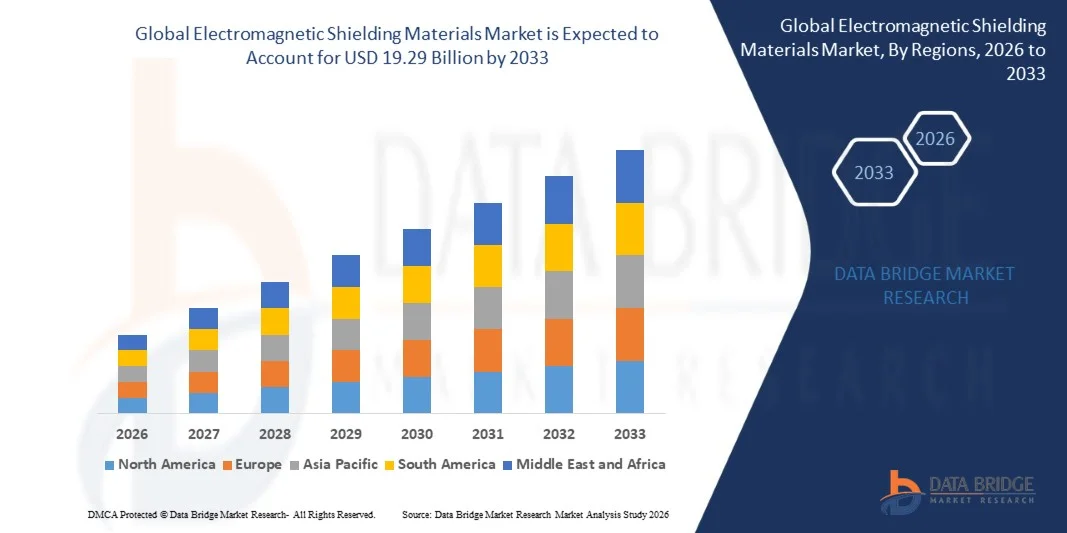
- As per Data Bridge Market Research analysis, the electromagnetic shielding materials market was valued at USD 10.90 billion in 2025 and is projected to reach USD 19.29 billion by 2033, growing at a CAGR of 7.40% from 2026 to 2033.
- The market is experiencing consistent growth driven by the rapid proliferation of consumer electronics, electric vehicles, 5G communication infrastructure, and increasing demand for electromagnetic compatibility (EMC) across automotive, aerospace, healthcare, and telecommunications industries.
- The increasing integration of high-frequency electronic components, coupled with stringent electromagnetic interference (EMI) compliance standards and the growing adoption of lightweight conductive polymers and advanced shielding composites, is accelerating market expansion. Manufacturers are increasingly replacing conventional shielding solutions with conductive coatings, metal shielding products, and engineered polymer-based materials to improve device reliability, signal integrity, and electromagnetic protection across next-generation electronic systems.
Market Size & Forecast
- Global Market Value (2025): USD 10.90 Billion
- Expected Market Value (2033): USD 19.29 Billion
- Forecast CAGR (2026–2033): 7.40%
- Leading Region in 2025: North America
- Fastest Growing Region: Asia Pacific
What are the Major Takeaways of the Electromagnetic Shielding Materials Market?
- North America dominated the electromagnetic shielding materials market with the largest revenue share of 37.4% in 2025, supported by the strong presence of leading electronics and aerospace manufacturers, early adoption of advanced shielding technologies, and stringent electromagnetic compatibility (EMC) regulations.
- Asia-Pacific is expected to be the fastest-growing region at a CAGR of 8.3% from 2026 to 2033, fueled by rapid expansion of consumer electronics manufacturing, increasing electric vehicle production, and continued investments in 5G infrastructure across China, India, South Korea, and Japan.
- The metal-based shielding materials segment led the market with a 43.7% share in 2025, driven by their high electrical conductivity, strong shielding effectiveness, and established use across consumer electronics, telecommunications, automotive, aerospace, and industrial applications.
- Conductive polymer materials are the fastest-growing material type, projected to register a CAGR of 8.0%, reflecting the surge in demand for lightweight, flexible, and corrosion-resistant EMI shielding solutions
- The coatings segment dominated the product form category with a 34% revenue share in 2025, led by its versatility, ease of application, and ability to provide EMI protection without substantially increasing component weight.
- Reflection shielding accounted for 45% of the market share in 2025, preferred by its extensive use with highly conductive metallic shielding materials
- The printing technologies segment is the fastest-growing manufacturing technology category, with a CAGR of 9.0%, driven by increasing development of printed electronics, flexible circuits, wearable devices, sensors, and smart electronic products.
Report Scope and Electromagnetic Shielding Materials Market Segmentation
|
Attributes |
Electromagnetic Shielding Materials Key Market Insights |
|
Segments Covered |
|
|
Countries Covered |
North America
Europe
Asia-Pacific
Middle East and Africa
South America
|
|
Key Market Players |
|
|
Market Opportunities |
|
|
Value Added Data Infosets |
In addition to the market insights such as market value, growth rate, market segments, geographical coverage, market players, and market scenario, the market report curated by the Data Bridge Market Research team includes in-depth expert analysis, import/export analysis, pricing analysis, production consumption analysis, and pestle analysis. |
What is the Key Trend in the Electromagnetic Shielding Materials Market?
- Advanced electromagnetic shielding materials are increasingly shifting toward lightweight graphene-based composites to improve shielding performance while reducing material density and supporting next-generation electronics.
- For instance, in July 2025, Carbon published research highlighting graphene-based macrostructures for electromagnetic shielding, reflecting their electrical properties, lightweight structures, and suitability for emerging 5G applications.
- Multifunctional designs increasingly combine electrical conductivity with microwave absorption and structural flexibility, improving protection across compact electronic applications.
- Manufacturers and researchers are developing recyclable, transparent, and flexible shielding materials for compact electronic systems and next-generation wireless technologies.
- For instance, in July 2024, Materials Research Bulletin reported lightweight graphene foam composites achieving EMI shielding effectiveness of 71 dB, demonstrating enhanced conductivity, microwave absorption, and flexibility for next-generation electronics.
- As electronics become smaller and wireless technologies become more advanced, demand for lightweight, multifunctional shielding materials is expected to accelerate, reinforcing advanced composites as a key direction for electromagnetic protection.
What are the Key Drivers of the Electromagnetic Shielding Materials Market?
- The rapid expansion of 5G, IoT, and densely integrated electronic devices has significantly increased demand for advanced electromagnetic shielding materials capable of controlling interference across increasingly complex operating frequencies and compact electronic architectures.
- For instance, in April 2025, Scientific Reports reported a metamaterial absorber designed for GSM and 5G 3.5 GHz systems, achieving measured shielding effectiveness of 40.12 dB at 1.8 GHz and 36.81 dB at 3.5 GHz.
- Automotive, electronics, telecommunications, and medical-device manufacturers are integrating advanced shielding materials to reduce electromagnetic interference, improve device reliability, and maintain electromagnetic compatibility across increasingly connected systems.
- For instance, in June 2026, MethodsX reported that inexpensive rubber-based materials reduced EMI emissions in electric-vehicle modules, achieving shielding effectiveness of up to 75.479 dB using a two-layer configuration.
- With electronic systems increasingly relying on high-frequency connectivity and electrification, electromagnetic shielding materials will remain essential for maintaining device performance, regulatory compliance, and reliable operation across next-generation technologies.
What Factors are Challenging the Growth of the Electromagnetic Shielding Materials Market?
- Advanced electromagnetic shielding materials face significant development challenges due to material consistency, complex characterization, manufacturing scale-up, and integration requirements across different electronic systems and operating environments.
- For instance, in August 2025, Wiley’s Advanced Engineering Materials highlighted material consistency, characterization difficulties, scale-up processes, and integration into existing technologies as major challenges in developing EMI shielding materials, indicating that moving from laboratory research to industrial production remains a significant restraint.
- These technical challenges can increase development costs and limit adoption among manufacturers requiring consistent performance, scalable processing, and compatibility with existing production infrastructure.
- The high cost, weight, poor flexibility, and difficult processability of conventional metal-based shielding materials continue to encourage development of alternative polymers, composites, coatings, and solution-processable materials.
- For instance, in May 2025, Wiley’s Advanced Materials Interfaces reported that conventional metal-based EMI shielding materials face high cost, poor flexibility, difficult processability, high density, and corrosion issues, creating limitations for their use in lightweight, flexible, and miniaturized electronic applications
- These material and manufacturing constraints can slow commercialization, particularly when advanced shielding solutions must simultaneously deliver high effectiveness, low weight, flexibility, durability, and cost efficiency across demanding applications.
How is the Electromagnetic Shielding Materials Market Segmented?
The electromagnetic shielding materials market is segmented on the basis of material type, product form, shielding mechanism, manufacturing technology, frequency range, application, and distribution channel.
- By Material Type
On the basis of material type, the electromagnetic shielding materials market is segmented into metal-based shielding materials, carbon-based shielding materials, conductive polymer materials, magnetic shielding materials, composite shielding materials, conductive coatings & inks, and EMI shielding gasket materials. The metal-based shielding materials segment dominated the market with 43.7% share, owing to their high electrical conductivity, strong shielding effectiveness, and established use across consumer electronics, telecommunications, automotive, aerospace, and industrial applications. Copper, aluminum, nickel, and stainless steel are widely used for electronic enclosures, connectors, cable shielding, and communication equipment. These materials provide reliable EMI attenuation across broad frequency ranges and offer strong mechanical and thermal properties. Their established manufacturing infrastructure and proven performance under demanding operating conditions further support adoption.
The conductive polymer materials segment is projected to register the fastest growth at a CAGR of 8.0% during forecast period, driven by increasing demand for lightweight, flexible, and corrosion-resistant EMI shielding solutions. Conductive polymers can reduce component weight while providing effective electromagnetic protection compared with conventional metal-based solutions. They are increasingly used in electric vehicles, wearable electronics, medical devices, aerospace systems, and compact consumer electronics. Advances in conductive fillers such as carbon-based materials and other conductive additives are improving shielding effectiveness and mechanical properties. Their compatibility with complex geometries and plastic components is also supporting wider adoption in compact electronic designs.
- By Product Form
On the basis of product form, the electromagnetic shielding materials market is segmented into films, foils, sheets, tapes, fabrics, meshes, foams, gaskets, coatings, paints, laminates, and molded components. The coatings segment dominated the market with 34% share in 2025, supported by its versatility, ease of application, and ability to provide EMI protection without substantially increasing component weight. Conductive coatings can be applied to plastic housings and other complex geometries that may be difficult to shield using conventional metal components. They are extensively utilized in consumer electronics, automotive components, aerospace equipment, and telecommunications devices. Improvements in coating formulations are increasing adhesion, durability, conductivity, and shielding effectiveness. Compatibility with lightweight polymer and composite substrates is further expanding their use in modern electronic assemblies.
The films segment is projected to register the fastest growth at a CAGR of 9.4% during forecast period, driven by increasing adoption of flexible electronics, wearable devices, compact electronic assemblies, and electric vehicle systems. EMI shielding films provide lightweight construction and flexibility while occupying limited installation space. Their thin profile makes them particularly suitable for compact electronic assemblies and increasingly miniaturized semiconductor packages. Manufacturers are developing advanced conductive films capable of achieving high shielding effectiveness while maintaining flexibility. The expansion of high-frequency communication devices and sophisticated electronic architectures is creating additional demand for film-based shielding. Multilayer conductive-film technologies are also improving performance across demanding frequency ranges.
- By Shielding Mechanism
On the basis of shielding mechanism, the electromagnetic shielding materials market is segmented into reflection shielding, absorption shielding, multiple reflection shielding, and hybrid shielding. The reflection shielding segment dominated the market with 45% share in 2025, primarily because of its extensive use with highly conductive metallic shielding materials. Reflection shielding works by reflecting incident electromagnetic energy away from sensitive electronic components. It is widely incorporated into consumer electronics, aerospace systems, telecommunications equipment, and industrial electronic systems. High electrical conductivity and relatively straightforward material configurations make reflection-based shielding suitable for a broad range of commercial applications. Conventional copper, aluminum, and other metallic shielding products commonly depend substantially on reflection to achieve electromagnetic attenuation.
The hybrid shielding segment is expected to witness the fastest growth at CAGR of 8.5% during forecast period, driven by increasing demand for shielding solutions that combine reflection and absorption mechanisms. Hybrid structures can provide effective electromagnetic protection across broader frequency ranges than solutions relying on a single mechanism. They are increasingly relevant for complex electronic systems where multiple interference sources operate simultaneously. Demand is rising across autonomous vehicles, aerospace electronics, advanced communication equipment, and high-performance electronic devices. Manufacturers are developing multilayer composite structures that combine conductive and absorbing materials to improve electromagnetic compatibility. Advances in nanomaterials and conductive composites are further improving the performance and design flexibility of hybrid shielding systems.
- By Manufacturing Technology
On the basis of manufacturing technology, the electromagnetic shielding materials market is segmented into electroplating, electroless plating, physical vapor deposition (PVD), chemical vapor deposition (CVD), vacuum metallization, extrusion, injection molding, compression molding, lamination, and printing technologies. The electroplating segment dominated the market with an 30% share in 2025, supported by its widespread industrial use, high-quality conductive coatings, and suitability for large-scale production. Electroplating enables manufacturers to deposit uniform metallic layers on electronic components and substrates to improve electromagnetic shielding and corrosion resistance. The technology is extensively utilized for automotive electronics, printed circuit boards, connectors, telecommunications equipment, and aerospace components. Its established production infrastructure and mature processing methods provide manufacturers with consistent output and predictable performance. Electroplated surfaces can also provide durability under demanding operating environments.
The printing technologies segment is projected to register the fastest growth at a CAGR of 9.0% during forecast period, driven by increasing development of printed electronics, flexible circuits, wearable devices, sensors, and smart electronic products. Conductive ink printing enables manufacturers to produce lightweight shielding structures and intricate conductive patterns directly on substrates. The technology provides greater design flexibility and can reduce material waste compared with some conventional manufacturing approaches. Growing adoption of printed sensors, flexible electronics, and connected devices is creating additional demand for printable shielding materials. Advances in silver-based inks, graphene formulations, and conductive polymer inks are improving electrical performance. Printing also enables shielding structures to be incorporated into complex and increasingly miniaturized electronic designs.
- By Frequency Range
On the basis of frequency range, the electromagnetic shielding materials market is segmented into low frequency shielding, radio frequency (RF) shielding, microwave shielding, millimeter wave shielding, and broadband EMI shielding. The radio frequency (RF) shielding segment dominated the market with 38% share in 2025, owing to its extensive application across consumer electronics, telecommunications infrastructure, automotive electronics, aerospace systems, and industrial communication equipment. RF shielding protects electronic systems from unwanted radio-frequency interference while supporting electromagnetic compatibility requirements. The expansion of smartphones, wireless networks, Wi-Fi equipment, connected devices, and communication infrastructure is increasing demand for RF shielding solutions. RF shielding can be implemented using metals, conductive coatings, conductive polymers, and composite materials. The technology is also important for maintaining signal integrity in increasingly dense electronic environments.
The millimeter wave shielding segment is expected to witness the fastest growth at a CAGR of 10.0% during forecast period, driven by increasing deployment of advanced wireless networks, automotive radar, autonomous vehicles, satellite communications, and other high-frequency technologies. Millimeter-wave systems operate at frequencies where electromagnetic interference can significantly affect communication, sensing, and signal integrity. The increasing deployment of advanced driver-assistance systems and connected mobility technologies is creating additional requirements for high-performance shielding around radar and other electronic modules. Manufacturers are developing lightweight, multilayer materials specifically designed to address shielding requirements at higher frequencies. Advances in semiconductor packaging and antenna technologies are also supporting demand for specialized millimeter-wave shielding.
- By Application
On the basis of application, the electromagnetic shielding materials market is segmented into consumer electronics, telecommunications, automotive, aerospace, defense & military and homeland security, healthcare, energy & power systems, data centers, robotics & automation, and others. The consumer electronics segment dominated the market with 38% share in 2025, driven by high production volumes of smartphones, tablets, laptops, wearable devices, gaming systems, and smart home equipment. These products contain numerous closely integrated electronic components that require effective EMI protection and signal integrity management. Increasing device miniaturization is making electromagnetic shielding increasingly important within compact electronic architectures. Manufacturers are incorporating conductive coatings, films, gaskets, foils, and other shielding components into electronic assemblies. The expansion of connected devices and IoT-enabled products is further increasing shielding requirements.
The automotive segment is projected to register the fastest growth at a CAGR of 6.7% during forecast period, fueled by vehicle electrification, advanced driver-assistance systems, connected vehicles, autonomous driving technologies, and high-voltage battery systems. Modern vehicles contain increasing numbers of electronic control units, radar sensors, cameras, infotainment systems, communication modules, and power electronics that require reliable EMI protection. Electric vehicles introduce additional high-power electronic systems, including battery, inverter, charging, and power-management components, increasing the need for electromagnetic compatibility. Lightweight conductive materials are becoming particularly important as automakers seek to manage vehicle weight while protecting electronic systems. Growing adoption of vehicle-to-everything communication is also increasing the number of high-frequency electronic systems within vehicles.
- By Distribution Channel
On the basis of distribution channel, the electromagnetic shielding materials market is segmented into direct sales, OEM supply, component distributors, electronic material suppliers, and online distribution. The OEM supply segment dominated the market with 35% share in 2025, supported by long-term procurement relationships between shielding-material manufacturers and original equipment manufacturers. OEM supply allows manufacturers to provide customized shielding materials designed around specific product architectures and electromagnetic compatibility requirements. This channel is particularly important across consumer electronics, automotive, aerospace, healthcare, and industrial equipment manufacturing. Close collaboration between shielding suppliers and OEM engineering teams also enables materials to be integrated during the product-development stage. Long-term contracts provide manufacturers with more predictable supply and quality requirements for high-volume production.
The electronic material suppliers segment is expected to witness the fastest growth at a CAGR of 8.5% during forecast period, driven by increasing demand for specialized conductive materials, engineered composites, conductive inks, and advanced shielding components. These suppliers provide manufacturers and electronics developers with specialized materials selected according to frequency, geometry, conductivity, and shielding requirements. Their role is expanding as semiconductor manufacturers, electronics assemblers, research organizations, and prototype developers require increasingly specialized shielding solutions. Growth in flexible electronics, printed electronics, wearable devices, and electric vehicle technologies is creating additional demand through this channel. Electronic material suppliers are also expanding technical support and customized material-development capabilities.
Which Region Holds the Largest Share of the Electromagnetic Shielding Materials Market?
- North America dominated the electromagnetic shielding materials market with the largest revenue share of 37.4% in 2025, supported by the strong presence of leading electronics and aerospace manufacturers, early adoption of advanced shielding technologies, and stringent electromagnetic compatibility (EMC) regulations.
- The region also benefits from a well-established defense industrial base, continued procurement of lightweight ceramic protection systems, and strong research and development activities in advanced armor materials. Increasing adoption of silicon carbide and boron carbide ceramics, together with demand for body armor, armored vehicles, and aerospace protection systems, continues to support regional demand.
U.S. Electromagnetic Shielding Materials Market Insight
The U.S. electromagnetic shielding materials market is witnessing strong growth due to rising demand for advanced electronic systems, wireless communication infrastructure, electric vehicles, and data center technologies. The country’s mature electronics, automotive, aerospace, and defense industries, along with increasing adoption of high-frequency communication and connected devices, are driving demand across a wide range of applications. In addition, growing emphasis on electromagnetic compatibility, signal integrity, and protection of sensitive electronic components is accelerating the adoption of conductive coatings, films, gaskets, composites, and other shielding materials across manufacturers and technology providers.
Asia-Pacific Electromagnetic Shielding Materials Market Insight
The Asia-Pacific electromagnetic shielding materials market is expected to witness rapid growth, driven by expanding electronics manufacturing, increasing deployment of telecommunications infrastructure, and rising production of electric and connected vehicles across countries such as China, Japan, South Korea, and India. Growing adoption of smartphones, wearable devices, industrial electronics, and high-frequency communication technologies is supporting regional market expansion. In addition, the growing presence of semiconductor and electronics manufacturing facilities is accelerating demand for advanced EMI shielding materials across consumer, automotive, industrial, and telecommunications applications. Increasing investments in advanced materials and lightweight shielding technologies are further contributing to market growth.
Japan Electromagnetic Shielding Materials Market Insight
The Japan electromagnetic shielding materials market is witnessing consistent growth due to rising investments in advanced electronics, automotive technologies, telecommunications systems, and precision manufacturing. Electronics manufacturers and automotive companies are increasingly utilizing electromagnetic shielding materials to protect compact electronic components and improve signal integrity across sophisticated devices and vehicle systems. Moreover, Japan’s strong capabilities in materials science, advanced ceramics, conductive polymers, and precision electronics manufacturing are supporting technological development in the market. Increasing integration of sensors, connected technologies, and high-frequency communication systems is further contributing to demand for advanced shielding solutions.
China Electromagnetic Shielding Materials Market Insight
The China electromagnetic shielding materials market is growing rapidly, driven by expanding electronics production, telecommunications infrastructure, electric vehicle manufacturing, and increasing integration of connected technologies. Growing adoption of smartphones, consumer electronics, automotive electronics, and industrial automation systems is significantly boosting demand for EMI shielding materials. In addition, increasing investments in semiconductor manufacturing and advanced electronic components are encouraging the use of conductive coatings, films, foils, composites, and shielding gaskets. Rising focus on improving electromagnetic compatibility, reducing interference, and supporting increasingly compact electronic designs is further accelerating adoption across China’s electronics and automotive industries.
U.K. Electromagnetic Shielding Materials Market Insight
The U.K. electromagnetic shielding materials market is experiencing steady growth, supported by rising adoption of advanced electronic systems, telecommunications technologies, automotive electronics, and aerospace applications. Increasing investments in connected devices, high-performance communication systems, and electronic infrastructure are contributing to market growth across manufacturers and technology developers. Furthermore, growing emphasis on electromagnetic compatibility, cybersecurity-related electronic protection, and reliable signal transmission is supporting wider use of shielding materials. Continuous development of conductive polymers, advanced coatings, composite materials, and lightweight shielding solutions is further strengthening the market across the U.K.’s electronics and industrial sectors.
Germany Electromagnetic Shielding Materials Market Insight
The Germany electromagnetic shielding materials market is expanding steadily due to the country’s strong automotive manufacturing base, advanced industrial automation capabilities, and growing adoption of sophisticated electronic systems. Automotive manufacturers, electronics companies, telecommunications providers, and industrial equipment producers are increasingly utilizing shielding materials to manage electromagnetic interference and protect sensitive electronic components. Continuous advancements in electric mobility, connected vehicles, industrial robotics, and high-frequency communication technologies are further supporting market development. In addition, Germany’s strong engineering capabilities and focus on efficient, lightweight, and durable material solutions are accelerating demand for advanced electromagnetic shielding technologies.
Which are the Top Companies in Electromagnetic Shielding Materials Market?
The electromagnetic shielding materials industry is primarily led by well-established companies, including:
- 3M (U.S.)
- Henkel AG & Co. KGaA (Germany)
- Parker-Hannifin Corporation (U.S.)
- DuPont. (U.S.)
- PPG Industries, Inc. (U.S.)
- TDK Corporation (Japan)
- TATSUTA ELECTRIC WIRE & CABLE CO., LTD. (Japan)
- Nitto Denko Corporation (Japan)
- Panasonic Industry Co., Ltd. (Japan)
- TE Connectivity Ltd. family of companies (Ireland)
- Rogers Corporation (U.S.)
- Dexerials Corporation (Japan)
- MARUWA CO., LTD. (Japan)
- KITAGAWA INDUSTRIES CO., LTD. (Japan)
- TOYOCHEM CO., LTD. (Japan)
- Fair-Rite Products Corp. (U.S.)
- Tech Etch, Inc. (U.S.)
- Spira Manufacturing (U.S.)
- Orbel Corporation (U.S.)
- Murata Manufacturing Co., Ltd. (Japan)
What are Latest Developments in Electromagnetic Shielding Materials Market?
- In October 2025, Henkel announced the launch of its new electromagnetic interference (EMI) shielding film for automotive electronics, designed as a cost- and process-efficient alternative to metal housings and developed to support EMI noise management in increasingly complex electronic systems. The new shielding film is intended for automotive applications where compact designs, reliable electromagnetic compatibility, and efficient manufacturing are increasingly important. Henkel planned to showcase the solution at Productronica 2025 alongside its broader portfolio of electronics assembly technologies, highlighting the company’s continued development of advanced materials for automotive and industrial electronics.
- In August 2024, Würth Elektronik launched its hybrid WE-EMIP EMI absorber sheet, developed to provide a convenient solution for controlling electromagnetic interference in electronic components. The material combines an EMI absorber with an aluminum layer and incorporates an adhesive backing so that it can be directly attached to the component requiring protection. The company stated that the new shielding material provides high attenuation across a wide frequency range and is available in both isolated and non-isolated configurations. The development expands Würth Elektronik’s portfolio of flexible electromagnetic shielding and absorption solutions for electronic designs where conventional shielding structures may be difficult to integrate.
- In August 2023, Parker Chomerics introduced CHO-SEAL 6750, a new low-durometer fluorosilicone EMI shielding material formulated with nickel-plated graphite filler. The material was developed to provide electromagnetic shielding together with environmental sealing in applications exposed to demanding temperatures, chemicals, and fluids. Parker Chomerics highlighted its suitability for both commercial and military applications where design flexibility and reliable EMI protection are required. The addition of CHO-SEAL 6750 expanded the company’s conductive elastomer portfolio and provided engineers with another material option for molded, sheet-stock, and die-cut shielding applications.
- In August 2022, Panasonic Industry announced that it had started joint research with JAXA, Nagoya University, Yamagata University, and Akita University on an ultra-lightweight electromagnetic compatibility (EMC) shielding material. The technology combines carbon-nanotube-based lightweight materials with Panasonic Industry’s thermosetting polymer formulation technology to address electromagnetic shielding requirements while reducing material weight. The research was aimed at potential applications including spacecraft, electric aircraft, 5G/6G infrastructure, industrial equipment, automotive sensors, and VR/AR devices. Panasonic Industry stated that the project was intended to advance commercialization of lightweight electromagnetic shielding and absorption materials for next-generation applications.
- In March 2021, DuPont announced an agreement to acquire Laird Performance Materials, a major supplier of high-performance electromagnetic shielding and thermal management solutions. The transaction was intended to combine Laird’s electromagnetic shielding technologies with DuPont’s portfolio of films, laminates, and plating chemistries for advanced electronic applications. DuPont highlighted applications including 5G telecommunications, smart and autonomous vehicles, artificial intelligence, Internet of Things devices, and high-performance computing. The development strengthened DuPont’s position in advanced electronic materials and expanded its capabilities in technologies designed to protect electronic devices from electromagnetic interference.

- Interactive Data Analysis Dashboard
- Company Analysis Dashboard for high growth potential opportunities
- Research Analyst Access for customization & queries
- Competitor Analysis with Interactive dashboard
- Latest News, Updates & Trend analysis
- Harness the Power of Benchmark Analysis for Comprehensive Competitor Tracking
Data collection and base year analysis are done using data collection modules with large sample sizes. The stage includes obtaining market information or related data through various sources and strategies. It includes examining and planning all the data acquired from the past in advance. It likewise envelops the examination of information inconsistencies seen across different information sources. The market data is analysed and estimated using market statistical and coherent models. Also, market share analysis and key trend analysis are the major success factors in the market report. To know more, please request an analyst call or drop down your inquiry.
The key research methodology used by DBMR research team is data triangulation which involves data mining, analysis of the impact of data variables on the market and primary (industry expert) validation. Data models include Vendor Positioning Grid, Market Time Line Analysis, Market Overview and Guide, Company Positioning Grid, Patent Analysis, Pricing Analysis, Company Market Share Analysis, Standards of Measurement, Global versus Regional and Vendor Share Analysis. To know more about the research methodology, drop in an inquiry to speak to our industry experts.
Data Bridge Market Research is a leader in advanced formative research. We take pride in servicing our existing and new customers with data and analysis that match and suits their goal. The report can be customized to include price trend analysis of target brands understanding the market for additional countries (ask for the list of countries), clinical trial results data, literature review, refurbished market and product base analysis. Market analysis of target competitors can be analyzed from technology-based analysis to market portfolio strategies. We can add as many competitors that you require data about in the format and data style you are looking for. Our team of analysts can also provide you data in crude raw excel files pivot tables (Fact book) or can assist you in creating presentations from the data sets available in the report.












