


What is the Emergency Response and Rescue Vessels Market Size and Growth Rate?
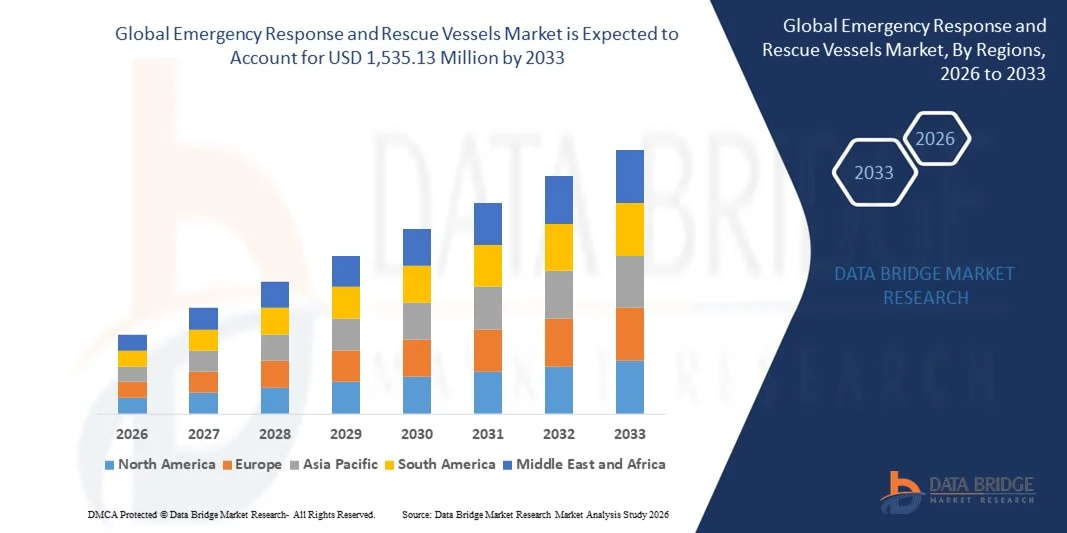
- As per Data Bridge Market Research Analysis the global emergency response and rescue vessels market size was valued at USD 913.75 million in 2025 and is expected to reach USD 1,535.13 million by 2033, at a CAGR of 6.70% during the forecast period
- The market growth is largely fuelled by the rising demand for maritime safety, increasing offshore oil and gas activities, and growing investments in disaster management infrastructure
- Enhanced focus on search and rescue operations, coupled with stringent maritime safety regulations, is further driving the adoption of specialized rescue vessels across commercial, defense, and public sectors
Market Size & Forecast
- Global Market Value (2025): USD 913.75 million
- Expected Market Value (2033): USD 1,535.13 million
- Forecast CAGR (2026–2033): 6.70%
What are the Major Takeaways of Emergency Response and Rescue Vessels Market ?
- The market is witnessing significant growth due to increasing maritime accidents, offshore exploration, and rising awareness of safety protocols in both commercial and governmental sectors
- Investments in fleet modernization, coupled with the integration of advanced communication and navigation technologies, are contributing to improved operational efficiency and faster response times during emergencies
- North America dominated the emergency response and rescue vessels market with the largest revenue share in 2025, driven by increasing investments in port safety, offshore infrastructure, and disaster preparedness, as well as stringent maritime safety regulations
- Asia-Pacific region is expected to witness the highest growth rate in the global emergency response and rescue vessels market, driven by rapid industrialization, expanding shipping activities, rising government expenditure on port safety, and increasing adoption of technologically advanced rescue vessels
- The Large Rescue Boat segment held the largest market revenue share in 2025, driven by the increasing need for multi-purpose vessels capable of handling high-capacity evacuations and complex offshore emergencies. Large rescue boats are particularly preferred by governments and port authorities for their enhanced stability, advanced onboard safety systems, and longer operational endurance
Report Scope and Emergency Response and Rescue Vessels Market Segmentation
|
Attributes |
Emergency Response and Rescue Vessels Key Market Insights |
|
Segments Covered |
|
|
Countries Covered |
North America
Europe
Asia-Pacific
Middle East and Africa
South America
|
|
Key Market Players |
|
|
Market Opportunities |
|
|
Value Added Data Infosets |
In addition to the market insights such as market value, growth rate, market segments, geographical coverage, market players, and market scenario, the market report curated by the Data Bridge Market Research team includes in-depth expert analysis, import/export analysis, pricing analysis, production consumption analysis, and pestle analysis. |
What is the Key Trend in the Emergency Response and Rescue Vessels Market ?
Rise of Rapid Response and Rescue Operations
- The growing focus on maritime safety and emergency preparedness is transforming the emergency response and rescue vessels landscape by enabling faster on-site interventions during accidents, natural disasters, and offshore emergencies. These vessels allow rapid deployment of personnel, medical aid, and evacuation services, reducing casualties and property loss. Advanced onboard communication systems and GPS integration further improve coordination and efficiency during critical operations
- Increasing demand for versatile and technologically advanced rescue vessels is accelerating the adoption of high-speed, multi-purpose vessels equipped with navigation, communication, and life-saving systems. Such vessels are particularly effective in offshore oil and gas, ports, and coastal areas, ensuring timely and efficient response. Manufacturers are incorporating automated rescue equipment and modular designs to support diverse emergency scenarios
- The cost-effectiveness and operational reliability of modern rescue vessels are making them attractive for governments, port authorities, and private operators. They enable extended operational readiness with reduced crew requirements, lower maintenance, and enhanced safety standards. Longer service life and fuel-efficient engines also contribute to reduced total cost of ownership
- For instance, in 2023, several coastal authorities in Europe reported faster response times and improved rescue operations after deploying new high-speed rescue vessels with advanced radar, medical facilities, and stabilization systems. These vessels also supported multi-agency coordination and improved preparedness for offshore disasters, demonstrating tangible operational benefits
- While adoption of advanced vessels is increasing, the market’s growth depends on continual innovation in vessel speed, endurance, safety features, and multi-role capabilities. Manufacturers must focus on durable, versatile, and regulatory-compliant solutions to fully capitalize on growing demand. Integration with real-time monitoring systems and autonomous operation features is expected to further enhance operational efficiency
Emergency Response and Rescue Vessels Market Dynamics
Driver
Growing Emphasis on Maritime Safety and Disaster Preparedness
- The increasing frequency of maritime accidents, natural disasters, and offshore emergencies is pushing governments and private operators to prioritize the deployment of emergency response and rescue vessels as a frontline solution for rapid intervention. Enhanced vessel capabilities allow faster evacuation, fire suppression, and medical response, improving overall safety outcomes
- Ports, offshore platforms, and coastal authorities are increasingly aware of the operational and safety benefits offered by advanced vessels, including reduced response times, enhanced crew safety, and improved rescue efficiency. Multi-role features, such as firefighting, towing, and environmental protection, are driving adoption across various sectors
- Supportive government regulations, maritime safety standards, and disaster management policies are further encouraging investment in technologically advanced rescue vessels. Funding for fleet upgrades and modernization is boosting market growth globally. Insurance incentives and compliance requirements are also motivating organizations to adopt high-performance vessels
- For instance, in 2022, several North American port authorities upgraded their fleets with multi-purpose rescue vessels to comply with updated maritime safety regulations and improve emergency response capabilities. These upgrades also improved offshore incident management and reduced the risk of financial losses during accidents
- While demand is rising, ensuring vessel reliability, compliance with safety standards, and adaptability for diverse maritime conditions is essential to sustain market growth and long-term adoption of emergency response vessels. Continuous crew training and incorporation of smart onboard technologies further enhance the value proposition for operators
Restraint/Challenge
High Acquisition Costs and Operational Constraints
- The high upfront investment required for advanced emergency response and rescue vessels can be a barrier for smaller port authorities and private operators, limiting widespread adoption despite long-term operational benefits. Additional costs for retrofitting existing fleets with modern safety equipment further add to the financial burden
- Many organizations lack the technical expertise and trained crew necessary to operate and maintain complex rescue vessels. Insufficient training can reduce operational efficiency and compromise safety during emergencies. Continuous skill development programs and simulator-based training are critical to overcoming this challenge
- Market growth is also constrained by logistical challenges, such as docking, maintenance, and fuel supply requirements. Improper upkeep or lack of infrastructure can negatively impact vessel readiness and effectiveness. Seasonal variations, harsh maritime environments, and unpredictable demand spikes add complexity to fleet management
- For instance, in 2023, surveys in Asia-Pacific revealed that over 50% of smaller coastal operators delayed fleet upgrades due to high acquisition costs and limited technical knowledge for vessel operation. These operators also faced challenges in sourcing spare parts and adhering to safety standards, impacting overall operational reliability
- While vessel technology continues to evolve with enhanced speed, multi-role functionality, and onboard safety systems, addressing cost, training, and operational constraints remains critical. Stakeholders must focus on user-friendly, cost-efficient, and high-performance vessels to unlock the long-term potential of the emergency response and rescue vessels market. Collaborative initiatives between manufacturers, governments, and training institutions are expected to further strengthen market growth
How is the Emergency Response and Rescue Vessels Market Segmented ?
The emergency response and rescue vessels market is segmented into three notable segments based on product, type, and industry.
- By Product
On the basis of product, the emergency response and rescue vessels market is segmented into Large Rescue Boat, Small Boat, and Other. The Large Rescue Boat segment held the largest market revenue share in 2025, driven by the increasing need for multi-purpose vessels capable of handling high-capacity evacuations and complex offshore emergencies. Large rescue boats are particularly preferred by governments and port authorities for their enhanced stability, advanced onboard safety systems, and longer operational endurance.
The Small Boat segment is expected to witness the fastest growth rate from 2026 to 2033, driven by its agility, lower acquisition cost, and suitability for rapid-response operations in shallow waters and coastal regions. Small boats are increasingly adopted for nearshore rescue missions, port security, and quick medical evacuations, offering flexible deployment and reduced crew requirements.
- By Type
On the basis of type, the market is segmented into Very Large (Greater than 60 m), Large (Between 48 - 60 m), and Medium (Less than 48 m). The Large (Between 48 - 60 m) segment accounted for the largest share in 2025 due to its balanced combination of capacity, operational range, and onboard equipment for emergency response. Large vessels provide optimal safety, multi-role functionality, and compliance with maritime regulations, making them widely used by defense and offshore authorities.
The Medium (Less than 48 m) segment is expected to register the fastest growth from 2026 to 2033, driven by the demand for cost-effective, easy-to-maneuver vessels suitable for small-scale rescue operations, coastal patrols, and nearshore interventions. Medium vessels are increasingly favored by private operators and smaller port authorities for their flexibility and lower maintenance requirements.
- By Industry
On the basis of industry, the market is segmented into Defense, Oil and Gas, Fishing, Marine Tourism, and Others. The Defense segment held the largest market revenue share in 2025, driven by increasing investments in coastal security, maritime surveillance, and disaster preparedness. Rescue vessels in this segment are equipped with advanced communication systems, medical facilities, and multi-role capabilities to support national security and emergency response operations.
The Oil and Gas segment is expected to witness the fastest growth from 2026 to 2033, driven by the need for offshore emergency preparedness, rapid evacuation, and firefighting capabilities on drilling platforms and vessels. Enhanced safety compliance, stringent regulations, and increasing offshore exploration activities are boosting the adoption of technologically advanced rescue vessels in the sector.
Which Region Holds the Emergency Response and Rescue Vessels Market ?
- North America dominated the emergency response and rescue vessels market with the largest revenue share in 2025, driven by increasing investments in port safety, offshore infrastructure, and disaster preparedness, as well as stringent maritime safety regulations
- Organizations and authorities in the region highly value rapid deployment capabilities, advanced navigation and communication systems, and multi-purpose operational functionality offered by modern rescue vessels
- This widespread adoption is further supported by strong government funding, well-developed maritime infrastructure, and a growing focus on reducing response times and enhancing crew safety, establishing advanced vessels as a critical solution for both coastal and offshore operations
U.S. Emergency Response and Rescue Vessels Market Insight
The U.S. emergency response and rescue vessels market captured the largest revenue share in 2025 within North America, fueled by growing offshore activities, hurricane preparedness, and port safety programs. Maritime authorities are increasingly prioritizing faster and safer response through high-speed, multi-purpose rescue vessels. The trend is further accelerated by investments in technologically advanced fleets equipped with medical facilities, stabilization systems, and modern communication equipment, supporting the expansion of the market.
Europe Emergency Response and Rescue Vessels Market Insight
The Europe emergency response and rescue vessels market is expected to witness the fastest growth rate from 2026 to 2033, primarily driven by strict maritime safety regulations, increasing offshore energy exploration, and rising demand for coastal disaster management solutions. The region is investing in modern fleets with advanced radar, navigation, and life-saving systems. European authorities are also emphasizing multi-role vessel functionality, enhancing adoption across ports, oil and gas platforms, and marine tourism sectors.
U.K. Emergency Response and Rescue Vessels Market Insight
The U.K. emergency response and rescue vessels market is expected to witness the fastest growth rate from 2026 to 2033, driven by growing concern for maritime accidents and the need for rapid evacuation and rescue operations. The adoption of technologically advanced rescue vessels is being encouraged by government safety programs and increasing offshore operations. The U.K.’s strong maritime infrastructure, combined with focus on training and fleet modernization, is expected to support sustained market growth.
Germany Emergency Response and Rescue Vessels Market Insight
The Germany emergency response and rescue vessels market is expected to witness the fastest growth rate from 2026 to 2033, fueled by heightened awareness of maritime safety, offshore wind energy expansion, and investment in high-speed, multi-purpose rescue vessels. Germany’s emphasis on innovation, safety, and environmental compliance is promoting the integration of modern vessels across ports, coastal authorities, and industrial facilities. The market is also witnessing a trend towards eco-friendly and efficient vessel designs.
Asia-Pacific Emergency Response and Rescue Vessels Market Insight
The Asia-Pacific emergency response and rescue vessels market is expected to witness the fastest growth rate from 2026 to 2033, driven by increasing maritime trade, offshore energy projects, and urbanization along coastal regions in countries such as China, Japan, and India. Rising investments in disaster preparedness, fleet modernization, and government initiatives to strengthen port and offshore safety are accelerating market adoption. The region is emerging as both a manufacturing hub and a major consumer of high-speed, technologically advanced rescue vessels.
Japan Emergency Response and Rescue Vessels Market Insight
The Japan emergency response and rescue vessels market is expected to witness the fastest growth rate from 2026 to 2033 due to the country’s vulnerability to natural disasters, strong maritime culture, and need for rapid response capabilities. Japan is focusing on fleets equipped with advanced navigation, stabilization, and life-saving systems. The integration of rescue vessels with offshore and coastal safety infrastructure, alongside government safety programs, is fueling market expansion.
China Emergency Response and Rescue Vessels Market Insight
The China emergency response and rescue vessels market accounted for the largest revenue share in Asia-Pacific in 2025, attributed to the country’s growing maritime trade, expanding offshore oil and gas platforms, and government investments in disaster management. China is one of the largest consumers of multi-purpose, high-speed rescue vessels, used in ports, coastal safety operations, and offshore platforms. Government policies supporting fleet modernization, combined with domestic manufacturing capabilities, are key factors propelling market growth in China.
Which are the Top Companies in Emergency Response and Rescue Vessels Market ?
The Emergency Response and Rescue Vessels industry is primarily led by well-established companies, including:
• Offshore Ship Designers (U.K.)
• Green Yard Kleven (Norway)
• Tidewater Inc (U.S.)
• Shipyard De Hoop (Netherlands)
• Galliano Marine Service (U.S.)
• Damen Shipyards Group (Netherlands)
• Solstad Offshore ASA (Norway)
• Nam Cheong Limited (Malaysia)
• Siem Offshore (Norway)
• Eastern Shipbuilding (U.S.)
• Wärtsilä (Finland)
• Ulstein Group (Norway)
• Robert Allan Ltd. (Canada)
• Basaran Shipyard (Turkey)

- Interactive Data Analysis Dashboard
- Company Analysis Dashboard for high growth potential opportunities
- Research Analyst Access for customization & queries
- Competitor Analysis with Interactive dashboard
- Latest News, Updates & Trend analysis
- Harness the Power of Benchmark Analysis for Comprehensive Competitor Tracking
Data collection and base year analysis are done using data collection modules with large sample sizes. The stage includes obtaining market information or related data through various sources and strategies. It includes examining and planning all the data acquired from the past in advance. It likewise envelops the examination of information inconsistencies seen across different information sources. The market data is analysed and estimated using market statistical and coherent models. Also, market share analysis and key trend analysis are the major success factors in the market report. To know more, please request an analyst call or drop down your inquiry.
The key research methodology used by DBMR research team is data triangulation which involves data mining, analysis of the impact of data variables on the market and primary (industry expert) validation. Data models include Vendor Positioning Grid, Market Time Line Analysis, Market Overview and Guide, Company Positioning Grid, Patent Analysis, Pricing Analysis, Company Market Share Analysis, Standards of Measurement, Global versus Regional and Vendor Share Analysis. To know more about the research methodology, drop in an inquiry to speak to our industry experts.
Data Bridge Market Research is a leader in advanced formative research. We take pride in servicing our existing and new customers with data and analysis that match and suits their goal. The report can be customized to include price trend analysis of target brands understanding the market for additional countries (ask for the list of countries), clinical trial results data, literature review, refurbished market and product base analysis. Market analysis of target competitors can be analyzed from technology-based analysis to market portfolio strategies. We can add as many competitors that you require data about in the format and data style you are looking for. Our team of analysts can also provide you data in crude raw excel files pivot tables (Fact book) or can assist you in creating presentations from the data sets available in the report.













