


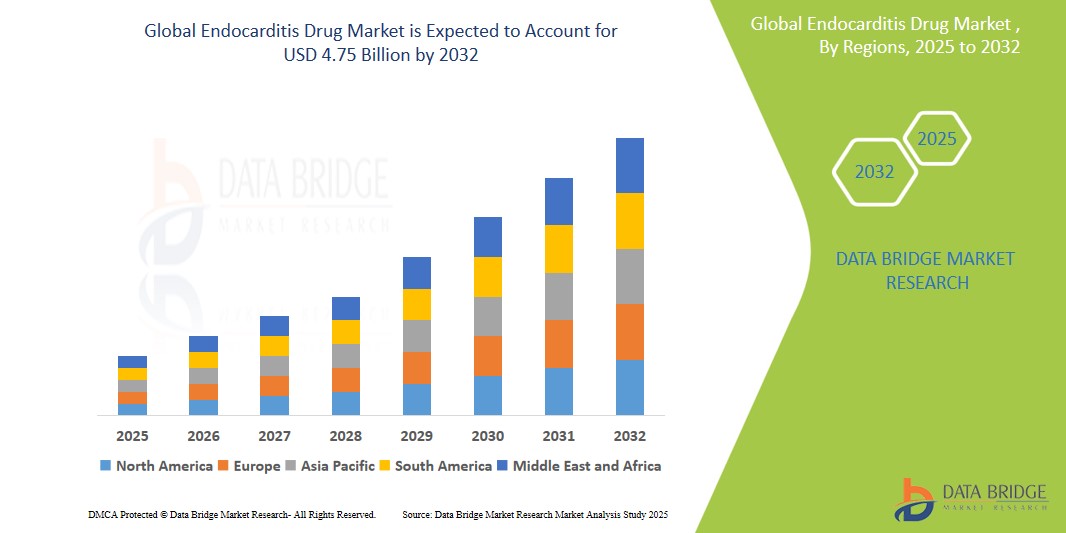
Endocarditis Drug Market Size
• The global Endocarditis Drug Market was valued at USD 2.85 billion in 2024 and is expected to reach USD 4.75 billion by 2032.
• During the forecast period of 2025 to 2032, the market is likely to grow at a CAGR of 6.7%, primarily driven by increasing incidence of infectious diseases and advancements in antimicrobial therapies.
• This growth is driven by factors such as the rising prevalence of infective endocarditis, expanding awareness initiatives for early diagnosis, and innovations in both pharmacological and adjunctive treatment approaches.
Endocarditis Drug Market Analysis
• The global Endocarditis Drug Market is expected to gain market growth in the forecast period of 2025 to 2032. Data Bridge Market Research analyzes the market to account for growth at a CAGR of 6.7% in the above-mentioned forecast period.
• Endocarditis is a potentially life-threatening inflammation of the inner lining of the heart chambers and valves, usually caused by bacterial or fungal infection. It can lead to severe complications including heart failure, stroke, and systemic infection if left untreated.
• The rise in risk factors such as prosthetic heart valves, congenital heart defects, intravenous drug use, increasing government initiatives for infectious disease control, technological advancements in diagnostics, and rising healthcare expenditures are key factors driving the growth of the global Endocarditis Drug Market
Report Scope and Endocarditis Drug Market Segmentation
|
Attributes |
Endocarditis Drug Market Key Market Insights |
|
Segments Covered |
|
|
Countries Covered |
North America
Europe
Asia-Pacific
Middle East and Africa
South America
|
|
Key Market Players |
|
|
Market Opportunities |
|
|
Value Added Data Infosets |
In addition to the insights on market scenarios such as market value, growth rate, segmentation, geographical coverage, and major players, the market reports curated by the Data Bridge Market Research also include import export analysis, production capacity overview, production consumption analysis, price trend analysis, climate change scenario, supply chain analysis, value chain analysis, raw material/consumables overview, vendor selection criteria, PESTLE Analysis, Porter Analysis, and regulatory framework. |
Global Endocarditis Drug Market Trends
“Increased Emphasis on Early Diagnosis and Targeted Antimicrobial Therapy”
• A significant trend in the endocarditis drug market is the growing focus on early detection methods and precision-targeted therapeutic regimens to improve patient outcomes for both native and prosthetic valve infections.
• Treatment strategies are increasingly combining empiric broad-spectrum antibiotics with organism-specific antimicrobial therapies, often in conjunction with surgical interventions when necessary, to manage complicated cases more effectively.
• For example, updated clinical guidelines emphasize the prompt initiation of tailored antibiotic therapy based on blood culture results to reduce mortality rates and complications associated with infective endocarditis.
• Furthermore, the incorporation of advanced imaging modalities such as PET-CT and molecular diagnostic tools is enhancing the accuracy and speed of endocarditis diagnosis, leading to timely intervention.
• Factors such as rising prevalence of healthcare-associated infections, growing rates of cardiac device implants, and increased awareness among clinicians are driving the demand for endocarditis treatments.
Global Endocarditis Drug Market Dynamics
Driver
“Rising Incidence of Infective Endocarditis and Healthcare-Associated Infections”
Endocarditis is a severe and life-threatening infection of the heart valves and endocardial surface, often caused by bacterial or fungal pathogens entering the bloodstream.
For instance:
• According to a 2023 study published in the European Heart Journal, the global incidence of infective endocarditis is estimated at 3–10 cases per 100,000 individuals annually, with higher rates among older adults and patients with prosthetic heart valves or intravenous drug use.
• Symptoms such as persistent fever, embolic phenomena, and heart failure contribute significantly to morbidity and mortality, emphasizing the urgent need for effective drug therapies.
“Supportive Health Policies and Expanded Antibiotic Stewardship Programs”
Government policies promoting early identification of bloodstream infections and the expansion of antibiotic stewardship programs are positively influencing the adoption of optimal treatment practices.
For instance:
• In 2022, several countries strengthened guidelines to improve blood culture protocols and mandated antimicrobial stewardship initiatives in hospitals to better manage infections like endocarditis, promoting rational drug use and better patient outcomes.
Opportunity
“Advancements in Antimicrobial Agents and Combination Therapies”
The endocarditis drug market is witnessing new opportunities through the development of next-generation antibiotics, antifungals, and combination regimens targeting resistant pathogens.
For instance:
• Newer antibiotics with activity against multidrug-resistant organisms, adjunctive therapies such as bacteriophage therapy, and combination regimens are gaining interest to address the complexity of endocarditis management.
• Healthcare systems are also investing in patient education initiatives and postoperative care programs for individuals with prosthetic valves and other risk factors to prevent recurrent infections.
• As antimicrobial resistance continues to pose challenges, the demand for innovative, effective, and safer drug options is steadily increasing.
Restraint/Challenge
“High Treatment Costs and Risk of Antimicrobial Resistance”
• Despite advancements, the market is restrained by the high cost of prolonged antimicrobial therapies, hospital stays, and complex surgical interventions required for severe endocarditis cases.
• Moreover, widespread use of broad-spectrum antibiotics without proper stewardship can lead to increased antimicrobial resistance, complicating treatment protocols.
For example:
• While novel agents and combination therapies offer improved efficacy, their uptake may be limited by cost, regulatory hurdles, and limited availability in low-resource settings, particularly in regions with constrained healthcare infrastructure.
Global Endocarditis Drug Market Scope
The market is segmented on the basis of drug class, application, dosage, route of administration, end-users, and distribution channel.
|
Segmentation |
Sub-Segmentation |
|
• By Drug
|
|
|
Route of Administration |
|
|
End-Users |
|
|
Distribution Channel |
|
Global Endocarditis Drug Market Regional Analysis
“North America is the Dominant Region in the Global Endocarditis Drug Market”
- North America leads the global Endocarditis Drug market due to its advanced healthcare infrastructure, high disease awareness, and significant investments in infectious disease management.
- The United States holds the largest market share, driven by the high prevalence of heart conditions, rising cases of prosthetic valve endocarditis, and widespread adoption of targeted antibiotic therapies.
- The presence of leading pharmaceutical innovators and strong academic research collaborations fosters ongoing drug development and clinical trial activity.
- Favorable reimbursement policies and supportive regulatory pathways have accelerated the uptake of both hospital-administered and outpatient antimicrobial therapies for endocarditis treatment.
“Asia-Pacific is Projected to Register the Highest Growth Rate”
- The Asia-Pacific region is expected to exhibit the fastest growth in the Endocarditis Drug market due to expanding healthcare access, rising burden of cardiac infections, and improving diagnostic capabilities.
- Countries such as China, India, Japan, and South Korea are driving this growth through enhanced healthcare funding and public health initiatives targeting infectious diseases.
- Government programs emphasizing early diagnosis and preventive cardiac care are positively impacting treatment rates.
- Japan, with its aging population and advanced hospital networks, is a leading adopter of newer endocarditis therapies.
- Growing partnerships between multinational pharmaceutical companies and local healthcare organizations, along with increased digital healthcare penetration, are further supporting regional market expansion.
Endocarditis Drug Market Share
The competitive landscape of the market offers detailed insights by key players. This includes company profiles, financials, revenue, investment in R&D, product offerings, global presence, production capacities, strategic initiatives, strengths, weaknesses, and competitive positioning—specifically in relation to the development and commercialization of endocarditis therapies.
The Major Market Leaders Operating in the Market Include:
- Pfizer Inc.
- Eli Lilly and Company
- AbbVie Inc.
- Johnson & Johnson Services, Inc.
- Baxter International Inc.
- Hikma Pharmaceuticals PLC
- Fresenius Kabi AG
- Sunovion Pharmaceuticals Inc.
- Medtronic
- Dr. Reddy’s Laboratories Ltd.
- Teva Pharmaceutical Industries Ltd.
- Mylan N.V.
- BioXcel Therapeutics, Inc.
- Neurocrine Biosciences, Inc.
- Zydus Lifesciences
- Amneal Pharmaceuticals LLC
- Akorn Pharmaceuticals
- Troikaa Pharmaceuticals Ltd.
- Glenmark Pharmaceuticals
- Aurobindo Pharma
Latest Developments in Global Endocarditis Drug Market
In February 2021, a study published by the National Center for Biotechnology Information (NCBI) highlighted several systemic barriers to the effective management of endocarditis. These included diagnostic delays, variability in antibiotic stewardship programs, and insufficient multidisciplinary collaboration in hospitals.
Additionally, the lack of standardized treatment protocols across healthcare settings can complicate timely diagnosis and therapeutic intervention, emphasizing the need for greater integration of clinical guidelines, enhanced infection control practices, and expanded education for healthcare providers.
Global Endocarditis Drug Market Regional Analysis
“North America is the Dominant Region in the Global Endocarditis Drug Market”
- North America leads the global Endocarditis Drug market due to its advanced healthcare infrastructure, high disease awareness, and significant investments in infectious disease management.
- The United States holds the largest market share, driven by the high prevalence of heart conditions, rising cases of prosthetic valve endocarditis, and widespread adoption of targeted antibiotic therapies.
- The presence of leading pharmaceutical innovators and strong academic research collaborations fosters ongoing drug development and clinical trial activity.
- Favorable reimbursement policies and supportive regulatory pathways have accelerated the uptake of both hospital-administered and outpatient antimicrobial therapies for endocarditis treatment.
“Asia-Pacific is Projected to Register the Highest Growth Rate”
- The Asia-Pacific region is expected to exhibit the fastest growth in the Endocarditis Drug market due to expanding healthcare access, rising burden of cardiac infections, and improving diagnostic capabilities.
- Countries such as China, India, Japan, and South Korea are driving this growth through enhanced healthcare funding and public health initiatives targeting infectious diseases.
- Government programs emphasizing early diagnosis and preventive cardiac care are positively impacting treatment rates.
- Japan, with its aging population and advanced hospital networks, is a leading adopter of newer endocarditis therapies.
- Growing partnerships between multinational pharmaceutical companies and local healthcare organizations, along with increased digital healthcare penetration, are further supporting regional market expansion.
Endocarditis Drug Market Share
The competitive landscape of the market offers detailed insights by key players. This includes company profiles, financials, revenue, investment in R&D, product offerings, global presence, production capacities, strategic initiatives, strengths, weaknesses, and competitive positioning—specifically in relation to the development and commercialization of endocarditis therapies.
The Major Market Leaders Operating in the Market Include:
- Pfizer Inc.
- Eli Lilly and Company
- AbbVie Inc.
- Johnson & Johnson Services, Inc.
- Baxter International Inc.
- Hikma Pharmaceuticals PLC
- Fresenius Kabi AG
- Sunovion Pharmaceuticals Inc.
- Medtronic
- Dr. Reddy’s Laboratories Ltd.
- Teva Pharmaceutical Industries Ltd.
- Mylan N.V.
- BioXcel Therapeutics, Inc.
- Neurocrine Biosciences, Inc.
- Zydus Lifesciences
- Amneal Pharmaceuticals LLC
- Akorn Pharmaceuticals
- Troikaa Pharmaceuticals Ltd.
- Glenmark Pharmaceuticals
- Aurobindo Pharma
Latest Developments in Global Endocarditis Drug Market
In February 2021, a study published by the National Center for Biotechnology Information (NCBI) highlighted several systemic barriers to the effective management of endocarditis. These included diagnostic delays, variability in antibiotic stewardship programs, and insufficient multidisciplinary collaboration in hospitals.
Additionally, the lack of standardized treatment protocols across healthcare settings can complicate timely diagnosis and therapeutic intervention, emphasizing the need for greater integration of clinical guidelines, enhanced infection control practices, and expanded education for healthcare providers.

- Interactive Data Analysis Dashboard
- Company Analysis Dashboard for high growth potential opportunities
- Research Analyst Access for customization & queries
- Competitor Analysis with Interactive dashboard
- Latest News, Updates & Trend analysis
- Harness the Power of Benchmark Analysis for Comprehensive Competitor Tracking
Data collection and base year analysis are done using data collection modules with large sample sizes. The stage includes obtaining market information or related data through various sources and strategies. It includes examining and planning all the data acquired from the past in advance. It likewise envelops the examination of information inconsistencies seen across different information sources. The market data is analysed and estimated using market statistical and coherent models. Also, market share analysis and key trend analysis are the major success factors in the market report. To know more, please request an analyst call or drop down your inquiry.
The key research methodology used by DBMR research team is data triangulation which involves data mining, analysis of the impact of data variables on the market and primary (industry expert) validation. Data models include Vendor Positioning Grid, Market Time Line Analysis, Market Overview and Guide, Company Positioning Grid, Patent Analysis, Pricing Analysis, Company Market Share Analysis, Standards of Measurement, Global versus Regional and Vendor Share Analysis. To know more about the research methodology, drop in an inquiry to speak to our industry experts.
Data Bridge Market Research is a leader in advanced formative research. We take pride in servicing our existing and new customers with data and analysis that match and suits their goal. The report can be customized to include price trend analysis of target brands understanding the market for additional countries (ask for the list of countries), clinical trial results data, literature review, refurbished market and product base analysis. Market analysis of target competitors can be analyzed from technology-based analysis to market portfolio strategies. We can add as many competitors that you require data about in the format and data style you are looking for. Our team of analysts can also provide you data in crude raw excel files pivot tables (Fact book) or can assist you in creating presentations from the data sets available in the report.












