


What is the Enterprise AI Operating Systems (AI OS) Market Size and Overview?
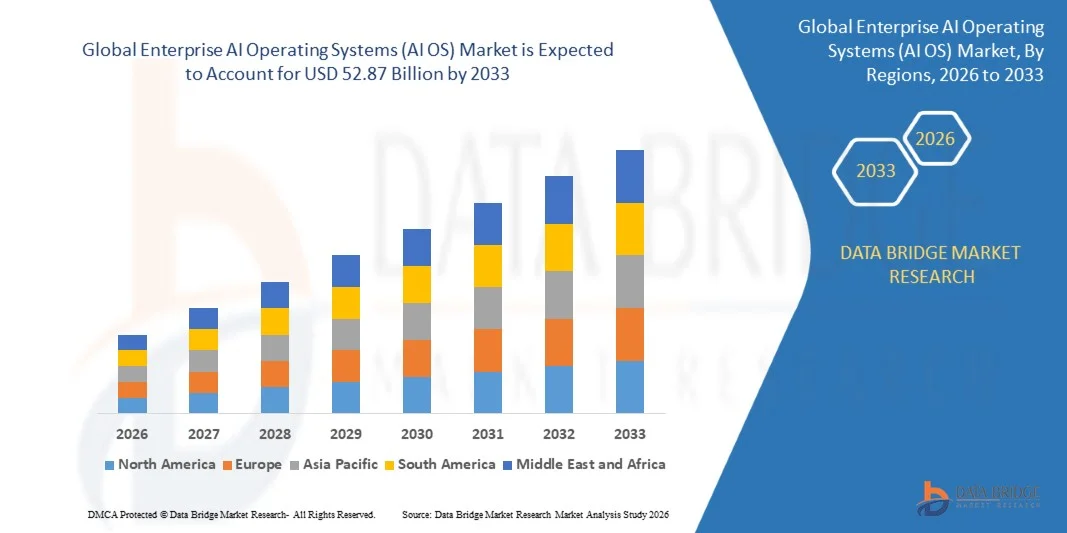
As per Data Bridge Market Research Analysis The Enterprise AI Operating Systems (AI OS) Market was valued at USD 18.64 billion in 2025 and is projected to reach USD 52.87 billion by 2033, growing at a CAGR of 13.9% from 2026 to 2033. The market is experiencing rapid growth driven by increasing enterprise adoption of generative AI, rising demand for centralized AI security orchestration platforms, and growing investments in enterprise-wide AI automation infrastructure.
Organizations across industries are increasingly deploying AI operating systems to manage AI workloads, orchestrate foundation models, automate workflows, and ensure governance across enterprise environments. AI OS platforms are becoming critical for integrating large language models (LLMs), AI agents, predictive analytics, and real-time decision-making into enterprise operations while maintaining scalability, security, and compliance.
What are the Major Takeaways of Enterprise AI Operating Systems (AI OS) Market?
- North America dominated the global enterprise AI operating systems market with the largest revenue share of 38.91% in 2025, supported by strong AI infrastructure investments, rapid enterprise AI adoption, and the presence of major technology providers.
- The Cloud-Based AI OS segment led the market with a 46.18% share in 2025, driven by scalability, lower infrastructure costs, and increasing enterprise demand for flexible AI deployment environments.
- Asia-Pacific is expected to be the fastest-growing region at a CAGR of 15.1% from 2026 to 2033, fueled by rapid digital transformation, growing AI investments, and expanding adoption across China, India, Japan, and South Korea.
- Hybrid AI OS platforms are the fastest-growing deployment type, projected to register a CAGR of 14.8%, reflecting rising enterprise demand for secure, multi-cloud AI orchestration environments.
- The Large Enterprises segment dominates the enterprise size category with a 63.74% revenue share in 2025, led by high AI spending capacity and increasing deployment of enterprise-scale AI automation systems.
- Public Cloud deployment accounts for 57.21% of the market, preferred by enterprises seeking scalable AI compute infrastructure, rapid deployment, and integrated AI services.
- The AI Security & Governance segment is the fastest-growing component category, with a CAGR of 15.0%, driven by rising concerns regarding AI compliance, data privacy, explainability, and responsible AI governance.
Market Size & Forecast
- Global Market Value (2025): USD 18.64 Billion
- Expected Market Value (2033): USD 87 Billion
- Forecast CAGR (2026–2033): 13.9%
- Leading Region in 2025: North America
- Fastest Growing Region: Asia-Pacific
Report Scope and Enterprise AI Operating Systems (AI OS) Market Segmentation
Attributes |
Enterprise AI Operating Systems (AI OS) Key Market Insights |
|
Segments Covered |
|
|
Countries Covered |
North America · U.S. · Canada · Mexico Europe · Germany · France · U.K. · Netherlands · Switzerland · Belgium · Russia · Italy · Spain · Turkey · Rest of Europe Asia-Pacific · China · Japan · India · South Korea · Singapore · Malaysia · Australia · Thailand · Indonesia · Philippines · Rest of Asia-Pacific Middle East and Africa · Saudi Arabia · U.A.E. · South Africa · Egypt · Israel · Rest of Middle East and Africa South America · Brazil · Argentina · Rest of South America |
|
Key Market Players |
· Microsoft Corporation (U.S.) · Alphabet Inc. (U.S.) · Amazon Web Services, Inc. (U.S.) · IBM Corporation (U.S.) · Oracle Corporation (U.S.) · Salesforce, Inc. (U.S.) · NVIDIA Corporation (U.S.) · SAP SE (Germany) · ServiceNow, Inc. (U.S.) · OpenAI (U.S.) · Anthropic PBC (U.S.) · Databricks, Inc. (U.S.) · Snowflake Inc. (U.S.) · C3.ai, Inc. (U.S.) · Hugging Face, Inc. (U.S.) · Palantir Technologies Inc. (U.S.) · Baidu, Inc. (China) · Alibaba Cloud (China) · Tencent Cloud (China) · Infosys Limited (India) · Tata Consultancy Services Limited (India) · Wipro Limited (India) · H2O.ai, Inc. (U.S.) · DataRobot, Inc. (U.S.) · UiPath Inc. (U.S.) · SambaNova Systems, Inc. (U.S.) · Cerebras Systems Inc. (U.S.) · Adept AI Labs, Inc. (U.S.) · Cohere Inc. (Canada) · Mistral AI SAS (France) |
|
Market Opportunities |
· Rising enterprise adoption of generative AI and AI agents · Increasing demand for AI governance and orchestration platforms · Expansion of multi-cloud and hybrid AI infrastructure |
|
Value Added Data Infosets |
In addition to the insights on market scenarios such as market value, growth rate, segmentation, geographical coverage, and major players, the market reports curated by the Data Bridge Market Research also include import export analysis, production capacity overview, production consumption analysis, price trend analysis, climate change scenario, supply chain analysis, value chain analysis, raw material/consumables overview, vendor selection criteria, PESTLE Analysis, Porter Analysis, and regulatory framework. |
What is the Key Trend in the Enterprise AI Operating Systems (AI OS) Market?
Trend: Growth in Enterprise AI Orchestration & Autonomous AI Agents
Enterprises are increasingly adopting AI operating systems to orchestrate generative AI models, AI agents, enterprise data pipelines, and automated workflows within unified environments. Organizations are leveraging AI OS platforms to manage multi-model deployments, automate decision-making processes, and improve enterprise productivity while maintaining governance and compliance. The integration of multi-agent AI frameworks, low-code AI development tools, and real-time analytics is enabling businesses to deploy scalable AI ecosystems that support customer service automation, predictive operations, software development, and enterprise knowledge management.
Enterprise AI Operating Systems (AI OS) Market Dynamics
Key Market Driver: Rising Adoption of Generative AI Across Enterprises
The rapid enterprise adoption of generative AI, large language models (LLMs), and autonomous AI agents is significantly driving demand for enterprise AI operating systems. Organizations across BFSI, healthcare, retail, manufacturing, and IT sectors are deploying AI OS platforms to centralize AI model management, automate workflows, monitor AI performance, and streamline enterprise-scale AI operations. These platforms help enterprises accelerate AI deployment cycles, improve operational efficiency, reduce infrastructure complexity, and ensure secure integration of AI applications across business environments.
Key Restraint/Challenge: High Infrastructure and Integration Costs
A significant restraint in the global enterprise AI operating systems market is the high infrastructure and implementation cost associated with enterprise-grade AI platforms. Advanced AI operating systems require high-performance computing infrastructure, GPU acceleration, AI security frameworks, and integration with existing enterprise systems, resulting in substantial upfront investment. In addition, ongoing costs related to model training, cloud compute consumption, AI governance compliance, and workforce upskilling create financial challenges for small and medium-sized enterprises.
The growing deployment of large-scale AI clusters and enterprise-grade generative AI infrastructure across major technology companies highlights the substantial capital investment required to support advanced AI operating systems, reflecting broader adoption challenges among cost-sensitive organizations.
Key Market Opportunity: Expansion of AI Governance and Multi-Cloud AI Platforms
The growing focus on responsible AI, regulatory compliance, and enterprise AI governance presents a major opportunity for the enterprise AI operating systems market. AI OS platforms with integrated governance, explainability, model monitoring, and security capabilities are becoming increasingly important for enterprises deploying mission-critical AI applications. In addition, the expansion of multi-cloud and hybrid AI environments is creating demand for interoperable AI operating systems capable of orchestrating AI workloads across distributed infrastructures. The integration of AI agents, real-time inference engines, and low-code AI orchestration tools is further expanding adoption opportunities across both developed and emerging markets.
How is the Enterprise AI Operating Systems (AI OS) Market Segmented?
The enterprise AI operating systems (AI OS) market is segmented on the basis of deployment model, component, enterprise size, application, industry vertical, AI capability, integration type, deployment environment, end user, and support & services.
- By Deployment Model
On the basis of deployment model, the Enterprise AI Operating Systems (AI OS) Market is segmented into on-premise, cloud-based, hybrid, and edge AI operating systems. The cloud-based segment dominated the market with a share of 44.38% in 2025 due to its scalability, lower infrastructure costs, and rapid deployment capabilities across enterprise AI workloads. Organizations are increasingly adopting cloud-native AI operating systems to support generative AI applications, large-scale data processing, and cross-functional automation while enabling remote accessibility and continuous software updates.
The hybrid AI operating systems segment is expected to witness the fastest CAGR of 8.6% from 2026 to 2033, driven by increasing enterprise demand for flexible infrastructure that combines cloud scalability with on-premise data control and regulatory compliance. Hybrid deployment models are gaining traction among highly regulated industries requiring secure AI orchestration and workload optimization across distributed environments.
- By Component
On the basis of component, the global enterprise AI operating systems market is segmented into AI orchestration platforms, AI middleware, AI infrastructure management tools, AI security & governance tools, workflow automation engines, and monitoring & analytics solutions. The AI orchestration platforms segment dominated the market with a share of 31.42% in 2025 due to rising adoption of centralized AI workload management, multi-model deployment, and automated resource allocation capabilities across enterprise ecosystems.
The AI security & governance tools segment is projected to register the fastest CAGR of 8.8% from 2026 to 2033, driven by increasing concerns related to AI transparency, model bias, compliance management, and enterprise cybersecurity risks. Organizations are investing heavily in governance frameworks to ensure responsible and auditable AI deployment.
- By Enterprise Size
On the basis of enterprise size, the global enterprise AI operating systems market is segmented into large enterprises and small & medium enterprises (SMEs). The large enterprises segment dominated the market with a share of 68.15% in 2025 due to higher AI infrastructure spending, large-scale digital transformation initiatives, and strong adoption of enterprise automation platforms across multinational organizations.
The SMEs segment is anticipated to witness the fastest CAGR of 8.4% from 2026 to 2033, driven by growing accessibility of subscription-based AI OS platforms, low-code AI development tools, and cloud-based deployment models that reduce implementation complexity and upfront investment costs.
- By Application
On the basis of application, the global enterprise AI operating systems market is segmented into enterprise automation, predictive analytics, generative AI management, cybersecurity & threat intelligence, customer experience management, supply chain optimization, and workforce productivity. The enterprise automation segment dominated the market with a share of 29.87% in 2025 due to increasing demand for AI-driven workflow optimization, intelligent process automation, and operational efficiency improvements across enterprise departments.
The generative AI management segment is expected to witness the fastest CAGR of 9.1% from 2026 to 2033, driven by rapid enterprise adoption of foundation models, copilots, AI agents, and multimodal generative AI systems requiring centralized orchestration and governance capabilities.
- By Industry Vertical
On the basis of industry vertical, the global enterprise AI operating systems market is segmented into BFSI, healthcare, retail & e-commerce, IT & telecom, manufacturing, government, energy & utilities, transportation & logistics, and others. The IT & telecom segment dominated the market with a share of 24.63% in 2025 due to early adoption of AI-native infrastructure, large-scale cloud operations, and increasing integration of AI-driven network optimization and automation platforms.
The healthcare segment is projected to witness the fastest CAGR of 8.9% from 2026 to 2033, driven by increasing use of AI operating systems for clinical decision support, medical workflow automation, patient analytics, and healthcare data management.
- By AI Capability
On the basis of AI capability, the global enterprise AI operating systems market is segmented into machine learning operations (MLOps), generative AI orchestration, natural language processing (NLP), computer vision management, autonomous AI agents, and multimodal AI systems. The MLOps segment dominated the market with a share of 33.12% in 2025 due to rising enterprise demand for automated model deployment, lifecycle management, monitoring, and continuous optimization of AI systems.
The autonomous AI agents segment is expected to witness the fastest CAGR of 9.3% from 2026 to 2033, driven by increasing adoption of AI-powered digital assistants, autonomous workflow engines, and intelligent enterprise task execution systems.
- By Integration Type
On the basis of integration type, the global enterprise AI operating systems market is segmented into API integration, ERP & CRM integration, cloud platform integration, data lake integration, and third-party AI model integration. The API integration segment dominated the market with a share of 37.45% in 2025 due to increasing enterprise reliance on interoperable AI ecosystems and seamless connectivity between AI platforms and existing enterprise applications.
The third-party AI model integration segment is projected to witness the fastest CAGR of 8.7% from 2026 to 2033, driven by growing enterprise demand for integrating external foundation models, open-source LLMs, and specialized AI services into centralized AI operating systems.
- By Deployment Environment
On the basis of deployment environment, the global enterprise AI operating systems market is segmented into public cloud, private cloud, hybrid cloud, and edge infrastructure. The public cloud segment dominated the market with a share of 42.74% in 2025 due to cost efficiency, elastic computing resources, and widespread adoption of cloud-based AI development and deployment platforms.
The edge infrastructure segment is expected to witness the fastest CAGR of 8.5% from 2026 to 2033, driven by increasing demand for real-time AI processing, low-latency decision-making, and decentralized AI deployment across manufacturing, automotive, and industrial environments.
- By End User
On the basis of end user, the global enterprise AI operating systems market is segmented into enterprises, cloud service providers, government organizations, research institutions, and managed service providers. The enterprises segment dominated the market with a share of 58.31% in 2025 due to rising investments in enterprise-wide AI transformation strategies, intelligent automation, and AI governance platforms.
The managed service providers segment is anticipated to witness the fastest CAGR of 8.2% from 2026 to 2033, driven by increasing outsourcing of AI infrastructure management, deployment services, and enterprise AI optimization solutions.
- By Support & Services
On the basis of support & services, the global enterprise AI operating systems market is segmented into consulting services, deployment & integration, maintenance & support, training & certification, and managed AI services. The deployment & integration segment dominated the market with a share of 30.26% in 2025 due to growing complexity of enterprise AI infrastructure and increasing demand for seamless AI platform implementation across existing IT ecosystems.
The managed AI services segment is expected to witness the fastest CAGR of 8.6% from 2026 to 2033, driven by rising enterprise preference for outsourced AI operations, continuous monitoring, performance optimization, and lifecycle management services.
Enterprise AI Operating Systems (AI OS) Market Regional Analysis
North America dominated the enterprise AI operating systems market and accounted for the largest revenue share of 38.91% in 2025, supported by strong cloud infrastructure, high enterprise AI spending, and the presence of leading AI technology providers. The region benefits from rapid adoption of generative AI platforms, advanced digital transformation initiatives, and increasing integration of AI governance and automation systems across enterprise environments.
U.S. Enterprise AI Operating Systems (AI OS) Market Insight
The U.S. enterprise AI operating systems market is witnessing strong growth due to rising adoption of generative AI, intelligent automation, and enterprise-scale AI orchestration platforms. Large technology companies and enterprises are investing heavily in AI-native operating environments to improve productivity, optimize workflows, and accelerate AI-driven innovation. Increasing focus on AI governance, cybersecurity, and responsible AI deployment is further strengthening market growth.
Europe Enterprise AI Operating Systems (AI OS) Market Insight
The Europe enterprise AI operating systems market remains a major contributor to global revenue, driven by increasing enterprise digitalization, stringent AI governance regulations, and rising investments in secure AI infrastructure. Enterprises across banking, healthcare, and manufacturing sectors are increasingly deploying AI operating systems to improve operational efficiency and ensure compliance with evolving regulatory frameworks.
U.K. Enterprise AI Operating Systems (AI OS) Market Insight
The U.K. enterprise AI operating systems market is experiencing steady growth due to rising enterprise adoption of AI-driven automation, cloud computing, and intelligent analytics platforms. Increasing investments in AI innovation hubs, fintech transformation, and enterprise cybersecurity are supporting widespread deployment of AI OS solutions across commercial sectors.
Germany Enterprise AI Operating Systems (AI OS) Market Insight
The Germany enterprise AI operating systems market is expanding steadily due to strong industrial automation capabilities, advanced manufacturing infrastructure, and growing adoption of AI-powered enterprise management systems. German enterprises are increasingly integrating AI operating systems into industrial operations, predictive maintenance platforms, and supply chain optimization frameworks to enhance productivity and operational efficiency.
Asia-Pacific Enterprise AI Operating Systems (AI OS) Market Insight
The Asia-Pacific enterprise AI operating systems market is expected to witness rapid growth, driven by accelerating digital transformation initiatives, rising cloud adoption, and expanding AI infrastructure investments across China, India, Japan, and Southeast Asia. Growing enterprise demand for scalable AI platforms, automation technologies, and generative AI solutions is significantly contributing to regional market expansion.
Japan Enterprise AI Operating Systems (AI OS) Market Insight
The Japan enterprise AI operating systems market is witnessing consistent growth due to increasing adoption of AI-powered enterprise automation, robotics integration, and intelligent business management platforms. Enterprises are investing in AI OS solutions to improve operational efficiency, workforce productivity, and data-driven decision-making capabilities across industries.
China Enterprise AI Operating Systems (AI OS) Market Insight
The China enterprise AI operating systems market is growing rapidly, driven by strong government support for AI innovation, expanding cloud infrastructure, and rising adoption of generative AI technologies across enterprises. Increasing investments in domestic AI ecosystems, industrial automation, and enterprise AI platforms are accelerating deployment of AI operating systems across manufacturing, finance, retail, and telecommunications sectors.
Enterprise AI Operating Systems (AI OS) Market Share
The Enterprise AI Operating Systems (AI OS) industry is primarily led by well-established companies, including:
- Microsoft Corporation (U.S.)
- Alphabet Inc. (U.S.)
- Amazon Web Services, Inc. (U.S.)
- IBM Corporation (U.S.)
- Oracle Corporation (U.S.)
- Salesforce, Inc. (U.S.)
- NVIDIA Corporation (U.S.)
- SAP SE (Germany)
- ServiceNow, Inc. (U.S.)
- OpenAI (U.S.)
- Anthropic PBC (U.S.)
- Databricks, Inc. (U.S.)
- Snowflake Inc. (U.S.)
- ai, Inc. (U.S.)
- Hugging Face, Inc. (U.S.)
- Palantir Technologies Inc. (U.S.)
- Baidu, Inc. (China)
- Alibaba Cloud (China)
- Tencent Cloud (China)
- Infosys Limited (India)
- Tata Consultancy Services Limited (India)
- Wipro Limited (India)
- ai, Inc. (U.S.)
- DataRobot, Inc. (U.S.)
- UiPath Inc. (U.S.)
- SambaNova Systems, Inc. (U.S.)
- Cerebras Systems Inc. (U.S.)
- Adept AI Labs, Inc. (U.S.)
- Cohere Inc. (Canada)
- Mistral AI SAS (France)
Latest Developments in Enterprise AI Operating Systems (AI OS) Market
- In October 2025, Microsoft Corporation expanded its enterprise AI operating ecosystem by enhancing Copilot Studio and Azure AI Foundry with multi-agent orchestration capabilities, enabling enterprises to automate complex workflows and deploy autonomous AI agents securely across enterprise environments. The update strengthened Microsoft’s position in the enterprise AI OS market by improving interoperability, governance, and enterprise-scale AI automation capabilities.
- In September 2025, NVIDIA Corporation introduced new enterprise AI infrastructure and AI operating stack enhancements through its NVIDIA AI Enterprise platform, enabling organizations to manage generative AI workloads, optimize inference performance, and deploy multimodal AI applications across cloud and on-premise environments. These developments reinforced NVIDIA’s leadership in enterprise AI computing and AI-native operating environments.
- In August 2025, Salesforce, Inc. launched upgraded autonomous AI agent functionalities within its Agentforce platform, enabling enterprises to deploy AI-driven workflow automation and customer interaction systems integrated with enterprise data ecosystems. The launch accelerated adoption of enterprise AI operating systems focused on intelligent orchestration, business automation, and real-time decision-making.
- In May 2024, Google LLC introduced advanced enterprise AI management capabilities within Vertex AI, enabling enterprises to manage foundation models, generative AI applications, and AI governance frameworks through a unified AI operations environment. The update enhanced enterprise AI deployment scalability, security, and model lifecycle management across cloud-based enterprise infrastructures.
- In March 2024, IBM Corporation expanded its watsonx platform with enhanced AI governance, model monitoring, and enterprise orchestration capabilities to support secure deployment of generative AI across regulated industries. The platform improvements strengthened IBM’s enterprise AI OS capabilities by enabling organizations to manage AI compliance, transparency, and operational efficiency at scale.

- Interactive Data Analysis Dashboard
- Company Analysis Dashboard for high growth potential opportunities
- Research Analyst Access for customization & queries
- Competitor Analysis with Interactive dashboard
- Latest News, Updates & Trend analysis
- Harness the Power of Benchmark Analysis for Comprehensive Competitor Tracking
Data collection and base year analysis are done using data collection modules with large sample sizes. The stage includes obtaining market information or related data through various sources and strategies. It includes examining and planning all the data acquired from the past in advance. It likewise envelops the examination of information inconsistencies seen across different information sources. The market data is analysed and estimated using market statistical and coherent models. Also, market share analysis and key trend analysis are the major success factors in the market report. To know more, please request an analyst call or drop down your inquiry.
The key research methodology used by DBMR research team is data triangulation which involves data mining, analysis of the impact of data variables on the market and primary (industry expert) validation. Data models include Vendor Positioning Grid, Market Time Line Analysis, Market Overview and Guide, Company Positioning Grid, Patent Analysis, Pricing Analysis, Company Market Share Analysis, Standards of Measurement, Global versus Regional and Vendor Share Analysis. To know more about the research methodology, drop in an inquiry to speak to our industry experts.
Data Bridge Market Research is a leader in advanced formative research. We take pride in servicing our existing and new customers with data and analysis that match and suits their goal. The report can be customized to include price trend analysis of target brands understanding the market for additional countries (ask for the list of countries), clinical trial results data, literature review, refurbished market and product base analysis. Market analysis of target competitors can be analyzed from technology-based analysis to market portfolio strategies. We can add as many competitors that you require data about in the format and data style you are looking for. Our team of analysts can also provide you data in crude raw excel files pivot tables (Fact book) or can assist you in creating presentations from the data sets available in the report.













