


What is the Epigenetic Kits Size and Growth Rate?
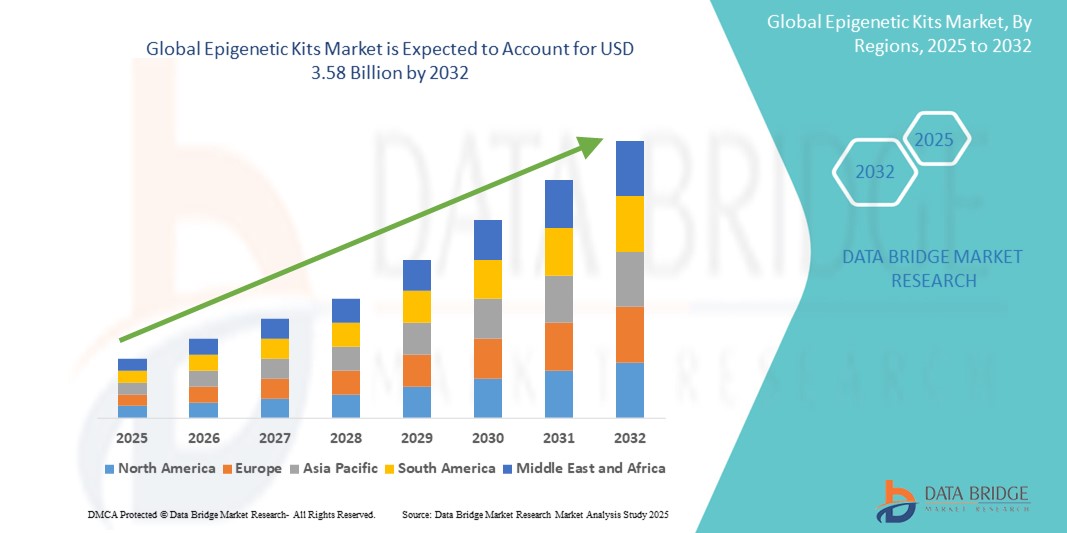
- As per Data Bridge Market Research Analysis the global epigenetic kits market size was valued at USD 1.15 billion in 2024 and is expected to reach USD 3.58 billion by 2032, at a CAGR of 15.20% during the forecast period
- The market growth is largely fueled by the increasing focus on precision medicine and personalized therapies, driving the demand for advanced research tools such as epigenetic kits. Technological advancements in DNA methylation, histone modification analysis, and chromatin accessibility assays are also contributing significantly to the expansion of the epigenetic kits market across academic, clinical, and pharmaceutical research settings
- Furthermore, rising investments in epigenetics research, along with growing awareness about the role of epigenetic mechanisms in cancer, neurodegenerative disorders, and autoimmune diseases, are accelerating the uptake of epigenetic kits. These converging factors are significantly boosting the industry's growth as researchers seek accurate, high-throughput, and easy-to-use solutions for studying gene regulation and epigenomic changes
Market Size & Forecast
- Global Market Value (2024): USD 1.15 billion
- Expected Market Value (2032): USD 3.58 billion
- Forecast CAGR (2024–2032):15.20%
What are the Major Takeaways of Epigenetic Kits?
- Epigenetic kits, which are used to detect, quantify, and analyze epigenetic modifications such as DNA methylation, histone modification, and chromatin accessibility, are becoming vital tools in research and clinical diagnostics due to their role in understanding complex gene regulation mechanisms in diseases such as cancer, neurological disorders, and autoimmune conditions.
- The rising demand for personalized medicine, cancer diagnostics, and targeted therapies is a key driver fueling the global demand for epigenetic kits, especially in academic research institutions, pharmaceutical companies, and diagnostic laboratories
- North America dominated the epigenetic kits market with the largest revenue share of 40.8% in 2024, attributed to the presence of advanced research infrastructure, well-established biotechnology firms, and substantial government and private funding for epigenetics research
- Asia-Pacific is expected to be the fastest growing region in the epigenetic kits market, projected to grow at a CAGR of 15.2% from 2025 to 2032, driven by increasing investments in life sciences research, rising prevalence of chronic diseases, growing healthcare expenditure, and expanding genomics-based infrastructure in countries such as China, India, and Japan
- The oncology segment dominated the epigenetic kits market with the largest market revenue share of 48.7% in 2024, driven by increasing reliance on epigenetic biomarkers for cancer detection, prognosis, and personalized treatment planning. Epigenetic kits are integral to liquid biopsies, methylation-specific PCR, and other tumor profiling methods
Report Scope and Epigenetic Kits Market Segmentation
|
Attributes |
Epigenetic Kits Key Market Insights |
|
Segments Covered |
|
|
Countries Covered |
North America
Europe
Asia-Pacific
Middle East and Africa
South America
|
|
Key Market Players |
|
|
Market Opportunities |
|
|
Value Added Data Infosets |
|
What is the Key Trend in the Epigenetic Kits?
“Rising Adoption in Personalized Medicine and Disease-Specific Applications”
- A significant and accelerating trend in the global epigenetic kits market is the growing use of these tools in personalized medicine and targeted disease diagnostics, especially for conditions such as cancer, neurological disorders, and autoimmune diseases. This shift is enhancing the relevance and demand for epigenetic testing in both research and clinical settings
- For instance, DNA methylation kits are now widely used to identify disease biomarkers and monitor epigenetic changes over time in patient samples, offering clinicians a more precise understanding of disease mechanisms and potential therapeutic responses. Similarly, histone modification kits support detailed investigations into gene expression regulation, allowing for more tailored treatment strategies.
- Epigenetic kits enable researchers to study dynamic, reversible changes in gene expression, leading to breakthroughs in early diagnosis, prognosis, and drug development. Some kits are designed to work with low-input or single-cell samples, making them ideal for advanced research on rare diseases or minimally invasive diagnostics
- The availability of user-friendly, high-throughput, and ready-to-use kits has greatly simplified complex experimental workflows in laboratories. These kits often come with streamlined protocols and validated reagents that reduce errors, save time, and increase reproducibility — factors that are critical for both academic researchers and pharmaceutical companies
- This trend toward more standardized, efficient, and versatile epigenetic solutions is fundamentally reshaping expectations within life sciences research. Consequently, companies such as Zymo Research and Active Motif are expanding their product lines to cater to both core research labs and translational medicine initiatives
- The demand for epigenetic kits that offer robust performance, compatibility with next-generation sequencing (NGS), and disease-specific applications is growing rapidly across academic, clinical, and pharma-biotech sectors, as researchers and healthcare professionals increasingly focus on precision and personalized medicine
Epigenetic Kits Market Dynamics
Driver
“Growing Need for Precision Research and Personalized Medicine”
- The rising prevalence of complex diseases such as cancer, neurological disorders, and autoimmune conditions has intensified the demand for epigenetic research, thereby fueling the adoption of epigenetic kits in both clinical and research settings
- For instance, in April 2024, Zymo Research launched a next-generation bisulfite conversion kit that significantly improves DNA methylation analysis accuracy, boosting demand across academic institutions and pharmaceutical companies. Such product innovations by key industry players are expected to drive the Epigenetic Kits market growth in the forecast period
- Growing awareness of the role of epigenetic mechanisms in disease progression has led to increased funding from governments and private entities to support research in this domain
- In addition, the global shift toward personalized medicine and targeted therapies is driving the need for advanced molecular profiling tools, with epigenetic kits playing a pivotal role in biomarker discovery, diagnostics, and therapeutic development
- Furthermore, the integration of automation and user-friendly platforms in epigenetic kits has expanded their accessibility, making them a staple in both high-throughput labs and smaller research institutions
Restraint/Challenge
“High Cost of Kits and Technical Complexity”
- The relatively high cost of advanced epigenetic kits, particularly those used for whole-genome methylation or chromatin immunoprecipitation (ChIP-Seq), poses a barrier to adoption in cost-sensitive regions and among smaller academic labs
- In addition, the technical complexity of epigenetic workflows—requiring highly skilled personnel and precise sample handling—limits usage in under-resourced laboratories and developing nations
- For instance, whole-genome bisulfite sequencing remains expensive and labor-intensive, often necessitating sophisticated infrastructure and bioinformatics support
- Further concerns include reproducibility challenges and data interpretation complexity, especially for large-scale epigenomics studies
- To address these barriers, companies are investing in the development of more cost-effective, automated, and integrated solutions, while educational institutions and vendors are focusing on training programs to build user proficiency
- Overcoming these challenges through price reduction strategies, technical support services, and kit standardization will be crucial for sustained global market growth
How is the Epigenetic Kits Segmented?
The market is segmented on the basis of product, technology, application, and end user.
- By Product
On the basis of product, the epigenetic kits market is segmented into bisulfite conversion kits, ChIP-Seq Kits, deep sequencing kits, whole genome amplification kits, histone modification kits, and others. The bisulfite conversion kits segment dominated the market with the largest revenue share of 34.6% in 2024, owing to their critical role in DNA methylation analysis—a major focus area in epigenetic research and diagnostics. These kits are widely used in both academic and clinical labs due to their ability to provide accurate conversion of unmethylated cytosines without degrading the DNA.
The ChIP-Seq Kits segment is anticipated to witness the fastest growth rate of 20.4% from 2025 to 2032, fueled by increasing demand for chromatin immunoprecipitation followed by next-generation sequencing (NGS) for gene regulation studies. This technology is gaining traction for its efficiency in identifying protein-DNA interactions and mapping epigenetic markers across genomes.
- By Technology
On the basis of technology, the epigenetic kits market is segmented into DNA Methylation, histone modifications, non-coding RNA modifications, and chromatin remodeling. The DNA Methylation segment held the largest market revenue share of 42.1% in 2024, due to its broad use in cancer research, diagnostics, and gene expression regulation. DNA methylation is a primary epigenetic mechanism, making related kits essential tools across research, pharmaceutical, and clinical sectors.
The Non-Coding RNA Modifications segment is expected to witness the fastest CAGR of 21.3% from 2025 to 2032, driven by expanding research in RNA-based regulation and its implications in disease pathology and therapeutics.
- By Application
On the basis of application, the epigenetic kits market is segmented into oncology, non-oncology, developmental biology, drug discovery, and others. The oncology segment accounted for the largest market revenue share of 48.7% in 2024, driven by increasing reliance on epigenetic biomarkers for cancer detection, prognosis, and personalized treatment planning. Epigenetic kits are integral to liquid biopsies, methylation-specific PCR, and other tumor profiling methods.
The drug discovery segment is projected to witness the fastest CAGR of 19.8% from 2025 to 2032, as pharmaceutical companies increasingly integrate epigenetic profiling to identify novel drug targets and evaluate epigenetic drug efficacy during development.
- By End User
On the basis of end user, the Epigenetic Kits market is segmented into pharmaceutical & biotechnology companies, academic & research institutions, and hospitals & clinics. The academic & research institutions segment dominated the market with a revenue share of 45.5% in 2024, as universities and government-funded research organizations continue to lead the way in epigenetic research, driving high demand for versatile and cost-effective kits.
The pharmaceutical & biotechnology companies segment is anticipated to grow at the fastest rate of 20.1% from 2025 to 2032, propelled by increased investment in epigenetic drug discovery, biomarker development, and translational medicine applications.
Which Region Holds the Largest Share of the How is Epigenetic Kits Segmented?
- North America dominated the epigenetic kits market with the largest revenue share of 40.8% in 2024, driven by the robust biotechnology infrastructure, increasing research funding, and strong presence of major players in the U.S. and Canada
- The region’s academic institutions and pharmaceutical companies actively engage in epigenetics research, leading to high demand for research kits and reagents
- The growing application of epigenetics in cancer diagnostics and personalized medicine, coupled with advancements in next-generation sequencing (NGS), supports the region's leadership in the market. Strategic collaborations between research organizations and biotech firms are also fueling continued innovation in the field
U.S. Epigenetic Kits Market Insight
The U.S. epigenetic kits market captured the largest revenue share of 81.05% within North America in 2024, supported by a surge in cancer research, growing funding from NIH and private investors, and the expanding focus on precision medicine. In addition, a rise in clinical trials involving epigenetic biomarkers and therapies is significantly accelerating demand for specialized kits in both academic and commercial laboratories.
Europe Epigenetic Kits Market Insight
The Europe epigenetic kits market is projected to expand at a substantial CAGR throughout the forecast period, driven by increased government funding for genomic and epigenomic studies and the growth of biotechnology clusters in countries such as Germany, France, and the U.K. Stringent regulatory frameworks, particularly regarding cancer diagnostics and companion diagnostics, are also propelling demand for validated epigenetic solutions in clinical and research settings.
U.K. Epigenetic Kits Market Insight
The U.K. epigenetic kits market is anticipated to grow at a noteworthy CAGR during the forecast period, fueled by significant investments in life sciences R&D and early adoption of advanced genomics technologies. The presence of national initiatives like Genomics England and growing collaborations between academia and biotech companies further enhance the adoption of epigenetic tools for disease research and drug discovery.
Germany Epigenetic Kits Market Insight
The Germany epigenetic kits market is expected to expand at a considerable CAGR during the forecast period, driven by the country’s innovation-driven healthcare system, strong emphasis on personalized medicine, and extensive university-led research. Germany’s well-developed regulatory and funding framework for molecular diagnostics makes it a leading contributor to the regional epigenetics landscape.
Asia-Pacific Epigenetic Kits Market Insight
The Asia-Pacific epigenetic kits market is poised to register the fastest CAGR of 24% from 2025 to 2032, driven by rising biotechnology investments, expanding academic research base, and a growing focus on cancer diagnostics in emerging economies. Countries such as China, India, and Japan are investing heavily in life sciences, and local manufacturers are improving access to high-quality, affordable epigenetic kits.
Japan Epigenetic Kits Market Insight
The Japan epigenetic kits market is expanding due to a strong foundation in genomic research, rising cancer incidence, and government support for healthcare innovation. With a growing elderly population and strong demand for early disease detection, Japan’s epigenetic kits segment is projected to grow at a CAGR of 18.4% through 2032.
China Epigenetic Kits Market Insight
The China epigenetic kits market accounted for the largest revenue share in Asia-Pacific at 38.5% in 2024, supported by an expanding middle class, rapid growth in life sciences funding, and strong domestic production of molecular biology tools. China’s leadership in smart healthcare, precision medicine, and genomics-based diagnostics positions it as a key growth engine for the regional market.
Which are the Top Companies in Epigenetic Kits?
The epigenetic kits industry is primarily led by well-established companies, including:
- Illumina, Inc. (U.S.)
- Thermo Fisher Scientific Inc. (U.S.)
- Agilent Technologies Inc. (U.S.)
- Merck KGaA, Darmstadt (Germany)
- Qiagen N.V. (Netherlands)
- Diagenode SA (Belgium)
- Active Motif Inc. (U.S.)
- Cayman Chemical Company (U.S.)
- Aviva Biosciences (U.S.)
- Zymo Research Corp. (U.S.)
What are Latest Developments in Epigenetic Kits?
- In June 2024, Epigenica, a pioneering start-up in epigenomic research, launched its EpiFinder Platform, introducing a patented high-throughput, multiplexing, quantitative ChIP-seq (hmqChIP-seq) technology. Alongside this, the company unveiled EpiFinder Genome, a solution designed for comprehensive genome-wide epigenomic profiling
- In February 2022, Element Biosciences, Inc., developer of a new and disruptive DNA sequencing platform, entered a partnership with Dovetail Genomics to demonstrate the value and performance of Dovetail’s proximity ligation-based-based next-generation sequencing (NGS) library prep solutions on Element’s AVITI System

- Interactive Data Analysis Dashboard
- Company Analysis Dashboard for high growth potential opportunities
- Research Analyst Access for customization & queries
- Competitor Analysis with Interactive dashboard
- Latest News, Updates & Trend analysis
- Harness the Power of Benchmark Analysis for Comprehensive Competitor Tracking
Data collection and base year analysis are done using data collection modules with large sample sizes. The stage includes obtaining market information or related data through various sources and strategies. It includes examining and planning all the data acquired from the past in advance. It likewise envelops the examination of information inconsistencies seen across different information sources. The market data is analysed and estimated using market statistical and coherent models. Also, market share analysis and key trend analysis are the major success factors in the market report. To know more, please request an analyst call or drop down your inquiry.
The key research methodology used by DBMR research team is data triangulation which involves data mining, analysis of the impact of data variables on the market and primary (industry expert) validation. Data models include Vendor Positioning Grid, Market Time Line Analysis, Market Overview and Guide, Company Positioning Grid, Patent Analysis, Pricing Analysis, Company Market Share Analysis, Standards of Measurement, Global versus Regional and Vendor Share Analysis. To know more about the research methodology, drop in an inquiry to speak to our industry experts.
Data Bridge Market Research is a leader in advanced formative research. We take pride in servicing our existing and new customers with data and analysis that match and suits their goal. The report can be customized to include price trend analysis of target brands understanding the market for additional countries (ask for the list of countries), clinical trial results data, literature review, refurbished market and product base analysis. Market analysis of target competitors can be analyzed from technology-based analysis to market portfolio strategies. We can add as many competitors that you require data about in the format and data style you are looking for. Our team of analysts can also provide you data in crude raw excel files pivot tables (Fact book) or can assist you in creating presentations from the data sets available in the report.













