


Equilibrium Dialysis Market Size
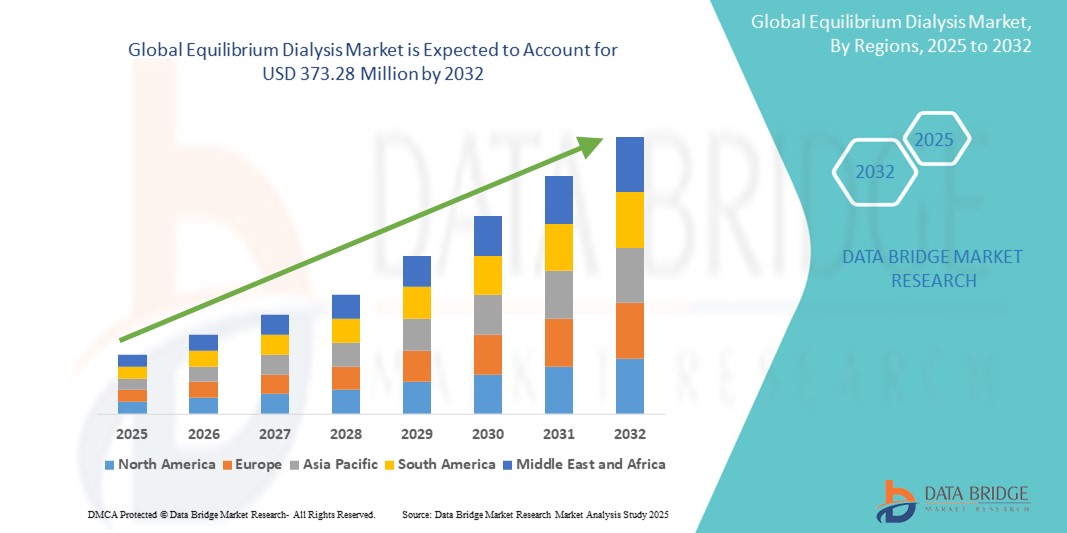
- The global equilibrium dialysis market size was valued at USD 185.97 Million in 2024 and is expected to reach USD 373.28 Million by 2032, at a CAGR of 9.10% during the forecast period
- The market growth is primarily driven by the increasing demand for accurate and efficient techniques for studying drug-protein interactions, which are critical in drug development and pharmacokinetic studies. Equilibrium dialysis is widely regarded as a gold standard for determining the binding affinity of small molecules to proteins, which is crucial in both pharmaceutical research and academic applications
- Furthermore, the rising prevalence of chronic diseases and the growing focus on personalized medicine are contributing to the increased adoption of equilibrium dialysis in both clinical and research settings
Equilibrium Dialysis Market Analysis
- The equilibrium dialysis market is witnessing substantial growth, primarily driven by the rising need for precise drug-protein binding studies in pharmaceutical R&D, bioavailability studies, and therapeutic monitoring
- The growing emphasis on personalized medicine and biologics development is increasing the demand for accurate, reproducible, and high-throughput analytical techniques such as equilibrium dialysis
- North America dominated the global equilibrium dialysis market, with the largest revenue share of 38.5% in 2024. This leadership position is attributed to the region's well-established pharmaceutical industry, high R&D investments, and early adoption of advanced laboratory technologies
- Asia-Pacific is expected to be the fastest growing region in the global equilibrium dialysis market, driven by rapid urbanization, rising healthcare spending, expanding research capabilities, and the growing presence of contract research organizations (CROs) in countries such as China, India, and South Korea
- Protein-drug binding assays dominated the market, with a market share of 38.6% in 2024. This segment’s growth is fueled by the critical role it plays in evaluating drug efficacy, pharmacokinetics, and bioavailability during early-stage drug development. The widespread use of protein-binding studies in regulatory submissions and preclinical assessments further drives the adoption of equilibrium dialysis in this application area
Report Scope and Equilibrium Dialysis Market Segmentation
|
Attributes |
Equilibrium Dialysis Key Market Insights |
|
Segments Covered |
|
|
Countries Covered |
North America
Europe
Asia-Pacific
Middle East and Africa
South America
|
|
Key Market Players |
|
|
Market Opportunities |
|
|
Value Added Data Infosets |
In addition to the insights on market scenarios such as market value, growth rate, segmentation, geographical coverage, and major players, the market reports curated by the Data Bridge Market Research also include in-depth expert analysis, pricing analysis, brand share analysis, consumer survey, demography analysis, supply chain analysis, value chain analysis, raw material/consumables overview, vendor selection criteria, PESTLE Analysis, Porter Analysis, and regulatory framework. |
Equilibrium Dialysis Market Trends
“Technological Advancements Driving Precision and Efficiency”
- A significant and accelerating trend in the global equilibrium dialysis market is the increasing adoption of high-throughput and automated dialysis systems within pharmaceutical and biotechnological workflows. This technological shift is greatly enhancing the efficiency, accuracy, and reproducibility of drug–protein binding studies critical for drug development and regulatory submissions
- For instance, advanced 96-well equilibrium dialysis plates integrated with automated liquid handling systems are now being widely utilized by leading CROs and pharmaceutical companies. These systems allow simultaneous processing of multiple samples with minimal manual intervention, significantly reducing time and variability in pharmacokinetic assessments
- Automation in equilibrium dialysis enables features such as standardized buffer exchange, temperature regulation, and real-time data monitoring. Some platforms incorporate built-in sensors for pH and concentration, improving analytical precision and allowing laboratories to meet stringent GxP and FDA requirements for bioanalytical method validation
- The seamless integration of equilibrium dialysis devices with laboratory information management systems (LIMS) and electronic lab notebooks (ELNs) facilitates centralized data management across departments. Through a single digital interface, researchers can schedule runs, track sample metadata, and retrieve historical data, promoting a unified and compliant analytical environment
- This trend toward more intelligent, data-integrated, and automation-friendly dialysis systems is fundamentally transforming lab expectations in drug discovery and development. As a result, companies such as Harvard Apparatus and Thermo Fisher Scientific are expanding their equilibrium dialysis portfolios with platforms designed for full lab automation and scalable throughput
- The demand for such next-generation equilibrium dialysis solutions is growing rapidly across both research institutions and commercial pharma/biotech sectors, as the industry prioritizes speed, data integrity, and reproducibility in high-volume drug screening and protein-binding studies
Equilibrium Dialysis Market Dynamics
Driver
“Growing Need for Accurate Drug–Protein Binding Analysis in Drug Development”
- The increasing complexity of therapeutic molecules, especially biologics and biosimilars, has created a strong demand for precise and reproducible drug–protein binding assays. Equilibrium dialysis is considered a gold standard method for measuring free drug concentrations, making it a critical tool in pharmacokinetic and pharmacodynamic evaluations
- For instance, in February 2024, Thermo Fisher Scientific announced the enhancement of its equilibrium dialysis product line by launching a high-throughput system tailored for biologics research. Such developments by major players are expected to drive significant market expansion during the forecast period
- As regulatory agencies such as the FDA and EMA tighten standards around bioanalytical method validation, pharmaceutical companies are increasingly relying on equilibrium dialysis for its reliability, low variability, and compatibility with large-scale screening
- Furthermore, the global rise in R&D spending, expansion of clinical trials, and increased outsourcing to CROs are all contributing to a greater demand for equilibrium dialysis platforms that are automation-ready and compliant with GxP standards
- The growing emphasis on personalized medicine and targeted drug delivery is also boosting the need for tools that can assess patient-specific drug–protein interactions, positioning equilibrium dialysis as an essential component in precision medicine pipelines
Restraint/Challenge
“High Operational Costs and Complexity of Manual Protocols”
- The relatively high operational cost of advanced equilibrium dialysis systems—including specialized membranes, equipment, and skilled personnel—can act as a barrier to adoption, especially among academic institutions and small-scale biotech firms
- For instance, smaller labs often face challenges with the manual nature of equilibrium dialysis, which requires strict environmental control and time-intensive setup. The lack of trained staff to ensure precision in buffer preparation and sample handling can further affect adoption and result consistency
- While automated and high-throughput solutions are entering the market, they often come with a premium price, limiting accessibility in developing countries or budget-constrained environments. This creates a divide where only top-tier institutions can afford state-of-the-art platforms
- Moreover, compared to alternative techniques such as ultrafiltration or surface plasmon resonance (SPR), equilibrium dialysis may require longer incubation times and larger sample volumes, which can be a disadvantage in high-speed drug screening environments
- Overcoming these challenges will require the development of cost-efficient, miniaturized, and pre-assembled dialysis systems, as well as increased industry focus on training resources and simplified protocols to make the technology more accessible across all user levels
Equilibrium Dialysis Market Scope
The market is segmented on the basis of type, product and services, application and end user.
- By Type
On the basis of type, the equilibrium dialysis market is segmented into linear regression and non-linear regression. The linear regression segment accounted for the largest market revenue share in 2024, driven by its wide use in pharmacokinetic modeling and straightforward implementation for analyzing drug–protein binding interactions. Linear models are often favored for their simplicity, speed, and suitability for equilibrium studies where a linear binding relationship is observed.
The non-linear regression segment is expected to witness the fastest growth from 2025 to 2032, propelled by its superior accuracy in modeling complex binding kinetics and saturation effects. As drug molecules become more structurally intricate—particularly in biologics and biosimilars—the need for more precise analytical techniques is boosting the use of non-linear models in equilibrium dialysis studies.
- By Product and Services
On the basis of product and services, the equilibrium dialysis market is segmented into instruments, kits and reagents, and services. The kits and reagents segment held the largest revenue share in 2024 due to the recurring demand for dialysis membranes, buffer solutions, and ready-to-use consumables essential for routine protein-binding experiments. Their ease of use, cost-effectiveness, and compatibility with existing systems drive consistent purchasing across research and clinical labs.
The services segment is projected to grow at the fastest CAGR during the forecast period, fueled by increasing outsourcing of bioanalytical testing to contract research organizations (CROs). These services help pharma and biotech companies streamline workflows, reduce internal burden, and ensure regulatory compliance in clinical studies.
- By Application
On the basis of application, the equilibrium dialysis market is segmented into protein-drug binding assays, receptor binding assays, ligand binding assays, protein-protein interactions, protein-DNA interactions, and serum protein binding. The protein-drug binding assays segment dominated the market with a share of 38.6% in 2024, as it plays a crucial role in evaluating free drug concentrations and pharmacokinetic profiles. These assays are essential in both early-stage drug discovery and later clinical development phases.
The receptor binding assays segment is anticipated to witness the fastest CAGR from 2025 to 2032, owing to their expanding role in drug mechanism-of-action studies and target validation, especially in oncology and neurodegenerative disease research. The increasing need to evaluate compound specificity and affinity is further driving demand.
- By End-User
On the basis of end-user, the market is segmented into contract research organizations (CROs), pharmaceutical and biotechnology companies, and others. The pharmaceutical and biotechnology companies segment accounted for the largest market share in 2024, supported by high R&D investments and growing pipelines of small molecules and biologics. These companies utilize equilibrium dialysis to ensure accurate protein-binding data for regulatory submissions and drug dosing strategies.
The contract research organizations (CROs) segment is expected to grow at the fastest CAGR from 2025 to 2032, driven by increasing outsourcing trends across the pharma sector. CROs provide specialized equilibrium dialysis services, offering scalable and cost-effective solutions for clinical trials and drug development programs globally.
Equilibrium Dialysis Market Regional Analysis
- North America dominated the equilibrium dialysis market with the largest revenue share of 38.5% in 2024, driven by a strong pharmaceutical and biotechnology ecosystem, high R&D expenditure, and early adoption of advanced analytical technologies
- Research institutions and pharmaceutical companies in the region heavily rely on equilibrium dialysis for precise drug–protein binding studies, benefiting from well-established laboratory infrastructure and regulatory support
- This dominance is further supported by a robust presence of key market players, increased outsourcing to contract research organizations (CROs), and a high focus on biologics and biosimilar development—establishing equilibrium dialysis as a preferred analytical technique across the drug discovery and development landscape in both the U.S. and Canada
U.S. Equilibrium Dialysis Market Insight
The U.S. equilibrium dialysis market captured the largest revenue share of 82.3% within North America in 2024, driven by a well-established pharmaceutical and biotechnology industry, advanced research infrastructure, and strong regulatory compliance requirements.
Equilibrium dialysis is extensively used in drug-protein binding studies, especially for biologics and biosimilars. The presence of global pharma giants, increasing R&D budgets, and integration of automated systems with LIMS are further boosting market growth.
Europe Equilibrium Dialysis Market Insight
The Europe equilibrium dialysis market is projected to grow at a CAGR of 7.6% from 2025 to 2032, supported by strong investments in precision medicine, biologics development, and growing demand for validated protein-binding assays in early-phase drug discovery.
Countries such as Germany, France, and the U.K. are experiencing consistent adoption of equilibrium dialysis solutions, particularly in academic research and CRO collaborations, aligned with EMA’s strict data quality standards.
U.K. Equilibrium Dialysis Market Insight
The U.K. equilibrium dialysis market is expected to expand at a CAGR of 8.2% over the forecast period, driven by increasing public–private partnerships, demand for innovative therapeutics, and a rise in biologics research.
The U.K.'s strong university research network and biotech clusters, especially in London, Cambridge, and Oxford, are significantly contributing to the uptake of equilibrium dialysis in drug development pipelines.
Germany Equilibrium Dialysis Market Insight
The Germany equilibrium dialysis market is forecasted to grow at a CAGR of 7.9% from 2025 to 2032, with momentum coming from the country’s leadership in pharmaceutical innovation, GMP compliance, and sustainable lab technologies.
Demand is particularly strong in serum protein binding and receptor-ligand interaction studies, fueled by local and international drug development efforts.
Asia-Pacific Equilibrium Dialysis Market Insight
The Asia-Pacific equilibrium dialysis market is projected to register the fastest CAGR of 9.8% during the forecast period (2025–2032), supported by rapid healthcare expansion, increased R&D spending, and growing biologics production in China, Japan, and India.
The region benefits from government initiatives, local CRO growth, and expanding academic infrastructure, making equilibrium dialysis more accessible and affordable.
Japan Equilibrium Dialysis Market Insight
Japan’s equilibrium dialysis market is anticipated to grow at a CAGR of 8.4% from 2025 to 2032, driven by increasing demand for high-precision analytical tools and an aging population fueling pharmaceutical innovation.
Strong technological infrastructure and integration of dialysis assays with automation platforms make Japan a key market for protein-binding and interaction studies.
China Equilibrium Dialysis Market Insight
China accounted for the largest share of the Asia-Pacific equilibrium dialysis market in 2024, holding 43.7% of the regional revenue, fueled by a booming pharmaceutical sector, fast-growing biotech firms, and supportive government policies.
With strong domestic manufacturing and affordable equilibrium dialysis solutions, China is rapidly advancing in drug discovery and bioanalytical testing, positioning itself as a global leader in the region.
Equilibrium Dialysis Market Share
The equilibrium dialysis industry is primarily led by well-established companies, including:
- Harvard Apparatus (U.S.)
- Thermo Fisher Scientific Inc. (U.S.)
- Aurora Borealis Control BV (Netherlands)
- The Nest Group, Inc. (U.S.)
- Cole-Parmer Instrument Company, LLC (U.S.)
- Vivaproducts (U.S.)
- Interchim (France)
- Merck KGaA (Germany)
- 3B Pharmaceuticals (Germany)
- Eurofins Scientific (Luxembourg)
- H T Dialysis LLC (U.S.)
- Creative Biolabs (U.S.)
- BioDuro (China)
- XenoTech (U.S.)
- SDR Scientific (Australia)
- BioIVT (U.S.)
Latest Developments in Global Equilibrium Dialysis Market
- In January 2025, Thermo Fisher Scientific released an enhanced Automated Equilibrium Dialysis System designed for biologic drug development. This system integrates robotic liquid handling and LIMS capabilities to provide regulatory-compliant data capture and significantly faster throughput
- In February 2024, Stratagem Market Insights published a detailed report forecasting Equilibrium Dialysis market trends through 2030. The publication provides insights into segment growth, competitive landscape (highlighting companies such as Harvard Apparatus, Thermo Fisher, Merck, and BioDuro), and regional expansion strategies

- Interactive Data Analysis Dashboard
- Company Analysis Dashboard for high growth potential opportunities
- Research Analyst Access for customization & queries
- Competitor Analysis with Interactive dashboard
- Latest News, Updates & Trend analysis
- Harness the Power of Benchmark Analysis for Comprehensive Competitor Tracking
Data collection and base year analysis are done using data collection modules with large sample sizes. The stage includes obtaining market information or related data through various sources and strategies. It includes examining and planning all the data acquired from the past in advance. It likewise envelops the examination of information inconsistencies seen across different information sources. The market data is analysed and estimated using market statistical and coherent models. Also, market share analysis and key trend analysis are the major success factors in the market report. To know more, please request an analyst call or drop down your inquiry.
The key research methodology used by DBMR research team is data triangulation which involves data mining, analysis of the impact of data variables on the market and primary (industry expert) validation. Data models include Vendor Positioning Grid, Market Time Line Analysis, Market Overview and Guide, Company Positioning Grid, Patent Analysis, Pricing Analysis, Company Market Share Analysis, Standards of Measurement, Global versus Regional and Vendor Share Analysis. To know more about the research methodology, drop in an inquiry to speak to our industry experts.
Data Bridge Market Research is a leader in advanced formative research. We take pride in servicing our existing and new customers with data and analysis that match and suits their goal. The report can be customized to include price trend analysis of target brands understanding the market for additional countries (ask for the list of countries), clinical trial results data, literature review, refurbished market and product base analysis. Market analysis of target competitors can be analyzed from technology-based analysis to market portfolio strategies. We can add as many competitors that you require data about in the format and data style you are looking for. Our team of analysts can also provide you data in crude raw excel files pivot tables (Fact book) or can assist you in creating presentations from the data sets available in the report.













