


Erythroid Maturation Agent Market Size
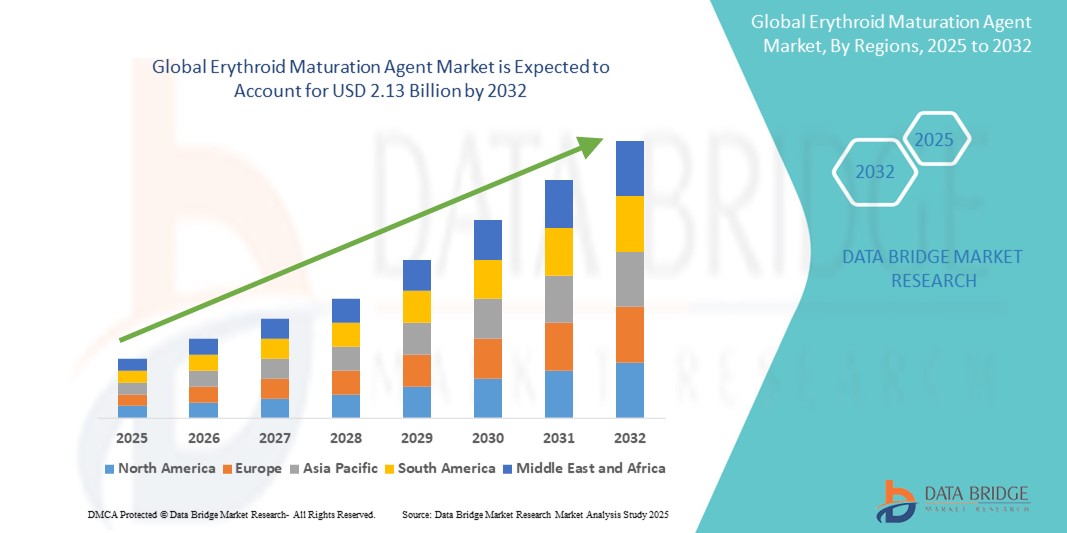
- The global erythroid maturation agent market size was valued at USD 1.06 billion in 2024 and is expected to reach USD 2.13 billion by 2032, at a CAGR of 9.10% during the forecast period
- The market growth is primarily driven by the increasing prevalence of beta-thalassemia and sickle cell disease, where erythroid maturation agents such as luspatercept show promise in reducing transfusion dependency and improving patient outcomes
- Furthermore, expanding clinical research, favorable regulatory approvals, and rising healthcare investments in rare blood disorders are strengthening demand for targeted hematologic therapies. These synergistic factors are catalyzing adoption across global healthcare systems, thereby fueling robust market expansion
Erythroid Maturation Agent Market Analysis
- Erythroid maturation agents, which promote red blood cell maturation, are becoming increasingly important in the treatment of hematologic disorders such as beta-thalassemia and myelodysplastic syndromes (MDS), due to their ability to reduce transfusion dependence and improve patient quality of life
- The rising demand for erythroid maturation agents is primarily driven by growing prevalence of chronic anemia-related diseases, expanding clinical approvals, and increased awareness and access to targeted biologic therapies
- North America dominated the erythroid maturation agent market with the largest revenue share of 42.1% in 2024, supported by a high number of patients with rare blood disorders, rapid adoption of biologics, favorable reimbursement frameworks, and early regulatory approval and uptake of agents such as Reblozyl particularly in the U.S.
- Asia-Pacific is expected to be the fastest growing region in the erythroid maturation agent market during the forecast period due to a large undiagnosed patient population, rising healthcare investment, and greater inclusion of erythroid maturation agents in clinical guidelines across developing countries
- Reblozyl segment dominated the erythroid maturation agent market with a market share of 89.8% in 2024, attributed to its dual indication for beta-thalassemia and MDS, proven clinical efficacy, and early market entry as the first approved agent in this category
Report Scope and Erythroid Maturation Agent Market Segmentation
|
Attributes |
Erythroid Maturation Agent Key Market Insights |
|
Segments Covered |
|
|
Countries Covered |
North America
Europe
Asia-Pacific
Middle East and Africa
South America
|
|
Key Market Players |
|
|
Market Opportunities |
|
|
Value Added Data Infosets |
In addition to the insights on market scenarios such as market value, growth rate, segmentation, geographical coverage, and major players, the market reports curated by the Data Bridge Market Research also include in-depth expert analysis, pricing analysis, brand share analysis, consumer survey, demography analysis, supply chain analysis, value chain analysis, raw material/consumables overview, vendor selection criteria, PESTLE Analysis, Porter Analysis, and regulatory framework. |
Erythroid Maturation Agent Market Trends
“Therapeutic Expansion and Clinical Innovation in Rare Blood Disorders”
- A significant and accelerating trend in the global erythroid maturation agent market is the expansion of therapeutic applications into broader hematologic indications, including beta-thalassemia, myelodysplastic syndromes (MDS), and emerging off-label uses, supported by clinical trial advancements and biomarker-based patient selection
- For instance, Reblozyl (luspatercept) has been approved for both transfusion-dependent beta-thalassemia and anemia associated with MDS with ring sideroblasts, reflecting a growing interest in addressing late-stage erythropoiesis deficiencies
- Continued innovation in clinical trials is enabling deeper understanding of erythroid biology, with several studies exploring new indications, dosing strategies, and long-term outcomes. For instance, current research into non-transfusion-dependent thalassemia and pediatric applications is opening up additional market opportunities
- Pharmaceutical companies such as Bristol Myers Squibb and Acceleron Pharma are investing in novel biologics targeting similar pathways, with some pipeline agents aimed at combining erythroid maturation with iron metabolism modulation to improve therapeutic impact
- This trend toward targeted hematologic care is enhancing treatment precision, patient response rates, and long-term outcomes. As more healthcare providers adopt guideline-supported use of these therapies, the market is transitioning toward more personalized, effective, and durable anemia management solutions
- The demand for such agents is rising across regions with high disease prevalence, supported by stronger diagnostic infrastructure and increased prioritization of rare disease treatment in public health agendas, especially in North America and selected Asia-Pacific nations
Erythroid Maturation Agent Market Dynamics
Driver
“Increasing Prevalence of Chronic Hematologic Anemias and Unmet Treatment Needs”
- The growing global burden of rare and chronic anemias, particularly beta-thalassemia and MDS, combined with the limitations of conventional treatments such as blood transfusions and erythropoiesis-stimulating agents (ESAs), is driving demand for erythroid maturation agents
- For instance, Reblozyl has demonstrated clinical success in reducing transfusion burden and improving hemoglobin levels, making it a preferred option for patients with inadequate response to existing therapies
- These agents offer a novel mechanism by enhancing late-stage red blood cell development, helping to minimize transfusion frequency and associated complications. Their introduction has reshaped anemia treatment protocols in several countries
- In addition, regulatory agencies and healthcare payers are increasingly supportive of innovative rare disease treatments, enabling faster approvals and market entry. Patient advocacy groups and hematology societies are also raising awareness of newer, more effective treatment options
- The rising awareness among hematologists and the inclusion of erythroid maturation agents in clinical guidelines are contributing to their rapid adoption in specialized treatment centers, particularly in developed regions with access to advanced hematology care
- These factors are collectively contributing to a shift in treatment paradigms for chronic anemia, establishing erythroid maturation agents as critical components in hematologic care pathways
Restraint/Challenge
“High Treatment Costs and Limited Access in Developing Regions”
- One of the key challenges in the erythroid maturation agent market is the high cost of biologic therapies, which limits accessibility, especially in low- and middle-income countries where reimbursement systems may not fully support rare disease treatments
- For instance, the annual cost of Reblozyl therapy can exceed the affordability threshold for patients lacking comprehensive insurance coverage, posing a barrier to widespread adoption in resource-constrained settings
- In addition, administration via subcutaneous injection and the need for ongoing patient monitoring require specialized clinical infrastructure that may not be readily available in all healthcare systems
- Concerns over pricing and equitable access have prompted calls for expanded patient access programs, tiered pricing models, and increased investment in healthcare delivery systems to accommodate biologic treatments
- Pharmaceutical companies are gradually responding through global access initiatives, but broader adoption in emerging markets remains dependent on policy support and improvements in diagnostics and care delivery
- Addressing these challenges will be critical to unlocking full global market potential and ensuring that patients across all regions can benefit from advances in erythroid maturation therapy
Erythroid Maturation Agent Market Scope
The market is segmented on the basis of type, strength, application, dosage, route of administration, end-users, and distribution channel.
- By Type
On the basis of type, the erythroid maturation agent market is segmented into Reblozyl and Others. The Reblozyl segment dominated the market with the largest market revenue share of 89.8% in 2024, owing to its regulatory approval across major regions and its clinical success in reducing transfusion dependence in patients with beta-thalassemia and MDS. Reblozyl has become the go-to biologic in this segment, supported by favorable clinical outcomes and integration into international treatment guidelines. The market sees consistent demand for Reblozyl due to its targeted mechanism and strong physician adoption.
The Others segment is expected to witness the fastest CAGR from 2025 to 2032, as new erythroid maturation agents progress through clinical development. With promising pipeline therapies aimed at broader anemia indications and pediatric use, this segment is anticipated to offer diversification and competition in the coming years.
- By Strength
On the basis of strength, the erythroid maturation agent market is segmented into 25 mg, 75 mg, and Others. The 75 mg segment dominated the market with the largest market revenue share of 52.6% in 2024, primarily due to its widespread use as a maintenance dose in adult patients receiving long-term treatment. This dosage offers sustained therapeutic benefit and is aligned with common treatment protocols, making it the most preferred strength in routine clinical practice.
The 25 mg segment is anticipated to witness the fastest growth rate from 2025 to 2032, driven by increased adoption among new or low-weight patients and growing use in pediatric populations as clinical indications expand. Lower doses are also important in dose titration for adverse event management or transitioning patients to long-term therapy.
- By Application
On the basis of application, the erythroid maturation agent market is segmented into anemia due to beta-thalassemia and anemia with myelodysplastic syndrome (MDS). The anemia due to beta-thalassemia segment dominated the market with the largest market revenue share of 61.8% in 2024, due to the high burden of transfusion-dependent beta-thalassemia globally and the drug’s effectiveness in reducing transfusion needs. The segment also benefits from strong awareness among hematologists and rapid adoption following regulatory approvals.
The anemia with MDS segment is expected to witness the fastest CAGR from 2025 to 2032, supported by rising incidence in aging populations and increasing resistance to ESA therapy. MDS patients who are ring sideroblast-positive represent a key subpopulation that responds well to erythroid maturation agents, bolstering growth in this segment.
- By Dosage
On the basis of dosage, the erythroid maturation agent market is segmented into injection, powder, and others. The injection segment dominated the market with the largest market revenue share of 77.4% in 2024, as subcutaneous injection remains the only approved and widely accepted method of administering these agents. Injections ensure controlled dosing and adherence, typically administered under healthcare supervision.
The powder segment is expected to witness the fastest CAGR from 2025 to 2032due to the advantages of longer shelf life and reconstitution flexibility, particularly in regions with limited cold-chain infrastructure. This format also supports broader access in decentralized healthcare settings.
- By Route of Administration
On the basis of route of administration, the erythroid maturation agent market is segmented into subcutaneous and other. The subcutaneous segment dominated the market with the largest market revenue share of 94.5% in 2024, due to its proven efficacy, patient compliance, and favorable tolerability profile. Subcutaneous delivery is commonly used for chronic therapies and has become standard for erythroid maturation agents such as Reblozyl.
The other segment, which may include emerging or investigational delivery routes, is expected to witness fastest growth during forecast period, as innovation in long-acting or implantable formulations develops in the future.
- By End-Users
On the basis of end-users, the erythroid maturation agent market is segmented into hospitals, clinics, and others. The hospital segment dominated the market with the largest market revenue share of 48.2% in 2024, owing to centralized hematology services, access to transfusion support, and the need for ongoing monitoring. Most initial treatments and dose adjustments occur in hospitals under specialist supervision.
The clinics segment is anticipated to grow at the fastest rate from 2025 to 2032, driven by the shift toward outpatient care, rising availability of hematology specialists in community settings, and patient preference for more convenient access to treatment outside large institutions.
- By Distribution Channel
On the basis of distribution channel, the erythroid maturation agent market is segmented into hospital pharmacy, retail pharmacy, and online pharmacy. The hospital pharmacy segment dominated the market with the largest market revenue share of 45.6% in 2024, reflecting the centralized nature of biologic administration in hospital environments where medication procurement and monitoring are closely linked.
The online pharmacy segment is expected to expand rapidly from 2025 to 2032, particularly in developed regions, as digital health platforms evolve and support chronic therapy delivery. Online channels also enable easier refill access and improved reach in remote areas, making them an attractive future growth avenue.
Erythroid Maturation Agent Market Regional Analysis
- North America dominated the erythroid maturation agent market with the largest revenue share of 42.1% in 2024, supported by a high number of patients with rare blood disorders, rapid adoption of biologics, favorable reimbursement frameworks, and early regulatory approval and uptake of agents such as Reblozyl particularly in the U.S.
- Patients and healthcare providers in the region value the improved clinical outcomes and transfusion independence enabled by these agents, which are increasingly incorporated into standard treatment guidelines and covered by insurance providers
- This widespread adoption is further supported by advanced diagnostic infrastructure, the presence of leading hematology centers, and growing awareness of rare disease therapies, positioning erythroid maturation agents as essential tools in chronic anemia management across both academic and community healthcare settings
U.S. Erythroid Maturation Agent Market Insight
The U.S. erythroid maturation agent market captured the largest revenue share of 79% in 2024 within North America, fueled by early FDA approvals, a strong presence of leading hematology centers, and widespread adoption of Reblozyl in both hospital and outpatient settings. The increasing focus on personalized anemia care, supported by robust reimbursement frameworks and clinical guideline integration, continues to drive market expansion. In addition, a high prevalence of beta-thalassemia and MDS, combined with rising awareness among healthcare providers, strengthens the U.S. position as a dominant player in the global market.
Europe Erythroid Maturation Agent Market Insight
The Europe erythroid maturation agent market is projected to expand at a substantial CAGR throughout the forecast period, primarily driven by the increasing burden of hematologic disorders and proactive regulatory support for rare disease therapies. Rising adoption of Reblozyl across EU countries, along with improving access to specialized care, is boosting market growth. Furthermore, the region’s structured healthcare systems and coordinated reimbursement policies are enabling broader adoption in both public and private healthcare institutions.
U.K. Erythroid Maturation Agent Market Insight
The U.K. erythroid maturation agent market is anticipated to grow at a noteworthy CAGR during the forecast period, supported by national focus on rare disease management and improved diagnostic practices for conditions such as MDS and beta-thalassemia. Increasing NHS inclusion of erythroid maturation agents, along with clinician familiarity and ongoing clinical research participation, is expanding access and awareness. A well-established hematology network and early patient identification are also supporting faster adoption of advanced anemia therapies.
Germany Erythroid Maturation Agent Market Insight
The Germany erythroid maturation agent market is expected to expand at a considerable CAGR during the forecast period, driven by the country’s emphasis on precision medicine and support for biologic innovation. With one of the most advanced healthcare infrastructures in Europe, Germany is at the forefront of integrating erythroid maturation agents into routine care for chronic anemia patients. The presence of key biopharmaceutical companies and ongoing real-world evidence generation are further strengthening market momentum in both inpatient and outpatient care settings.
Asia-Pacific Erythroid Maturation Agent Market Insight
The Asia-Pacific erythroid maturation agent market is poised to grow at the fastest CAGR of 25% during the forecast period of 2025 to 2032, driven by the large patient pool with thalassemia and rising healthcare investment in countries such as China, India, and Japan. Government initiatives to improve rare disease treatment access, along with rising awareness among clinicians and expansion of specialty care infrastructure, are contributing to increased adoption. Regional manufacturing and clinical trial activity are also expected to support cost-effective availability in emerging economies.
Japan Erythroid Maturation Agent Market Insight
The Japan erythroid maturation agent market is gaining momentum due to a strong culture of innovation in biologics, high disease awareness, and government focus on orphan drug accessibility. Japan’s universal healthcare system, combined with its aging population and advanced hematology infrastructure, is fostering the early adoption of Reblozyl in MDS management. In addition, physician-led research and participation in global clinical trials are enhancing local confidence in the efficacy and long-term benefits of erythroid maturation agents.
India Erythroid Maturation Agent Market Insight
The India erythroid maturation agent market accounted for the largest revenue share in Asia Pacific in 2024, attributed to the country’s high beta-thalassemia burden, growing access to specialty care, and rising demand for affordable biologics. The expansion of diagnostic services, along with government efforts to improve treatment for rare diseases, is accelerating adoption in both public and private sectors. Strong pharmaceutical manufacturing capabilities and a growing number of hematologists are further supporting long-term market growth
Erythroid Maturation Agent Market Share
The erythroid maturation agent industry is primarily led by well-established companies, including:
- Bristol-Myers Squibb Company (U.S.)
- Pfizer Inc. (U.S.)
- F. Hoffmann-La Roche Ltd (Switzerland)
- Amgen Inc. (U.S.)
- Novartis AG (Switzerland)
- Johnson & Johnson Services, Inc. (U.S.)
- Sanofi (France)
- GSK plc (U.K.)
- Bayer AG (Germany)
- Takeda Pharmaceutical Company Limited (Japan)
- Lilly (U.S.)
- AstraZeneca (U.K.)
- Otsuka Pharmaceutical Co., Ltd. (Japan)
- Hoffmann-La Roche Ltd (Switzerland)
- Teva Pharmaceutical Industries Ltd. (Israel)
- Regeneron Pharmaceuticals, Inc. (U.S.)
- Jazz Pharmaceuticals plc (Ireland)
- AbbVie Inc. (U.S.)
- Sandoz Group AG (Switzerland)
What are the Recent Developments in Global Erythroid Maturation Agent Market?
- In March 2024, Bristol Myers Squibb announced the expansion of Reblozyl’s indication in the U.S. following FDA approval for the treatment of anemia in adult patients with non-transfusion-dependent beta-thalassemia. This regulatory milestone reflects the growing clinical confidence in erythroid maturation agents beyond transfusion-dependent populations and is expected to broaden patient access, reinforcing Reblozyl's market leadership in anemia therapeutics
- In February 2024, EMA’s Committee for Medicinal Products for Human Use (CHMP) adopted a positive opinion recommending the approval of Reblozyl for anemia associated with very low- to intermediate-risk MDS with ring sideroblasts in adults. This endorsement supports the expansion of erythroid maturation therapy across Europe, offering a targeted solution for patients who are ESA-refractory or have limited options
- In January 2024, Acceleron Pharma, a subsidiary of Bristol Myers Squibb, initiated Phase 3 clinical trials investigating the long-term efficacy of erythroid maturation agents in pediatric populations with transfusion-dependent thalassemia. This trial aims to address a significant unmet need in pediatric hematology and demonstrates the company’s commitment to expanding treatment to younger patient groups with chronic anemia
- In October 2023, Health Canada approved Reblozyl for the treatment of anemia due to MDS and beta-thalassemia, marking a significant step toward improving access to advanced anemia therapies across Canada. The approval enables hematologists in the region to offer a targeted alternative to traditional transfusion-heavy approaches, supporting better quality of life for patients
- In August 2023, Bristol Myers Squibb published new real-world evidence in The Lancet Haematology, showcasing sustained hemoglobin improvement and transfusion reduction in MDS patients treated with Reblozyl over a 12-month period. This study supports the clinical utility of erythroid maturation agents and strengthens the evidence base for broader guideline inclusion and payer coverage globally

- Interactive Data Analysis Dashboard
- Company Analysis Dashboard for high growth potential opportunities
- Research Analyst Access for customization & queries
- Competitor Analysis with Interactive dashboard
- Latest News, Updates & Trend analysis
- Harness the Power of Benchmark Analysis for Comprehensive Competitor Tracking
Data collection and base year analysis are done using data collection modules with large sample sizes. The stage includes obtaining market information or related data through various sources and strategies. It includes examining and planning all the data acquired from the past in advance. It likewise envelops the examination of information inconsistencies seen across different information sources. The market data is analysed and estimated using market statistical and coherent models. Also, market share analysis and key trend analysis are the major success factors in the market report. To know more, please request an analyst call or drop down your inquiry.
The key research methodology used by DBMR research team is data triangulation which involves data mining, analysis of the impact of data variables on the market and primary (industry expert) validation. Data models include Vendor Positioning Grid, Market Time Line Analysis, Market Overview and Guide, Company Positioning Grid, Patent Analysis, Pricing Analysis, Company Market Share Analysis, Standards of Measurement, Global versus Regional and Vendor Share Analysis. To know more about the research methodology, drop in an inquiry to speak to our industry experts.
Data Bridge Market Research is a leader in advanced formative research. We take pride in servicing our existing and new customers with data and analysis that match and suits their goal. The report can be customized to include price trend analysis of target brands understanding the market for additional countries (ask for the list of countries), clinical trial results data, literature review, refurbished market and product base analysis. Market analysis of target competitors can be analyzed from technology-based analysis to market portfolio strategies. We can add as many competitors that you require data about in the format and data style you are looking for. Our team of analysts can also provide you data in crude raw excel files pivot tables (Fact book) or can assist you in creating presentations from the data sets available in the report.












