


What is the EV Taxi Market Size and Growth Rate?
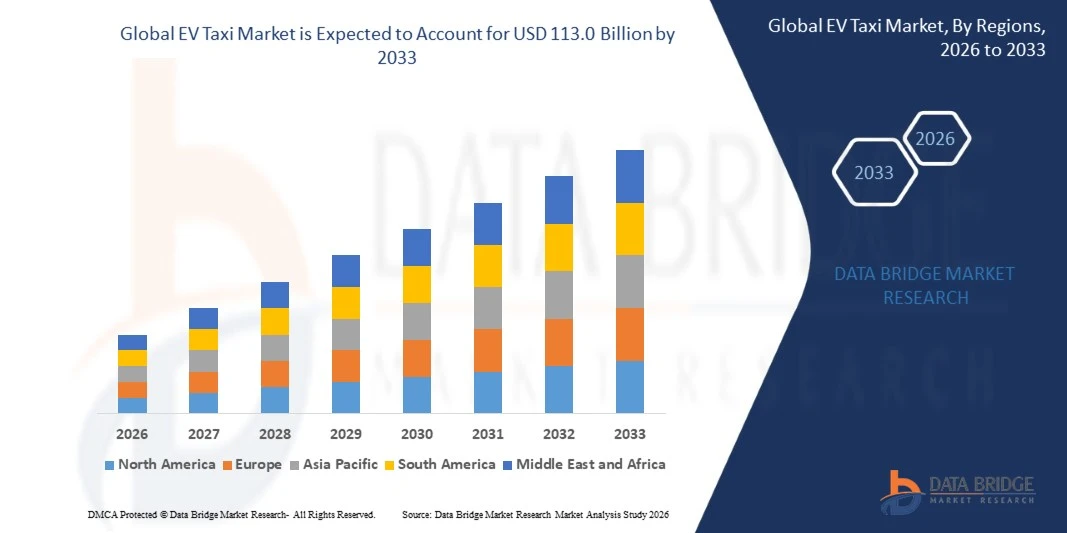
- As per Data Bridge Market Research analysis, the EV taxi market was valued at USD 31.1 billion in 2025 and is projected to reach USD 113.0 billion by 2033, growing at a CAGR of 17.50% from 2026 to 2033.
- The market is experiencing strong growth driven by city-level taxi electrification policies, lower operating costs of electric vehicles for high-mileage use, expanding fast-charging networks, and the growing participation of ride-hailing platforms and autonomous vehicle developers.
- The increasing shift toward zero-emission urban mobility, the entry of purpose-built and autonomous electric taxis, and growing partnerships between platforms and vehicle makers are supporting market adoption. EV taxis are being deployed across ride-hailing networks, autonomous vehicle services, and urban fleets supported by expanding EV charging infrastructure, offering lower emissions, reduced fuel costs, and quieter urban transport.
Market Size & Forecast
- Global Market Value (2025): USD 31.1 billion
- Expected Market Value (2033): USD 113.0 billion
- Forecast CAGR (2026–2033): 17.50%
- Leading Region in 2025: Asia-Pacific
- Fastest Growing Region: Europe
What are the Major Takeaways of the EV Taxi Market?
- Asia-Pacific dominated the EV taxi market with the largest revenue share of 54.19% in 2025, supported by large ride-hailing fleets, dense urban demand, supportive electrification policy, and the strength of domestic EV and autonomous driving manufacturers in China, India, and Southeast Asia.
- Europe is expected to be the fastest-growing region at a CAGR of 19.60% from 2026 to 2033, fueled by low-emission zone regulations, city-level taxi electrification mandates, and the entry of robotaxi operators into major urban markets.
- The sedan segment led the vehicle type category with a 57.44% share in 2025, supported by its cost efficiency, range, and suitability for urban ride-hailing.
- SUV is the fastest-growing vehicle type segment, projected to register a CAGR of 20.40% from 2026 to 2033, driven by premium ride-hailing demand and use as robotaxi platforms.
- The battery electric vehicle (BEV) segment led the propulsion category with an 88.93% share in 2025, supported by falling battery costs and lower running costs for high-mileage taxi duty.
- The conventional (human-driven) segment led the level of autonomy category with a 93.42% share in 2025, supported by the large installed base of driver-operated electric taxis.
- Fully autonomous (L4 and above) is the fastest-growing level of autonomy segment, projected to register a CAGR of 58.70% from 2026 to 2033, driven by commercial scaling of robotaxi services and platform–automaker partnerships.
Report Scope and EV Taxi Market Segmentation
|
Attributes |
EV Taxi Key Market Insights |
|
Segments Covered |
|
|
Countries Covered |
North America
Europe
Asia-Pacific
Middle East and Africa
South America
|
|
Key Market Players |
|
|
Market Opportunities |
|
|
Value Added Data Infosets |
In addition to the market insights such as market value, growth rate, market segments, geographical coverage, market players, and market scenario, the market report curated by the Data Bridge Market Research team includes in-depth expert analysis, import/export analysis, pricing analysis, production consumption analysis, and pestle analysis. |
What is the Key Trend in the EV Taxi Market?
- EV taxis are evolving from conventional human-driven electric vehicles toward platform-integrated and autonomous fleets, as ride-hailing operators partner with EV makers and self-driving developers to scale electric robotaxi services.
- For instance, in October 2025, according to TechCrunch, Uber announced a premium robotaxi service in San Francisco using Lucid Gravity electric SUVs equipped with Nuro self-driving technology, with a test fleet of about 100 vehicles ahead of a 2026 public launch.
- Platforms are moving toward owning or underwriting vehicle supply, signaling a shift from the asset-light driver model to company-managed electric fleets.
- For instance, in April 2026, according to Smart Cities Dive, Waymo operated in 11 U.S. cities and reported more than half a million electric autonomous rides weekly, while Uber was reported by the Financial Times to be considering a shift toward company-owned robotaxi fleets.
- Purpose-built electric robotaxi designs and multi-supplier platform networks are expanding the range of vehicles available for taxi service.
- As battery costs fall, charging networks mature, and autonomous technology scales, EV taxis are expected to expand from urban ride-hailing into airport, corporate, and shared mobility services.
What are the Key Drivers of the EV Taxi Market?
- Stricter urban emission standards, low-emission zones, and municipal taxi electrification mandates are pushing fleet operators to replace diesel and petrol vehicles with electric models.
- For instance, in February 2025, according to EV Powered, 61% of London’s black cab fleet was battery-powered and zero-emission capable, reflecting the progress of city-level taxi electrification.
- Lower energy and maintenance costs over high annual mileages improve the total cost of ownership of electric taxis, particularly where depot or off-peak charging is available.
- For instance, in October 2025, according to ABC News (via iHeart), Uber confirmed plans with Nvidia and Stellantis for at least 5,000 vehicles powered by Nvidia software starting in 2028, and began offering autonomous rides in Saudi Arabia with WeRide.
- Large partnerships between ride-hailing platforms and EV manufacturers, including a multi-year Uber–BYD agreement for 100,000 electric vehicles initially in Europe and Latin America in 2026, according to BusinessGreen, are accelerating fleet electrification.
What Factors Are Challenging the Growth of the EV Taxi Market?
- The high upfront cost of electric taxis remains a barrier for individual drivers and small fleets, particularly as purchase incentives are reduced or withdrawn.
- For instance, in February 2025, according to EV Powered (citing a Centre for London report), upfront costs for a new London electric taxi had risen 39% in cash terms since 2017, while the UK Plug-in Taxi Grant fell from USD 9.94 billion to USD 5.30 billion and was due to end in 2026.
- Access to affordable rapid charging is a key operational constraint, as charging downtime directly reduces revenue for taxi drivers and public charging costs can erode running-cost savings.
- For instance, in June 2025, according to EV Infrastructure News (citing Transport for London’s Taxi and Private Hire Action Plan), more than half of taxi and private hire drivers said high public charging costs were stopping them from switching to electric vehicles.
- Grid capacity limits and the capital cost of depot charging can slow fleet electrification, particularly in dense urban areas.
- For autonomous electric taxis, regulatory approvals, safety validation, and city-by-city mapping requirements limit the speed of commercial rollout.
How is the EV Taxi Market Segmented?
The EV taxi market is segmented on the basis of vehicle type, propulsion, level of autonomy, and service type.
- By Vehicle Type
On the basis of vehicle type, the EV taxi market is segmented into sedan, SUV, and van & MPV. The sedan segment dominated the market with a 57.44% share in 2025, supported by its cost efficiency, range, and suitability for urban ride-hailing and traditional taxi use. Wide availability of electric sedan models at competitive prices and lower energy consumption per kilometer make this segment the preferred choice for fleet operators.
The SUV segment is projected to register the fastest growth at a CAGR of 20.40% from 2026 to 2033, driven by demand for premium ride-hailing services, greater passenger and luggage space, and the adoption of electric SUVs as robotaxi platforms. Growing launches of electric SUV models with extended range and fast-charging capability are further supporting segment growth.
- By Propulsion
On the basis of propulsion, the EV taxi market is segmented into battery electric vehicle (BEV), plug-in hybrid electric vehicle (PHEV), and fuel cell electric vehicle (FCEV). The BEV segment dominated the market with an 88.93% share in 2025, supported by falling battery costs, expanding model availability, and lower running costs for high-mileage taxi duty. Zero tailpipe emissions also align with low-emission zone requirements in major cities.
The FCEV segment is projected to register the fastest growth at a CAGR of 24.30% from 2026 to 2033, driven by pilot taxi fleets in cities investing in hydrogen refueling infrastructure. Fast refueling and long range suit intensive taxi operation, although the segment is growing from a small base and depends on hydrogen station availability.
- By Level of Autonomy
On the basis of level of autonomy, the EV taxi market is segmented into conventional (human-driven), semi-autonomous (L2–L3), and fully autonomous (L4 and above). The conventional segment dominated the market with a 93.42% share in 2025, supported by the large installed base of driver-operated electric taxis and ride-hailing vehicles. Regulatory limits on driverless operation and the need for mapped, geofenced service areas keep human-driven fleets as the core of the market.
The fully autonomous (L4 and above) segment is projected to register the fastest growth at a CAGR of 58.70% from 2026 to 2033, driven by the commercial scaling of robotaxi services in the U.S., China, the Middle East, and Europe. Partnerships between ride-hailing platforms, autonomous driving developers, and automakers are expanding fleets, although the segment is growing from a small base.
- By Service Type
On the basis of service type, the EV taxi market is segmented into app-based ride-hailing, traditional taxi fleet, and corporate & airport transfer. The app-based ride-hailing segment dominated the service category with a 61.51% share in 2025, supported by platform-led fleet electrification programs and driver incentives. Large platforms are negotiating bulk vehicle purchases and charging access to meet sustainability targets.
The corporate & airport transfer segment is projected to register the fastest growth at a CAGR of 19.70% from 2026 to 2033, driven by corporate sustainability commitments, airport zero-emission access policies, and premium chauffeur services adopting electric vehicles. Predictable routes and scheduled demand make charging logistics easier to manage in this segment.
Which Region Holds the Largest Share of the EV Taxi Market?
- Asia-Pacific dominated the EV taxi market with the largest revenue share of 54.19% in 2025, supported by large ride-hailing fleets, dense urban demand, supportive electrification policy, and the strength of domestic EV and autonomous driving manufacturers in China, India, and Southeast Asia.
- The region also benefits from the world’s largest EV manufacturing base, rapid expansion of public and fleet charging infrastructure, and early commercial robotaxi operations in major Chinese cities. Strong platform competition among ride-hailing operators and government support for clean urban mobility continue to strengthen Asia-Pacific’s position in the global market.
U.S. EV Taxi Market Insight
The U.S. EV taxi market is witnessing strong growth due to the expansion of robotaxi services and the electrification of ride-hailing fleets. Autonomous operators are scaling in cities such as San Francisco, Los Angeles, Phoenix, Austin, and Atlanta, while ride-hailing platforms are partnering with automakers and autonomous driving companies. Federal and state clean transportation incentives and growing fast-charging coverage further support adoption.
Asia-Pacific EV Taxi Market Insight
The Asia-Pacific EV taxi market is expected to witness rapid growth, driven by large ride-hailing markets, strong EV manufacturing, and government support for clean mobility in countries such as China, India, and Japan. City-level taxi electrification programs, expanding charging networks, and early robotaxi commercialization are accelerating regional adoption. Competitive platform ecosystems are also driving fleet investment.
Japan EV Taxi Market Insight
The Japan EV taxi market is witnessing consistent growth due to the country’s advanced automotive industry, dense urban demand, and efforts to modernize taxi services. Taxi operators are testing electric and hydrogen models, and partnerships among automakers, ride-hailing platforms, and autonomous driving developers are creating pathways for autonomous taxi services in Tokyo and other cities. Labor shortages among drivers further support interest in automation.
China EV Taxi Market Insight
The China EV taxi market is growing rapidly, driven by the world’s largest EV manufacturing base, city-level electrification of taxi fleets, and early commercial robotaxi operations in major cities. Domestic ride-hailing platforms, automakers, and autonomous driving companies are scaling fleets, while dense charging and battery-swapping networks reduce downtime. Strong policy support is positioning China as the largest EV taxi market in Asia-Pacific.
U.K. EV Taxi Market Insight
The U.K. EV taxi market is experiencing steady growth, supported by London’s zero-emission requirements for black cabs and strong adoption of purpose-built electric taxis. Rising upfront costs, reduced grant support, and charging costs are key concerns for drivers, prompting calls for further support. Ride-hailing operators and autonomous vehicle developers are also preparing electric robotaxi pilots in London.
Germany EV Taxi Market Insight
The Germany EV taxi market is expanding steadily due to city-level low-emission policies, strong EV model availability from domestic automakers, and growing charging infrastructure. Taxi and ride-hailing operators in cities such as Berlin, Munich, and Hamburg are electrifying fleets, supported by municipal incentives. Germany’s focus on sustainable urban mobility and its automotive industry base further support market growth.
Which are the Top Companies in EV Taxi Market?
The EV taxi industry is primarily led by well-established companies, including:
- BYD Company Limited (China)
- Waymo LLC (U.S.)
- Tesla, Inc. (U.S.)
- Uber Technologies, Inc. (U.S.)
- Baidu Apollo Go (China)
- Pony.ai Inc. (China)
- WeRide Inc. (China)
- Zoox, Inc. (U.S.)
- Lucid Group, Inc. (U.S.)
- Hyundai Motor Company (South Korea)
- Geely Automobile Holdings Limited (China)
- Nissan Motor Co., Ltd. (Japan)
- Toyota Motor Corporation (Japan)
- Volkswagen AG (Germany)
- Mercedes-Benz Group AG (Germany)
- Stellantis N.V. (Netherlands)
- DiDi Global Inc. (China)
- Grab Holdings Limited (Singapore)
- Bolt Technology OÜ (Estonia)
- Lyft, Inc. (U.S.)
What are Latest Developments in EV Taxi Market?
- In April 2026, Uber employees began test rides in Lucid electric vehicles in the San Francisco Bay Area and started testing autonomous rides in Los Angeles on April 8, with a public launch expected later in 2026, according to Smart Cities Dive.
- In March 2026, Wayve, Nissan, and Uber signed a memorandum of understanding to develop and deploy robotaxi services in Tokyo, Uber’s first autonomous vehicle partnership in Japan, according to Electroverse.
- In October 2025, Uber announced a premium robotaxi service for San Francisco using Lucid Gravity electric SUVs with Nuro self-driving technology, according to TechCrunch.
- In October 2025, Uber confirmed plans with Nvidia and Stellantis to have Stellantis produce at least 5,000 vehicles powered by Nvidia software starting in 2028, according to ABC News (via iHeart).
- In October 2025, Uber began offering autonomous taxi rides in Saudi Arabia through its partnership with WeRide, according to ABC News (via iHeart).

- Interactive Data Analysis Dashboard
- Company Analysis Dashboard for high growth potential opportunities
- Research Analyst Access for customization & queries
- Competitor Analysis with Interactive dashboard
- Latest News, Updates & Trend analysis
- Harness the Power of Benchmark Analysis for Comprehensive Competitor Tracking
Data collection and base year analysis are done using data collection modules with large sample sizes. The stage includes obtaining market information or related data through various sources and strategies. It includes examining and planning all the data acquired from the past in advance. It likewise envelops the examination of information inconsistencies seen across different information sources. The market data is analysed and estimated using market statistical and coherent models. Also, market share analysis and key trend analysis are the major success factors in the market report. To know more, please request an analyst call or drop down your inquiry.
The key research methodology used by DBMR research team is data triangulation which involves data mining, analysis of the impact of data variables on the market and primary (industry expert) validation. Data models include Vendor Positioning Grid, Market Time Line Analysis, Market Overview and Guide, Company Positioning Grid, Patent Analysis, Pricing Analysis, Company Market Share Analysis, Standards of Measurement, Global versus Regional and Vendor Share Analysis. To know more about the research methodology, drop in an inquiry to speak to our industry experts.
Data Bridge Market Research is a leader in advanced formative research. We take pride in servicing our existing and new customers with data and analysis that match and suits their goal. The report can be customized to include price trend analysis of target brands understanding the market for additional countries (ask for the list of countries), clinical trial results data, literature review, refurbished market and product base analysis. Market analysis of target competitors can be analyzed from technology-based analysis to market portfolio strategies. We can add as many competitors that you require data about in the format and data style you are looking for. Our team of analysts can also provide you data in crude raw excel files pivot tables (Fact book) or can assist you in creating presentations from the data sets available in the report.













