


Events Services Market Overview
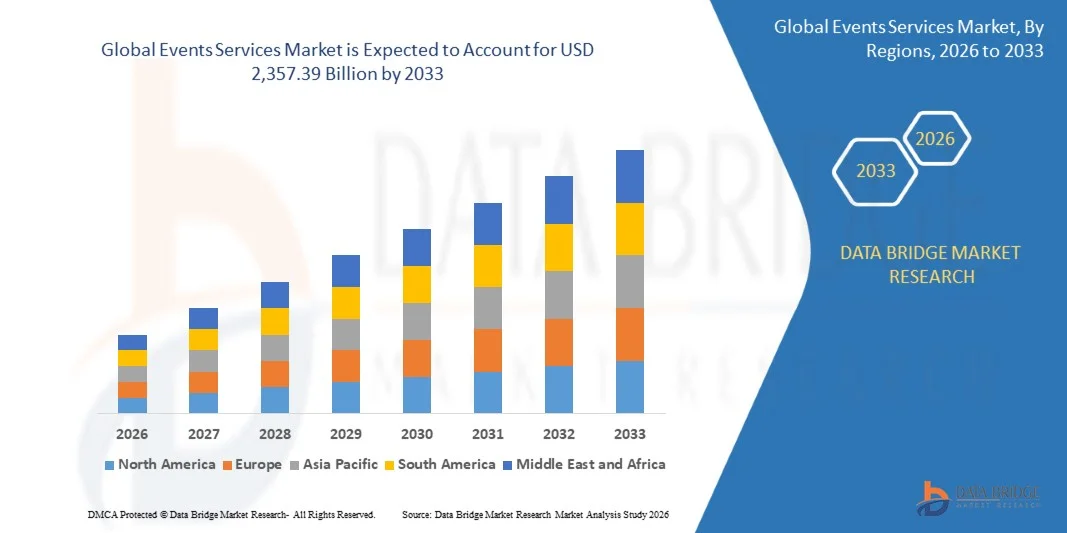
The Events Services Market was valued at USD 855.98 billion in 2025 and is projected to reach USD 2,357.39 billion by 2033, growing at a CAGR of 13.50% from 2026 to 2033. The market is witnessing strong expansion driven by rising demand for corporate events, exhibitions, trade shows, and hybrid event formats, along with increasing marketing investments by enterprises to enhance brand visibility and customer engagement.
The growing shift toward hybrid and virtual event models, combined with advancements in digital event platforms, live streaming technologies, and immersive audience engagement tools, is further accelerating market growth. In addition, increasing globalization of businesses and rising participation in international conferences and exhibitions are driving demand for professional event planning, management, and production services across both developed and emerging economies.
Key Market Trends & Insights
- North America dominated the events services market with the largest revenue share of 39.6% in 2025, supported by strong corporate event spending, advanced event infrastructure, and early adoption of hybrid and AI-driven event management platforms that enhance audience engagement and global reach.
- Asia-Pacific is expected to be the fastest-growing region, recording a CAGR of 14.8% from 2026 to 2033. Growth is driven by rapid urbanization, expanding corporate sector investments, rising popularity of exhibitions and entertainment events, and increasing adoption of digital and hybrid event technologies across emerging economies such as China and India.
- The Professional Services segment held the largest market revenue share of approximately 58.4% in 2025 driven by strong demand for event planning, production, logistics management, and on-ground execution support across corporate conferences, exhibitions, and trade shows. Organizations increasingly rely on professional event agencies to manage end-to-end event delivery, including venue selection, branding, and audience engagement strategies.
- The Managed Services segment is projected to register the fastest growth at a CAGR of 14.2% from 2026 to 2033, driven by rising adoption of outsourced event management platforms, hybrid event infrastructure support, and real-time digital event monitoring solutions. Increasing demand for technology-enabled event operations, such as live streaming, virtual attendee management, and AI-based engagement tracking, is accelerating segment expansion.
- The Cloud segment held the largest market revenue share of approximately 72.6% in 2025 driven by rapid adoption of virtual and hybrid event platforms, SaaS-based event management tools, and real-time collaboration technologies. Cloud deployment enables scalability, remote accessibility, and seamless integration of digital engagement features such as live analytics and audience interaction tools
- The On-Premise segment is projected to register steady growth at a CAGR of 9.1% from 2026 to 2033, driven by demand from large enterprises and government organizations requiring higher data control, security, and customized event infrastructure for confidential or high-profile events.
- The Large Enterprises segment held the largest market revenue share of approximately 66.9% in 2025 driven by high investment in global conferences, product launches, employee engagement events, and international exhibitions. Large organizations increasingly prioritize experiential marketing and brand visibility, fueling demand for large-scale event services and hybrid event technologies.
- The SMEs segment is projected to register the fastest growth at a CAGR of 15.3% from 2026 to 2033, driven by increasing participation in cost-effective virtual events, digital marketing exhibitions, and regional networking events. Rising availability of affordable cloud-based event platforms is further supporting adoption among smaller organizations.
- The Corporate segment held the largest market revenue share of approximately 48.7% in 2025 driven by strong demand for business conferences, shareholder meetings, trade exhibitions, and brand activation events across industries such as IT, BFSI, and manufacturing. Corporates are increasingly investing in hybrid event formats to expand global reach and improve stakeholder engagement.
- The Third-party Planner segment is projected to register the fastest growth at a CAGR of 13.8% from 2026 to 2033, driven by rising outsourcing of event execution to specialized agencies offering end-to-end event management, digital integration, and audience engagement solutions. Increasing complexity of large-scale hybrid events is further accelerating reliance on professional planners across global markets.
Market Size & Forecast
- Global Market Value (2025): USD 855.98 Billion
- Expected Market Value (2033): USD 2,357.39 Billion
- Forecast CAGR (2026–2033): 13.50%
- Leading Region in 2025: North America
- Fastest Growing Region: Asia-Pacific
Report Scope and Events Services Market Segmentation
|
Attributes |
Events Services Key Market Insights |
|
Segments Covered |
|
|
Countries Covered |
North America
Europe
Asia-Pacific
Middle East and Africa
South America
|
|
Key Market Players |
• KitApps, Inc./Attendify (U.S.) |
|
Market Opportunities |
• Expansion Of Hybrid And Virtual Event Platforms |
|
Value Added Data Infosets |
In addition to the market insights such as market value, growth rate, market segments, geographical coverage, market players, and market scenario, the market report curated by the Data Bridge Market Research team includes in-depth expert analysis, import/export analysis, pricing analysis, production consumption analysis, and pestle analysis. |
Events Services Market Trends
Trend: Growth In Hybrid And Digital Event Experience Platforms
Increasing demand for immersive, scalable, and technology-driven event experiences across corporate, entertainment, and exhibition sectors, driven by the rapid shift toward hybrid and virtual event formats. Traditional physical-only event models are increasingly being replaced by integrated digital platforms that combine live participation with real-time streaming, audience analytics, and interactive engagement tools to enhance reach and effectiveness.
In modern event ecosystems, organizers are increasingly adopting hybrid event technologies, For instance for global conferences, product launches, and trade exhibitions, to enable seamless participation across geographies while improving attendee engagement through AI-driven matchmaking, virtual networking lounges, and real-time polling systems. Leading global event companies are integrating platforms such as virtual reality event spaces and 3D digital venues to replicate physical experiences and expand global audience access.
The rapid expansion of corporate marketing budgets and international business collaborations is also increasing demand for large-scale exhibitions, trade fairs, and experiential marketing events capable of delivering measurable brand impact. In addition, sports, entertainment, and music industries continue to rely on advanced event production technologies, such as large-scale stadium concerts and global streaming events such as Coachella and FIFA-related fan engagement activations, to reach multi-million global audiences through hybrid broadcasting models. Growing industry validation through 2025 global events shows that hybrid events can increase audience reach by over 40–60% compared to traditional physical-only formats.
Events Services Market Dynamics
Key Market Driver: Rising Demand For Corporate Events And Hybrid Engagement Models
Organizations worldwide are increasingly prioritizing experiential marketing, brand visibility, and stakeholder engagement, leading to strong demand for professional event management services. Companies are investing heavily in conferences, exhibitions, and product launch events to strengthen customer relationships and enhance global presence.
Enterprises across sectors such as IT, BFSI, healthcare, and manufacturing are increasingly adopting hybrid event models that combine in-person and virtual participation to maximize reach and cost efficiency. For instance, large-scale global technology conferences such as CES and Web Summit have reported attendance levels exceeding 100,000+ participants through combined physical and digital formats, demonstrating the scalability of hybrid event ecosystems.
Similarly, the rise of digital platforms and event management software is enabling real-time analytics, automated scheduling, and AI-based audience engagement tools, improving overall event effectiveness and ROI for organizers.
Key Restraint/Challenge: High Operational Costs And Logistical Complexity
Despite strong growth, the events services market faces challenges related to high operational costs, complex logistics, and dependency on large-scale infrastructure. Organizing international exhibitions and live events requires significant investment in venue setup, technology integration, security, and manpower, which increases overall execution costs for organizers.
In addition, unpredictable external factors such as travel restrictions, geopolitical uncertainties, and economic slowdowns can disrupt event planning and attendance rates. Small and mid-sized event organizers often face difficulties in adopting advanced digital event platforms due to high technology implementation costs and lack of technical expertise.
Industry data indicates that large-scale international events can incur cost overruns of 15–25% due to last-minute logistical changes, vendor coordination issues, and technology integration challenges, particularly in multi-country event setups.
Key Market Opportunity: Expansion Of AI Powered Event Management And Virtual Engagement Solutions
The growing integration of artificial intelligence, augmented reality, and data analytics into event management platforms is creating significant opportunities for next-generation event services. Organizers are increasingly leveraging AI-driven tools for attendee personalization, predictive engagement analytics, and automated event planning to improve efficiency and experience quality.
Companies are deploying virtual and hybrid event platforms, For instance for global product launches, investor conferences, and corporate summits, to enable real-time global participation while reducing travel costs and carbon footprint. Leading platforms are introducing immersive 3D virtual venues and AI-powered networking systems that match attendees based on interests and professional profiles, improving engagement outcomes.
In addition, increasing adoption of sustainable event practices and digital-first formats is driving innovation in low-carbon event production models across Europe and North America. Large-scale hybrid events in 2025 have demonstrated up to 50% reduction in operational costs and a 35–45% increase in global audience participation compared to traditional event formats.
Events Services Market Scope
The market is segmented on the basis of services, deployment, organization size, and end-use application.
• By Services
On the basis of services, the market is segmented into Professional Services and Managed Services. The Professional Services segment held the largest market revenue share of approximately 58.4% in 2025 driven by strong demand for event planning, production, logistics management, and on-ground execution support across corporate conferences, exhibitions, and trade shows. Organizations increasingly rely on professional event agencies to manage end-to-end event delivery, including venue selection, branding, and audience engagement strategies.
The Managed Services segment is projected to register the fastest growth at a CAGR of 14.2% from 2026 to 2033, driven by rising adoption of outsourced event management platforms, hybrid event infrastructure support, and real-time digital event monitoring solutions. Increasing demand for technology-enabled event operations, such as live streaming, virtual attendee management, and AI-based engagement tracking, is accelerating segment expansion.
• By Deployment
On the basis of deployment, the market is segmented into Cloud and On-Premise. The Cloud segment held the largest market revenue share of approximately 72.6% in 2025 driven by rapid adoption of virtual and hybrid event platforms, SaaS-based event management tools, and real-time collaboration technologies. Cloud deployment enables scalability, remote accessibility, and seamless integration of digital engagement features such as live analytics and audience interaction tools
The On-Premise segment is projected to register steady growth at a CAGR of 9.1% from 2026 to 2033, driven by demand from large enterprises and government organizations requiring higher data control, security, and customized event infrastructure for confidential or high-profile events.
• By Organization Size
On the basis of organization size, the market is segmented into Small and Medium-sized Enterprises (SMEs), and Large Enterprises. The Large Enterprises segment held the largest market revenue share of approximately 66.9% in 2025 driven by high investment in global conferences, product launches, employee engagement events, and international exhibitions. Large organizations increasingly prioritize experiential marketing and brand visibility, fueling demand for large-scale event services and hybrid event technologies.
The SMEs segment is projected to register the fastest growth at a CAGR of 15.3% from 2026 to 2033, driven by increasing participation in cost-effective virtual events, digital marketing exhibitions, and regional networking events. Rising availability of affordable cloud-based event platforms is further supporting adoption among smaller organizations.
• By End User
On the basis of end user, the market is segmented into Corporate, Government, Third-party Planner, Education, and Others. The Corporate segment held the largest market revenue share of approximately 48.7% in 2025 driven by strong demand for business conferences, shareholder meetings, trade exhibitions, and brand activation events across industries such as IT, BFSI, and manufacturing. Corporates are increasingly investing in hybrid event formats to expand global reach and improve stakeholder engagement.
The Third-party Planner segment is projected to register the fastest growth at a CAGR of 13.8% from 2026 to 2033, driven by rising outsourcing of event execution to specialized agencies offering end-to-end event management, digital integration, and audience engagement solutions. Increasing complexity of large-scale hybrid events is further accelerating reliance on professional planners across global markets.
Events Services Market Regional Analysis
North America Events Services Market Insight
North America dominated the events services market with the largest revenue share of 39.6% in 2025, supported by strong corporate spending on conferences, trade shows, exhibitions, and experiential marketing events. The region benefits from advanced event infrastructure, high adoption of hybrid event technologies, and strong presence of global event management companies. Organizations in North America increasingly prioritize large-scale business events to enhance brand visibility, customer engagement, and stakeholder networking. In addition, rising integration of AI-driven event platforms, virtual conferencing tools, and real-time audience analytics is further strengthening market growth across corporate and entertainment sectors.
U.S. Events Services Market Insight
The U.S. events services market captured the largest revenue share of 82.1% within North America in 2025, driven by high demand for corporate events, product launches, industry exhibitions, and large-scale entertainment events. Companies are increasingly investing in hybrid event formats that combine physical and virtual participation to maximize global reach and engagement. Strong presence of technology-driven event solution providers and widespread adoption of digital event platforms, such as AI-based attendee tracking and virtual networking tools, are further accelerating market expansion. In addition, increasing corporate marketing budgets and strong demand for experiential branding are supporting industry growth.
Europe Events Services Market Insight
The Europe events services market is expected to witness the fastest growth rate from 2026 to 2033, driven by rising demand for international trade fairs, corporate conferences, and cultural events. The region is benefiting from strong tourism infrastructure, increasing business globalization, and rapid adoption of hybrid event formats. European organizations are increasingly focusing on sustainable and low-carbon event solutions, including digital ticketing and virtual participation platforms. In addition, strong regulatory frameworks and government support for business tourism are contributing to the expansion of the events industry across major economies such as Germany, France, and Italy.
U.K. Events Services Market Insight
The U.K. events services market is expected to witness strong growth from 2026 to 2033, driven by rising demand for corporate meetings, exhibitions, and entertainment events across London and other major cities. The country’s strong financial and business services sector is a key contributor to corporate event spending. Increasing adoption of hybrid event technologies, coupled with advanced digital infrastructure, is supporting virtual participation and global audience engagement. In addition, growing emphasis on experiential marketing and brand activation strategies is further driving demand for professional event management services.
Germany Events Services Market Insight
The Germany events services market is expected to witness steady growth from 2026 to 2033, driven by strong demand for industrial trade fairs, automotive exhibitions, and corporate conferences. Germany’s well-established exhibition infrastructure and global leadership in manufacturing events are key growth drivers. Increasing adoption of sustainable event practices, digital event management platforms, and hybrid conferencing solutions is further supporting market expansion. In addition, strong participation from industrial and technology companies in global exhibitions is reinforcing Germany’s position as a major European events hub.
Asia-Pacific Events Services Market Insight
The Asia-Pacific events services market is expected to witness the fastest growth rate from 2026 to 2033, supported by rapid urbanization, rising corporate investments, and expanding entertainment and exhibition industries. Countries such as China, India, and Japan are witnessing strong demand for corporate conferences, trade exhibitions, and music festivals. Increasing adoption of digital and hybrid event platforms, along with government support for tourism and business events, is further accelerating market growth. In addition, the region’s large youth population and growing digital connectivity are boosting participation in both physical and virtual events.
Japan Events Services Market Insight
The Japan events services market is expected to witness strong growth from 2026 to 2033 due to the country’s advanced technology adoption, strong corporate culture, and demand for high-quality event experiences. Japanese companies are increasingly organizing corporate conferences, technology exhibitions, and product launch events with integrated digital engagement tools. The rising adoption of hybrid event platforms and immersive technologies such as AR and VR is further enhancing attendee experience. In addition, Japan’s focus on precision, organization, and innovation is supporting the development of highly structured and technology-enabled event services.
China Events Services Market Insight
The China events services market accounted for the largest market revenue share in Asia Pacific in 2025, driven by rapid urbanization, strong corporate expansion, and growing demand for exhibitions, trade fairs, and entertainment events. The country’s large-scale industrial and consumer markets are fueling demand for both domestic and international events. Increasing adoption of smart event technologies, including AI-powered registration systems and virtual event platforms, is further strengthening market growth. In addition, government initiatives supporting digital economy development and tourism expansion are boosting large-scale event activities across major cities such as Shanghai and Beijing.
Events Services Market Share
The Events Services industry is primarily led by well-established companies, including:
• KitApps, Inc./Attendify (U.S.)
• Active Network, LLC (U.S.)
• Aventri, Inc. (U.S.)
• Cvent Inc. (U.S.)
• Eventbrite (U.S.)
• New Work SE (Germany)
• Arlo (New Zealand)
• Glue Up (U.S.)
• EventBooking (U.S.)
• Circa (U.S.)
• RainFocus (U.S.)
• Bizzabo (U.S.)
• EventMobi (Canada)
• Gather Technology Ltd. (U.K.)
• Clarion Events Ltd. (U.K.)
• CL Events (U.K.)
• Freeman (U.S.)
• Questex (U.S.)
• Capita (U.K.)
• Live Nation Worldwide Inc. (U.S.)

- Interactive Data Analysis Dashboard
- Company Analysis Dashboard for high growth potential opportunities
- Research Analyst Access for customization & queries
- Competitor Analysis with Interactive dashboard
- Latest News, Updates & Trend analysis
- Harness the Power of Benchmark Analysis for Comprehensive Competitor Tracking
Data collection and base year analysis are done using data collection modules with large sample sizes. The stage includes obtaining market information or related data through various sources and strategies. It includes examining and planning all the data acquired from the past in advance. It likewise envelops the examination of information inconsistencies seen across different information sources. The market data is analysed and estimated using market statistical and coherent models. Also, market share analysis and key trend analysis are the major success factors in the market report. To know more, please request an analyst call or drop down your inquiry.
The key research methodology used by DBMR research team is data triangulation which involves data mining, analysis of the impact of data variables on the market and primary (industry expert) validation. Data models include Vendor Positioning Grid, Market Time Line Analysis, Market Overview and Guide, Company Positioning Grid, Patent Analysis, Pricing Analysis, Company Market Share Analysis, Standards of Measurement, Global versus Regional and Vendor Share Analysis. To know more about the research methodology, drop in an inquiry to speak to our industry experts.
Data Bridge Market Research is a leader in advanced formative research. We take pride in servicing our existing and new customers with data and analysis that match and suits their goal. The report can be customized to include price trend analysis of target brands understanding the market for additional countries (ask for the list of countries), clinical trial results data, literature review, refurbished market and product base analysis. Market analysis of target competitors can be analyzed from technology-based analysis to market portfolio strategies. We can add as many competitors that you require data about in the format and data style you are looking for. Our team of analysts can also provide you data in crude raw excel files pivot tables (Fact book) or can assist you in creating presentations from the data sets available in the report.













