


What is the Evidence Management Market Size and Growth Rate?
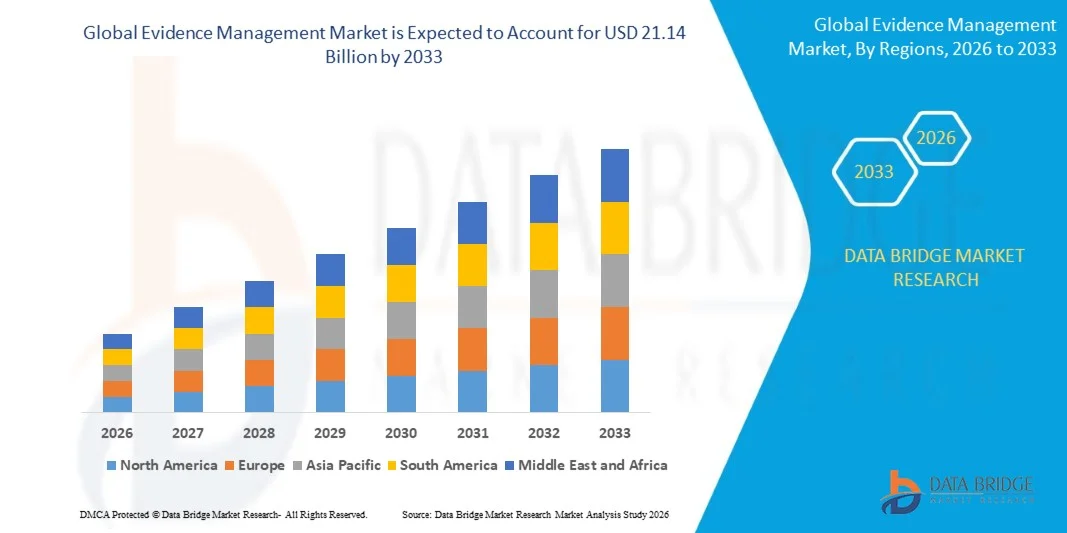
- As per Data Bridge Market Research analysis, the evidence management market was valued at USD 9.65 billion in 2025 and is projected to reach USD 21.14 billion by 2033, growing at a CAGR of 10.30% from 2026 to 2033.
- The market is experiencing consistent growth driven by the increasing volume of digital evidence, rising adoption of cloud-based evidence management platforms, and growing demand for secure, centralized, and easily accessible evidence storage across law enforcement and justice organizations.
- The increasing use of body-worn cameras, surveillance systems, smartphones, and other digital devices, combined with stricter requirements for evidence integrity, chain-of-custody management, and data security, is compelling law enforcement agencies and other organizations to adopt advanced evidence management solutions. Cloud-based platforms are increasingly replacing fragmented evidence storage systems, offering scalable, secure, and efficient environments for collecting, organizing, sharing, and managing digital evidence.
Market Size & Forecast
- Global Market Value (2025): USD 9.65 Billion
- Expected Market Value (2033): USD 21.14 Billion
- Forecast CAGR (2026–2033): 10.30%
- Leading Region in 2025: North America
- Fastest Growing Region: Asia Pacific
What are the Major Takeaways of the Evidence Management Market?
- North America dominated the evidence management market with the largest revenue share of 38.48% in 2025, supported by advanced law-enforcement infrastructure, high adoption of digital evidence solutions, and increasing use of body-worn cameras.
- Asia-Pacific is expected to be the fastest-growing region at a CAGR of 11.45% from 2026 to 2033, fueled by increasing digitalization of law-enforcement operations, smart-city investments, growing evidence volumes, and rising adoption of AI-enabled and cloud-based evidence management platforms
- The cloud segment led the market with a 62.95% share in 2025, driven by increasing digital evidence volumes and the need for scalable, centralized, and remotely accessible storage.
- On-premises are the fastest-growing deployment type, projected to register a CAGR of 10.5%, reflecting the surge in demand for direct control over sensitive evidence and data infrastructure
- The hardware segment dominated the component category with a 48.17% revenue share in 2025, led by widespread deployment of body-worn cameras, vehicle cameras, surveillance cameras, and other evidence-capture devices.
- Digital evidence accounted for 71.30% of the market share in 2025, preferred by the rapid growth of video, audio, photographs, documents, smartphone data, and surveillance recordings.
- The physical evidence metadata segment is the fastest-growing evidence type category, with a CAGR of 10.8%, driven by increasing digitization of records associated with physical evidence.
Report Scope and Evidence Management Market Segmentation
Attributes |
Evidence Management Key Market Insights |
|
Segments Covered |
|
|
Countries Covered |
North America
Europe
Asia-Pacific
Middle East and Africa
South America
|
|
Key Market Players |
|
|
Market Opportunities |
|
|
Value Added Data Infosets |
In addition to the insights on market scenarios such as market value, growth rate, segmentation, geographical coverage, and major players, the market reports curated by the Data Bridge Market Research also include in-depth expert analysis, geographically represented company-wise production and capacity, network layouts of distributors and partners, detailed and updated price trend analysis and deficit analysis of supply chain and demand. |
What is the Key Trend in the Evidence Management Market?
- AI-powered evidence management is increasingly being adopted to automate evidence review, transcription, tagging, redaction, and search, helping law-enforcement agencies manage rapidly expanding volumes of digital evidence more efficiently.
- For instance, in April 2025, Motorola Solutions launched the SVX, combining a body-worn camera with its AI-powered Assist technology to help public-safety personnel capture evidence and analyze information in real time. The device was developed with 32 public-safety agencies and tested by 150 users.
- Automated transcription and intelligent search enable investigators to identify relevant statements, events, and evidence more rapidly across large collections of video and audio files.
- Law-enforcement agencies are increasingly integrating evidence platforms with body-worn cameras, CCTV, smartphones, drones, and other digital evidence sources to establish centralized evidence repositories and streamline investigations.
- For instance, in November 2024, the Ontario Provincial Police selected Appian to implement a digital case-management platform that integrates previously disconnected systems, automates manual workflows, and provides stakeholders with a unified view of criminal-case information and evidence.
- As digital evidence volumes continue expanding and agencies prioritize faster investigations, secure workflows, and automated processing, AI-enabled evidence management is expected to accelerate, reinforcing intelligent automation as a core component of modern evidence management systems.
What are the Key Drivers of the Evidence Management Market?
- The rapid growth of digital evidence from body-worn cameras, smartphones, CCTV systems, drones, and other connected devices has significantly increased demand for centralized evidence management platforms capable of securely storing and organizing large data volumes.
- For instance, in June 2026, Axon reported that 70% of surveyed law-enforcement agencies had moved to cloud-based digital evidence management systems, highlighting the growing need for scalable storage, accessibility, and centralized management as digital evidence volumes increase.
- Law-enforcement agencies, prosecutors, and investigators are integrating cloud-based evidence management systems to improve accessibility, evidence sharing, chain-of-custody tracking, and collaboration across departments and jurisdictions.
- For instance, in June 2026, Axon announced upgrades to its cloud infrastructure to support growing evidence volumes and AI-powered workflows, including automated transcription and video analysis, demonstrating the increasing importance of scalable cloud infrastructure for evidence management.
- With digital evidence becoming increasingly central to criminal investigations and judicial processes, organizations will continue investing in scalable, secure, and integrated evidence management platforms to improve operational efficiency and preserve evidence integrity.
Which Factors are Challenging the Growth of the Evidence Management Market?
- The rapidly increasing volume and size of digital evidence creates significant storage, infrastructure, cybersecurity, and data-management costs for organizations deploying comprehensive evidence management systems
- For instance, in April 2026, Veritone highlighted the growing challenge of managing large volumes of digital evidence and diverse file formats, while also noting CJIS compliance requirements and fragmented workflows as major obstacles for law-enforcement agencies adopting digital evidence management systems.
- These costs can limit adoption among smaller law-enforcement agencies and organizations with constrained technology budgets, particularly when large quantities of high-resolution video and other digital evidence must be retained for extended periods.
- Data privacy, cybersecurity, chain-of-custody requirements, and regulatory compliance also increase the complexity of deploying evidence management platforms, particularly when evidence must be securely accessed and shared among multiple authorized parties.
- For instance, in August 2026, cities including Longmont, Colorado, moved away from Flock Safety surveillance-camera contracts amid concerns over surveillance, data privacy, transparency, and data-retention practices, demonstrating how privacy and governance concerns can restrict adoption of evidence-generating technologies.
- The combination of rising storage requirements, cybersecurity investments, privacy obligations, and integration complexity continues to create adoption barriers, particularly for smaller agencies and organizations transitioning from fragmented legacy evidence-storage systems.
How is the Evidence Management Market Segmented?
The evidence management market is segmented on the basis of deployment, component, evidence type, and end user.
- By Deployment
On the basis of deployment, the evidence management market is segmented into on-premises and cloud. The cloud segment dominated the market with a 62.95% share in 2025, owing to increasing digital evidence volumes and the need for scalable, centralized, and remotely accessible storage. Cloud platforms enable law-enforcement agencies to store and retrieve large quantities of video, audio, images, and documents without continuously expanding physical infrastructure. They also facilitate secure evidence sharing between investigators, prosecutors, courts, and other authorized stakeholders. Automated backups, centralized administration, and integration with body-worn cameras and surveillance systems further support adoption. The growing integration of artificial intelligence-powered transcription, search, redaction, and analytics is strengthening the functionality of cloud-based platforms.
The on-premises segment is projected to register the fastest growth at a CAGR of 10.5% during the forecast period, driven by increasing demand for direct control over sensitive evidence and data infrastructure. Federal agencies, defense organizations, and security-focused institutions often require locally controlled systems because of stringent security, privacy, and data-sovereignty requirements. On-premises deployment enables organizations to establish customized access controls and maintain evidence within their existing IT environments. It can also provide greater control over system configuration and integration with internal security infrastructure. Although higher hardware, maintenance, and IT-management requirements can limit adoption, these systems remain important for organizations handling highly sensitive information.
- By Component
On the basis of component, the evidence management market is segmented into hardware, software, and services. The hardware segment dominated the market with a 48.17% share in 2025, driven by widespread deployment of body-worn cameras, vehicle cameras, surveillance cameras, and other evidence-capture devices. Law-enforcement agencies are increasingly equipping personnel and vehicles with connected recording technologies that continuously generate digital evidence. Modern cameras increasingly provide high-resolution recording, wireless connectivity, GPS capabilities, and automated evidence-transfer functionality. The expansion of public surveillance and transportation-monitoring infrastructure is also increasing demand for evidence-capture hardware. Replacement cycles and technological upgrades provide recurring demand as agencies modernize their equipment. Integration between evidence-capture hardware and centralized management platforms further improves the efficiency of evidence collection and storage.
The services segment is projected to register the fastest growth at a CAGR of 11.3% during the forecast period, supported by increasing demand for implementation, integration, consulting, training, migration, and technical support. Organizations adopting evidence management platforms often require professional assistance to integrate new systems with existing records-management and public-safety technologies. Data migration services are particularly important when agencies transfer large legacy evidence repositories to modern platforms. Training services help investigators and administrative personnel use increasingly sophisticated evidence-management and artificial intelligence capabilities. Technical support services help maintain system reliability, cybersecurity, and evidence accessibility. Growing adoption of cloud and hybrid environments is also increasing demand for integration and managed services.
- By Evidence Type
On the basis of evidence type, the evidence management market is segmented into digital evidence and physical evidence metadata. The digital evidence segment dominated the market with a 71.30% share in 2025, owing to the rapid growth of video, audio, photographs, documents, smartphone data, and surveillance recordings. Body-worn cameras, CCTV systems, smartphones, drones, and digital-forensics technologies are generating increasingly large quantities of electronically stored evidence. Evidence management platforms enable organizations to securely collect, organize, search, retrieve, share, and preserve these digital files. Artificial intelligence-powered transcription, automated classification, redaction, and intelligent search are further improving digital evidence workflows. Increasing requirements for secure storage, audit trails, and chain-of-custody documentation are strengthening demand for specialized digital evidence platforms.
The physical evidence metadata segment is projected to register the fastest growth at a CAGR of 10.8% during the forecast period, driven by increasing digitization of records associated with physical evidence. Physical evidence metadata can include information concerning seized property, weapons, biological samples, documents, and other exhibits involved in investigations. Digital tracking allows investigators to monitor the location, status, ownership, and handling history of physical evidence more efficiently. Barcode and radio-frequency identification technologies can further strengthen evidence identification and chain-of-custody processes. Integration with laboratory information systems and case-management platforms is creating more connected evidence workflows. Growing emphasis on evidence accountability and traceability is encouraging agencies to replace fragmented manual records with digital metadata systems.
- By End User
On the basis of end user, the evidence management market is segmented into law-enforcement agencies, transportation agencies, federal and defense agencies, courts and prosecutors, and insurance companies. The law-enforcement agencies segment dominated the market with a 54.08% share in 2025, driven by extensive use of body-worn cameras, vehicle cameras, CCTV footage, interview recordings, and other investigative evidence. Police departments generate substantial quantities of evidence throughout investigations, arrests, traffic incidents, and public-safety operations. Evidence management systems help agencies securely store, organize, retrieve, and share evidence while maintaining chain-of-custody requirements. Integration with records-management, computer-aided dispatch, and case-management systems further improves investigative efficiency. Increasing transparency and accountability requirements are also encouraging police departments to modernize evidence workflows.
The insurance companies segment is projected to register the fastest growth at CAGR of 11.1% during the forecast period, supported by increasing use of digital evidence in claims processing, accident investigation, and fraud detection. Insurance companies increasingly handle photographs, video recordings, documents, vehicle footage, and other digital information when evaluating claims. Centralized evidence management can improve the organization and accessibility of claim-related information for authorized personnel. Advanced search and analytics can help insurers identify inconsistencies and potentially fraudulent claims more efficiently. Integration with claims-management platforms can also reduce manual evidence-handling processes and accelerate investigations. The increasing digitization of insurance operations is creating greater demand for secure systems capable of managing diverse evidence formats
Which Region Holds the Largest Share of the Evidence Management Market?
- North America dominated the evidence management market with the largest revenue share of 38.48% in 2025, supported by advanced law-enforcement infrastructure, high adoption of digital evidence solutions, and increasing use of body-worn cameras.
- The region also benefits from extensive deployment of body-worn cameras, surveillance systems, and AI-enabled evidence analysis, along with increasing requirements for secure evidence storage and chain-of-custody management. Growing digitalization of investigations, modernization of public-safety agencies, and rising adoption of integrated evidence management solutions continue to strengthen North America’s leadership position in the global market.
U.S. Evidence Management Market Insight
The U.S. evidence management market is witnessing strong growth due to rising investments in digital policing, body-worn camera programs, cloud-based evidence platforms, and advanced law-enforcement technologies. The country’s mature public-safety infrastructure, along with increasing adoption of AI-powered evidence analysis and automated digital workflows, is driving demand across police departments, federal agencies, courts, and prosecutors. In addition, growing emphasis on evidence integrity, chain-of-custody requirements, cybersecurity, and efficient investigation processes is accelerating adoption of centralized evidence management solutions across public-safety organizations.
Asia-Pacific Evidence Management Market Insight
The Asia-Pacific evidence management market is expected to witness rapid growth, driven by increasing digitalization of law-enforcement operations, expanding surveillance infrastructure, and rising investments in public-safety technologies across countries such as China, India, and Japan. Growing awareness regarding secure digital evidence storage, increasing deployment of body-worn cameras, and rising adoption of cloud-based evidence platforms are supporting regional market expansion. In addition, modernization of police and judicial systems, increasing smart-city development, and growing volumes of video and other digital evidence are accelerating adoption across government and public-sector organizations.
Japan Evidence Management Market Insight
The Japan evidence management market is witnessing consistent growth due to rising investments in digital law-enforcement infrastructure, advanced surveillance technologies, and secure evidence-management systems. Police agencies, transportation authorities, and government organizations are increasingly adopting digital platforms to manage video recordings, documents, images, and other electronically generated evidence. Moreover, increasing integration of artificial intelligence, cloud technologies, and automated evidence workflows, together with Japan’s focus on cybersecurity and efficient public-safety operations, is further contributing to market growth.
China Evidence Management Market Insight
The China evidence management market is growing rapidly, driven by increasing urbanization, expanding surveillance infrastructure, and rising government focus on public security and digital transformation. Growing adoption of AI-enabled video analytics, cloud-based platforms, and integrated surveillance technologies across law-enforcement and government organizations is significantly boosting market demand. In addition, rising investments in smart-city infrastructure, increasing volumes of digitally generated evidence, and rapid development of artificial intelligence technologies are positioning China as one of the fastest-growing markets for evidence management globally.
U.K. Evidence Management Market Insight
The U.K. evidence management market is experiencing steady growth, supported by rising adoption of digital evidence platforms across police forces, courts, prosecutors, and other public-sector organizations. Increasing investments in body-worn cameras, digital investigation technologies, and secure cloud infrastructure are contributing to market growth. Furthermore, integration of artificial intelligence, automated transcription, advanced search, and data analytics is improving evidence review and investigative efficiency, positioning the U.K. as a key market for technology-driven evidence management solutions.
Germany Evidence Management Market Insight
The Germany evidence management market is expanding steadily due to the country’s strong digital infrastructure, increasing modernization of law-enforcement systems, and growing adoption of secure evidence-management technologies. Police agencies, courts, transportation organizations, and government institutions are increasingly utilizing digital platforms for evidence storage, retrieval, sharing, and chain-of-custody management. Continuous advancements in cloud computing, artificial intelligence, cybersecurity, and digital forensics, along with strong regulatory focus on data protection and evidence security, are further driving market growth in Germany.
Which are the Top Companies in Evidence Management Market?
The evidence management industry is primarily led by well-established companies, including:
- Axon Enterprise, Inc. (U.S.)
- Motorola Solutions, Inc. (U.S.)
- Genetec Inc. (Canada)
- Veritone, Inc. (U.S.)
- NiCE (Israel)
- Micro Systemation AB (Sweden)
- Reveal Media Ltd (U.K.)
- CaseGuard (U.S.)
- Mark43 (U.S.)
- Tyler Technologies, Inc. (U.S.)
- Cellebrite DI Ltd. (Israel)
- Nuix (Australia)
- Oxygen Forensics Inc. (U.S.)
- Paraben Corporation (U.S.)
- FileOnQ (U.S.)
- PRO-VISION Solutions, LLC (U.S.)
- GETAC (Taiwan)
- Panasonic Connect Co., Ltd. (Japan)
- i-PRO Co., Ltd. (Japan)
- Coreforce (U.S.)
What are Latest Developments in Evidence Management Market?
- In December 2025, Axon launched the redesigned Axon Evidence platform globally, introducing a modern interface, streamlined navigation, improved search capabilities, expanded metadata views, and enhanced evidence organization. The redesign was developed to simplify workflows for agencies managing growing volumes of digital evidence and to make evidence review and organization more efficient. This development reflects the market’s shift toward more intuitive, centralized, and technology-driven digital evidence management platforms.
- In March 2024, Veritone launched its Intelligent Digital Evidence Management System (iDEMS), an AI-powered platform designed to modernize digital evidence workflows for public-safety and judicial organizations. The system provides a secure cloud repository and applies AI to evidence for automated redaction, translation, transcription, and information discovery. The launch strengthened the integration of artificial intelligence into evidence management and demonstrated the growing move toward automated evidence analysis and investigation workflows
- In March 2024, India’s National Investigation Agency launched its Digital Criminal Case Management System (CCMS), a browser-based platform designed to organize, integrate, and digitize investigation data including case documents, extracted information, collected evidence, and charge sheets. The system was introduced to improve coordination and standardize investigation processes involving terrorism and organized crime. The initiative demonstrates increasing government investment in centralized digital platforms for evidence and case management.
- In September 2022, StateTech reported that criminal-justice agencies were increasingly adopting digital evidence management to handle growing quantities of video, email, and other electronic records. The article highlighted how digital evidence platforms allow agencies to organize and share evidence more efficiently as evidence volumes increase. This development reflects the growing transition from fragmented evidence handling toward centralized digital systems capable of supporting investigations and collaboration.
- In January 2021, the U.S. Office of Justice Programs published a landscape study examining software-based evidence management systems available to law-enforcement agencies. The study highlighted systems using barcode-based tracking and searchable databases to improve the management, location, integrity, and disposition of physical evidence. It also identified adoption benefits and limitations, demonstrating the increasing role of dedicated software in modernizing evidence-storage and property-management processes.

- Interactive Data Analysis Dashboard
- Company Analysis Dashboard for high growth potential opportunities
- Research Analyst Access for customization & queries
- Competitor Analysis with Interactive dashboard
- Latest News, Updates & Trend analysis
- Harness the Power of Benchmark Analysis for Comprehensive Competitor Tracking
Global Evidence Management Market, Supply Chain Analysis and Ecosystem Framework
To support market growth and help clients navigate the impact of geopolitical shifts, DBMR has integrated in-depth supply chain analysis into its Global Evidence Management Market research reports. This addition empowers clients to respond effectively to global changes affecting their industries. The supply chain analysis section includes detailed insights such as Global Evidence Management Market consumption and production by country, price trend analysis, the impact of tariffs and geopolitical developments, and import and export trends by country and HSN code. It also highlights major suppliers with data on production capacity and company profiles, as well as key importers and exporters. In addition to research, DBMR offers specialized supply chain consulting services backed by over a decade of experience, providing solutions like supplier discovery, supplier risk assessment, price trend analysis, impact evaluation of inflation and trade route changes, and comprehensive market trend analysis.
Data collection and base year analysis are done using data collection modules with large sample sizes. The stage includes obtaining market information or related data through various sources and strategies. It includes examining and planning all the data acquired from the past in advance. It likewise envelops the examination of information inconsistencies seen across different information sources. The market data is analysed and estimated using market statistical and coherent models. Also, market share analysis and key trend analysis are the major success factors in the market report. To know more, please request an analyst call or drop down your inquiry.
The key research methodology used by DBMR research team is data triangulation which involves data mining, analysis of the impact of data variables on the market and primary (industry expert) validation. Data models include Vendor Positioning Grid, Market Time Line Analysis, Market Overview and Guide, Company Positioning Grid, Patent Analysis, Pricing Analysis, Company Market Share Analysis, Standards of Measurement, Global versus Regional and Vendor Share Analysis. To know more about the research methodology, drop in an inquiry to speak to our industry experts.
Data Bridge Market Research is a leader in advanced formative research. We take pride in servicing our existing and new customers with data and analysis that match and suits their goal. The report can be customized to include price trend analysis of target brands understanding the market for additional countries (ask for the list of countries), clinical trial results data, literature review, refurbished market and product base analysis. Market analysis of target competitors can be analyzed from technology-based analysis to market portfolio strategies. We can add as many competitors that you require data about in the format and data style you are looking for. Our team of analysts can also provide you data in crude raw excel files pivot tables (Fact book) or can assist you in creating presentations from the data sets available in the report.













