


Exhaust Heat Recovery System Market Size
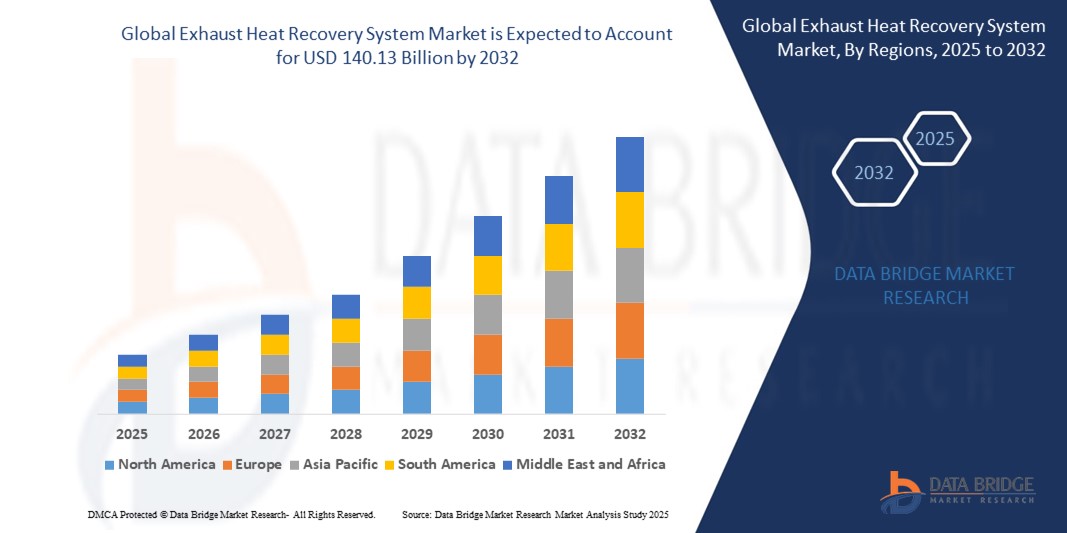
- The Global Exhaust Heat Recovery System Market size was valued at USD 46.16 billion in 2024 and is expected to reach USD 140.13 billion by 2032, at a CAGR of 17.2% during the forecast period
- This growth is driven by factors such as rising sales of hybrid vehicles
Exhaust Heat Recovery System Market Analysis
- Exhaust Heat Recovery Systems (EHRS) are gaining significant traction as a key component in enhancing energy efficiency and reducing emissions across various industries, particularly automotive and power generation. These systems capture and reuse heat from exhaust gases that would otherwise be wasted, thereby improving overall thermal efficiency and reducing fuel consumption
- Market growth is primarily driven by stringent emission regulations, rising demand for fuel efficient vehicles, and increasing adoption of energy recovery technologies in industrial processes. The push toward decarbonization and sustainable operations is further accelerating the deployment of EHRS in both on-road and off-road applications
- Market growth is driven by the rapid expansion of data centers, increasing demand for cloud computing, and the rising adoption of high density and modular servers in enterprise IT infrastructure. The growing emphasis on edge computing and hyperscale deployments further boosts demand for customizable and space efficient server enclosures
- Europe is expected to lead the global Exhaust Heat Recovery System Market, supported by strict environmental regulations (such as Euro 6 norms), government incentives for energy-efficient technologies, and a strong presence of automotive OEMs integrating EHRS in hybrid and conventional vehicles
- The Asia Pacific region is projected to register the fastest growth due to rising vehicle production, growing industrialization, and supportive government policies promoting clean energy technologies in countries like China, India, and Japan
- The Passenger vehicles segment holds the largest share and dominate the market with 60.12%, due to its rapid advancements in automotive technology facilitate the integration of sophisticated exhaust heat recovery systems in passenger vehicles, enhancing innovations such as turbocharging and hybrid powertrains
Report Scope and Exhaust Heat Recovery System Market Segmentation
|
Attributes |
Exhaust Heat Recovery System Key Market Insights |
|
Segments Covered |
|
|
Countries Covered |
North America
Europe
Asia-Pacific
Middle East and Africa
South America
|
|
Key Market Players |
|
|
Market Opportunities |
|
|
Value Added Data Infosets |
In addition to the insights on market scenarios such as market value, growth rate, segmentation, geographical coverage, and major players, the market reports curated by the Data Bridge Market Research also include import export analysis, production capacity overview, production consumption analysis, price trend analysis, climate change scenario, supply chain analysis, value chain analysis, raw material/consumables overview, vendor selection criteria, PESTLE Analysis, Porter Analysis, and regulatory framework. |
Exhaust Heat Recovery System Market Trends
“Integration of EHRS in Hybrid and Electric Vehicle Platforms”
- A major trend shaping the EHRS market is the integration of waste heat recovery systems into hybrid and electric vehicle (EV) platforms to enhance thermal management and increase energy efficiency.
- Advanced EHRS technologies are being used to optimize battery temperature, reduce auxiliary load, and improve overall system performance in low emission vehicles.
For Instance,
- In March 2024, Toyota and Hyundai began incorporating compact EHRS units in their hybrid and plug-in hybrid models to recover exhaust heat for cabin heating and battery preconditioning. These innovations are helping manufacturers meet strict fuel economy and emissions standards while improving vehicle comfort and efficiency.
- This trend is aligned with the global transition toward low-carbon transportation, especially as hybrid vehicles act as a bridge between ICE and fully electric mobility.
Exhaust Heat Recovery System Market Dynamics
Driver
“Stringent Emission Norms and Rising Demand for Fuel Efficiency”
- Governments across the globe are enforcing strict emission regulations, pushing automakers and industries to adopt technologies that improve fuel economy and reduce greenhouse gas emissions.
- EHRS plays a critical role by utilizing waste heat from exhaust gases, which would otherwise be lost, to enhance thermal efficiency and reduce fuel consumption.
For Instance,
- In June 2024, the European Union tightened CO₂ emission limits for passenger cars under the “Euro 7” standard, compelling OEMs to deploy EHRS in new models. Automakers responded by integrating compact, lightweight EHRS systems to meet fleet-wide efficiency targets.
- The growing need for sustainable and energy efficient solutions in sectors such as transportation, power generation, and marine is further fueling demand for EHRS.
Opportunity
“Rising Adoption in Industrial and Marine Applications”
- While EHRS has traditionally seen strong uptake in automotive applications, its adoption is expanding rapidly into industrial and marine sectors due to the rising need to optimize energy usage and reduce operating costs.
- Industrial furnaces, gas turbines, and marine engines generate large volumes of waste heat, making them ideal for heat recovery systems to improve thermal efficiency.
For instance,
- In January 2025, several shipping companies in Japan and South Korea began retrofitting their vessels with EHRS units to recover exhaust heat for onboard electricity generation, reducing fuel usage by up to 8%. This move supports IMO’s 2030 carbon reduction goals.
- This shift opens lucrative opportunities for EHRS manufacturers offering customized, high capacity systems tailored for non-automotive applications.
Restraint/Challenge
“High Initial Costs and System Complexity”
- A significant challenge for EHRS adoption, particularly among small- and mid-sized enterprises (SMEs), is the high upfront cost associated with system design, integration, and maintenance.
- EHRS require careful engineering to ensure compatibility with existing exhaust and thermal systems, increasing development complexity.
For instance,
- In February 2024, a German Tier-2 automotive supplier delayed the rollout of its EHRS-equipped engine line due to integration difficulties and rising component costs. This resulted in a six month production lag, highlighting how cost and complexity can disrupt project timelines.
- While long term fuel savings are substantial, the high CAPEX and technical barriers may slow adoption in cost-sensitive markets or among companies lacking technical expertise.
Exhaust Heat Recovery System Market Scope
The market is segmented on the basis of type, technology, component, energy source, vehicle and sales channel
|
Segmentation |
Sub-Segmentation |
|
By Type |
|
|
By Technology
|
|
|
By Component
|
|
|
By Energy Source
|
|
|
By Vehicle |
|
|
By Sales Channel |
|
In 2025, Passenger Vehicles is projected to dominate the market with a largest share in Vehicle segment
The Passenger Vehicles segment is expected to dominate the global exhaust heat recovery system market with 60.12%, in 2025, due to its rapid advancements in automotive technology facilitate the integration of sophisticated exhaust heat recovery systems in passenger vehicles, enhancing innovations such as turbocharging and hybrid powertrains. As consumers become more environmentally conscious, there is a rising preference for vehicles that deliver better fuel economy and lower emissions, making heat recovery systems a highly desirable feature.
The thermoelectric generator is expected to account for the largest share during the forecast period in Type segment
In 2025, the thermoelectric generator segment is expected to dominate the market with the largest market share of 49.79%. The thermoelectric generator segment is witnessing significant growth within the broader Exhaust Heat Recovery System market, fueled by its unique advantages. Thermoelectric generator function as distributed power sources that convert thermal energy directly into electricity. Their design and optimization are focused on maximizing power output from available heat sources.
Exhaust Heat Recovery System Market Regional Analysis
“Europe Holds the Largest Share in the Exhaust Heat Recovery System Market”
- Europe dominates the global EHRS market due to its strict emission regulations, early adoption of fuel-efficient technologies, and strong automotive and industrial base. The region is home to leading automotive OEMs and industrial equipment manufacturers that are actively integrating EHRS into their product lines to meet the European Union’s ambitious decarbonization targets.
- Germany, France, and the UK are key contributors, with Germany leading the market owing to its robust automotive industry and early investment in energy-efficient systems. The widespread implementation of Euro 6 and the upcoming Euro 7 standards are compelling manufacturers to adopt EHRS in both passenger and commercial vehicles to achieve fleet-wide compliance.
- Furthermore, the region benefits from strong policy support for energy recovery technologies in the industrial and marine sectors, particularly in countries like Norway and the Netherlands, where sustainable shipping initiatives are accelerating EHRS adoption in vessels and port side power systems.
“Asia-Pacific is Projected to Register the Highest CAGR in the Exhaust Heat Recovery System Market”
- The Asia-Pacific region is expected to witness the fastest growth in the global EHRS market, driven by rising vehicle production, expanding industrial activity, and increasing environmental awareness in countries such as China, India, Japan, and South Korea.
- China is a key driver, supported by its Made in China 2025 initiative and strict emission control policies targeting both vehicles and heavy industries. Automotive manufacturers in the region are rapidly deploying EHRS in internal combustion and hybrid vehicles to meet national fuel economy and emissions goals.
- India is also emerging as a high-growth market due to the implementation of Bharat Stage VI (BS-VI) norms and the government’s push for cleaner and more energy efficient technologies in both the transportation and power generation sectors.
Exhaust Heat Recovery System Market Share
The market competitive landscape provides details by competitor. Details included are company overview, company financials, revenue generated, market potential, investment in research and development, new market initiatives, global presence, production sites and facilities, production capacities, company strengths and weaknesses, product launch, product width and breadth, application dominance. The above data points provided are only related to the companies' focus related to market.
The Major Market Leaders Operating in the Market Are:
- BorgWarner Inc. (U.S.)
- Continental AG (Germany)
- Faurecia (France)
- DENSO CORPORATION (Japan)
- MAHLE GmbH (Germany)
- Aptiv (Ireland)
- Robert Bosch GmbH (Germany)
- Bosal (Belgium)
- Cummins Inc. (U.S.)
- Tenneco Inc. (U.S.)
- Autoliv Inc. (Sweden)
- IHI Corporation (Japan)
- ABB (Switzerland)
- Alstom (France)
- Econotherm (UK) LTD (United Kingdom)
- Thermax Limited (India)
- Ormat (U.S./Israel)
- Siemens (Germany)
- GENERAL ELECTRIC (U.S.)
- MITSUBISHI HEAVY INDUSTRIES, LTD. (Japan)
Latest Developments in Global Exhaust Heat Recovery System Market
- In February 2025, BorgWarner launched its next-generation Exhaust Heat Recovery System specifically designed for plug-in hybrid electric vehicles (PHEVs). The compact system integrates a rapid warm-up heat exchanger that recycles waste exhaust energy to reduce engine warm-up times and improve fuel economy in urban driving conditions. This product addresses growing regulatory demands for lower emissions and aligns with the global shift toward hybrid powertrains, especially in Europe and North America.
- In January 2025, Dana Incorporated announced a strategic partnership with Hyundai Motor Company to integrate its EHRS technology into Hyundai’s upcoming line of hybrid commercial vehicles. The collaboration focuses on optimizing energy recovery from heavy-duty engines, aiming to improve thermal efficiency and reduce emissions in fleet operations. The partnership reflects the growing trend of manufacturers targeting fuel savings through waste heat recovery in logistics and public transport vehicles.
- In December 2024, Cummins introduced a modular exhaust heat recovery solution designed for large industrial engines used in construction, mining, and power generation. The innovation features a scalable architecture that can be customized across engine sizes and applications, improving heat utilization efficiency by up to 15%. This development is expected to attract industries under pressure to meet tightening environmental standards without compromising performance.
- In October 2024, Faurecia, a global leader in automotive technologies, acquired Germany-based Thermamax, a specialist in high-temperature insulation and thermal energy recovery systems. The acquisition aims to enhance Faurecia’s EHRS portfolio by integrating Thermamax’s expertise in thermal shielding and energy-efficient exhaust designs. This move positions Faurecia to better serve OEMs with complete EHRS solutions amid rising demand for low-emission vehicle technologies.
- In November 2024, Tenneco announced the expansion of its EHRS manufacturing facility in Suzhou, China, to meet growing regional demand from automakers and industrial clients. The facility upgrade includes new automated production lines and R&D capabilities aimed at customizing EHRS units for hybrid vehicles and heavy-duty trucks. This expansion underlines Asia-Pacific’s emergence as a fast-growing EHRS market, driven by tighter emission norms and rising vehicle production.

- Interactive Data Analysis Dashboard
- Company Analysis Dashboard for high growth potential opportunities
- Research Analyst Access for customization & queries
- Competitor Analysis with Interactive dashboard
- Latest News, Updates & Trend analysis
- Harness the Power of Benchmark Analysis for Comprehensive Competitor Tracking
Data collection and base year analysis are done using data collection modules with large sample sizes. The stage includes obtaining market information or related data through various sources and strategies. It includes examining and planning all the data acquired from the past in advance. It likewise envelops the examination of information inconsistencies seen across different information sources. The market data is analysed and estimated using market statistical and coherent models. Also, market share analysis and key trend analysis are the major success factors in the market report. To know more, please request an analyst call or drop down your inquiry.
The key research methodology used by DBMR research team is data triangulation which involves data mining, analysis of the impact of data variables on the market and primary (industry expert) validation. Data models include Vendor Positioning Grid, Market Time Line Analysis, Market Overview and Guide, Company Positioning Grid, Patent Analysis, Pricing Analysis, Company Market Share Analysis, Standards of Measurement, Global versus Regional and Vendor Share Analysis. To know more about the research methodology, drop in an inquiry to speak to our industry experts.
Data Bridge Market Research is a leader in advanced formative research. We take pride in servicing our existing and new customers with data and analysis that match and suits their goal. The report can be customized to include price trend analysis of target brands understanding the market for additional countries (ask for the list of countries), clinical trial results data, literature review, refurbished market and product base analysis. Market analysis of target competitors can be analyzed from technology-based analysis to market portfolio strategies. We can add as many competitors that you require data about in the format and data style you are looking for. Our team of analysts can also provide you data in crude raw excel files pivot tables (Fact book) or can assist you in creating presentations from the data sets available in the report.













